Can a Dealer Sell a Salvage Title Car? Buying, Rebuilding, Pricing, and Disclosing Branded Titles
Can a dealer sell a salvage title car? Yes, once it's rebuilt and retitled. How dealers buy, rebuild, price, finance and disclose branded titles without getting burned.
Part of the Buying & sourcing inventory guide: How to buy at dealer auctions without getting buried
A rebuilt car can be the best-gross unit on your lot or the worst deal you make all year. The car isn't what decides it. What decides it is whether you priced the brand in when you bought it, and whether the buyer knew about it in writing before they signed. The question dealers search is simple: can a dealer sell a salvage title car? Nearly every answer online is written for the buyer who got burned.
This is the dealer-side version: how salvage and rebuilt titles work, who can buy them, how to price the brand, why financing and insurance shrink your buyer pool, and how to disclose so the deal holds up. It's an operator's read, not legal advice. Branded-title rules are state law, so check yours.
14-day free trial, then $29/mo · Cancel anytime
Can a dealer sell a salvage title car? The short answer
Yes, but usually not while it still says "salvage."
In most states a salvage title is a holding title. It proves who owns a car that an insurer or the owner wrote off. It doesn't let anyone register the car or drive it. Michigan's statute says a salvage title lets the holder "possess, transport, but not drive" the vehicle on a highway. Nevada, Maryland and North Dakota say the same thing in their own words: no registration until the car is rebuilt and inspected.
So retailing a branded car normally means:
- The car is repaired.
- It passes the state's salvage inspection.
- It gets a rebuilt-type title. The name varies by state: rebuilt, rebuilt salvage, reconstructed, previously salvaged, prior salvage.
Some states make the dealer finish that process in its own name. Florida's procedure says a dealer that rebuilds a car on a salvage title "must apply for a rebuilt title in their name prior to selling it." Texas's salvage manual says an independent dealer must get a title branded "Rebuilt Salvage" in the dealer's name before retailing the car. Mississippi's revenue department says a salvage vehicle can't be sold by a licensed dealer until it's re-titled as rebuilt, and the Illinois Secretary of State says Illinois dealers can't sell salvage vehicles to the public at all.
A car that's still on a salvage title can usually be sold to a rebuilder, a dismantler or another dealer, but not driven off your lot by a retail customer.
Salvage vs rebuilt vs junk: what the brands mean
The federal definition, used for the national title database (NMVTIS), calls a car salvage when its salvage value plus the cost to repair it would be more than its fair market value just before the damage. States don't all use that test:
- Florida calls it a total loss at 80% of replacement cost, or when the insurer pays the owner to replace the car.
- Michigan brands late-model cars salvage at 75% to under 91% of pre-damage value, and scrap at 91% or more.
- California has no percentage. A car is salvage when the owner or insurer decides it's uneconomical to repair.
The FTC put it plainly in its 2016 Used Car Rule update: "The meaning of a brand and the brands that states assign differ by state."
Junk, scrap, non-repairable and parts-only titles are a different animal. In many states those cars can never be titled for the road again. Texas, for one, says a vehicle with a nonrepairable title issued on or after September 1, 2003 can't be rebuilt or retitled. Don't buy one of those planning to retail it.
Brands also follow the car. NMVTIS "keeps a history of brands that have been applied to the vehicle by any state," and insurers and salvage yards have to report total losses to it every month. A car that was washed through another state's title still shows its history to anyone who runs the VIN.
Where branded cars come from, and who can buy them
Most salvage inventory comes through the insurance auctions, Copart and IAA, which is a different market from the dealer lanes. The guide to why cars end up at auction covers who sells there and why.
Whether you can bid depends on your state and the title type:
- Copart publishes a state licensing table. Licensed dealers and dismantlers can buy salvage in most states, and the public often needs a broker. Copart says the table is a guideline, not a complete list of eligibility rules.
- IAA says which license can buy which title type "varies by state." Some states add a card of their own: Michigan's Salvage Vehicle Agent license, Wisconsin's Salvage Buyer Identification card, and buyer cards in Alabama, Nevada and Utah.
Branded cars also show up at dealer auctions and on trades. At a dealer auction, the brand has to be announced. The NAAA arbitration policy that Manheim publishes (effective June 1, 2025) says title discrepancies, including salvage and flood damage, must be announced out loud and on the bill of sale. The arbitration window is 30 days for salvage titles and 120 days for flood history reported by government agencies or insurers. Separately, there's a four-year title guarantee covering any brand on a current or prior title that wasn't announced, with the payout dropping 2% a month after the sale. If you buy a car and find an unannounced brand, the arbitration guide walks through the claim.
On a trade or a private-party buy, you find out yourself. Run an NMVTIS report on every car before you put a number on it. Experian lists NMVTIS reports at $0.43 each for dealers, and the Carfax vs AutoCheck comparison covers what each history report adds on top.
The rebuild path, and what each state asks for
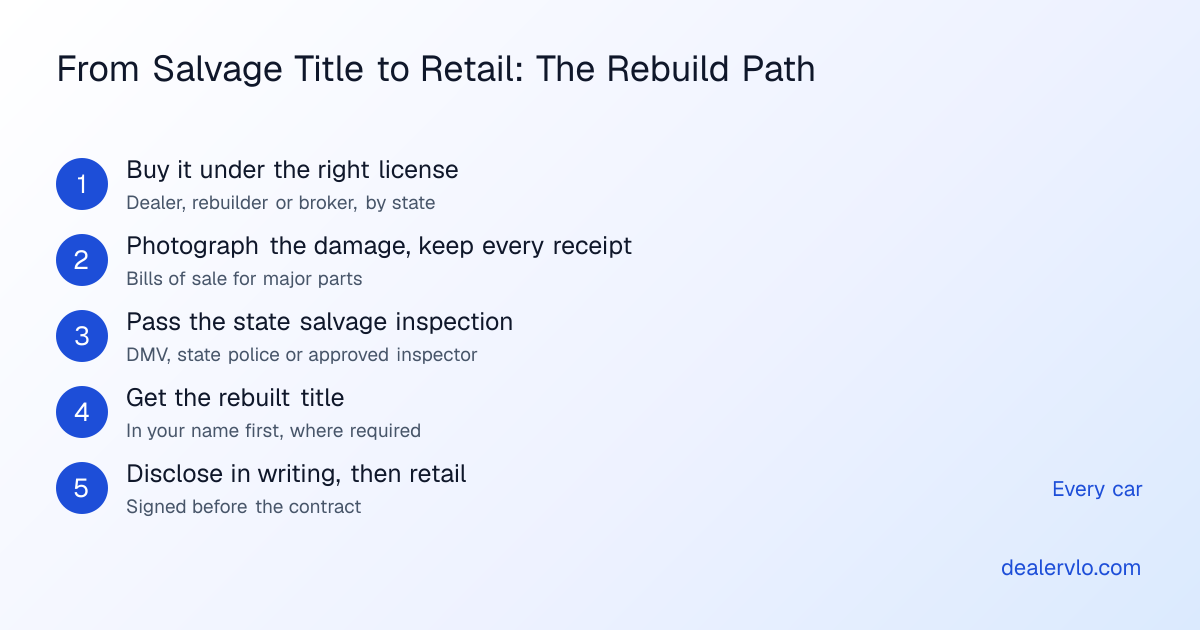
Every state's inspection is different, but the paperwork they ask for rhymes. Three examples from the agencies' own documents:
- Florida (FLHSMV procedure TL-37, rev. 08/25): the inspection is done at a regional office or a private rebuilt inspection facility, for $40 plus $20 for each re-inspection. You need original bills of sale or receipts for every major component part, and photos of the car in its wrecked condition from at least two angles. That means photos you take before you fix it. The car gets a "Rebuilt" decal.
- Texas (TxDMV salvage manual, January 2026): file Form VTR-61, the Rebuilt Vehicle Statement, listing where the major component parts came from, plus a $65 rebuilt salvage fee with the title application. Giving false information on the VTR-61 is a third-degree felony.
- California (DMV brochure HTVR 13): a DMV or CHP inspection with bills of sale for parts and repair receipts, plus brake and lamp adjustment certificates. The car must have working airbags that meet federal standards. California doesn't recognize another state's salvage inspection.
What carries over: photograph the damage before repairs, keep a receipt for every major part (with the donor VIN where the state asks for it), and budget for the inspection fee and the days the car sits waiting for an appointment.
What changes by state: some states require the inspector to be independent of whoever did the repairs. North Dakota's SFN 2486 inspection can't be done by the business that rebuilt the car. The state-by-state disclosure guide lists the brands and inspection rules for every state.
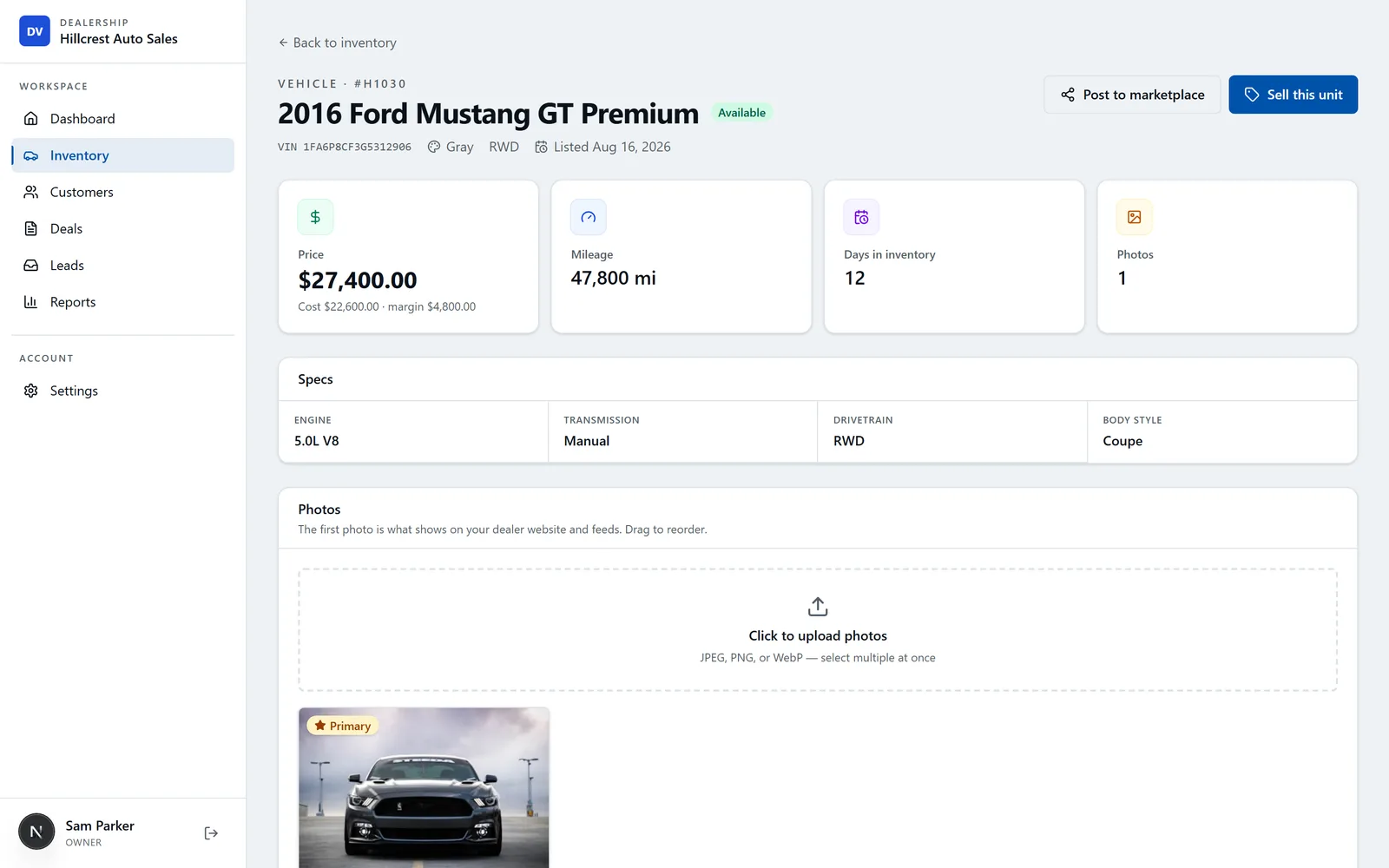
In DealerVLO, every one of those costs goes on the car as its own line: the auction buy fee, transport, each part, the body shop, the inspection fee, the NMVTIS report. Each line has a vendor, a description and a cost, and they all roll into that car's all-in cost and margin. On a rebuild, that list is the difference between knowing the car made money and guessing.
How to price a rebuilt title car
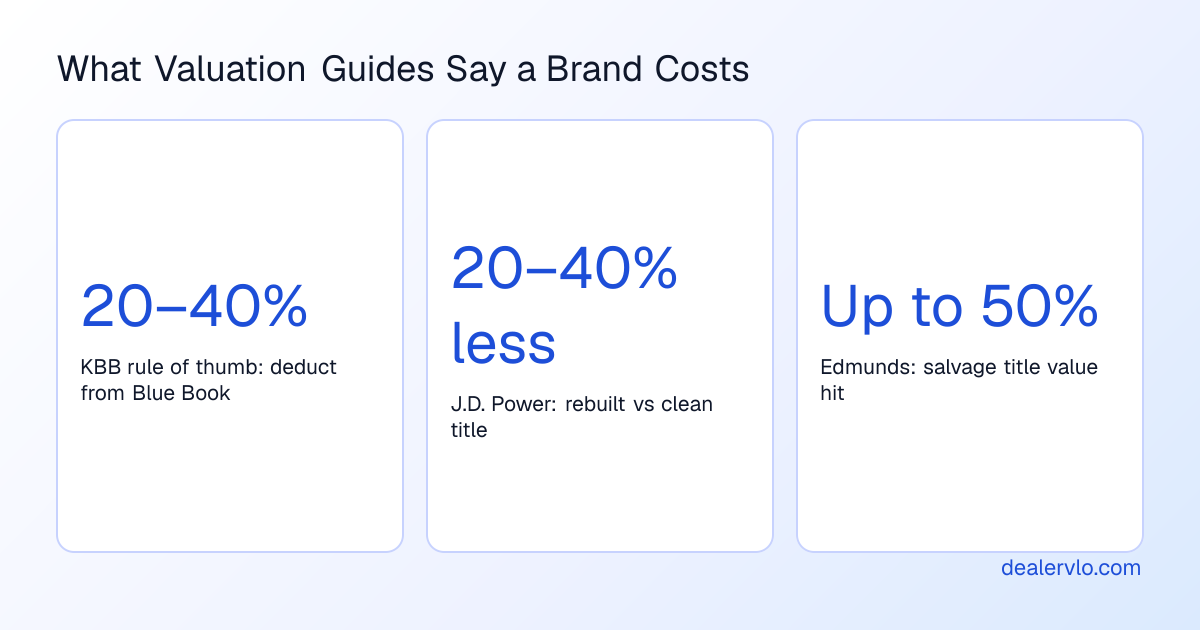
The guidebooks give you a range, not a number:
- Kelley Blue Book: "The industry rule of thumb is to deduct 20% to 40% of the Blue Book Value," and salvage title vehicles "really should be privately appraised."
- J.D. Power: a rebuilt title is typically worth 20 to 40 percent less than the same car with a clean title.
- Edmunds: a salvage title can cut value by up to 50% of its True Market Value. Edmunds doesn't publish values for branded titles at all.
So work backward from the retail price and set your bid from it, never the other way around. Here's an example with illustrative numbers. Say clean-title comps for the car are around $14,000. A 20% to 40% brand discount puts its retail somewhere around $8,400 to $11,200. Take the low end, then subtract:
- parts and labor
- the inspection fee and title fees
- transport
- your holding cost for the extra weeks a rebuild takes
- the gross you need
What's left is the most you can pay at the auction. If the car still pencils at the low end, it's a buy. If it only works at $11,200, you're betting on a buyer you haven't met. The market-comps pricing method covers building the comp set, and the salvage rebuild profit calculator does the bid math.
Branded-title resale minus every rebuild cost: see the profit, your max bid, and the brand discount where it breaks even.
Open the Salvage Rebuild Profit CalculatorWatch the listing side too. CarGurus doesn't give a deal rating when there's salvage history or frame damage on the title, so a branded car won't get a "Great Deal" badge however you price it.
DealerVLO's AI price suggestion builds its range from live comparable listings and is set up to leave salvage and branded-title outliers out of the comps. On a rebuilt car, treat that range as the clean-title number and take your brand discount off it. Then watch the car's days in inventory: DealerVLO flags any car at 60+ days with "aging, consider repricing."
14-day free trial, then $29/mo · Cancel anytime
Financing, insurance and listings shrink the buyer pool
The rebuilt discount isn't only about the car. It's also that fewer people can buy it.
Retail financing. Lender policies vary:
- Westlake Financial runs a branded title program, available in every state except New York, Massachusetts and Puerto Rico. Its product list says that if a service contract or GAP product has a branded-title option, it must be checked and any surcharge paid.
- Ally's dealer underwriting policy (revised September 10, 2026) says "Salvage titles, totaled vehicles, water or flood damaged vehicles, frame damaged vehicles, and vehicles with odometers turned back are ineligible for retail or lease financing."
- Some credit unions won't finance rebuilt titles at all.
Before you stock branded cars, ask each of your lenders whether they'll fund them.
In-house financing. Many dealers who sell branded cars carry the paper themselves, which is a business of its own. The buy-here-pay-here guide covers what that takes. DealerVLO tracks buy-here-pay-here payments with a collections view, but it isn't a lender and doesn't make credit decisions.
Floor plan. NextGear lists salvage and rebuilder units among the vehicles it floors, and AFC markets floor plan for salvage auction buys. IAA's own page describes Westlake Flooring's lines as for "non-salvage inventory." Confirm with your floor plan company before you bid.
Insurance. Progressive says salvage-title cars can't be insured, and with a rebuilt title "you may or may not be able to get comprehensive car insurance coverage or auto collision coverage," depending on the insurer. A buyer who signs, then can't get full coverage that their lender requires, is a deal that unwinds. Have them get an insurance quote on the VIN before they sign.
Listings. Google's vehicle ads require a clean title, and its policy lists salvage among the title types that make a car ineligible. Cars.com's listing policy says dealers must not misrepresent a vehicle's condition. Put the brand in the first line of the description everywhere you list. DealerVLO's listing feeds and dealer website carry the description you write for each car, but DealerVLO has no separate title-brand field. So the description is where the brand has to go.
Do dealers have to disclose a rebuilt or salvage title?
There's no general federal rule. When the FTC updated the Buyers Guide in 2016, it looked at a branded-title checkbox and decided against it. Instead it added a line on the front of the guide telling buyers to obtain a vehicle history report. The FTC's rule still makes it deceptive for a dealer to misrepresent a used car's mechanical condition. The Buyers Guide walkthrough covers the rest of that form.
The disclosure duty comes from state law, and the states that spell it out don't agree on how. A few examples:
- California requires a dealer to get an NMVTIS report before it displays or offers a used car at retail. If the report shows a brand or a salvage or total-loss record, the dealer has to post a red "WARNING" disclosure near the FTC Buyers Guide.
- Minnesota requires a dealer to disclose any title brand it knows of, in writing and, except for online sales, out loud. The buyer signs the written disclosure and the dealer keeps it in the sales file.
- Michigan requires a written certification, signed by the buyer and the dealer, before the sale agreement on a late-model rebuilt salvage car.
- Nevada requires written disclosure before the dealer signs the contract, with a copy to the buyer.
- New Hampshire requires written disclosure before the sale of the salvage status and the reason for it. A buyer who didn't get it can cancel within three business days.
- Massachusetts requires the dealer's purchase contract to say the car is "a rebuilt vehicle which was previously declared a total loss."
- North Dakota requires a damage and salvage disclosure on form SFN 18609 for every vehicle under nine model years old, branded or not.
The state-by-state disclosure guide has every state's rule and form.
State attorneys general do act on this. In April 2020, Indiana's attorney general announced $100,000 in restitution from four Indianapolis dealers. The state said they had sold more than 200 vehicles bought at salvage auctions after major accidents that didn't carry a "salvage" or "rebuilt" title brand. In December 2024, the same office sued another dealer, alleging it sold 17 salvage-branded vehicles to buyers who didn't know.
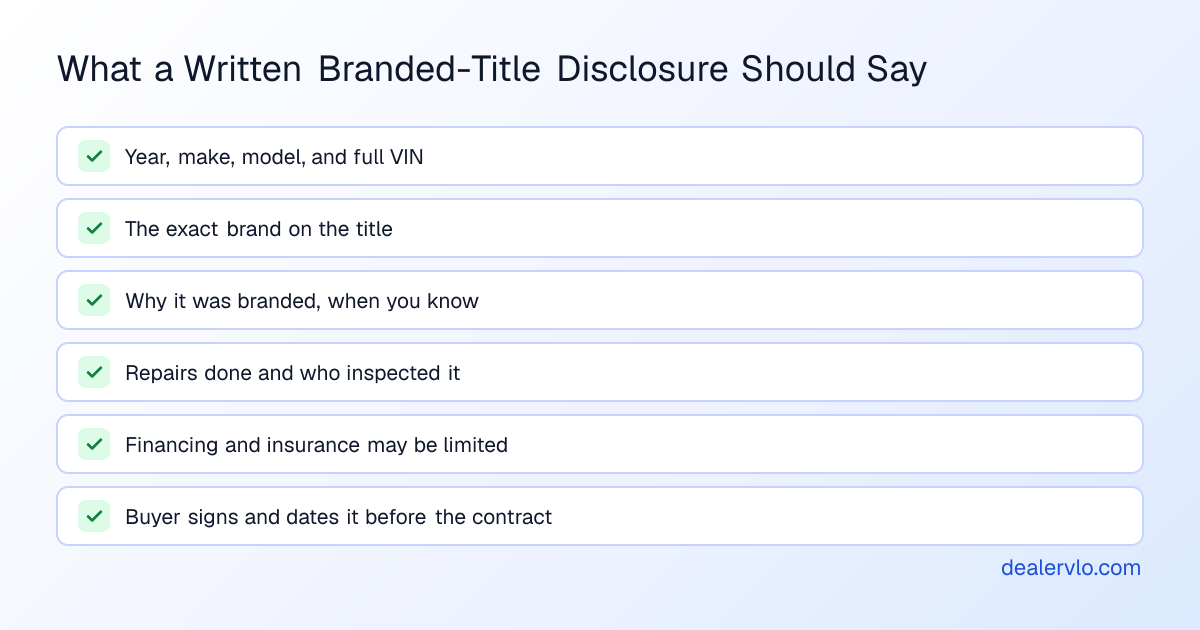
So disclose in writing on every branded car, even where your state doesn't spell out a form. Put it on its own page, get it signed before the contract, and keep a copy in the deal jacket. It's the one document that ends the "nobody told me" argument.
If your state publishes a disclosure form as a fillable PDF, or you've had an attorney draft your own, upload it once to DealerVLO under Settings → Forms. DealerVLO maps the fields and fills the vehicle, buyer and dealership details from every deal after that. The buyer can e-sign it in person or from an emailed link, and the signed copy stays with the deal.
Is it worth stocking rebuilt cars?
It can be, for the right lot. The discount is real and predictable, and a well-repaired late-model car at a rebuilt price is exactly what some buyers want. But it's a different business from clean-title retail:
- You're buying in a different market (insurance auctions), sometimes under a different license.
- Every car carries a repair you're responsible for, an inspection you have to pass, and weeks of extra holding time.
- Fewer lenders will fund the deal, fewer insurers will write full coverage, and some ad platforms won't take the car.
- The disclosure has to be perfect, every time.
For the full cost stack with real auction fees and a worked example, see can you make money selling salvage title cars?. If you do it, do a few, track every dollar on each car, and look at your actual margin and days to sell against your clean-title cars before you scale up. The reconditioning cost budget is a good model for budgeting repairs before you bid.
Where DealerVLO fits
DealerVLO is the DMS I built for my own lot in Tewksbury. Here's what it does for a lot that sells rebuilt cars, and what it doesn't:
- It does: track every rebuild cost line by line on the car (buy fee, transport, parts, labor, inspection, history report) and roll it into all-in cost and margin. Show days in inventory and flag cars at 60+ days. Suggest a price from live comps (a clean-title range you discount from). Fill your uploaded disclosure PDF from the deal, and collect e-signatures. Track buy-here-pay-here payments. Push your cars, with the description you write, to your website and your CarGurus, Cars.com and Autotrader feeds.
- It doesn't: pull NMVTIS, Carfax or AutoCheck reports, connect to Copart, IAA or Manheim, keep a separate title-brand field on the car, finance deals, or quote insurance. You run the history report and buy the car. DealerVLO keeps track of what it cost and what you told the buyer.
It's $29 a month, flat, with unlimited users.
Frequently asked questions
Can a dealer sell a salvage title car?
Yes, but in most states not as a road car while it still carries a salvage title. A salvage title generally can't be registered or driven until the car is repaired, passes the state's salvage inspection, and gets a rebuilt-type title. Some states, including Florida and Texas, require a dealer to title a rebuilt car in the dealership's own name before retailing it. Once it's retitled, a licensed dealer can retail it, with written disclosure where state law requires it. Check your state's rules; this isn't legal advice.
Do dealers have to disclose a rebuilt or salvage title?
There's no general federal rule. The FTC considered a branded-title checkbox for the Buyers Guide in 2016 and didn't adopt it. The duty comes from state law, and many states have one: Minnesota requires a written disclosure the buyer signs, Michigan requires a signed certification before the sale agreement on late-model rebuilt salvage, and Nevada and New Hampshire require written disclosure before the sale. Even where no statute names it, hiding a brand is misrepresentation. Disclose in writing on every branded car.
How much less is a rebuilt title car worth?
Kelley Blue Book says the industry rule of thumb is to deduct 20% to 40% of the Blue Book value, and that salvage title vehicles really should be privately appraised. J.D. Power says a rebuilt title is typically worth 20 to 40 percent less than the same car with a clean title. Edmunds says a salvage title can cut value by up to 50% and doesn't publish values for branded titles.
Can you finance a car with a rebuilt title?
Sometimes, with fewer lenders. Westlake Financial runs a branded title program in every state except New York, Massachusetts and Puerto Rico. Ally's dealer underwriting policy lists salvage titles, totaled vehicles, flood-damaged and frame-damaged vehicles as ineligible for retail or lease financing, and some credit unions won't finance rebuilt titles at all. Expect more cash buyers and in-house financing on branded cars.
Can a rebuilt title car get full coverage insurance?
It depends on the insurer. Progressive says salvage-title cars can't be insured, and that with a rebuilt title you may or may not be able to get comprehensive or collision coverage depending on the insurer. Tell buyers to get an insurance quote on the VIN before they sign.
Who can buy salvage cars at Copart or IAA?
It depends on the state and the title type. Copart publishes a state-by-state licensing table: licensed dealers and dismantlers can buy salvage in most states, while the public often needs a broker. IAA says which license can buy which title type varies by state, and some states add their own card, like Michigan's Salvage Vehicle Agent license or Wisconsin's Salvage Buyer Identification card.
Bottom line
A dealer can sell a salvage title car once it's rebuilt, inspected and retitled, and in some states only after the rebuilt title is in the dealer's own name. The money is made or lost before that. It's in the bid: start from the branded retail price, which runs 20% to 40% under clean-title comps by the guidebooks' own rule of thumb, and subtract every repair, fee and extra week of holding. The deal holds up only if the buyer signed a written disclosure of the brand before the contract.
I built DealerVLO for my own lot, and it keeps a rebuild honest: every cost on the car, the days it has sat, and the signed disclosure in the deal jacket. Try it free for 14 days.
14-day free trial, then $29/mo · Cancel anytime
Punch in cost, recon, holding days, and sale price to see your true net gross and margin.
Open the Profit Margin Calculator