Can You Make Money Selling Salvage Title Cars? The Rebuild Math, Line by Line
Can you make money selling salvage title cars? Sometimes. The real Copart and IAA fees, rebuild and inspection costs, the brand discount, and a worked example.
Part of the Profit, margins & the numbers guide: How Do Used-Car Dealerships Actually Make Money?
A $3,000 salvage car with a light hit looks like the cheapest inventory you'll ever buy. Then the auction adds about $875 in fees, the parts and labor go on top, the state wants its inspection before you can title it, and the car sits for months before it's even legal to sell. Whether you can make money selling salvage title cars comes down to that math, and almost everything that decides it happens before the repair starts.
This is the math, line by line, with the fees Copart and IAA actually publish, the state inspection costs, the discount buyers expect on a branded title, and a worked example you can rerun on your own deal. For the legal side (what you can sell, how to disclose it, and the paperwork), see the guide to selling salvage and rebuilt title cars.
14-day free trial, then $29/mo · Cancel anytime
Can you make money selling salvage title cars? The short answer
Sometimes. The ceiling is set by the brand: a rebuilt car sells for 20% to 40% less than the same car with a clean title, by the rule of thumb Kelley Blue Book and J.D. Power both publish. Everything you spend has to fit under that lower number with room left for your margin.
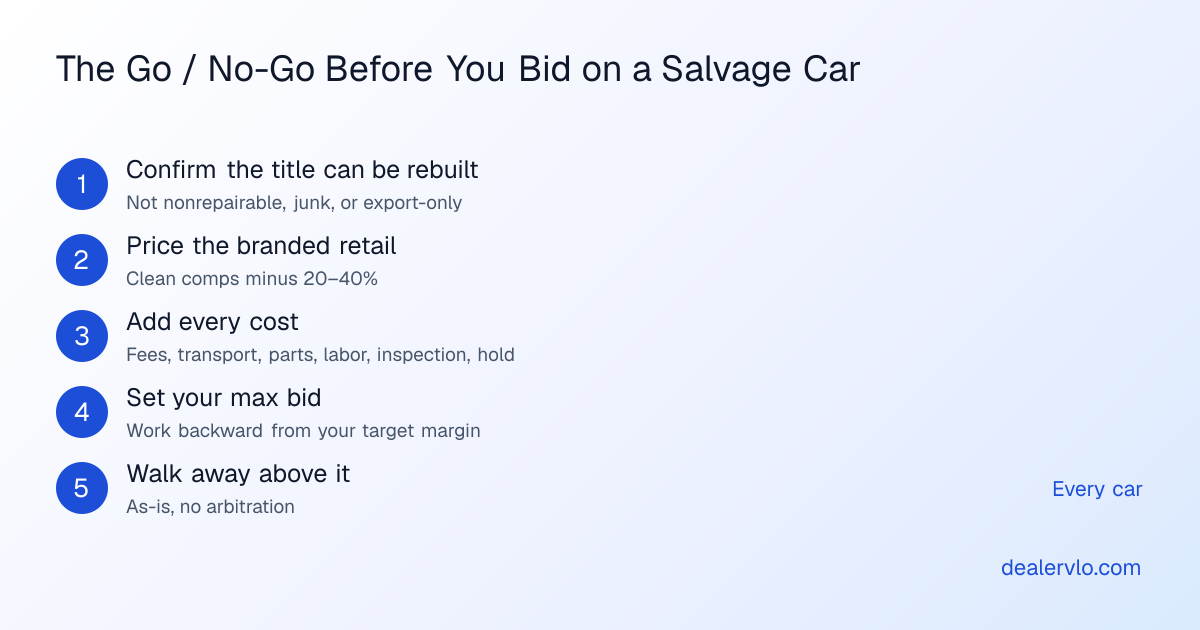
The dealers who make money do two things. They work backward from the branded retail price to a max bid before the auction, and they control the repair cost, usually by doing the work themselves. The dealers who lose money buy because the car looked cheap and find out what it cost after it's titled.
The revenue side: what a rebuilt car actually sells for
Start with clean-title comps (the same year, make, model, and trim listed near you), then take the brand off:
- Kelley Blue Book: "The industry rule of thumb is to deduct 20% to 40% of the Blue Book Value," and salvage title vehicles "really should be privately appraised."
- J.D. Power: a rebuilt title is typically worth 20 to 40 percent less than an equivalent clean-title car.
- Edmunds: a salvage title can cut value by up to 50%, and Edmunds doesn't publish values for branded titles at all.
The listing side pushes the same way. CarGurus doesn't give a deal rating when the title shows salvage history, and Google's vehicle ads require a clean title. Fewer lenders finance branded cars too, so more of your buyers pay cash or finance with you. None of that changes the comp, but it can stretch the time to sell.
The cost stack, line by line
1. Auction fees, which hit cheap cars hardest
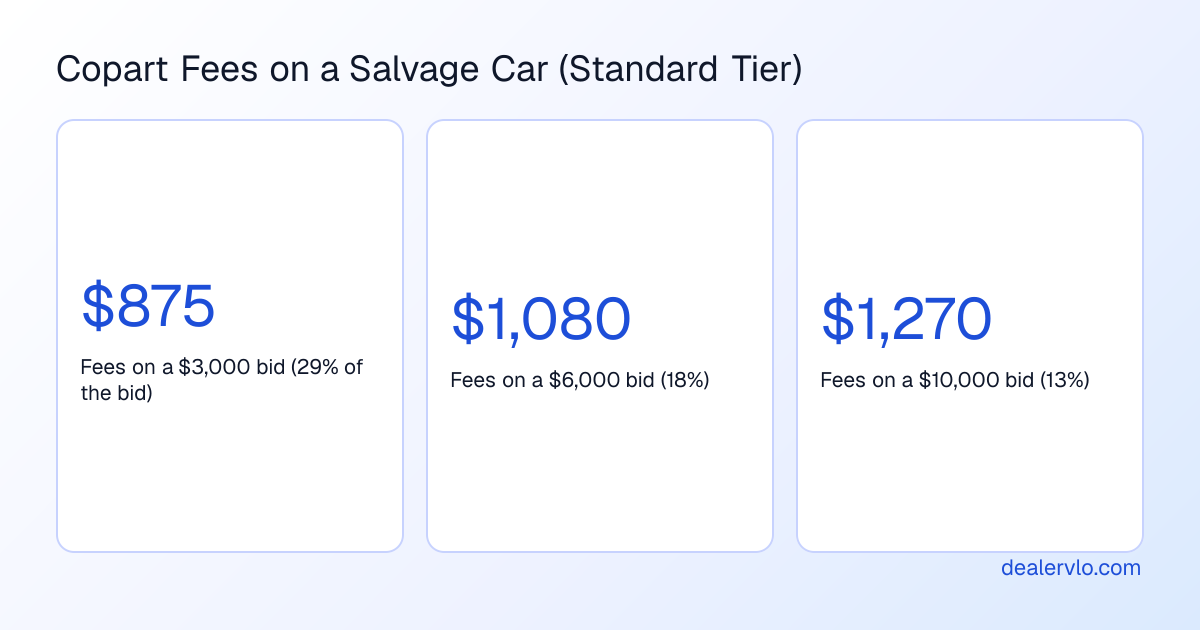
Copart publishes licensed-buyer fees with separate schedules for clean and non-clean titles. On the non-clean schedule, for a standard-volume buyer paying by a secured method with a live bid, the buyer fee, the virtual bid fee, the $95 gate fee, and the $15 environmental fee add up to:
| Winning bid | Total fees | Fees as % of bid |
|---|---|---|
| $3,000 | $875 | 29% |
| $6,000 | $1,080 | 18% |
| $10,000 | $1,270 | 13% |
Those are from Copart's published schedule as of October 4, 2026. The same $6,000 car costs $1,340 in fees with unsecured payment and less in the high-volume tier, which takes 25+ units, $75,000+ in spend, and fewer than five bidder accounts. Copart gives three free days after an online purchase before storage starts, and the late-payment fee is $50 if you don't pay within three business days.
IAA's standard licensed-buyer schedule (dated November 4, 2024) matches Copart's non-clean secured schedule row for row, and IAA lists a $105 service fee and a $20 title handling fee per unit effective October 1, 2026. Read the fee page for your exact tier before you bid. On a low-dollar car, the fees can come to nearly a third of what you paid.
2. Transport
There's no published rate to plug in; it depends on distance, the yard, and whether the car rolls. Get a quote before you bid, not after. The auction transport guide covers how dealers price it.
3. Parts and labor
This is the line you control, and it's where rebuilders win or lose. Keep every receipt. Most states want them for the salvage inspection, and several want the part number or the VIN of the car a used part came from (Texas, Delaware, and Rhode Island among them). A part you can't document can stop the title.
4. The state's inspection and title fees
Every state charges to turn salvage into rebuilt, and the amounts vary:
| State | Inspection / rebuilt-title fee |
|---|---|
| Florida | $40 inspection, $20 per re-inspection |
| Texas | $65 rebuilt salvage fee plus the title fee |
| Ohio | $50 State Highway Patrol inspection |
| Virginia | $125 DMV examination |
| Mississippi | $125 (since July 1, 2026) |
| New Jersey | $200 inspection |
The salvage title disclosure guide covers each state's inspection process and who does it.
5. Time
The clock starts when you win the car, not when it hits the lot. It covers the repair, the wait for an inspection appointment, the title, and then the sale, with fewer lenders and some ad platforms out of the picture. Every one of those days, your bid and your repair money are tied up. Put a real cost on that money (your floor plan rate, or what the cash would earn otherwise) across the whole stretch.
Branded-title resale minus every rebuild cost: see the profit, your max bid, and the brand discount where it breaks even.
Open the Salvage Rebuild Profit CalculatorA worked example
These are illustrative numbers. The auction fee comes from Copart's published schedule, and the rest are round numbers to show the math. Run your own car through the salvage rebuild profit calculator.
- Clean-title comps: $16,000
- Winning bid: $6,000, plus $1,080 in Copart fees
- Transport $400, parts $1,800, labor $1,200, inspection and title $100
- 90 days from auction to sale at a 9% cost of money: about $235
- All-in cost: about $10,815
What it sells for decides everything:
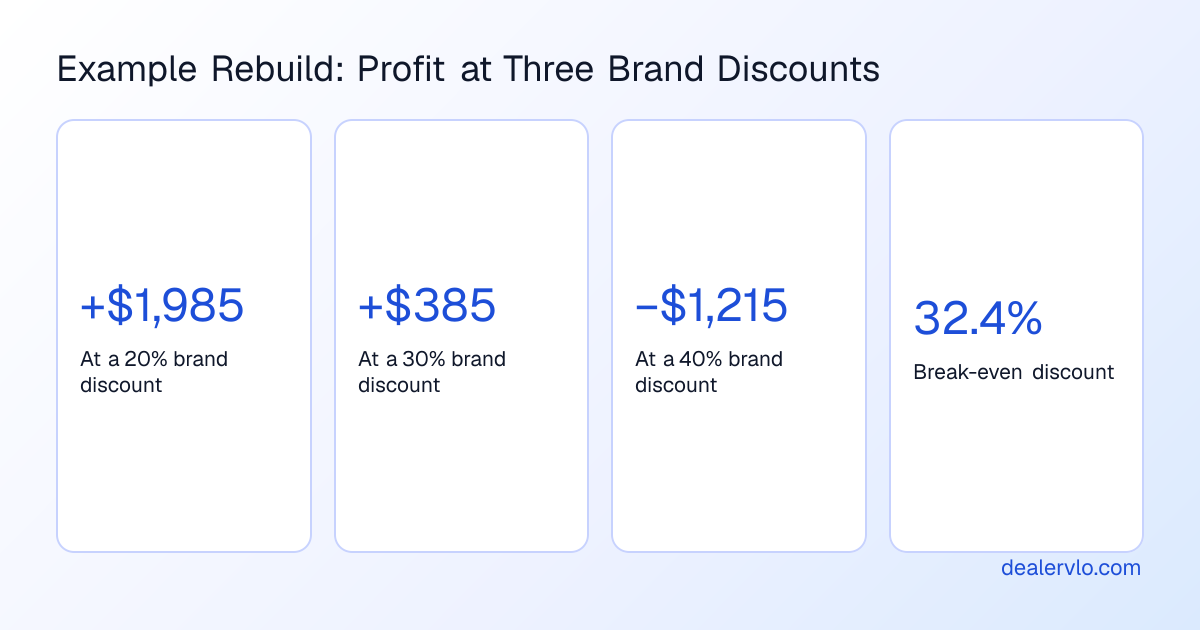
- At a 20% brand discount ($12,800): about $1,985 profit, a 15.5% margin.
- At 30% ($11,200): about $385, a 3.4% margin.
- At 40% ($9,600): a loss of about $1,215.
The car breaks even at a 32.4% discount. Since the guidebooks put the discount anywhere from 20% to 40%, this deal is a coin flip at a $6,000 bid. To clear a 15% margin at the 30% midpoint, the max bid is about $4,733. The fee would also drop a little at that price, since Copart's fees are tiered by price. That's the number you take to the auction.
14-day free trial, then $29/mo · Cancel anytime
The risks the math doesn't show
It's as-is, with no arbitration. Copart's terms sell vehicles "AS-IS WHERE-IS," warn they may need substantial repairs and expense, and say Copart doesn't guarantee a vehicle can be registered in any state. IAA also sells "AS IS, WHERE IS," says its vehicle score is no guarantee a car qualifies as "Run & Drive," and sends disputes to binding arbitration. That's very different from a dealer auction's condition arbitration. Copart's Member Protection Pledge covers narrower problems on lots under $50,000, like a wrong year, make, or model, a title that doesn't match the listing, or unannounced liens, with claim windows as short as delivery day, but not condition. Hidden damage is your cost. The Copart and IAA buying guide covers the rest of the buying process.
Some titles can never be rebuilt. Texas won't retitle a vehicle on a nonrepairable title issued on or after September 1, 2003, and Virginia won't title any vehicle that ever got a nonrepairable certificate. Read the title type on the listing before you bid.
Your state may limit what you can do. The Illinois Secretary of State says Illinois dealers can't sell salvage vehicles to the public. Florida and Texas require a dealer to put the rebuilt title in the dealership's own name before retailing it. The selling guide covers these rules.
The disclosure has to be perfect. Most states require written disclosure of the brand, and a missing signature can unwind the sale. In Delaware and Colorado the buyer gets a full refund. The state-by-state list has every rule and form.
Who actually makes money on salvage
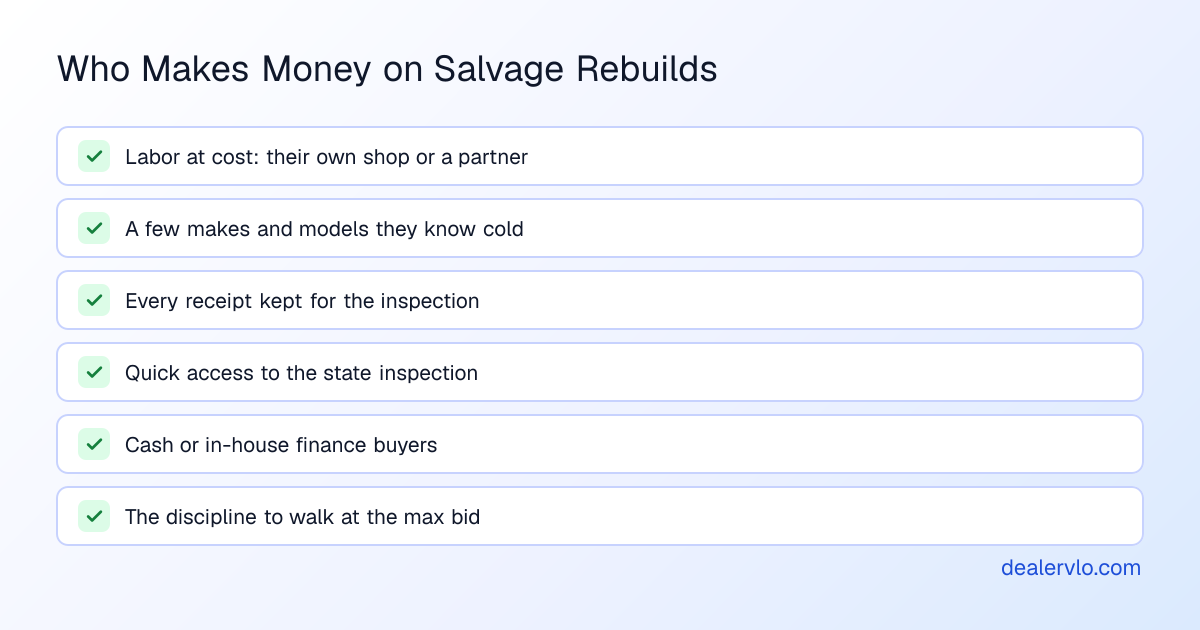
The worked example shows why. At a 30% discount the whole profit was about $385, so every $400 you save on labor is worth more than the deal itself. The operators who do well on salvage tend to share a few traits:
- Labor at cost. They have their own body shop, or a partner shop at wholesale rates.
- A narrow lane. A few makes and models they know, so they can price parts and damage from photos.
- Paperwork discipline. Every receipt, donor VIN, and pre-repair photo saved, so the inspection passes the first time.
- Buyers who can buy. Customers who pay cash or finance in-house, since fewer lenders fund branded titles.
- The walk-away. They bid their max and stop.
If that's not your operation, a salvage car is often a better wholesale or pass than a retail rebuild. The auction buying guide covers the clean-title side of the lane.
How to know if your rebuilds are actually making money
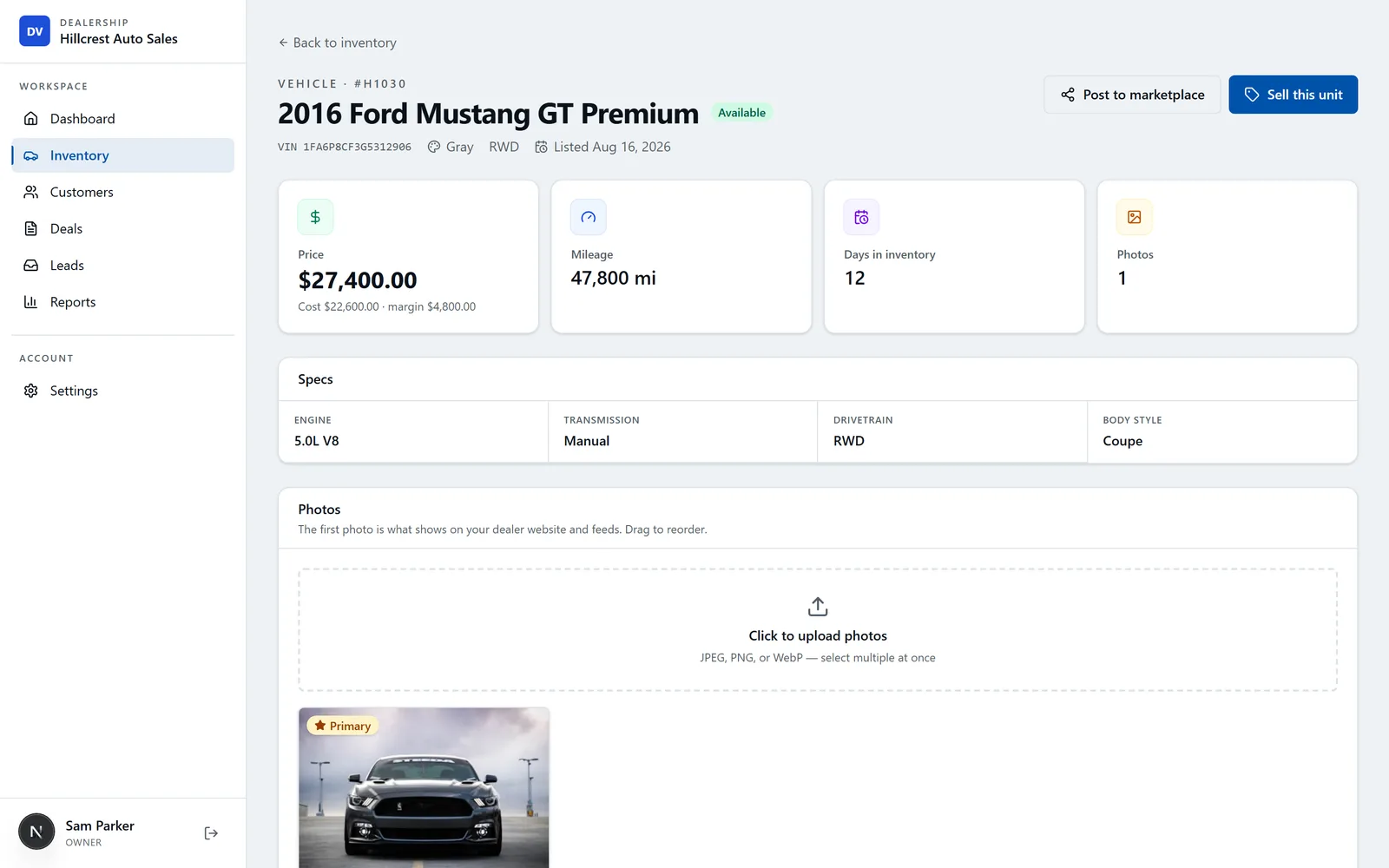
The only way to answer "can you make money selling salvage title cars?" for your lot is to track every rebuild's real cost and sale price. In DealerVLO, each cost goes on the car as its own line, with a vendor, a description, and an amount: the auction fee, transport, each part, the body shop, the inspection fee, the history report. They roll into that car's all-in cost and margin, so after a few rebuilds you know your real number, not the one you hoped for. Every car also shows its days in inventory, flagged at 60+ days, which on a rebuild is where the money quietly goes.
Where DealerVLO fits
DealerVLO is the DMS I built for my own lot in Tewksbury. For rebuilds:
- It does: track every rebuild cost line by line on the car and roll it into all-in cost and margin, count days in inventory, fill your state's disclosure form once you upload it, collect the buyer's e-signature, and track buy-here-pay-here payments.
- It doesn't: connect to Copart or IAA, pull NMVTIS or history reports, quote transport or insurance, keep a separate title-brand field on the car, or finance deals.
It's $29 a month, flat, with unlimited users.
Frequently asked questions
Can you make money selling salvage title cars?
Sometimes, and the deal is decided at the bid. A rebuilt title sells 20% to 40% under the same car with a clean title by the guidebooks' rule of thumb, and between that discount and the price you can retail it for sit the auction fees, transport, parts, labor, the state inspection, and months of holding. Dealers who make money work backward from the branded retail price to a max bid and walk away when the numbers don't hold.
How much are Copart fees for a dealer buying a salvage car?
Copart publishes separate licensed-buyer schedules for clean and non-clean titles. On its non-clean schedule for a standard-volume buyer paying by secured method with a live bid, the buyer fee, virtual bid fee, $95 gate fee, and $15 environmental fee come to $875 on a $3,000 car, $1,080 on a $6,000 car, and $1,270 on a $10,000 car, as published on October 4, 2026. Fees run higher with unsecured payment and lower in the high-volume tier.
How much does it cost to rebuild a salvage car?
There's no typical number, because it's the parts and labor for that car's damage plus fixed costs every rebuild carries: auction fees, transport, the state's salvage inspection and rebuilt-title fees, and the cost of the money tied up while it's repaired, inspected, and sold. Inspection fees alone range from $40 in Florida to $200 in New Jersey.
How much less is a rebuilt title car worth?
Kelley Blue Book's rule of thumb is to deduct 20% to 40% of the Blue Book value for a salvage title, and J.D. Power says a rebuilt title is typically worth 20 to 40 percent less than the same car with a clean title. Edmunds says a salvage title can cut value by up to 50% and doesn't publish values for branded titles.
Are salvage auction cars sold as-is?
Yes. Copart's terms sell vehicles "AS-IS WHERE-IS" and say they may require substantial repairs and expense and aren't guaranteed to be registrable in any state. IAA also sells "AS IS, WHERE IS" and says its vehicle score is no guarantee a car qualifies as Run & Drive. Unlike dealer auctions, there's no condition arbitration to fall back on.
Is it worth rebuilding a salvage car to sell?
It's worth it when the max bid you calculate from the branded retail price is above what the car actually sells for at auction, and when you control the repair cost, usually with your own shop. If the car only makes money at a brand discount under 20%, or the profit depends on the cheapest possible repair, it's a pass.
Bottom line
You can make money selling salvage title cars, but not by buying cheap and hoping. The brand takes 20% to 40% off the top, the auction fees can come to nearly a third of a low-dollar bid, and the inspection and the wait come before you can sell anything. Price the branded retail first, add every cost, set your max bid, and walk away above it. Then track what each rebuild really made, so the next bid is based on your numbers and not the lane's.
I built DealerVLO for my own lot, and it keeps every rebuild's real cost and margin on the car. Try it free for 14 days.
14-day free trial, then $29/mo · Cancel anytime
Work out the most you can bid at the lane and still hit your target margin.
Open the Auction Profit Calculator