Auction Transport for Dealers: How to Get Cars Home and What It Really Costs Per Car
Auction transport for dealers: auction-arranged shipping, load boards, brokers, or your own trailer, plus gate passes, storage clocks, and transport in the bid.
Part of the Buying & sourcing inventory guide: How to buy at dealer auctions without getting buried
You won the car. Now it's sitting at an auction two hours, or two states, away, and the clock is already running. Auction transport for dealers is the part of buying nobody talks about in the lane: who moves the car, what the gate wants before it lets the car go, how long you have before storage kicks in, and what the move really adds to the car's cost.
This post covers the four ways independent dealers get auction cars home, what drives the price, gate pass and storage rules from the auctions' own pages, how to vet a transporter, and the habit that matters most: putting transport into the max bid before you bid.
14-day free trial, then $29/mo · Cancel anytime
Auction transport for dealers: your four options
1. The auction's own transport. Most big auctions sell transport at checkout.
- Manheim: its logistics page offers two options at checkout: Ready Logistics, described as full-service with a vetted carrier and firm quotes, and Central Dispatch, a self-managed marketplace where you name your price and delivery date. Per Manheim's checkout tutorial, if the car is floored through NextGear Capital you can roll the Ready Logistics cost into your credit line.
- ACV: ACV Transportation is built into checkout, quotes in real time, covers every state except Alaska and Hawaii, and also moves cars bought elsewhere.
- IAA: IAA Transport lets you calculate a delivery quote on the vehicle page before you buy.
The upside is convenience: booking and tracking live in your auction account. The trade-off is you take the program's price, so compare it on a few cars first.
2. A carrier or broker you hire yourself. Many dealers keep one or two regional haulers who know their auctions. One who answers the phone is worth more than a few dollars a car.
3. A load board. Central Dispatch is a marketplace where shippers, including dealers, post a vehicle with a delivery date and trailer type, review carrier profiles and bids, and dispatch the one they pick. It also sells a Premium upgrade. You do the vetting.
4. Pick it up yourself. A truck and trailer, or a driver with a plate. For short hauls it's often the fastest option, but whether a dealer or transporter plate can be used for this, and by whom, varies by state. Check your state's rules first; our dealer plates hub is a starting point.
Whichever you choose, log the cost on the car the day you pay it. In DealerVLO, every car has a line-item cost list with a vendor, description, and cost on each line. It's built for reconditioning, but transport and the auction buy fee go there too, and every line rolls into that car's all-in cost and margin.
How much does it cost to ship a car from auction?
There's no published average for what dealers pay. What's published is consumer pricing. Kelley Blue Book's car shipping cost article (January 12, 2026) averaged quotes from eight transport companies for one car: about $751 for 500 miles, $1,020 for 1,000 miles, and $1,406 for 2,500 miles. That's roughly $1.50, $1.02, and $0.56 a mile, so the per-mile cost falls as distance grows. KBB also says enclosed transport can add 50% or more.
That's a consumer, one-car benchmark; auction pickups and multi-car loads can price differently. What moves the number:
- Open or enclosed. Open for most inventory; enclosed when a stone chip costs real money.
- Inoperable. Non-runners cost more to load. Even the auction may charge: Manheim New England's page lists $50 per car for towing and forklift requests.
- Location. Per KBB, rural pickups and deliveries can cost more than urban ones.
- Timing. KBB says brokers call April through September the busier half of the year, and faster delivery costs more.
- Number of cars. A carrier moving several of your cars from one auction has less empty space to fill.
Get quotes on the two or three lanes you buy from most, and keep what each car actually cost. Central Dispatch also advertises a Price Check tool showing current listings and prices, one way to sanity-check a quote. In DealerVLO, put the carrier's name in the vendor field on the transport line, so a car's history shows who moved it and what you paid.
Put transport into the bid, not after it
Transport is part of the car's cost, not a surprise after the auction. The cost stack is simple:
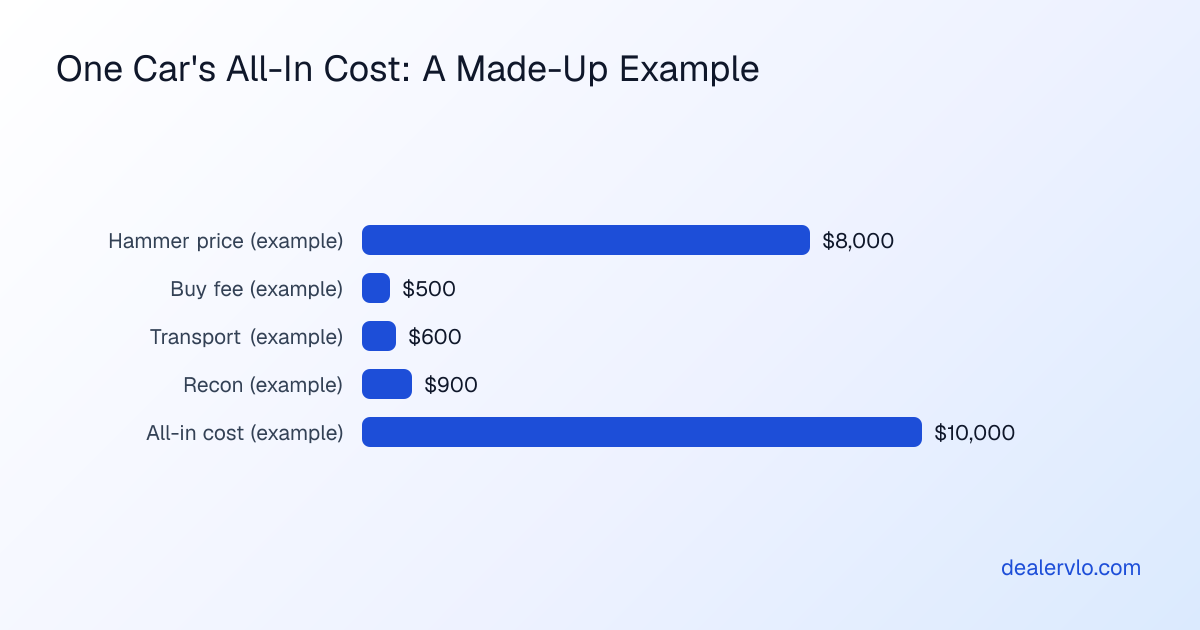
Those are made-up round numbers, not rates. Work it backward before you bid. Say you'll retail the car at $13,500 and want $2,000 of gross. Your all-in ceiling is $11,500. Subtract an example $500 buy fee, $900 of recon, and $150 of holding cost while it's in transit and in recon, and you're at $9,950 before transport.
Compare two identical cars. One is 90 miles away with an example $250 transport quote: max hammer $9,700. The other is 900 miles away with an example $900 quote: max hammer $9,050. The far car has to hammer $650 lower just to be the same deal, and it reaches your lot later. That's how a car that "looked cheap" ends up thin, the gap between the paper spread and real gross.
If you floor the car, check your agreement for when interest starts, because transit days may already be on the clock. How dealer floor plans work covers the mechanics.
The free calculator does this backward math: enter the buy fee, transport, recon, floor plan APR and days, expected resale, and target margin, and it returns your max bid.
Work out the most you can bid at the lane and still hit your target margin.
Open the Auction Profit CalculatorOnce the car is home, real numbers replace the guesses. In DealerVLO, the car's purchase cost is its own field, and the buy fee, transport, and recon go on the cost lines under it. The vehicle page then shows the all-in cost, the margin at your price, and days on the lot side by side.
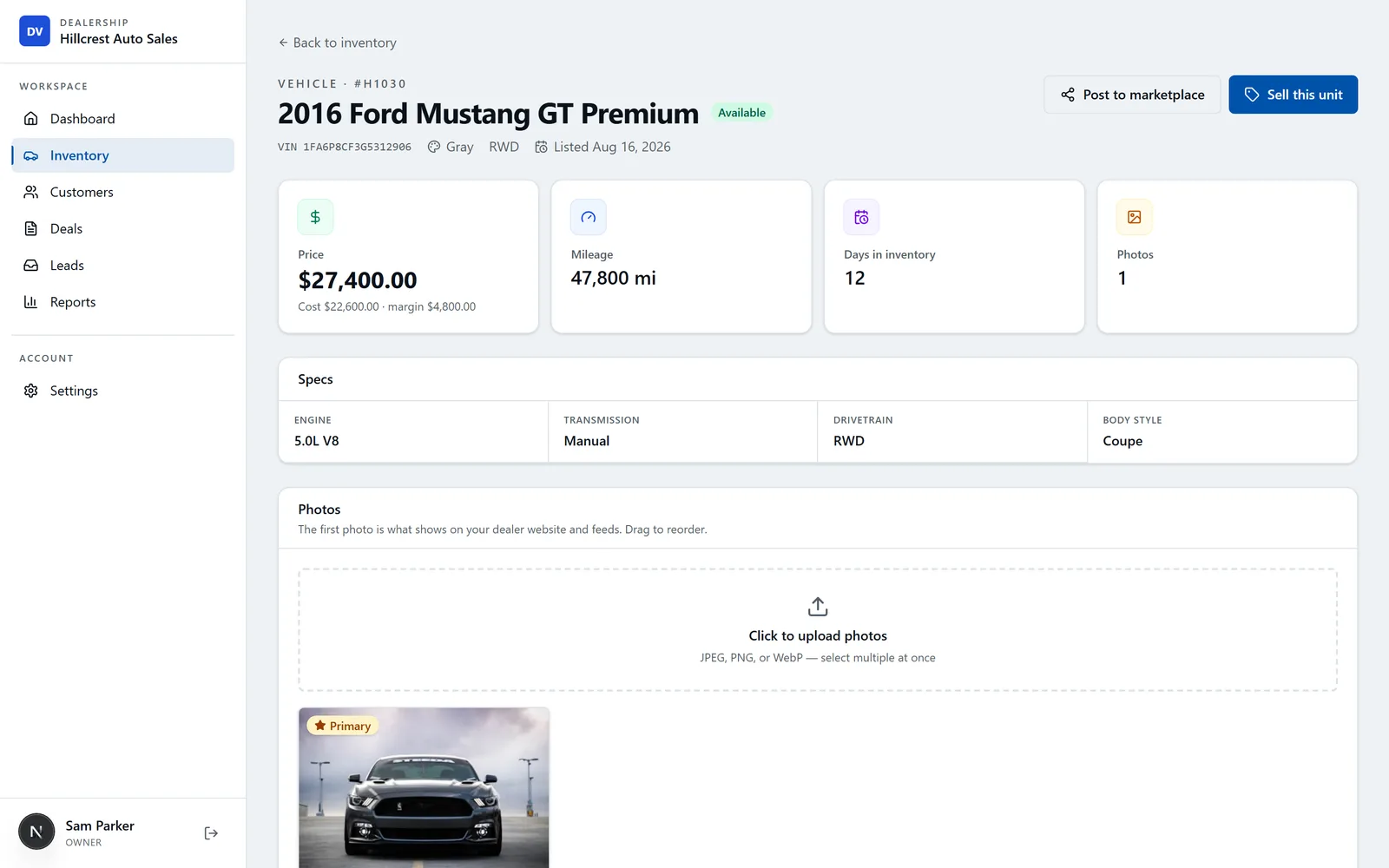
One caveat: DealerVLO counts days in inventory from when you add the car, with no field to backdate it. Add it the day you win it and transit days count; add it when it lands and they don't. Pick one habit so your aging numbers compare like for like.
14-day free trial, then $29/mo · Cancel anytime
Gate passes, releases, and storage clocks
A transporter can't drive in and take your car. The auction has to release it, and that release has a name: gate pass, vehicle release, or pickup slip.
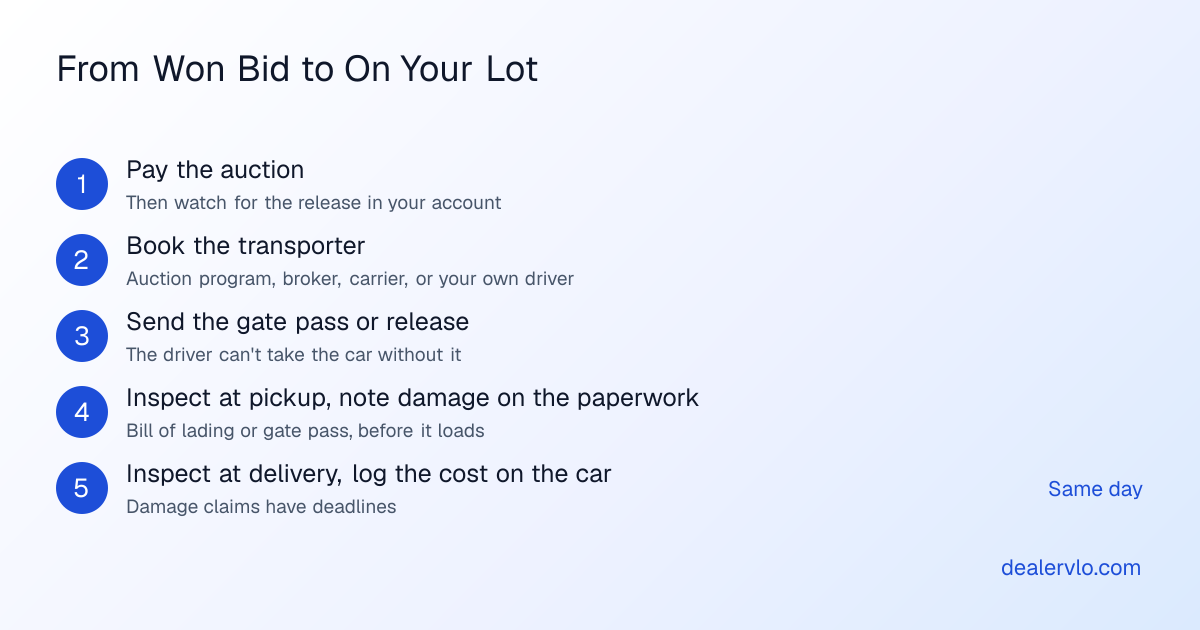
- Manheim calls it a Vehicle Release, formerly known as Gate Pass. Its gate pass tutorial shows where to print it: Post-Sale Management, Purchases tab.
- ACV uses a pickup slip. Its terms of service give the buyer 7 calendar days to pick up (counted from when the slip is delivered, if ACV delayed it), and if the car isn't picked up, ACV can force ship it to the buyer at the buyer's expense.
Storage terms vary, even inside one auction company. As listed on October 3, 2026: Manheim San Francisco Bay says units must be transported within 7 days of purchase to avoid a $25-a-day storage fee, while Manheim New England allows 21 days for most units before a daily fee starts. Check the terms for every auction and location you buy from.
The usual way to get burned is slow paperwork, not a slow truck. Pay promptly, get the release to the carrier the same day, and confirm the pickup date. If an arbitration is open, ask the auction whether it holds up the release; the arbitration guide covers those windows.
If you do pay storage, it's part of that car's cost. Add it as its own line on the car in DealerVLO so that unit's margin reflects it, instead of it vanishing into overhead.
Broker or carrier: how to vet a transporter
Are car shipping brokers legit? Brokers are a normal, regulated part of the business. Federal rules (49 CFR Part 371) define a broker as someone who, for compensation, arranges transportation by an authorized motor carrier, and say a broker may not represent its operation as a carrier; its advertising has to show it's a broker. Auction programs can work this way too: ACV Transportation's terms say it acts as a broker and third-party carriers do the hauling.
So the real question is who's hauling your car and whether they're covered.
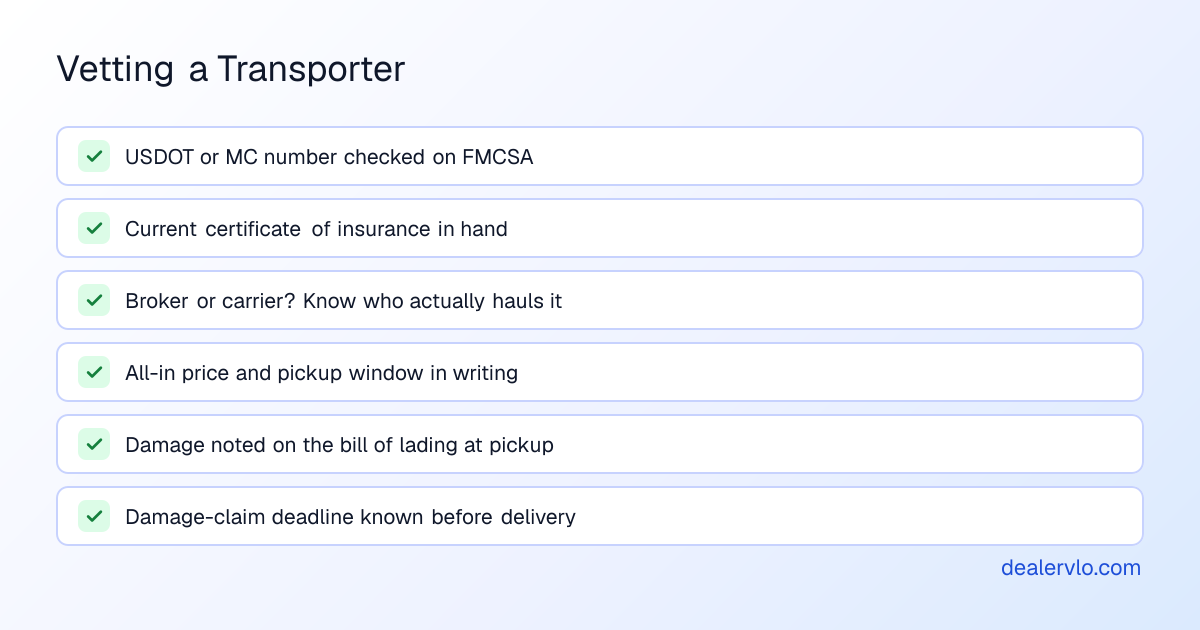
- Look them up. FMCSA's SAFER Company Snapshot searches by DOT number, MC/MX number, or company name. Its Licensing & Insurance search looks up licensing and insurance records by USDOT or docket number. No number, or a name that doesn't match, is your answer.
- Get a current certificate of insurance, and if a broker books it, ask which carrier is hauling.
- Inspect at pickup. Damage not written down at pickup is hard to pin on anyone later. Manheim New England's page says the driver is responsible for listing damages and missing items on the gate pass, and the auction isn't responsible for unreported ones.
- Inspect at delivery, before the driver leaves. Walk the car, compare it to the pickup paperwork, and photograph anything new. Claims have deadlines: ACV Transportation's terms require a written claim within 7 calendar days of delivery.
In DealerVLO, the carrier's name on the transport cost line means that when a claim or a late delivery comes up later, you can see who moved that car and what you paid.
Where DealerVLO fits
End to end, for getting auction cars home and priced:
- Before the bid: the free Auction Profit Calculator turns buy fee, transport, recon, floor plan, resale, and target margin into a max bid.
- Every cost on the car: purchase cost, plus lines for buy fee, transport, storage, and recon, each with a vendor, rolling into all-in cost and margin.
- Time on the lot: days in inventory on every car, an aging flag at 60+ days, and an aging report bucketed 0-30, 31-60, 61-90, and 90+.
- After the sale: front- and back-end gross per deal in the sales report, and floor plan interest under the Floor plan expense category in your P&L.
- Delivering to a remote buyer: a transport fee can go on the deal as its own labeled line that rolls into the total. The remote sales guide covers the rest.
What it doesn't do: DealerVLO doesn't book or quote transport, and it doesn't connect to Manheim, ACV, IAA, OPENLANE, or any other auction. You book through the auction's program, a broker, a carrier, or a load board, and print the release from the auction's site. It isn't a lender and doesn't provide floor plan financing. It's $29 a month flat, unlimited users, in a browser.
For the rest of buying, see the dealer auction buying guide, auction buying mistakes, and how dealers make money at auctions.
Frequently asked questions
How do car dealers transport cars from auction?
Four ways: the auction's own transport at checkout (Manheim, ACV, and IAA all offer it), a carrier or broker you hire, a load board like Central Dispatch, or picking it up yourself where your state's plate rules allow. Whoever goes needs the auction's gate pass or release.
How much does it cost to ship a car 1,000 miles?
Kelley Blue Book's January 12, 2026 article averaged eight transport companies' quotes for one car: about $1,020 for 1,000 miles, roughly $1.02 a mile. That's a consumer estimate; auction pickups and multi-car loads can price differently, so get quotes on your own lanes.
How much do dealerships pay to transport cars?
There's no published average for dealers. It depends on distance, location, open or enclosed, whether the car runs, timing, and how many cars ride together. Get quotes on your usual lanes and log what each car actually cost, so your next max bid uses your own numbers.
Are car shipping brokers legit?
Brokers are a normal, regulated part of vehicle transport. Federal rules define a broker as someone who, for pay, arranges transportation by an authorized motor carrier, and bar brokers from presenting themselves as carriers. Vet the company, not the label: look up its USDOT or MC number on FMCSA and ask for an insurance certificate.
Can you ship cars you get from the auction?
Yes. Manheim, ACV, and IAA all sell transport to buyers, and you can also send your own carrier or driver, as long as they bring the auction's gate pass or release and pick up before the deadline.
What happens if I don't pick up an auction car in time?
Storage fees or worse, and the rules vary by auction and location. As of October 3, 2026, Manheim San Francisco Bay charges $25 a day after 7 days, Manheim New England allows 21 days for most units, and ACV gives buyers 7 calendar days before it can force ship the car at the buyer's expense.
Bottom line
Getting auction cars home is routine, and it's where gross leaks if you treat it as an afterthought. Know your four options, get real quotes on your usual lanes, move the release the same day you pay, vet whoever touches the car, and put transport into the max bid before the car crosses the block.
I built DealerVLO for my own lot in Tewksbury, and it's where those numbers end up: transport, buy fee, and recon on every car, its all-in cost and margin, and how long it's been sitting. Try it free for 14 days.
14-day free trial, then $29/mo · Cancel anytime