5 Cars That Penciled at America's Auto Auction Denver — With the ROI Math
Five real cars from the 10/15 America's Auto Auction Denver sale that penciled for a Colorado lot: hammer vs. guide, grade, recon and estimated return.
Part of the Buying & sourcing inventory guide: How to buy at dealer auctions without getting buried
Switching from another DMS? Compare DealerVLO to DealerCenter, Frazer, or Lot Wizard.
I went through the results from America's Auto Auction Denver's October 15 sale, 483 cars, and pulled the five that penciled hardest for a small independent lot in Colorado. Same format as the last four editions: the hammer price, grade and wholesale guide value straight from the sale (the guide is what the auction platform, EDGE Pipeline, shows on each car), and an estimated return on each one with the math shown, so you can check it against your own market.
Retail is my estimate, a range for this market, before recon. The return is an estimated gross on your all-in cost, before overhead and holding costs: it's the room in the deal, not a guaranteed profit. This edition leans harder on the condition reports than the earlier ones did, because at this sale they're where the recon bill was written. (This is the Mountain edition. The Texas edition covered Houston, the Midwest edition Chicago, the Southeast edition a Georgia sale and the Northeast edition a Massachusetts one.)
How I read the sale
This was a rough sale. The median hammer price across all 483 cars was $4,100, and only 45 of them carried a grade of 3.5 or better. Most of the sheet, 285 cars, had no grade at all. Houston a week earlier had 173 clean cars out of 585. So the pool to pick from was small.
Two things stood out. First, it's a four-wheel-drive market: 314 of the 483 cars were listed as AWD or 4WD. Going into a Front Range winter, that's what retail buyers walk in asking for.
Second, the room did not pay up for clean trucks the way Texas did. Of the 14 pickups graded 3.5 or better that had a guide value, only 5 hammered above it. In Houston it was 30 of 43. Across the whole Denver sale, the median car sold at 92% of its guide, and the clean cars at about 97%. That's where two of the five came from.
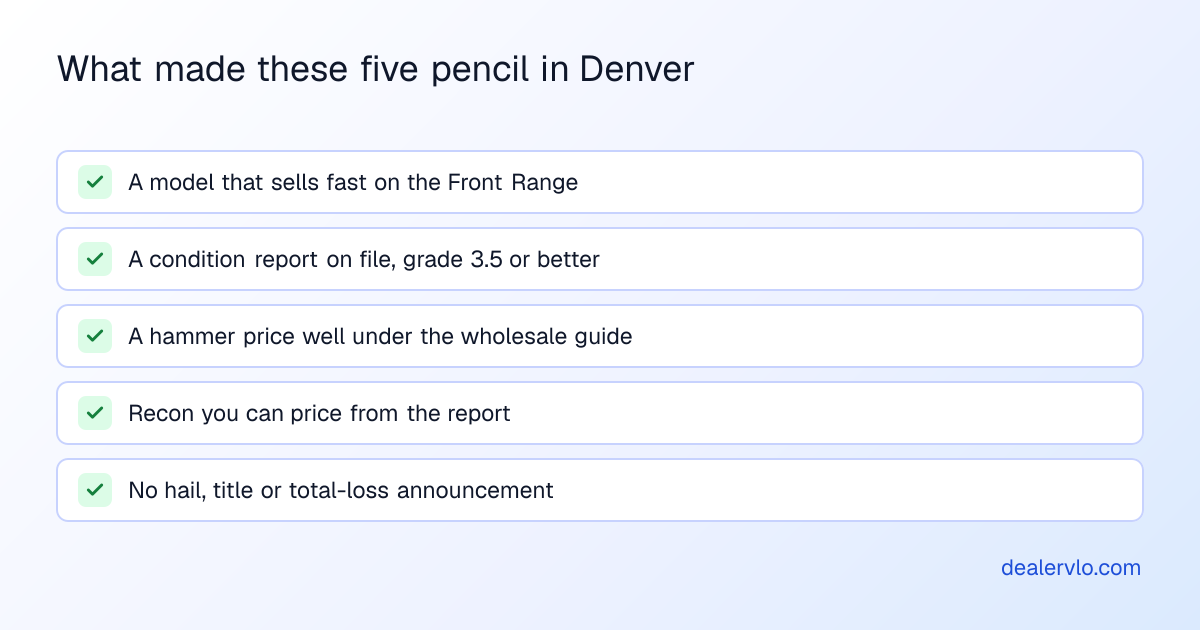
A Colorado-specific warning before the cars: hail. The Front Range gets hit most summers, and hail cars come through the lanes all year. At this sale, hail was announced on several of the most tempting cars on the sheet (more on those below). Read the announcements before the grade, and look at the roof and hood in angled light. And if a car says "previously repaired," that's a different buy from one with hail still in the panels. Carfax vs. AutoCheck for dealers covers which history report to pull for an insurance claim or a total-loss brand.
The five buys
Each one shows the estimate the same way: all-in cost is the hammer price plus my assumed allowance of about $600 for the buyer fee and local transport (check your auction's actual fee schedule and your hauler), plus a recon estimate taken from that car's condition report. The return is estimated gross ÷ all-in.
1. 2018 Volkswagen Tiguan SEL Premium 4MOTION — Run 6R-0004 · 92k mi · grade 3.9 · hammered $5,750
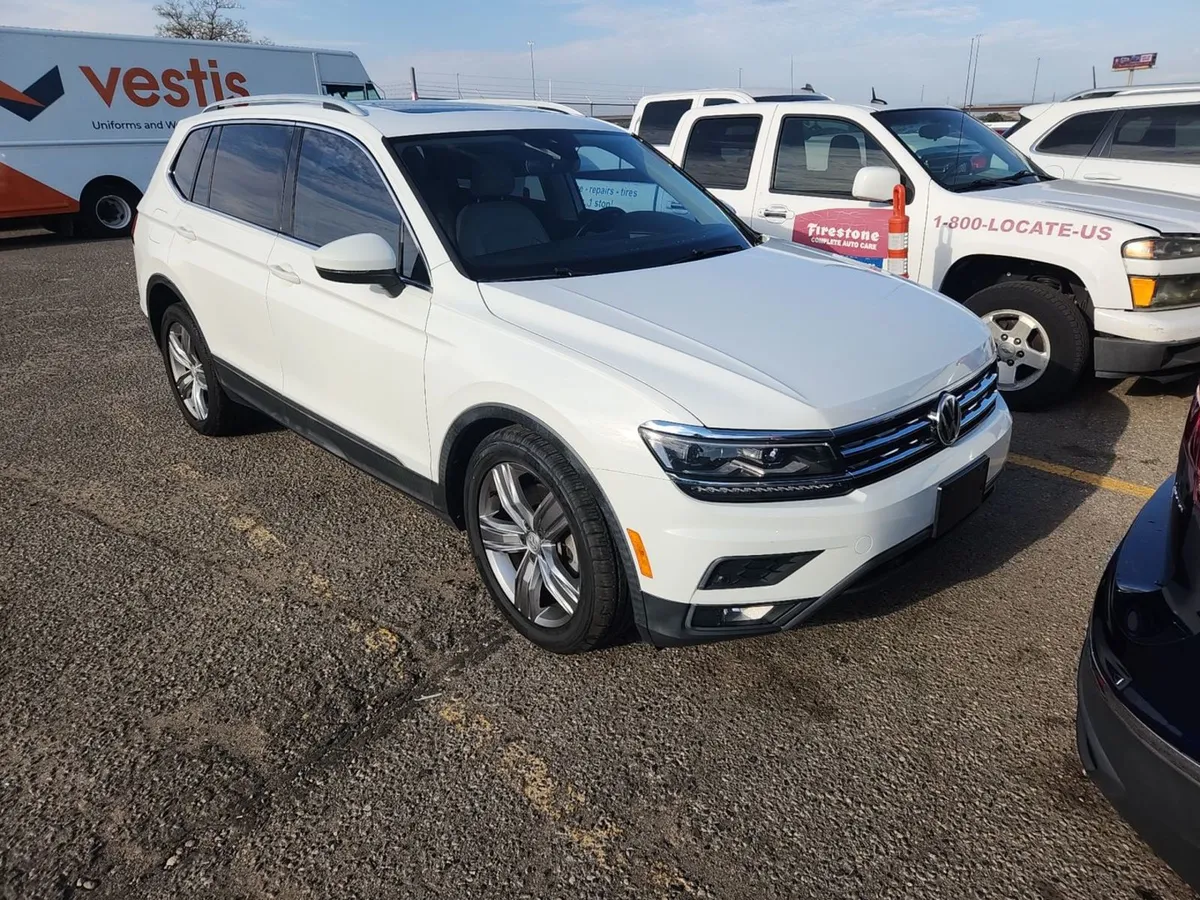
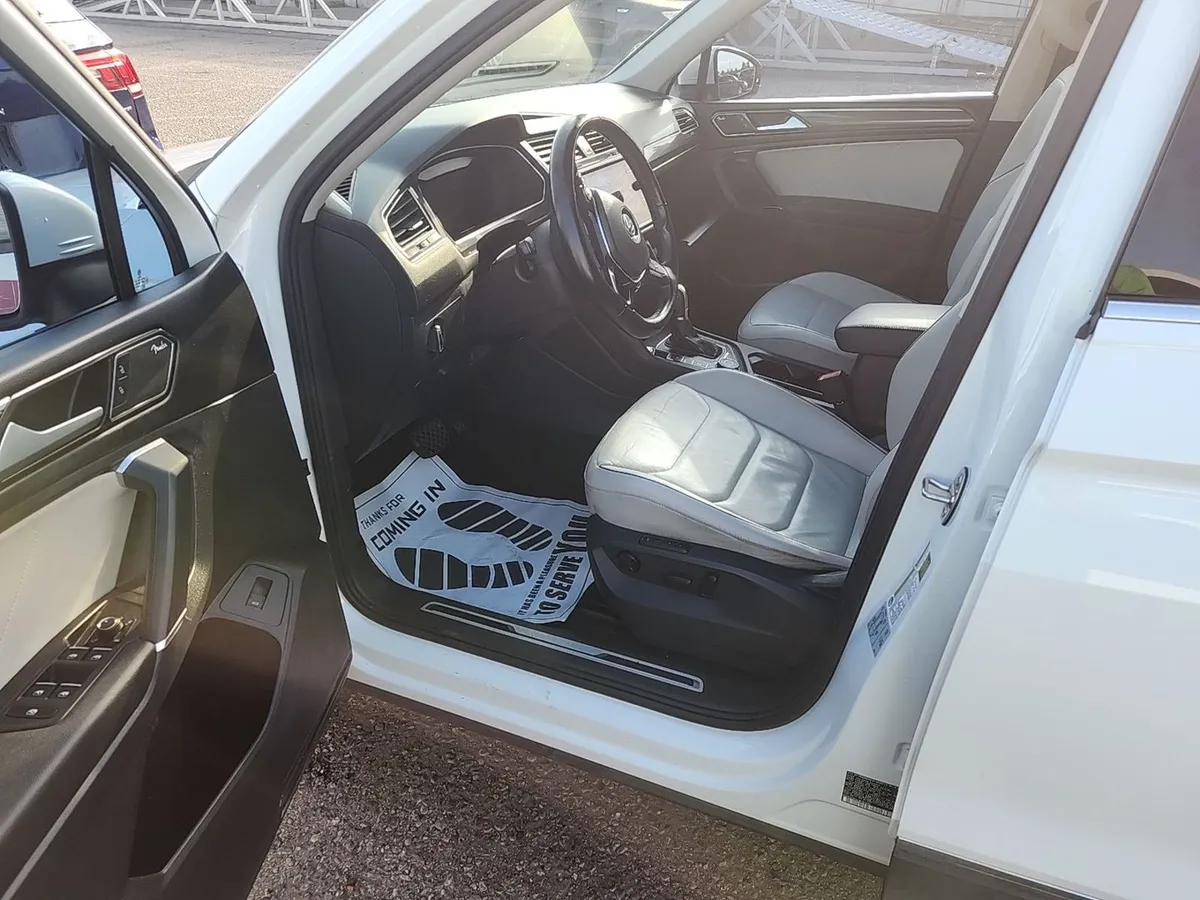
The read: the biggest discount to guide of any clean car on my list: $5,750 against a $9,950 guide, or 58%. It's the top trim with all-wheel drive, leather, navigation and the driver-assist package, and it sold on a green light. The condition report is all cosmetic: light scratches on most panels that call for a wet sand, chips on the hood and front bumper, and 6/32" on all four tires. Two things to budget for: it came with one key, and it carries an open recall, which a VW dealer handles at no charge. I can't tell you why the room let it go this cheap. That's the question mark on the biggest number below, so run the VIN before you bid on its twin.
The math (estimates): retail ~$12,500–$14,000 · all-in ≈ $5,750 + $600 + ~$900 recon (paint correction, second key) = $7,250 · est. gross $5,250–$6,750 · est. return ~72–93%.
2. 2024 Chevrolet Colorado Work Truck Crew Cab — Run 3-0009 · 11k mi · grade 3.6 · hammered $15,500
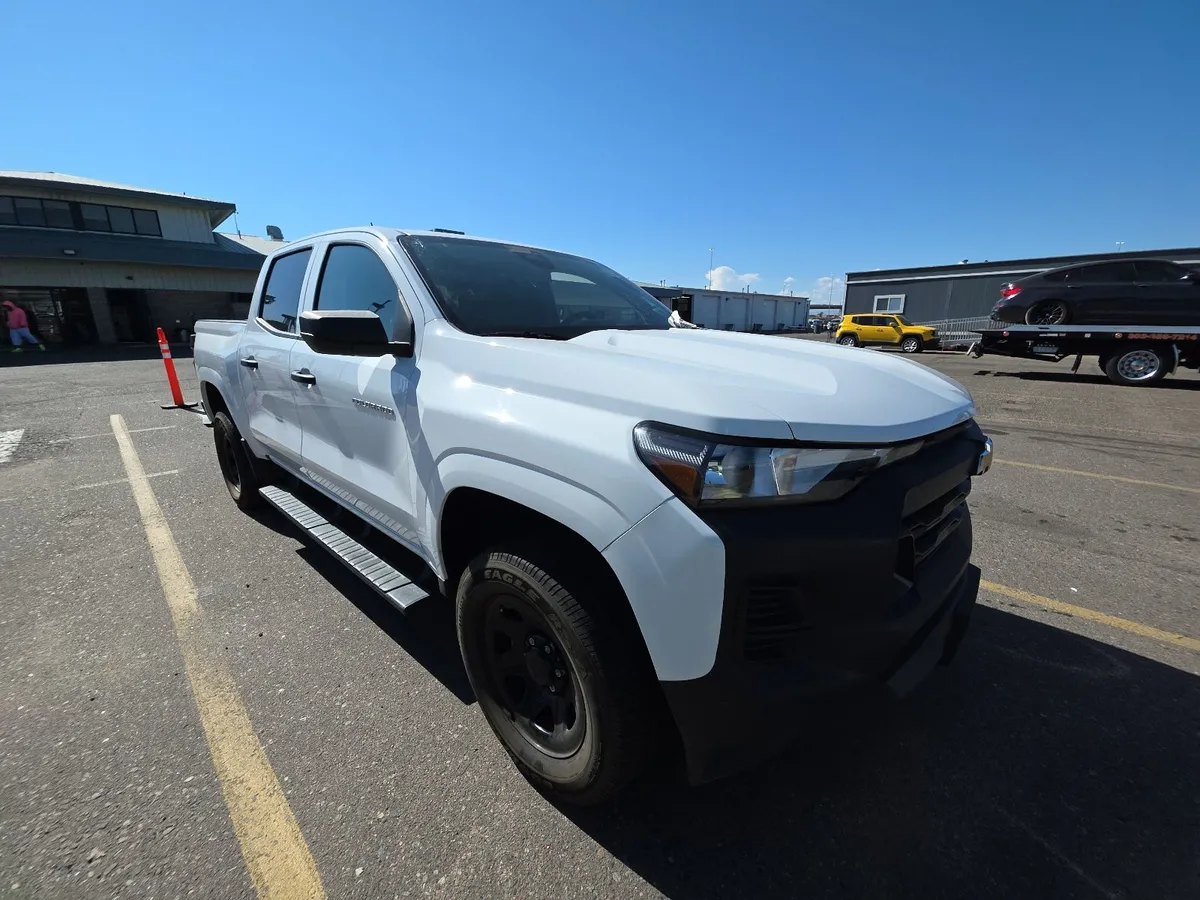
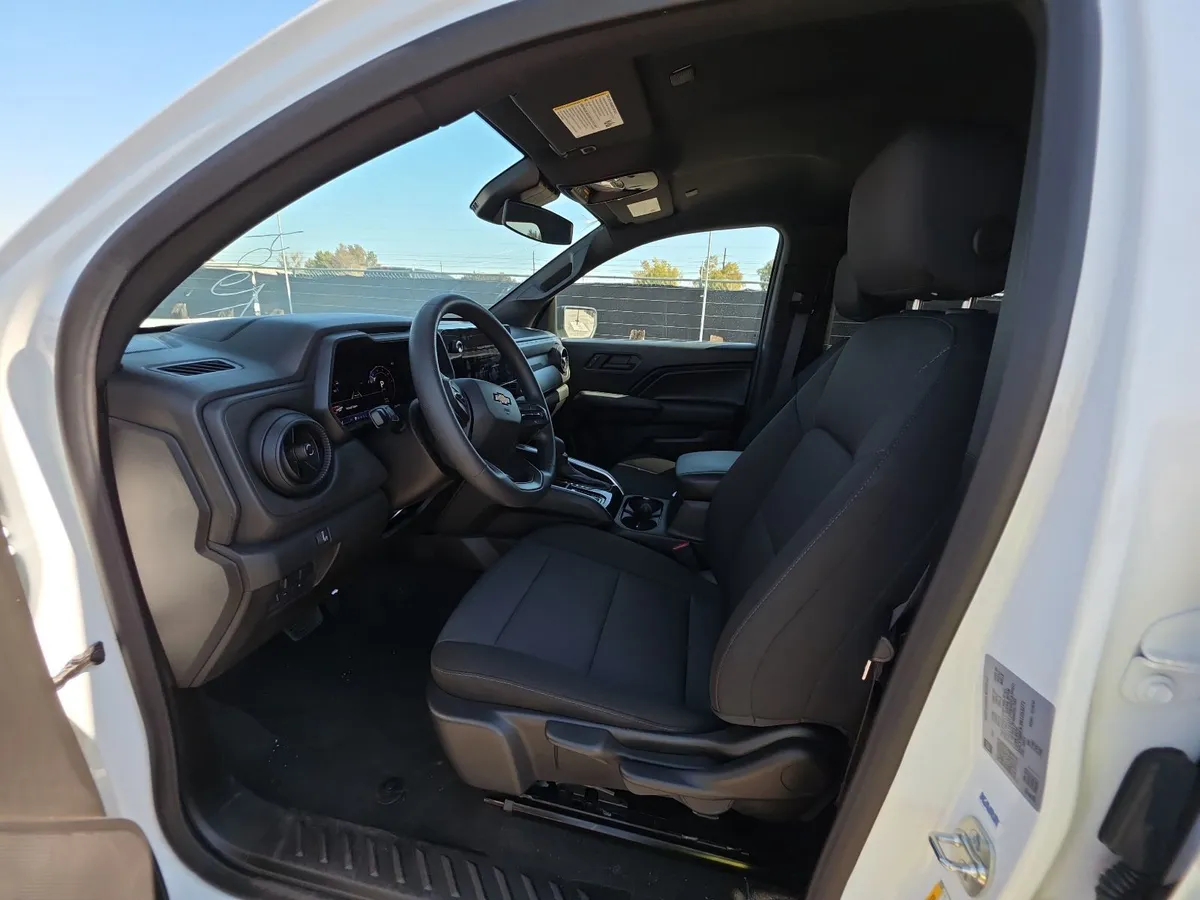
The read: a two-year-old crew-cab truck with 10,658 miles for $15,500 against a $21,800 guide. The condition report tells you where the discount went: a broken windshield, A/C that blows warm, and a dent in the rear bumper. Unlike most of this sale's discounts, those are things you can price. The windshield on a truck this new may need its camera recalibrated after replacement, so get that quote, not just the glass. The A/C is the unknown: it could be a recharge or a compressor. It's two-wheel drive, which costs it some buyers in Denver, so price it for the contractor or commuter who doesn't need 4x4.
The math (estimates): retail ~$25,500–$28,000 · all-in ≈ $15,500 + $600 + ~$2,000 recon (windshield + calibration, A/C, bumper) = $18,100 · est. gross $7,400–$9,900 · est. return ~41–55%.
3. 2018 Ford F-150 XLT FX4 Regular Cab — Run 5E-0032 · 109k mi · grade 3.5 · hammered $8,500
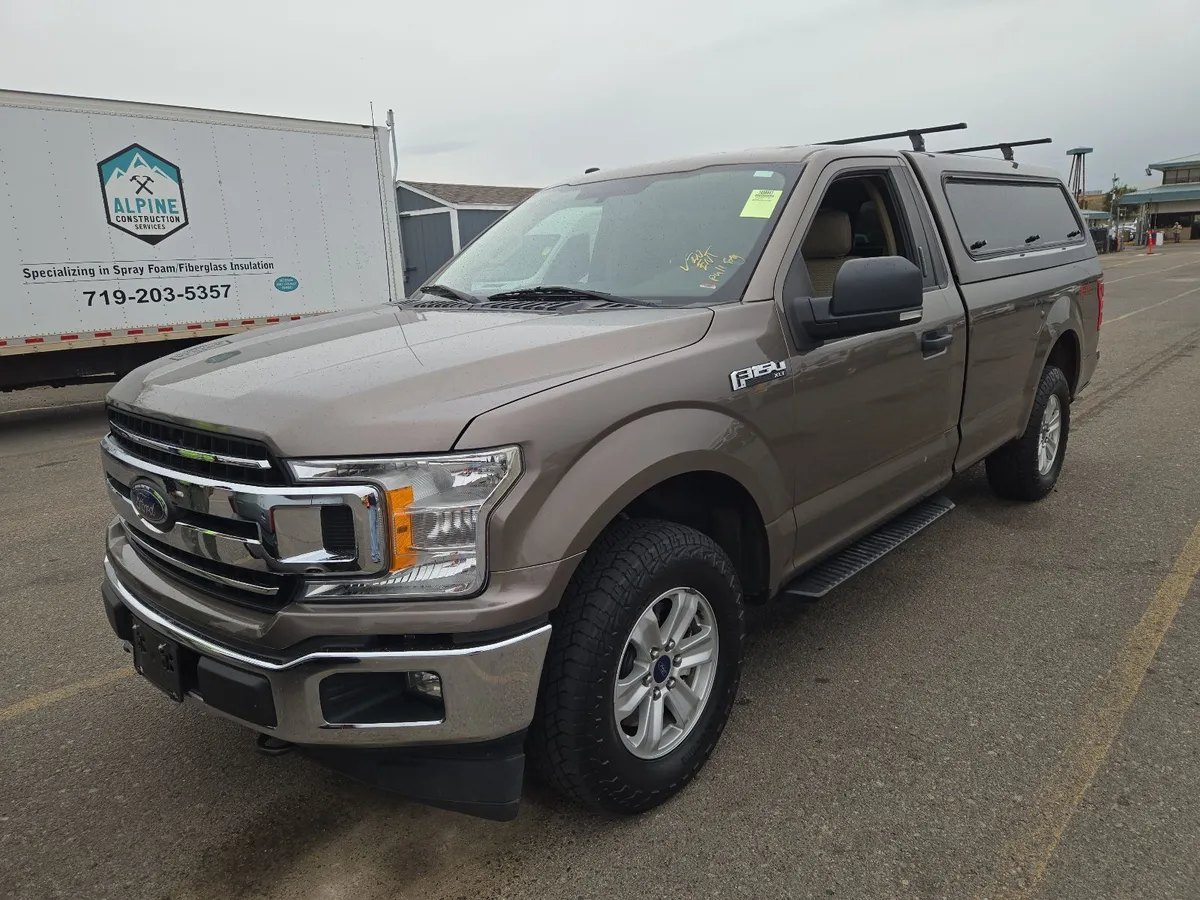
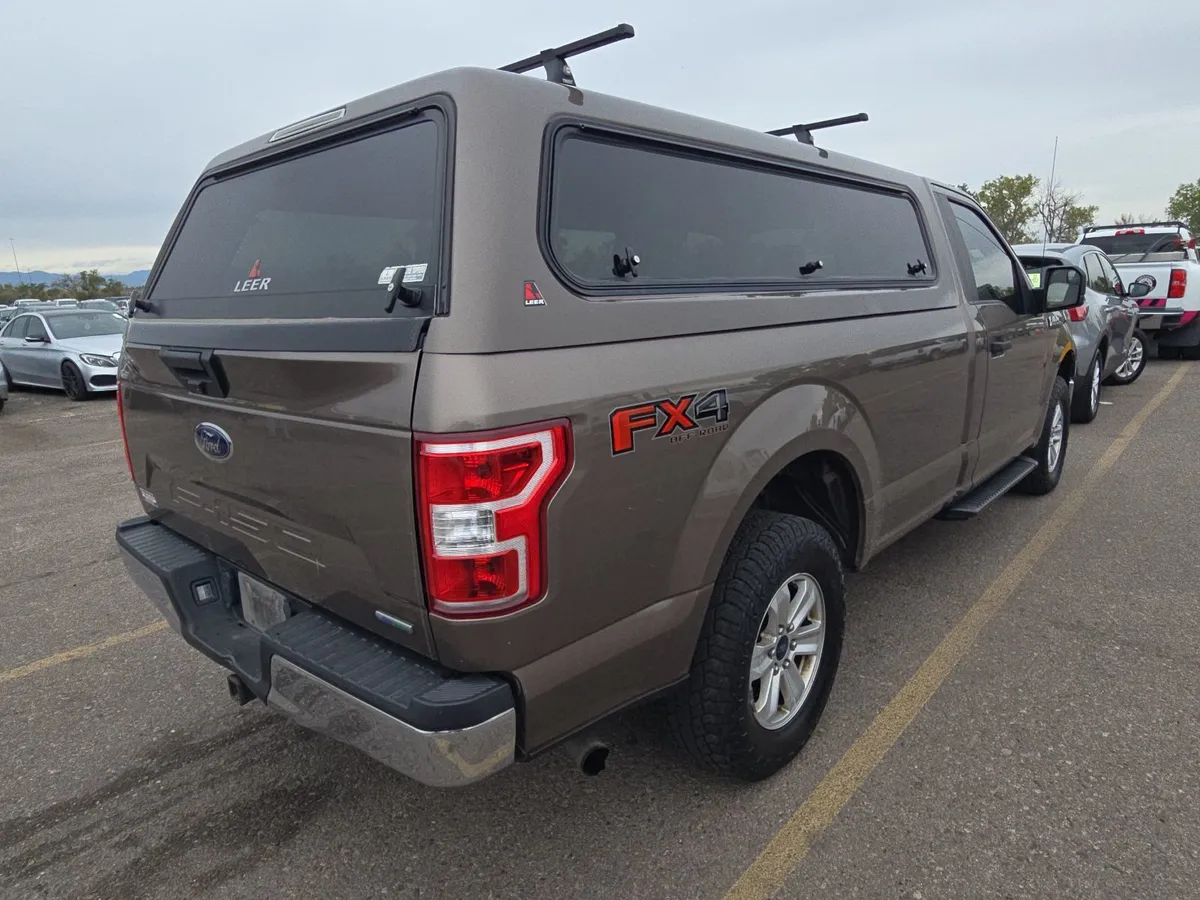
The read: a 4x4 half-ton (the FX4 badge is on the bed in the photos) with the 2.7 EcoBoost, for $8,500 against a $13,800 guide. It's an ex-fleet truck sold as-is, and the condition report lists a handful of dings for paintless dent repair, a chipped hood and 5/32" all around. It comes with a camper shell and a roof rack. The reason it's not higher on the list is the body style: a regular cab with an 8-foot bed is a work truck, and it sells to a narrower buyer than a crew cab. For a sense of the gap, Houston's sale had a 2019 F-150 XLT with 120k miles at $14,500. Know your work-truck buyer before you buy it.
The math (estimates): retail ~$16,500–$18,500 · all-in ≈ $8,500 + $600 + ~$1,000 recon (PDR, hood touch-up, detail) = $10,100 · est. gross $6,400–$8,400 · est. return ~63–83%.
4. 2020 Jeep Wrangler Unlimited Rubicon — Run 6R-0041 · 115k mi · grade 3.6 · hammered $10,250
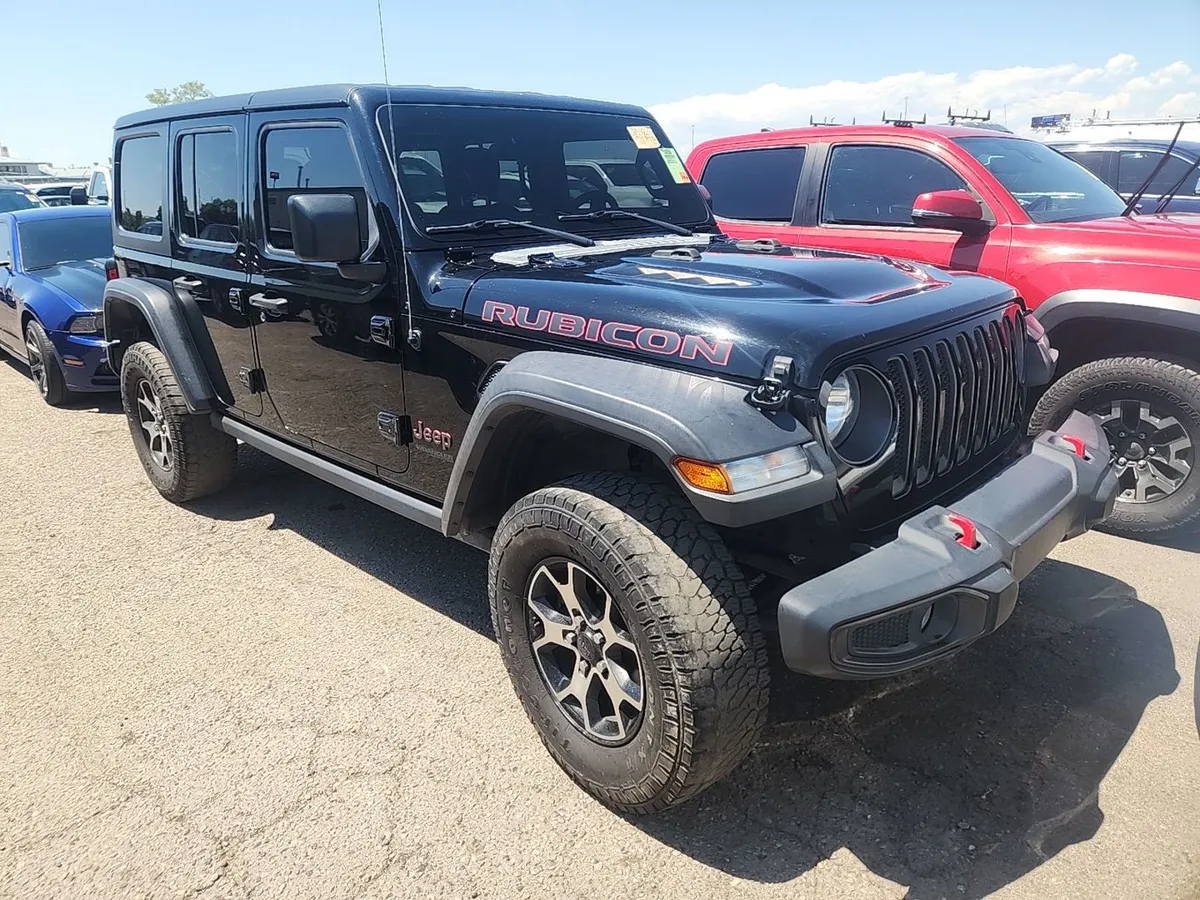
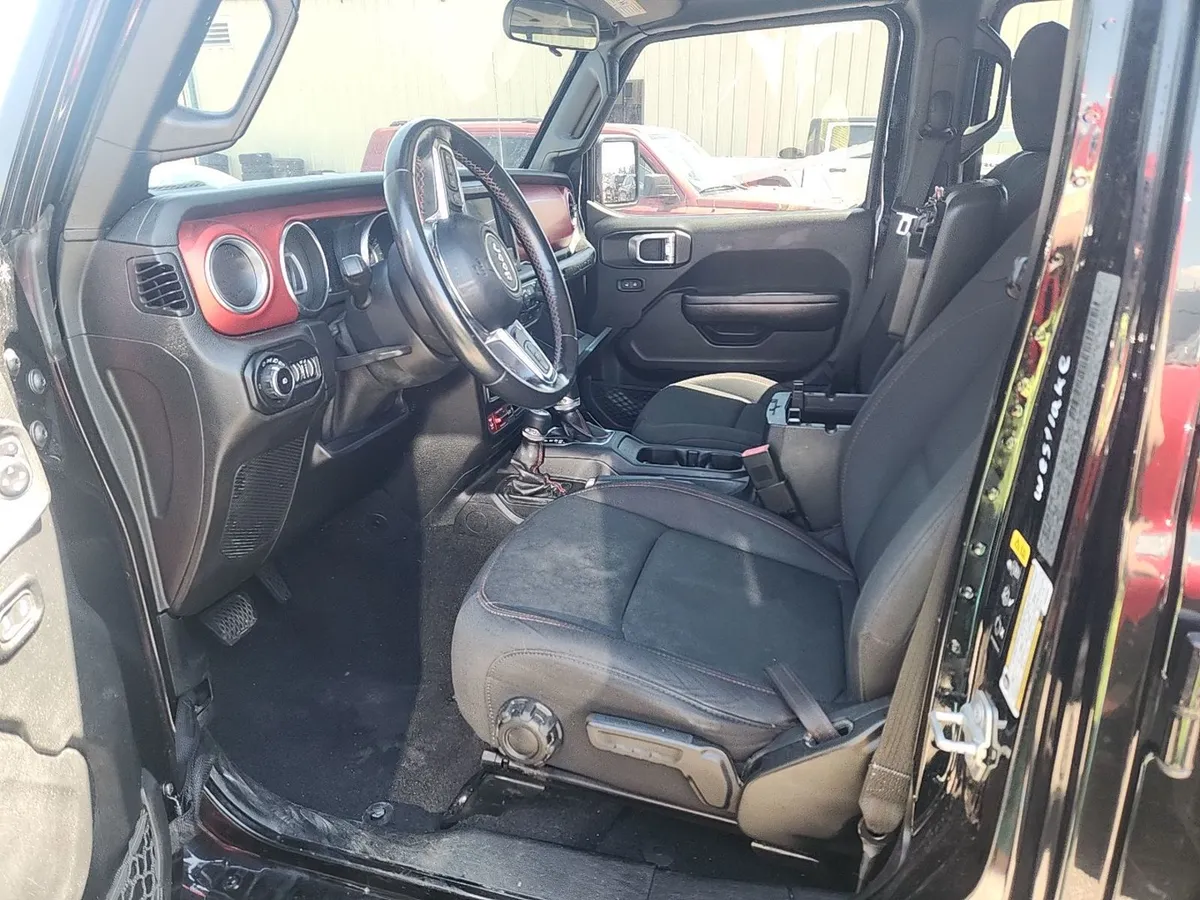
The read: a four-door Rubicon for $10,250 against a $17,250 guide, 59%. In Colorado, that's a car that sells itself. But the condition report shows why it was cheap: all four tires are at 1/32" to 3/32" (they're LT285/70R17s, so that's a real bill), the windshield has more than ten chips, and there's corrosion on two doors. It ran as-is, a lender repo, and it's the 2.0 turbo four, not the V6. None of that is a dealbreaker. It's just a lot of recon to count before the spread. I'd also want a mechanic to look at it before I treated the top of this range as real.
The math (estimates): retail ~$22,000–$25,000 · all-in ≈ $10,250 + $600 + ~$2,500 recon (four tires, windshield, door corrosion) = $13,350 · est. gross $8,650–$11,650 · est. return ~65–87%.
5. 2017 Ford Explorer Platinum 4WD — Run 6R-0011 · 137k mi · grade 4.1 · hammered $6,000
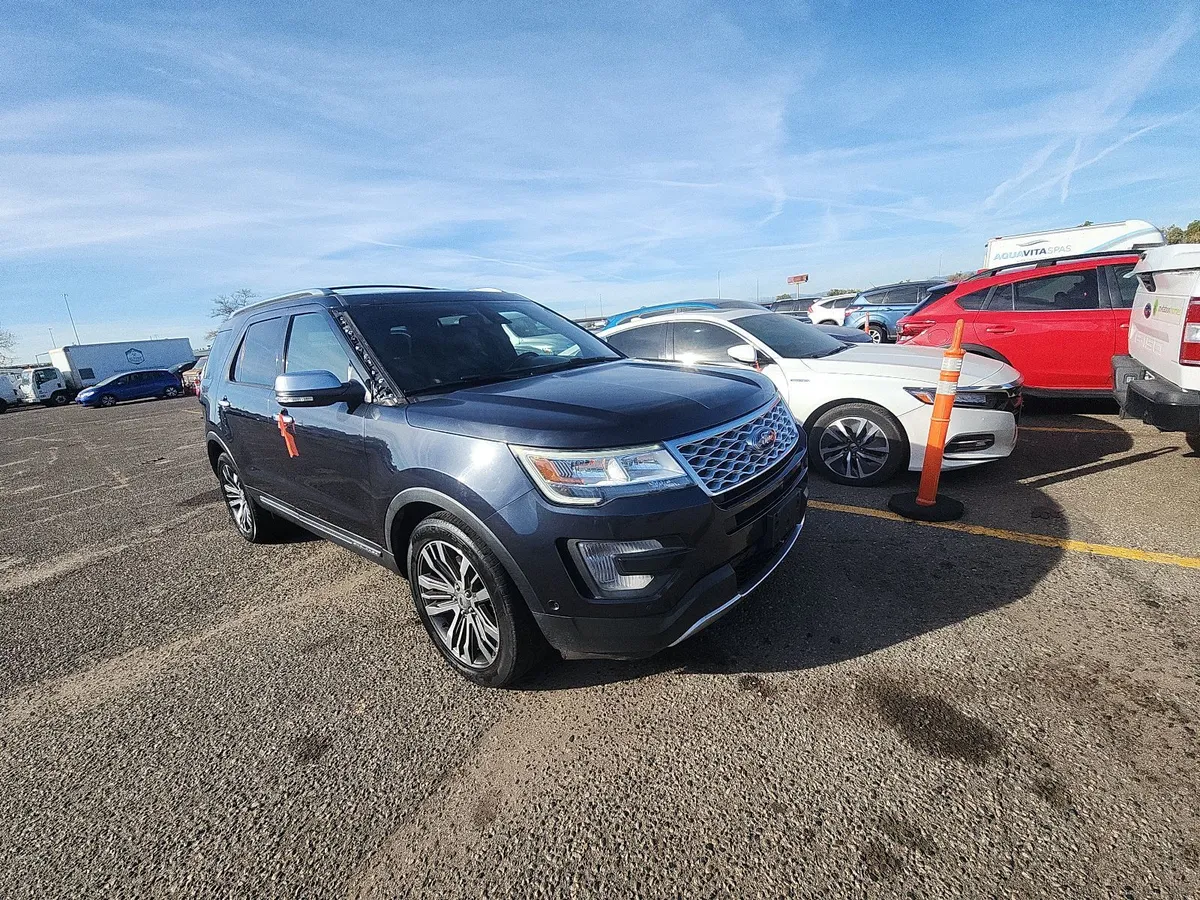
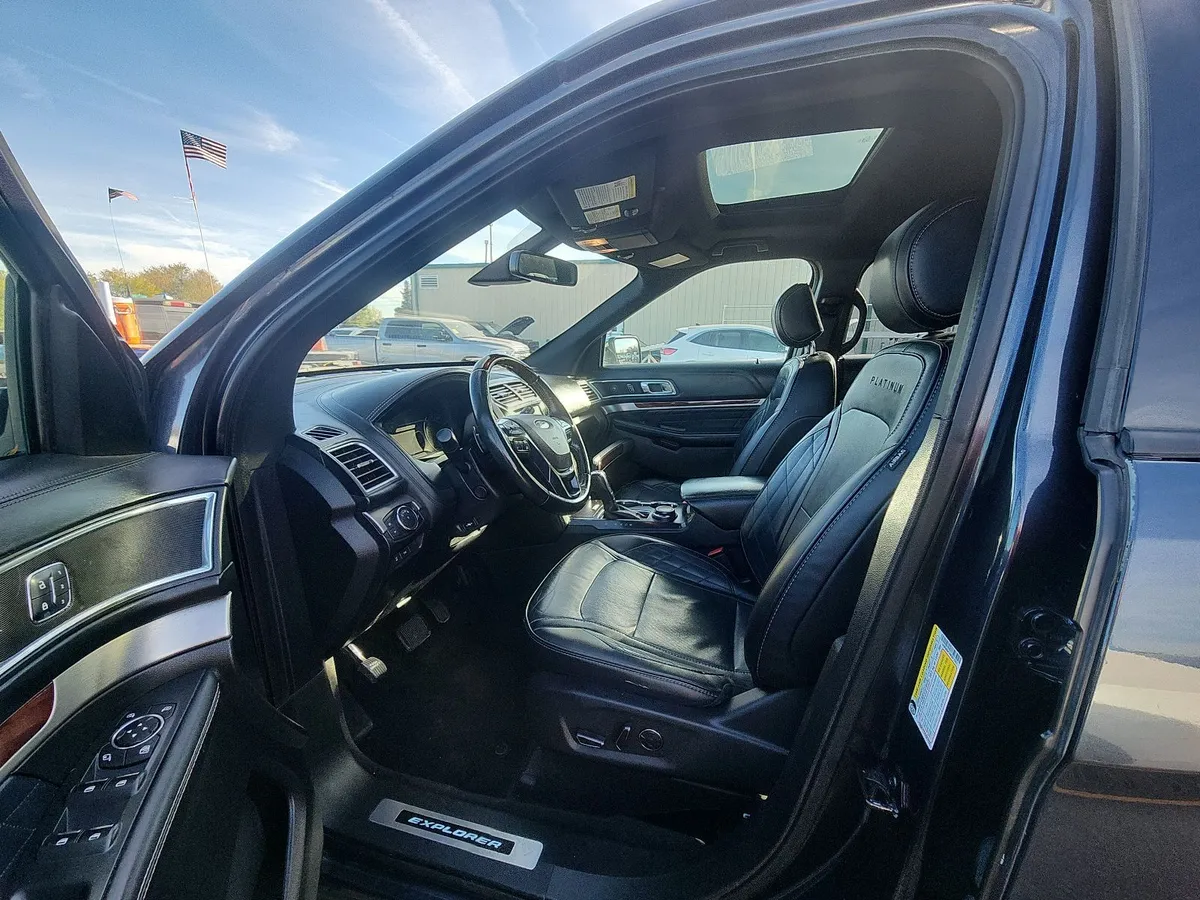
The read: a three-row 4WD SUV in its top trim, with the 3.5 EcoBoost, for $6,000 against a $7,700 guide. It's the thinnest return on the list, and the condition report earns that: two front tires at 3/32", a small tear in the driver's seat cushion, peeling paint on the hood and one wheel, a missing pillar trim cover and a broken rear wiper arm. It also carries an open recall. What's left is a loaded Platinum interior that photographs well, at a price that works for a family buyer on a budget. At 137k, it's a car to price to move.
The math (estimates): retail ~$10,500–$12,000 · all-in ≈ $6,000 + $600 + ~$1,300 recon (two tires, seat repair, paint and trim) = $7,900 · est. gross $2,600–$4,100 · est. return ~33–52%.
What the numbers really mean
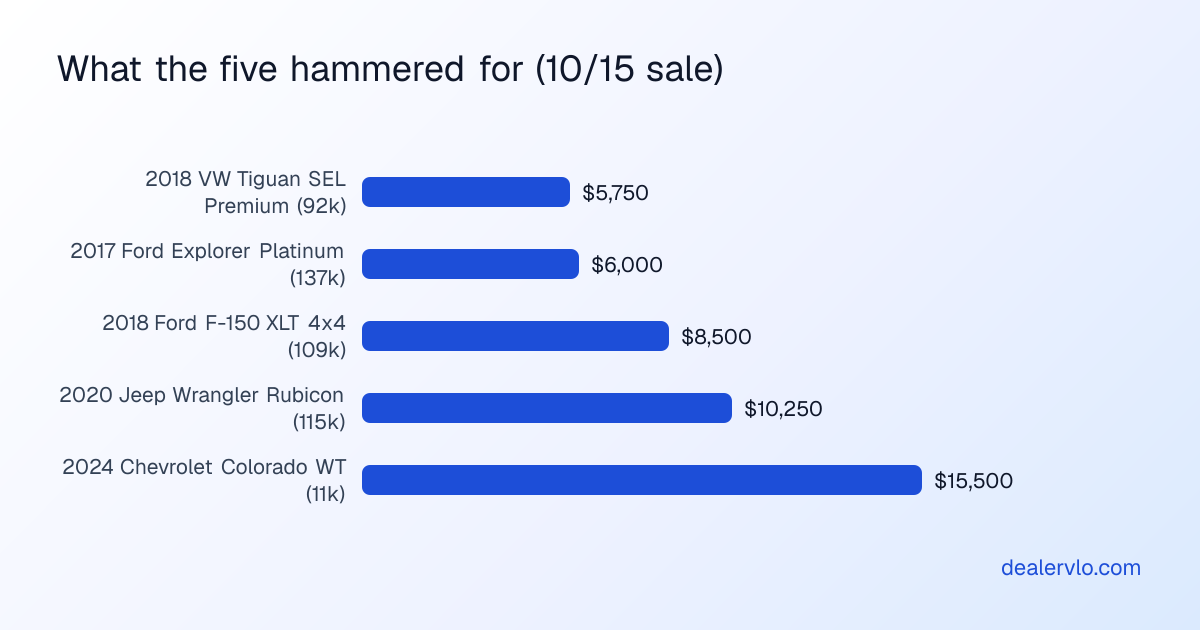
Here's what the five hammered for, straight from the sale:
And here's each one against the wholesale guide. Under 100% means it sold for less than the guide:
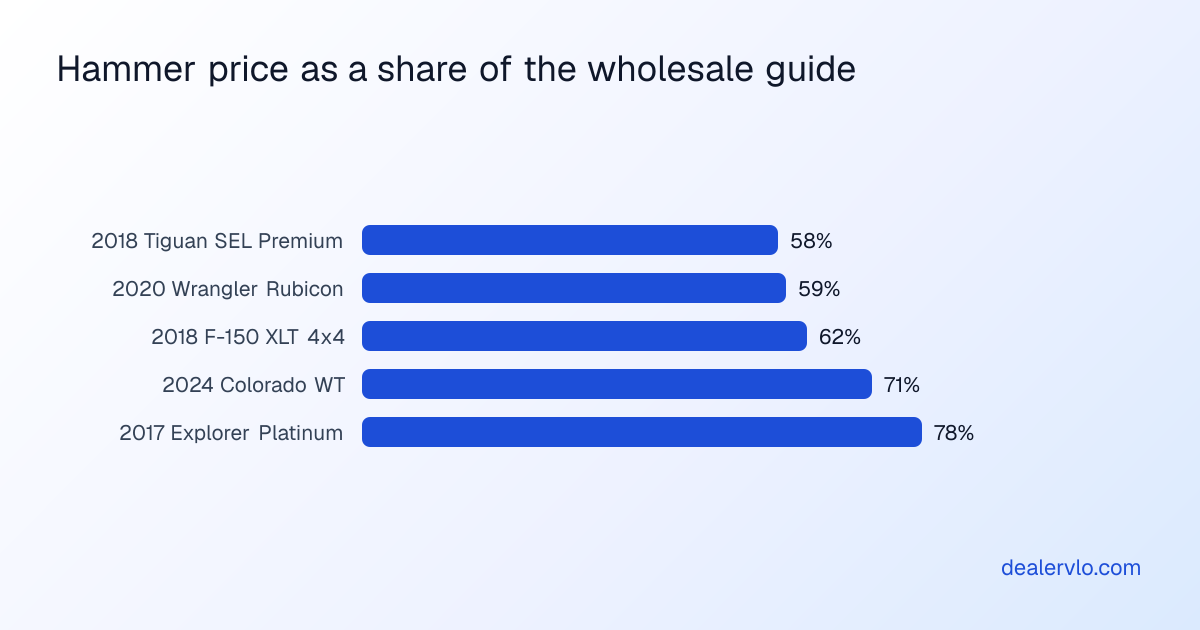
A guide value is a starting point, not a verdict. It's one company's read of the wholesale market, and it can't see the condition report the way the buyers in the lane can. On three of these five, the report explains most of the gap. How to use MMR and Black Book at auction covers how to read guide values without trusting them blindly. Then the estimated returns side by side:
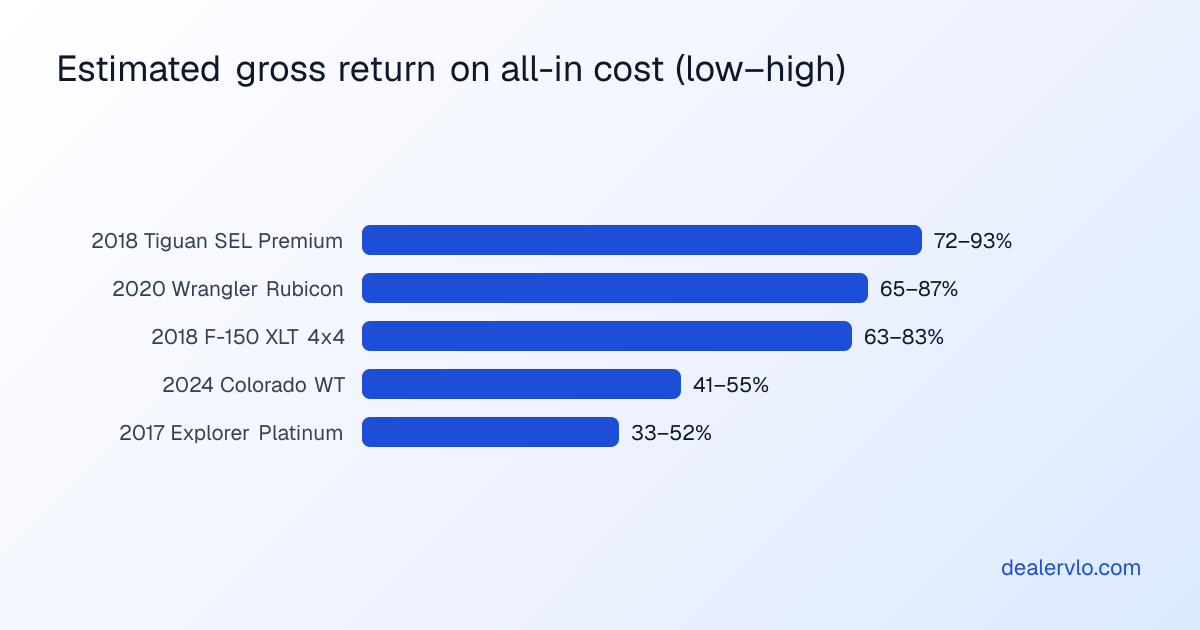
Three things to keep in mind before you treat those numbers as money in the bank:
- They're before holding cost. If a car costs you, say, $30 a day to carry (floor-plan interest, insurance, the slow slide in value), 30 days on the lot takes about $900 off every one of these. Holding costs on aging inventory breaks that daily number down.
- They're before overhead. Rent, payroll and insurance come out of the gross too. Used car dealer profit margin walks through working out what each car has to earn just to cover them.
- Recon estimates are where these go wrong. I priced recon from the condition reports, and a report only lists what the inspector saw. The Colorado's A/C and the Rubicon's mechanicals are the two lines most likely to come in high. Used car reconditioning cost covers how to budget for the line you can't see yet.
Want to run your own numbers before the next sale? The free calculator below works out the most you can bid and still hit your margin.
Work out the most you can bid at the lane and still hit your target margin.
Open the Auction Profit CalculatorOnce you've bought, the number to watch is what the car actually costs you by the time it sells: purchase, fees, and every recon bill. In DealerVLO, every recon line you log on a car (the Rubicon's tires, the Colorado's windshield) rolls into that car's all-in cost, so the margin you see is the real one.
14-day free trial, then $29/mo · Cancel anytime
Honorable mentions
Three more from the same sale that were close:
- 2022 Ram 1500 Big Horn 4WD (Run
5E-0018, 124k mi, grade 4.0, $16,000 against a $17,400 guide). An ex-fleet half-ton sold as-is. Less room than the F-150, but a crew-cab 4x4 is an easier Denver sale. - 2021 Chevrolet Silverado 1500 LT 4WD (Run
5R-0108, 80k mi, grade 3.7, $22,750 against a $21,450 guide). The 5.3 V8, a green light, and nothing worse than dents for PDR on the report. It sold over guide, so it's a turn car, not a margin car. - 2019 Toyota Tacoma SR5 V6 4WD (Run
5R-0111, 140k mi, grade 3.7, $19,500 against an $18,400 guide). High miles and stained seats, and it still sold over guide. That's what Tacomas do.
The ones I'd walk away from
On paper, some of the most tempting cars on the sheet were these:
- 2018 Ford Edge Titanium (Run
3-0012, 92k mi, grade 4.0) hammered at $4,250 against a $7,100 guide. - 2024 Jeep Wagoneer L Series II (Run
5E-0011, 62k mi, grade 4.0) hammered at $20,000 against a $24,550 guide. - 2017 Jeep Grand Cherokee SRT (Run
6R-0106, 127k mi, grade 3.9) hammered at $14,000 against a $17,200 guide. - 2021 Subaru WRX (Run
2R-0356, 47k mi) hammered at $4,000 against a $15,950 guide, about a quarter of it.
Then you read the announcements. All four were announced with hail. The Wagoneer's says the hail was previously repaired and that it has unrepaired damage. The WRX's adds inoperable, an airbag deployment and a rebuilt/salvage title. Note that three of the four carried a grade of 3.9 or 4.0: the grade didn't warn you, the announcement did.
Hail wasn't the only story. A 2017 Honda Pilot EX-L (Run 2-0112, $7,000 against an $11,000 guide) and a 2016 Acura RDX (Run 1R-0058, $7,000 against $9,400) both looked like cheap Hondas until you read "total loss" and "salvage" in their announcements. A 2020 BMW X3 xDrive30e (Run 5R-0090, 65k mi, grade 3.6, $12,500 against $16,400) was announced with a not-actual-mileage title, a total loss and a theft recovery. If branded titles are your business, selling salvage and rebuilt title cars covers how to do it honestly. If they're not, these are the cars that come back to you as a problem. It's the same discipline as reading a condition report for red flags and reading the real gross behind an auction spread: the cheaper a clean-looking car is against the guide, the harder you look for the reason.
Turning them fast: where DealerVLO fits
Buying right is half of it. The other half is getting from the lane to a signed deal before holding cost eats the spread. This is the part of the business I built DealerVLO to speed up:
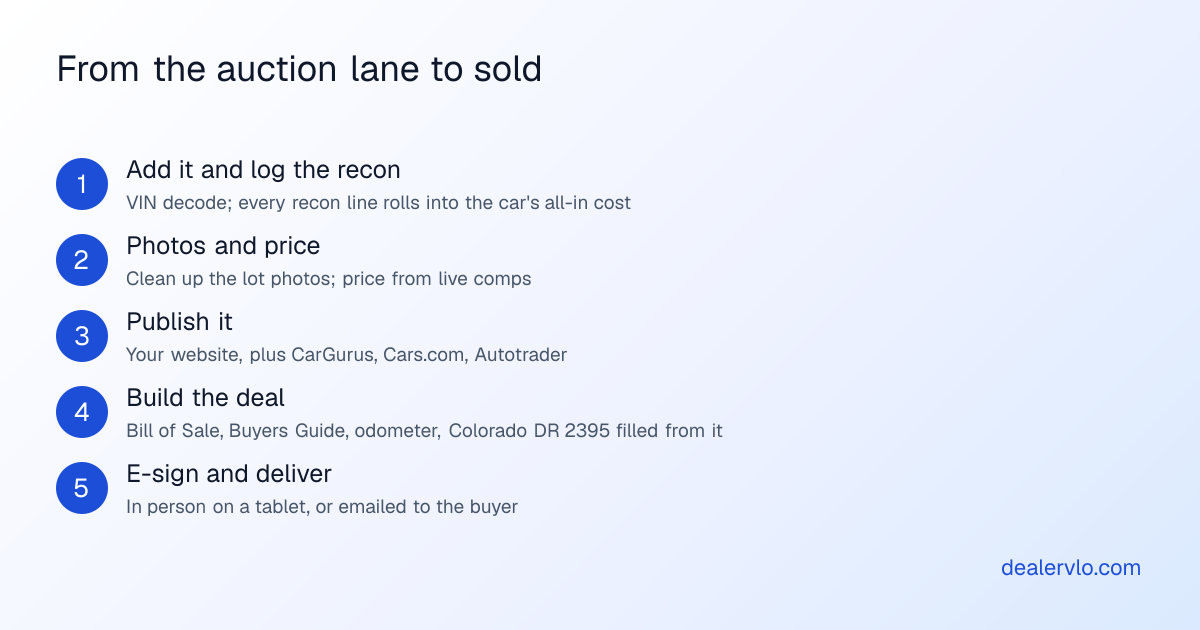
- Know the real cost from day one. Add the car with its VIN decoded, then log every recon line against it, from the Tiguan's paint correction to the Rubicon's tires. Each car's all-in cost and margin sit on its page, next to how many days it's been on the lot.
- Make the auction photos sellable. Photos like the ones above are fine for a run sheet, not for a listing. DealerVLO's optional AI photo enhance puts the car on a clean backdrop without altering the car itself.
- Price from live comps. The AI price suggestion shows a price range from live comparable listings and a target price for selling in about 30 days, so you can check it against the car's all-in cost before you list it.
- Advertise it everywhere at once. Every car posts automatically to the dealer website that comes with DealerVLO. It also goes out on the listing feeds to CarGurus, Cars.com and Autotrader once you've enrolled with each (you still pay those sites' own fees). More on how those work in car listing sites for dealers.
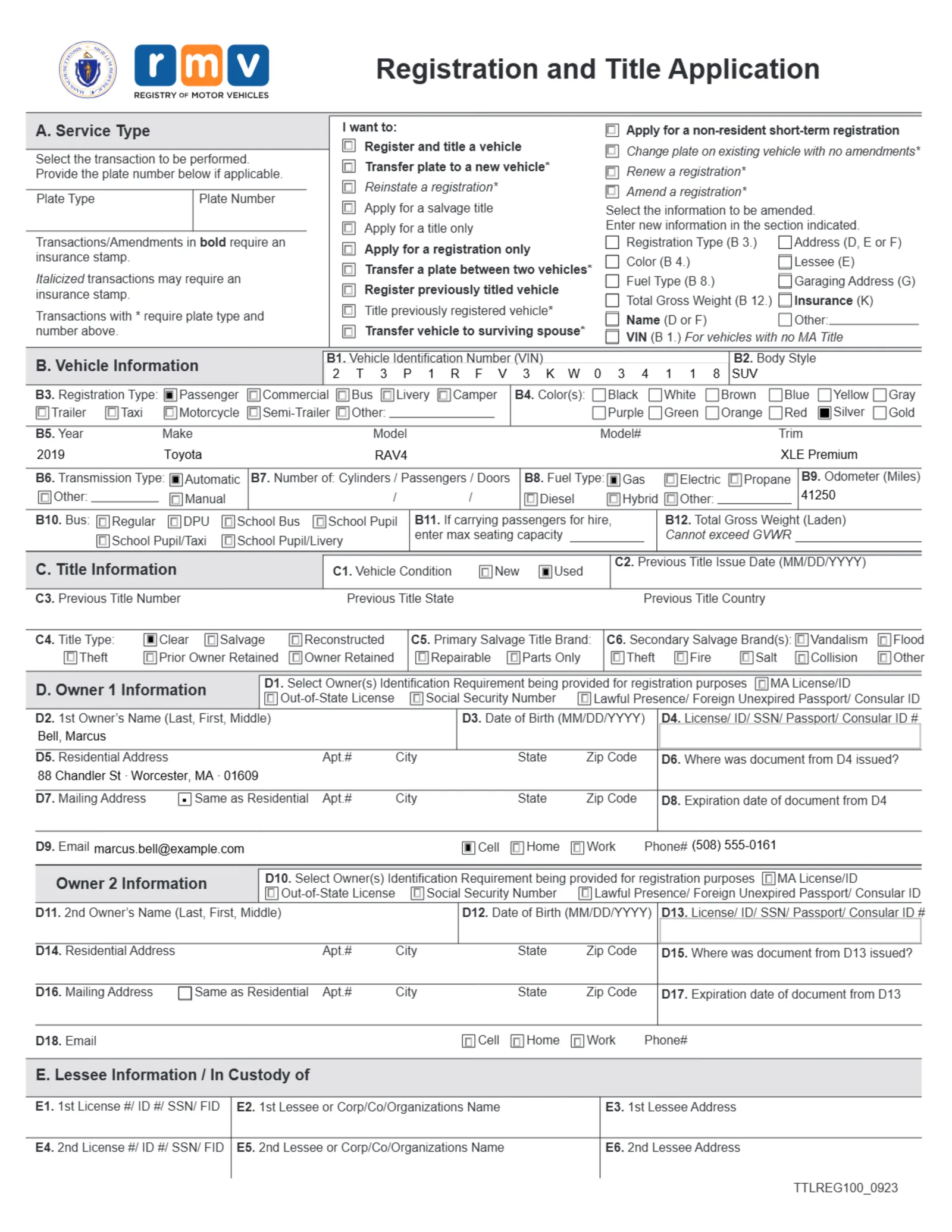
- Finish the paperwork from the deal. Build the deal once and DealerVLO fills the Bill of Sale, the FTC Buyers Guide, the odometer statement and the Colorado title application (Form DR 2395) straight from it, with no retyping the VIN into every form.
- Get it signed on the spot. E-signatures on the deal documents let the buyer sign in person on a tablet or from an emailed link, so a sale doesn't wait on a second trip to the lot.
None of that changes what you paid at the auction. What it changes is how many days it takes to turn that buy back into cash, and that's where these returns are won or lost. If trucks are your lane, sourcing used trucks picks up from here, and getting your lot ready for winter covers the season these 4x4s are about to sell into.
14-day free trial, then $29/mo · Cancel anytime
A free daily game: one used car, three guesses at wholesale and three at retail, then the comps behind the answer.
Open the Daily AppraisalFrequently asked questions
What used cars sell fastest for a lot in Colorado?
In my read of the Front Range market, anything with four-wheel or all-wheel drive comes first, especially going into winter, then trucks and mid-size SUVs. The auction sheet reflected it: 314 of the 483 cars at this sale were listed as AWD or 4WD. A front-wheel-drive sedan still sells in Denver, but it usually has to be priced to do it, while a clean 4x4 at the right number tends to go quickly.
How do I check a car for hail damage at a Colorado auction?
Read the announcements first, because hail is usually announced, and at this sale it explained several of the biggest discounts. Then look at the roof, hood, trunk lid and the tops of the fenders in low, angled light, where small dents show up best. Ask whether the damage was repaired or is still there: a previously repaired car and one with open hail damage are different buys. Get a paintless dent repair quote before you count the spread, and run a history report for an insurance total-loss or salvage brand.
Do trucks sell above wholesale guide at Denver auctions?
Not at this sale. Of the 14 pickups graded 3.5 or better that had a guide value, only 5 hammered above it. At the Houston sale a week earlier, 30 of 43 clean pickups went over guide. That's two sales, not a rule, but it means the Denver room wasn't paying up for trucks the way Texas was that week, and it's where two of the buys in this post came from.
What is a good ROI on a car bought at a dealer auction?
There's no fixed number, because it depends on your recon, your market, and how fast the car sells. The useful way to think about it is estimated gross divided by your all-in cost (hammer price, buyer fee, transport, and recon). On the five cars in this post, my estimates run roughly 33% to 93% before overhead and holding costs, and the top of that range assumes the condition report caught everything. The low end on a car that sells in two weeks can beat the high end on one that sits for three months.
Why did a car sell far below the wholesale guide at auction?
Usually because the room knew something: announced hail, a title problem, a total-loss history, or a known weakness in the model. At this sale, a 2021 Subaru WRX with 47k miles hammered at about a quarter of its guide, and the announcements explained it: hail, inoperable, airbag deployment and a rebuilt/salvage title. Read the announcements and the condition report before you treat a big discount as a deal.
Bottom line
The five cars that penciled in Denver weren't the cheapest on the sheet. The cheapest-looking ones were mostly hail cars and total losses, with the reason printed right on the listing. The buys were the cars where the discount was bigger than the recon the condition report listed: a loaded Tiguan at 58% of guide, a Rubicon that needs tires, a 4x4 F-150 work truck, an 11k-mile Colorado with a cracked windshield, and a Platinum Explorer priced for a budget buyer. The estimated returns are real room in the deal. Whether you keep it comes down to how close your recon comes in to the estimate, and how fast you get each car priced, listed and signed.
DealerVLO keeps that whole loop in one place, from the car's true all-in cost to the website, the listing feeds, the filled paperwork and the e-signature, for a flat $29 a month with unlimited users. Start your free 14-day trial and run your next auction buy through it.
14-day free trial, then $29/mo · Cancel anytime