Used Car Dealer Profit Margin: How to Calculate Your Real Margin Per Car
Your paper margin isn't your profit margin. How to calculate a used car's real margin on all-in cost, why margin isn't markup, and how to price to a target.
Most dealers can tell you what they "make" on a car in about two seconds: sticker minus what they paid at the auction. It's also the number that lies the most. By the time you add the buyer fee, the truck, the recon, and the weeks the car sat, a car that looked like a 30% deal can quietly be a single-digit one. I've priced cars off that paper number myself, and the month-end math was a surprise every time.
This post is the math I use now: how to calculate a used car's real profit margin on its all-in cost, why margin and markup aren't the same number (and what that mistake costs you per car), and how to work out the margin your lot actually needs.
What is a used car dealer's profit margin, really?
Profit margin is the share of the sale price you keep as gross profit:
Margin = (sale price − all-in cost) ÷ sale price × 100
The whole argument lives in the words "all-in cost". The auction price is where a car's cost starts. A car's real cost is everything you spent to turn it into a sold unit: the purchase price, the auction buyer fee, transport, every recon line, and what it cost you to carry it while it sat.
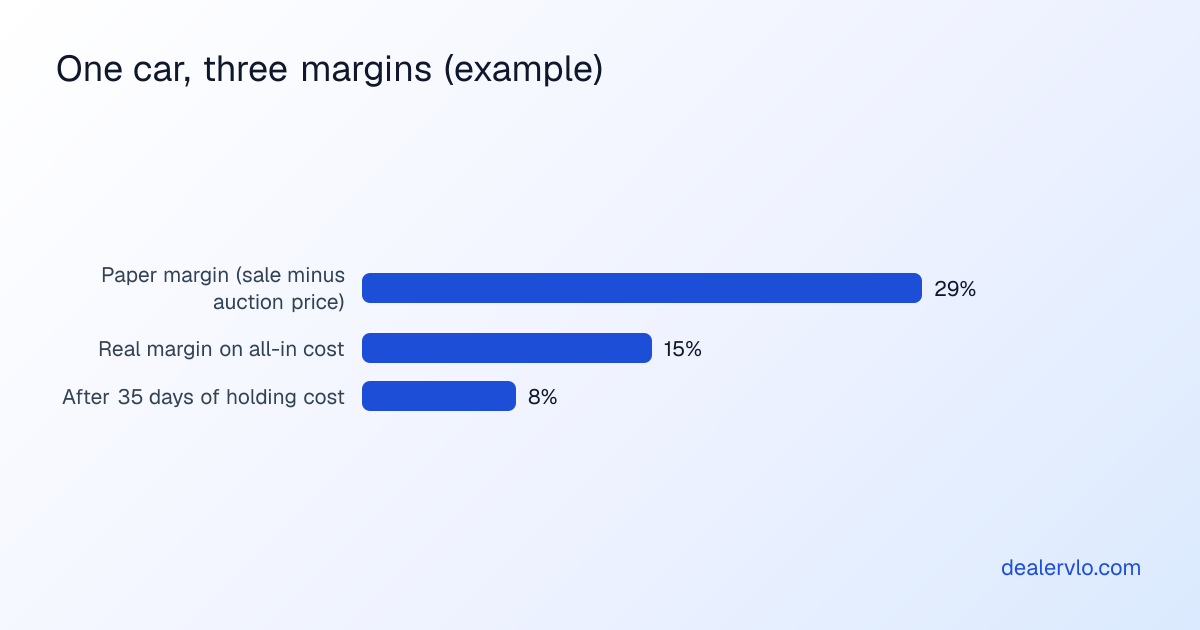
Here's one car, as an example. You buy it for $10,000 at the lane and sell it for $14,000:
- Paper math: $14,000 − $10,000 = $4,000, a 29% margin. Looks great.
- Add the costs: say a $400 buyer fee, $250 transport, and $1,200 of recon. All-in cost is $11,850, so gross is $2,150: about a 15% margin.
- Add the days: the car sits 35 days, and it costs you (call it) $30 a day to carry: floor-plan interest, insurance, the slow slide in value. That's $1,050, leaving $1,100: about an 8% margin.
Same car, same sale price. The margin went from 29% to 8% without anybody negotiating anything.
If that gap looks familiar, it's the same one I dug into in the auction paper spread vs. real gross: the spread you see at the lane isn't the gross you bank.
How do you calculate the real margin on each car?
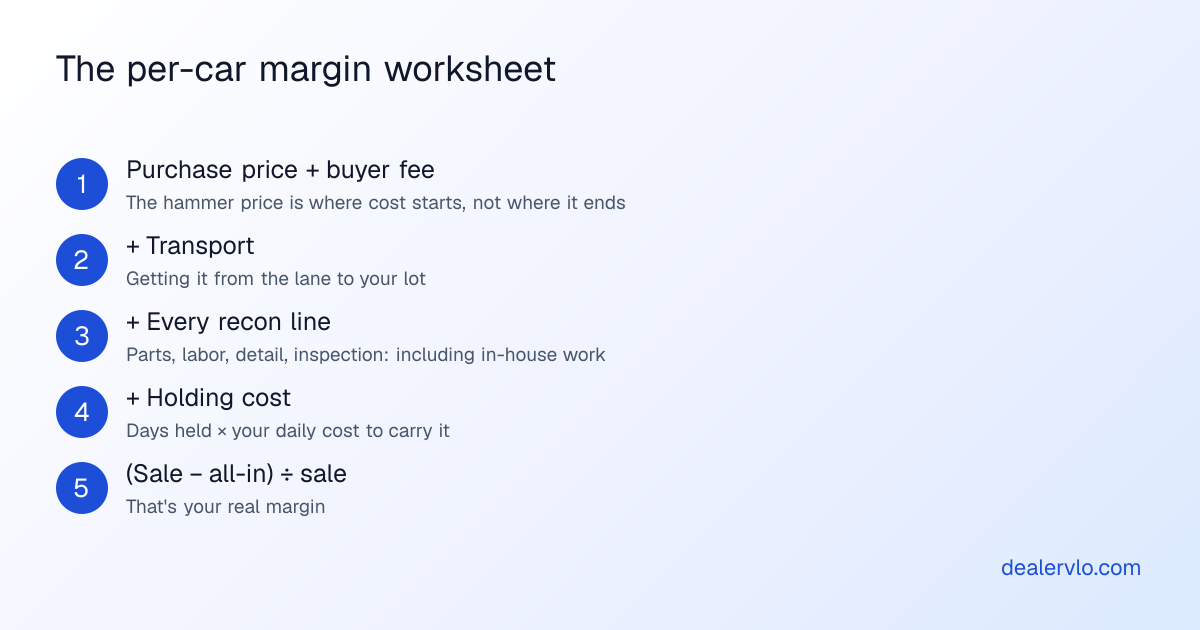
Do it per car, every car, with the same five lines:
- Purchase price + buyer fee. The fee is part of what the car cost; it isn't overhead.
- + Transport. Whether you pay a hauler or burn a day driving it yourself.
- + Every recon line. Parts, labor, detail, inspection. Including the work your own tech does: an hour of in-house labor has a cost even if no invoice shows up. If you want a budget to check yourself against, see how to budget reconditioning cost.
- + Holding cost. Days held × what a day costs you. Holding costs on aging inventory breaks that daily number down.
- (Sale price − all-in cost) ÷ sale price. That's the margin.
The hard part isn't the division. It's step 3: recon costs that live on receipts, in a text thread, or in your head never make it into the car's cost, so the margin you calculate is higher than the one you earned.
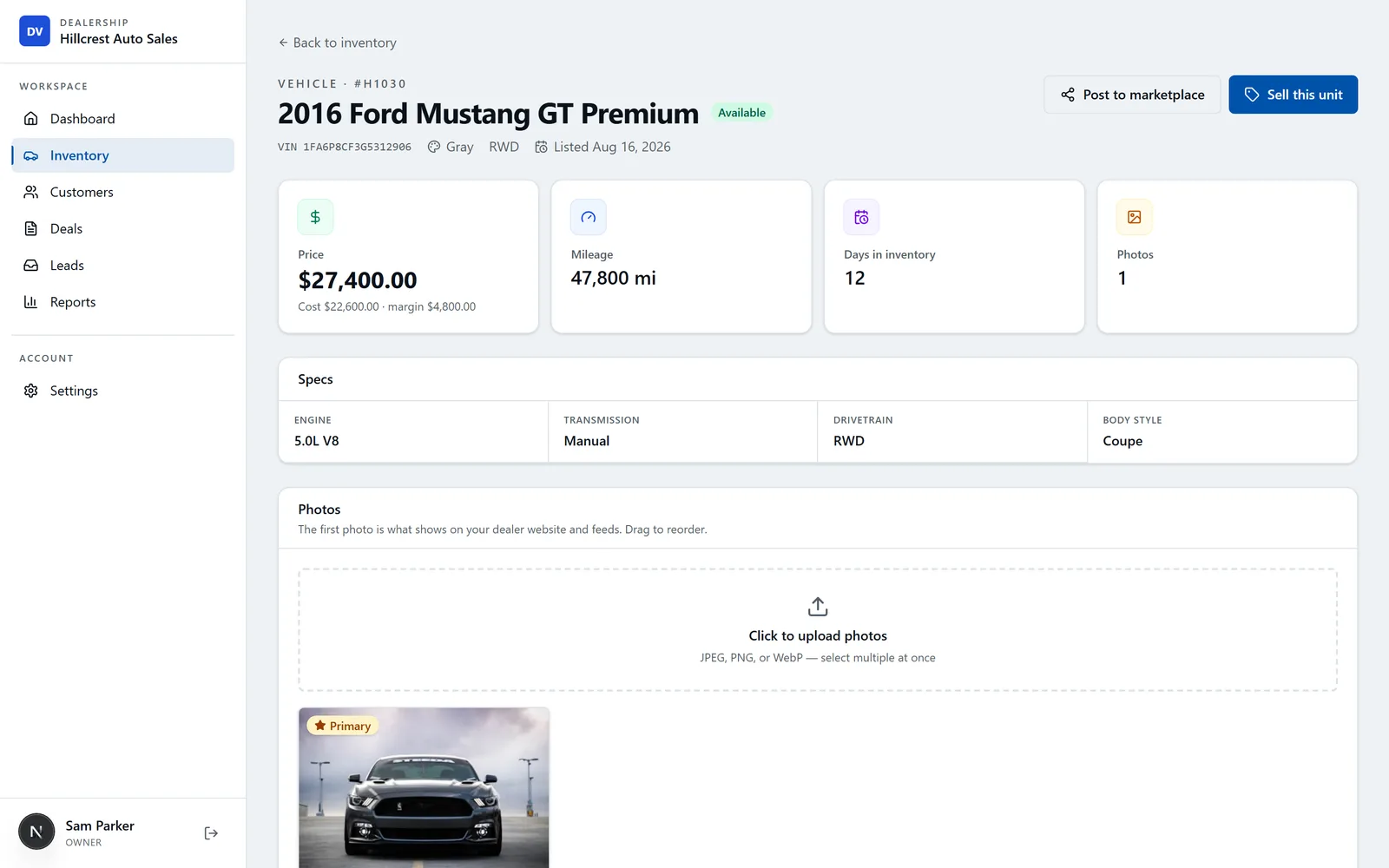
That's the reason I built recon tracking into DealerVLO the way it is: every recon cost is logged against the car, line by line, and rolls straight into that car's all-in cost and margin. The vehicle page shows cost, margin, and days on the lot next to the specs, so the real number is sitting there before you set a price, not after the car's gone.
If you want to run one car right now, the free calculator below takes cost, recon, transport, days held, and sale price and shows the real gross and margin.
Punch in cost, recon, holding days, and sale price to see your true net gross and margin.
Open the Profit Margin CalculatorMargin vs. markup: the mistake that underprices your cars
Markup and margin describe the same dollars, divided by different numbers:
- Markup = profit ÷ cost
- Margin = profit ÷ sale price
On a car that cost you $10,000 all-in and sold for $12,500, the $2,500 is a 25% markup but only a 20% margin. The conversion is fixed math: margin = markup ÷ (1 + markup).
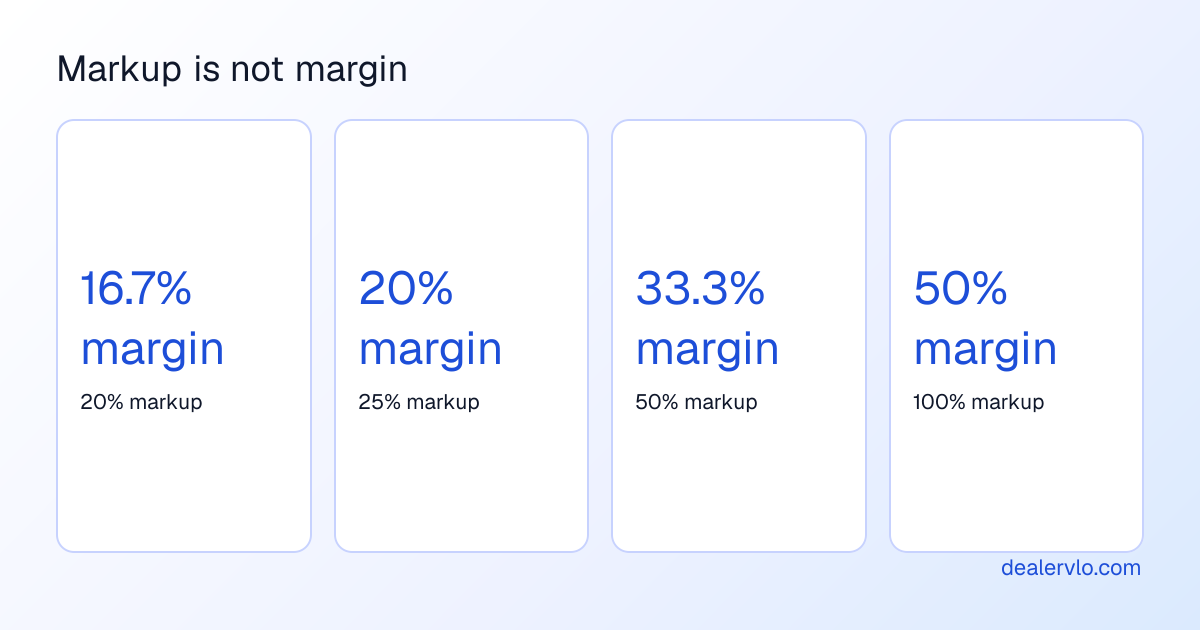
Why it matters: when a dealer says "I want 15% on this car" and then adds 15% to the cost, they didn't get 15%. Take the example car above, $11,850 all-in:
- Adding 15% to cost: $11,850 × 1.15 = $13,627.50. The margin on that price is about 13%.
- Pricing to a 15% margin: $11,850 ÷ (1 − 0.15) ≈ $13,941.
That's roughly $314 a car left on the table, before anyone negotiates. Across a year of sales, the math error alone can add up to real money.
So pick one and stick with it. I think in margin, because every other number I care about (overhead, net profit, what's left after the deal) is measured against revenue, not cost.
14-day free trial, then $29/mo · Cancel anytime
What profit margin does your lot actually need?
Search for "average used car dealer profit margin" and you'll find numbers all over the map. A lot of them mix franchise stores, new-car departments, and F&I income into one figure. None of them know your rent.
A better question: what margin does each car need to carry for your lot to make money? Work it backwards from your own overhead.
Say, as an example, your lot runs $12,000 a month in overhead (rent, payroll including your own pay, insurance, advertising, software, utilities) and you sell 10 cars a month. That's $1,200 of gross every car has to earn just to break even. On a $14,000 car, that's a margin of about 8.6% before you make any profit at all.
Now look back at the example car: after 35 days on the lot, it earned about 8%. On paper it was a 29% deal. In reality, on this lot's numbers, it lost money once overhead came out. (One thing to avoid when you run this yourself: if floor-plan interest is already in your per-car holding cost, don't count it again in overhead.)
This is the same gross-vs-net gap I walk through in is your lot actually profitable?. Margin per car is the front half of that story; the P&L is the back half.
In DealerVLO, overhead is recorded as one-time or recurring monthly expenses, and the P&L shows gross profit minus that overhead. The sales report shows front- and back-end gross on every deal, so the break-even-per-car number stops being a guess.
Where does used car margin leak?
In my experience, it's rarely one big mistake. It's six small ones:
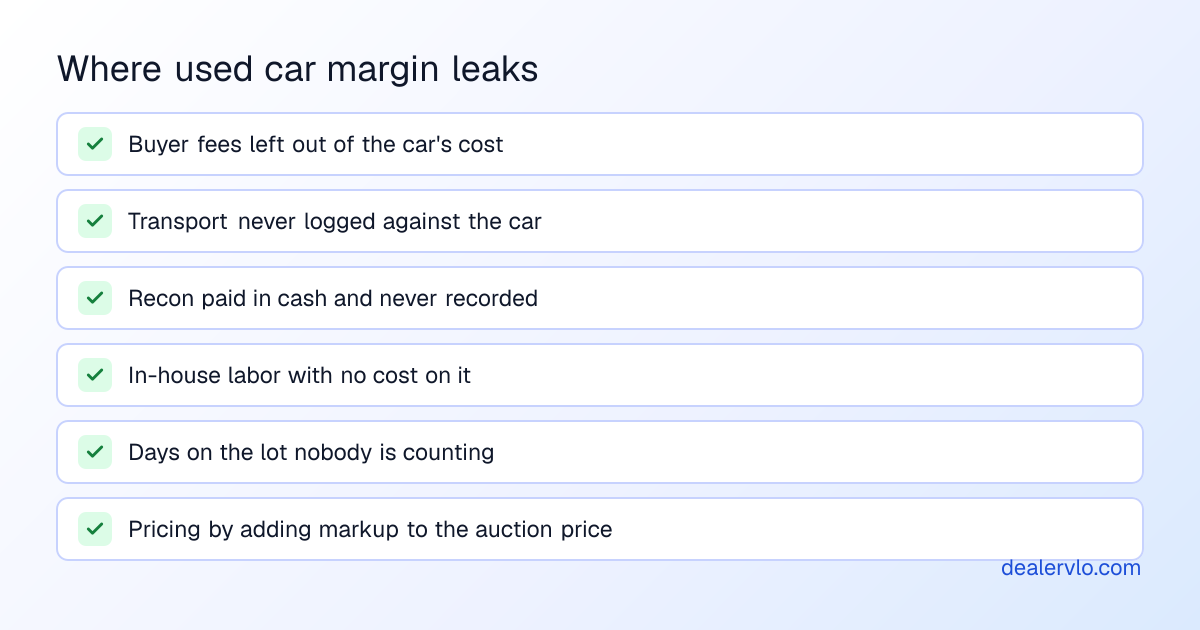
- Buyer fees and transport get treated as "the cost of doing business" instead of the cost of that car.
- Recon paid in cash never gets written down, so it never reaches the car's cost.
- In-house labor feels free. It isn't: your tech's hours are paid for either way.
- Days on the lot are the silent one. Every week a car sits takes a bite out of the margin you priced it at. DealerVLO shows days in inventory on every car, flags units at 60+ days with "aging, consider repricing", and has an inventory aging report bucketed 0–30, 31–60, 61–90, and 90+ days. It doesn't reprice anything for you; the call stays yours.
- Pricing off the auction price instead of all-in cost starts every car too thin.
- Mixing markup and margin, as above.
How to raise your margin without raising your prices
Most of the margin you can win back is on the cost side and the clock, not the sticker:
- Buy with the all-in cost in mind. Before you bid, add the buyer fee, transport, and your honest recon estimate to the number, and bid off that. How dealers make money at car auctions covers setting your max bid.
- Log every recon dollar against the car. You can't manage a cost you only see at month end.
- Price to the market, then check the margin. DealerVLO's AI price suggestion shows a price range from live comparable listings plus a target price for selling in about 30 days. Check that number against the car's all-in cost before you list it, so you know the market price still leaves you margin.
- Turn faster. Holding cost is the part of margin that grows every day. A car that sells in 20 days instead of 50 keeps the difference.
- Track F&I separately. It's real gross, but judge the car on its front end so a good back end doesn't hide a bad buy. How used-car dealerships make money covers how the front and back end fit together.
14-day free trial, then $29/mo · Cancel anytime
Frequently asked questions
What is a good profit margin for a used car dealer?
There's no single number that holds for every lot, and the figures you'll find online disagree widely, often because they mix franchise stores, new cars, and back-end income together. The useful number is the margin your lot needs: take a month of overhead, divide it by the cars you sell in a month, and that's the gross each car has to carry before you make a dime. Price above that, on your real all-in cost, and track what each car actually earns.
What's the difference between margin and markup on a used car?
Markup is profit divided by what the car cost you. Margin is profit divided by what you sold it for. On a car that cost $10,000 all-in and sold for $12,500, the $2,500 profit is a 25% markup but a 20% margin. Margin is always the smaller number, and mixing the two up is how dealers price cars thinner than they meant to.
How do you calculate profit margin on a used car?
Add up the car's all-in cost: purchase price, auction buyer fee, transport, every recon line, and the holding cost for the days it sat. Subtract that from the sale price to get the real gross. Divide the gross by the sale price and multiply by 100. That's your margin. If you only subtract the auction price, you're calculating a paper margin that leaves out most of what the car cost you.
Should F&I income count in a used car's margin?
Track it, but keep it separate. Front-end margin (sale price against all-in cost) tells you whether you bought and priced the car right. Back-end F&I gross is real money, but it depends on the buyer, not the car, so folding it in can hide a car you overpaid for. Look at both: front-end per car, and total gross per deal.
Why is my real margin lower than I thought?
Usually because costs never made it into the math. The most common misses are the auction buyer fee, transport, recon lines paid out of petty cash or done in-house without a cost, and the holding cost of the days the car sat. Each one is small; together they can cut a car's real margin roughly in half.
Bottom line
Your profit margin is whatever is left after the car's whole cost, divided by what you sold it for. Not sticker minus hammer, and not a markup on cost. Work out the margin your overhead needs, price every car to clear it on its all-in cost, and watch the days, because the clock is the cost that keeps growing after you've priced the car.
DealerVLO keeps that math on every car for you: recon logged line by line, all-in cost and margin on the vehicle page, days on the lot, and front- and back-end gross on every deal, for a flat $29 a month with unlimited users. Start your free 14-day trial and put your next car through it.