5 Cars That Penciled at Last Week's Auction — and How to Spot Your Own
Five real cars from last week's Lynnway sale that penciled for an independent lot — the buy price, the read, and the value signals so you can spot your own. Retail figures are estimates.
You make your money on the buy. Everybody says it; fewer live it. So I went through last week's Lynnway run sheet — 467 cars — and pulled the five that penciled hardest for a small independent lot: models people actually want, clean-enough grades, miles low for the age, all hammered well under what they retail for around here.
Two honesty notes before the cars. I don't have MMR on these, so the retail figures below are my estimates — ranges, before recon, and your market will move them. And the "spread" between the buy and retail isn't guaranteed profit; it's the room you have for reconditioning and gross. With that said, here's the read on each, and the signals so you can spot your own next week.
What makes a car pencil in the lane
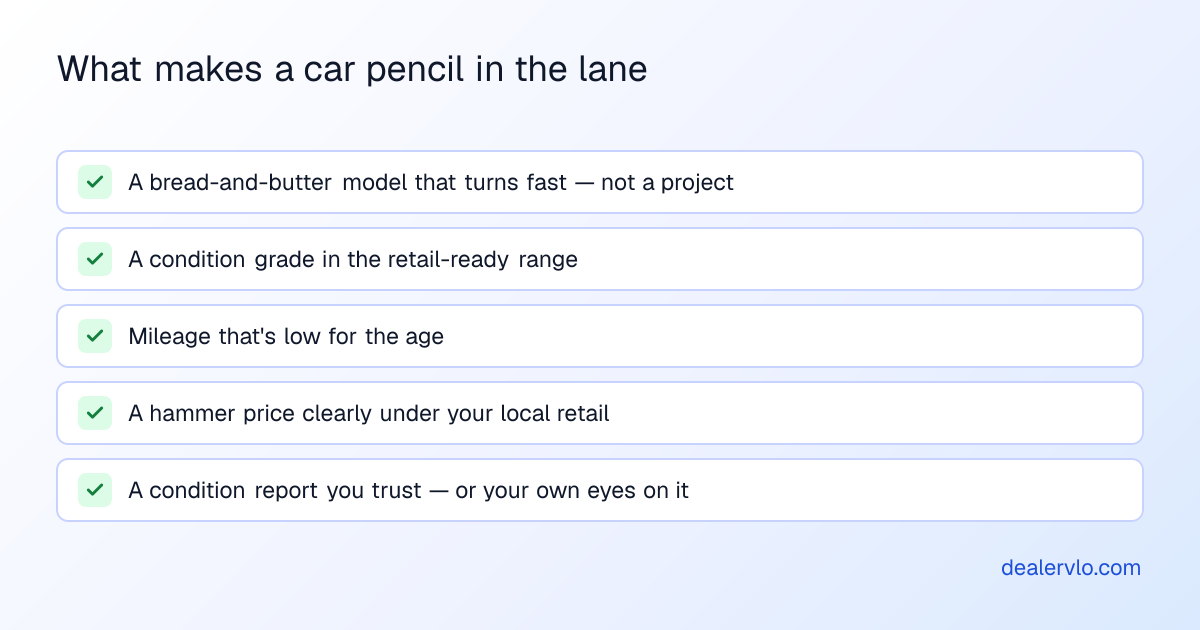
None of this is complicated, which is exactly why dealers talk themselves out of it. A car pencils when four things line up: it's a model people want (bread-and-butter demand, not a project you fell in love with), the grade says retail-ready, the miles are low for the age, and the price is under your local retail. Miss one and the math gets shaky; hit all four and you're just doing arithmetic. Same discipline that makes you money on the buy is what keeps you off the list of auction mistakes that quietly kill gross.
Reading the condition grade
Every car runs with a condition grade — roughly a 0-to-5 read on how clean it is. It guides your bid; it doesn't replace walking the car.
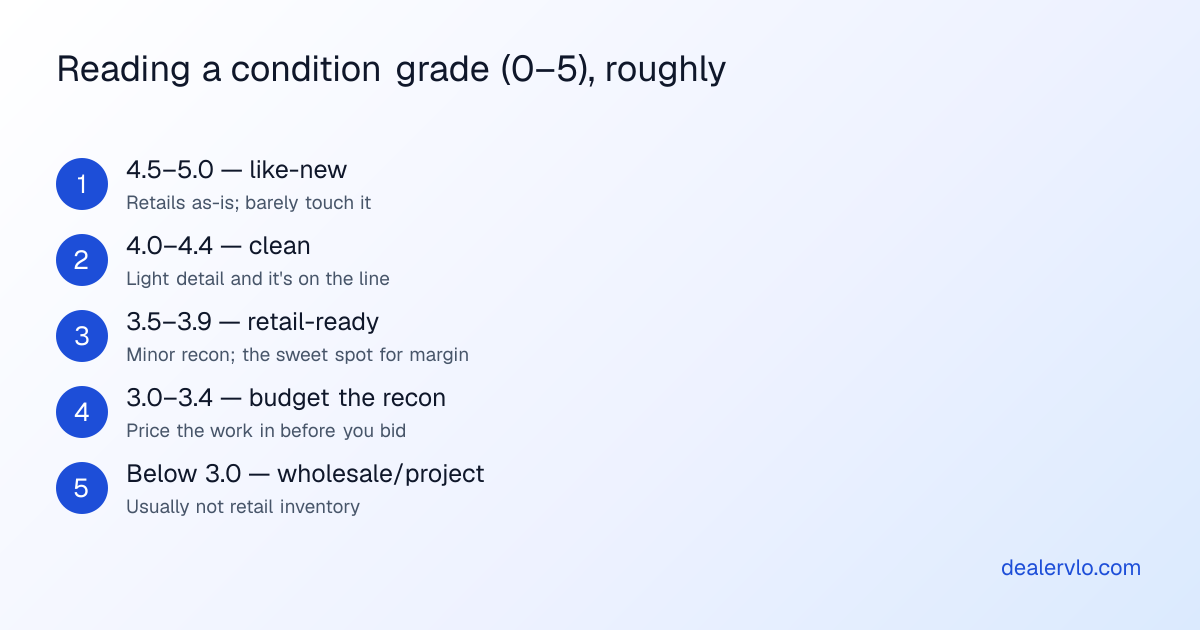
The sweet spot for a lot that needs margin and turn is the 3.5–4.4 band — clean enough to retail with light recon, cheap enough that the grade scared off the guy bidding only on 4.5s. Four of the five below live right there.
Work out the most you can bid at the lane and still hit your target margin.
Open the Auction Profit CalculatorThe five buys
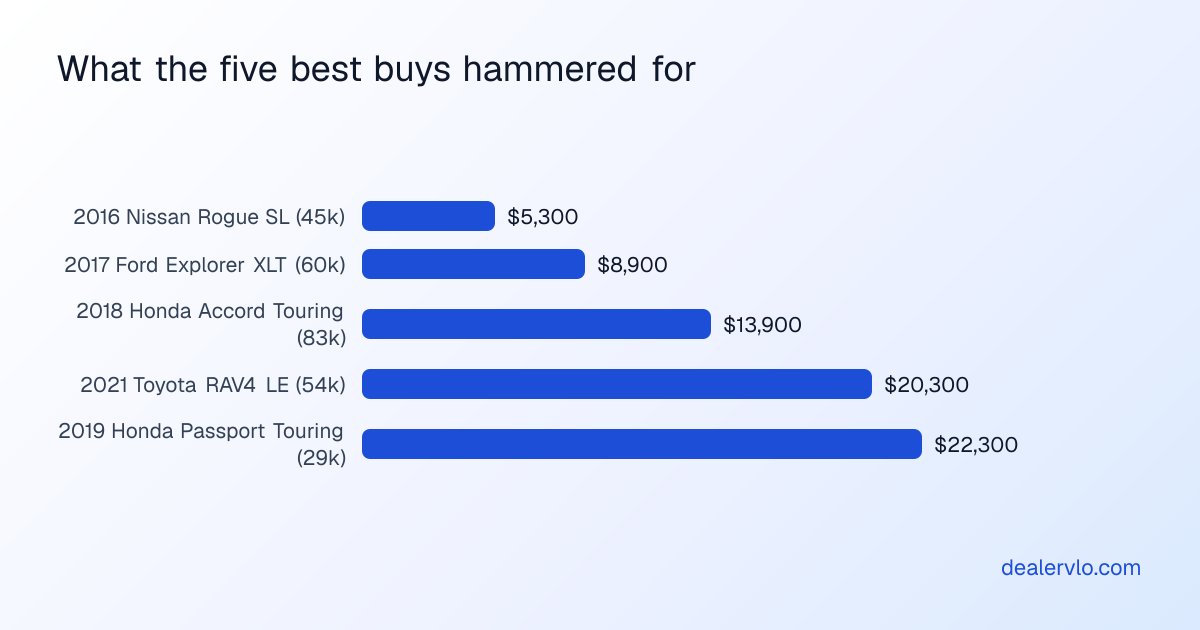
1. 2016 Nissan Rogue SL — Run C-0057 · 45k mi · grade 3.6 · hammered $5,300
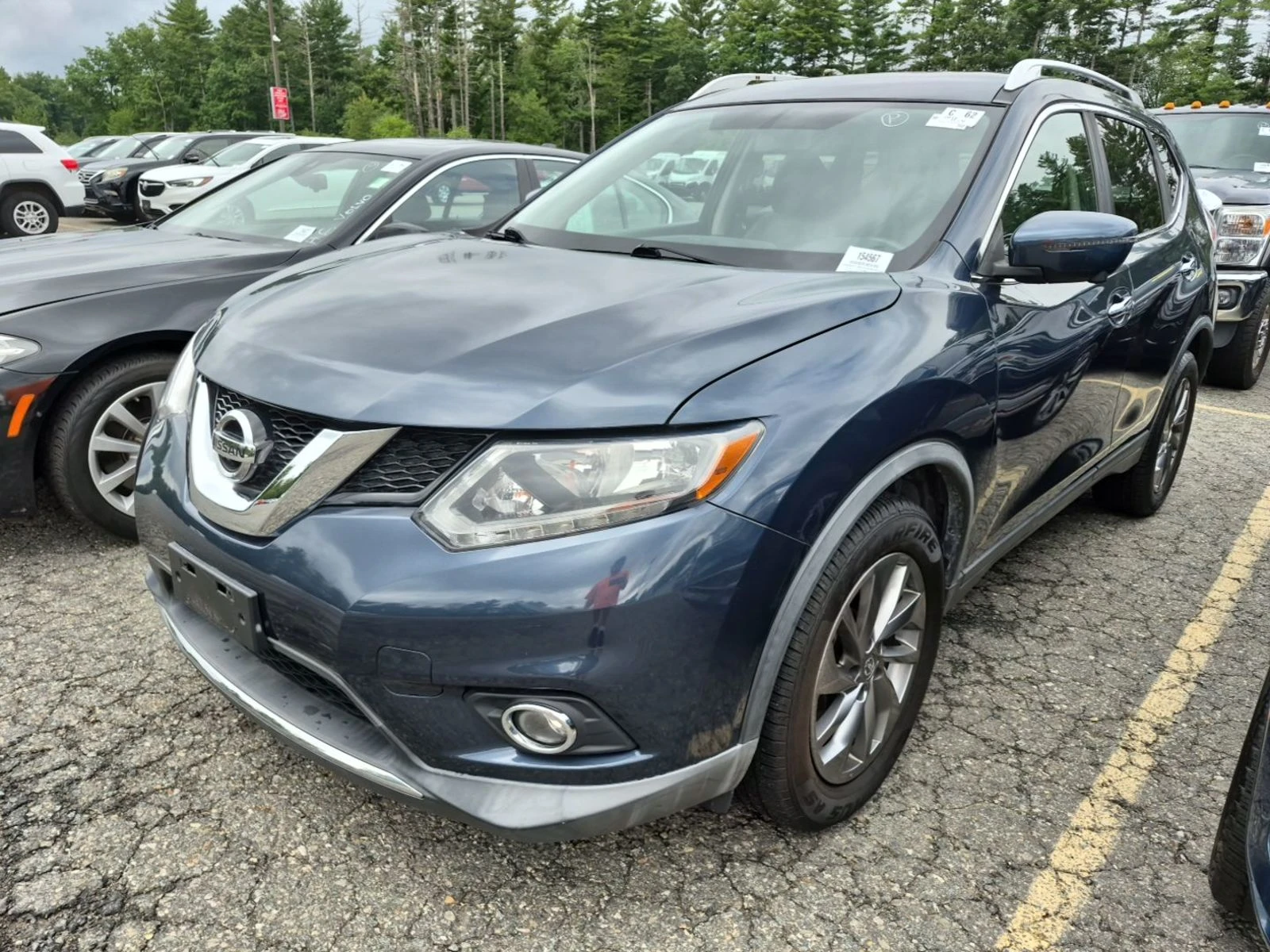
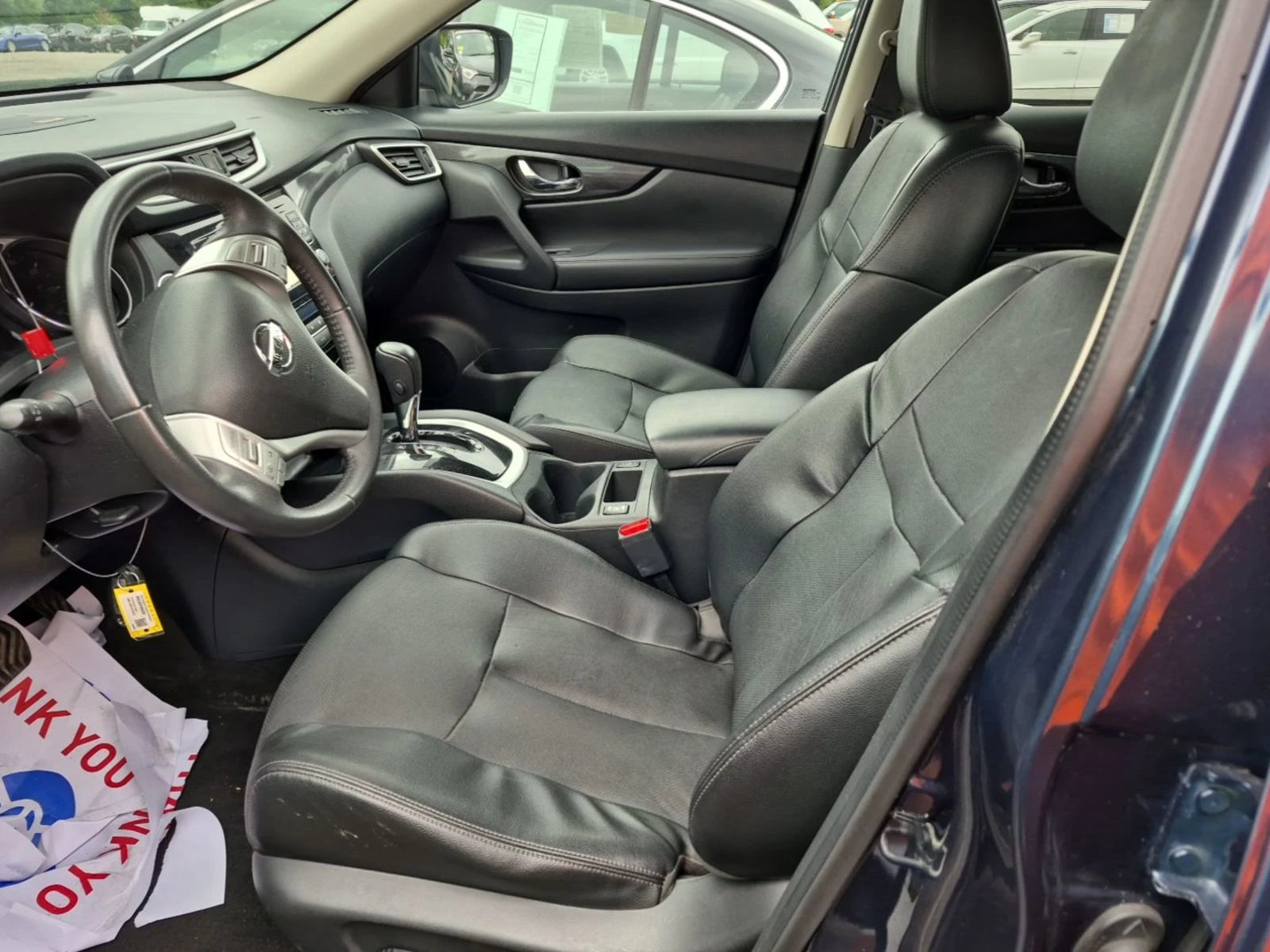
The read: 45,000 miles on a nine-year-old top-trim Rogue is the whole story — SL means leather, the works, AWD — and it hammered at $5,300, roughly 40% of what a clean one retails for around here (est. ~$11–13k independent, before recon). That's not a margin play, it's a mispriced clock: a compact SUV in this shape turns in days. The relative spread here is the widest in the group.
2. 2017 Ford Explorer XLT — Run C-0062 · 60k mi · grade 3.7 · hammered $8,900
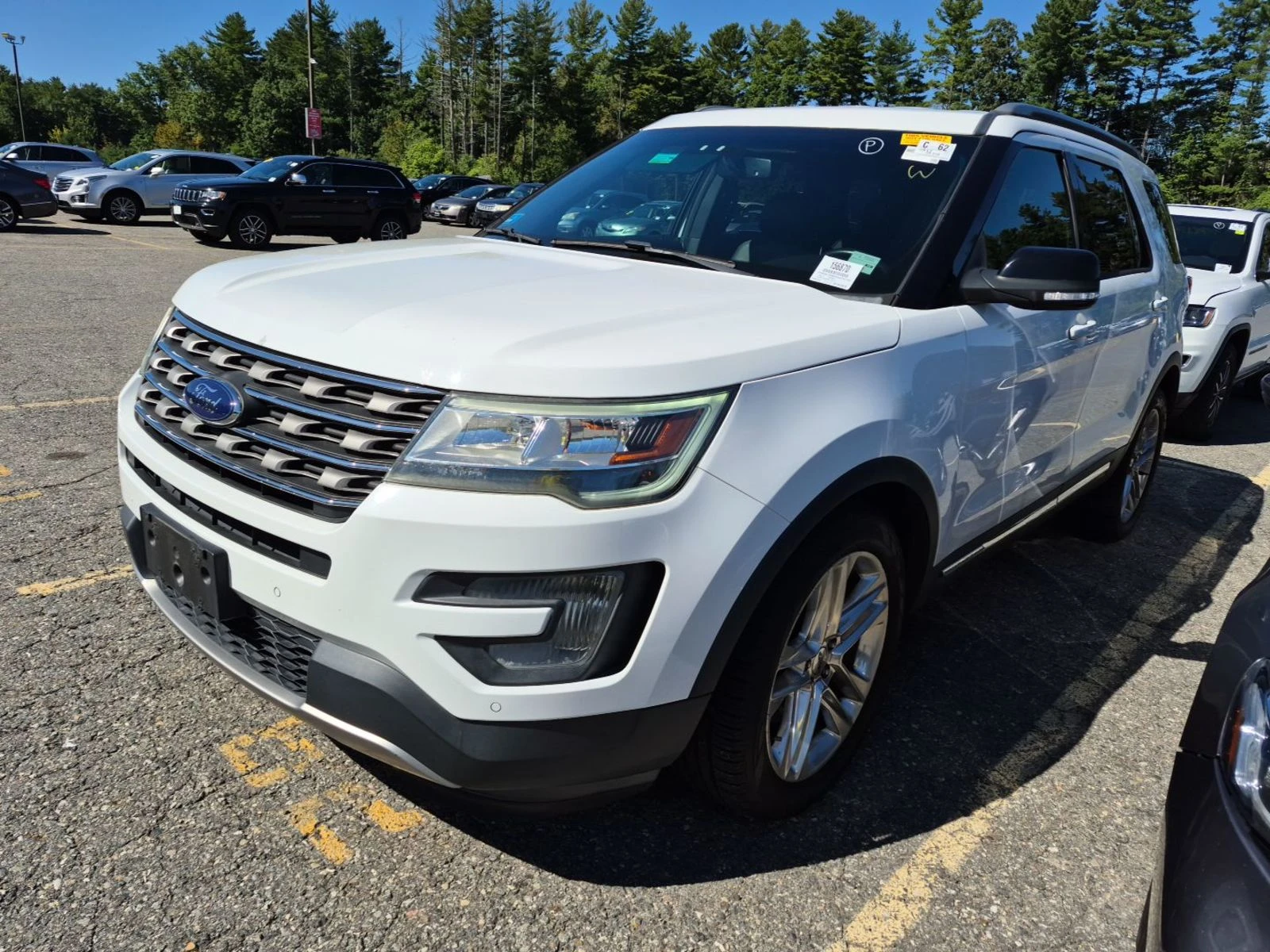
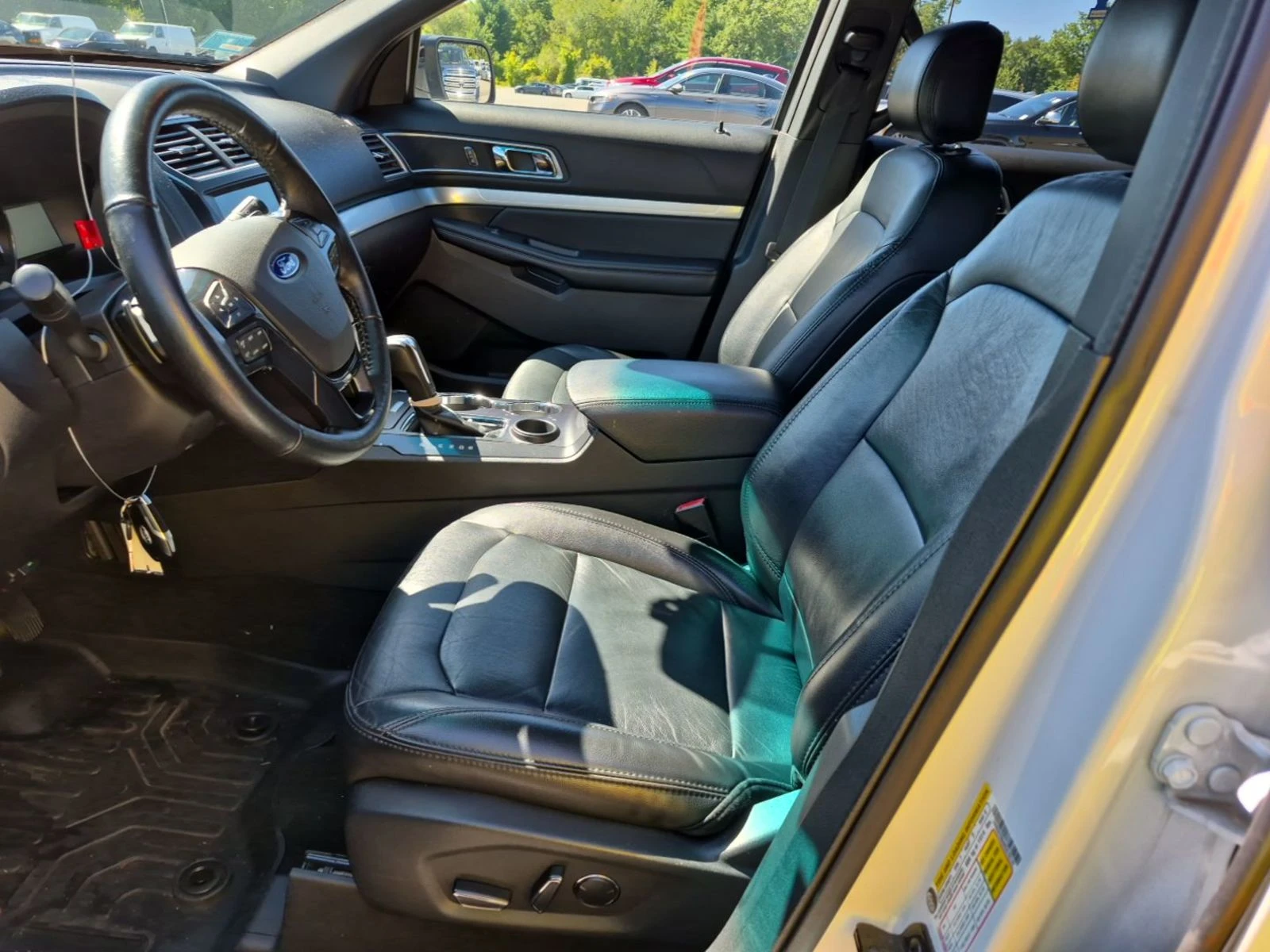
The read: a 60k-mile three-row family SUV, XLT trim, clean white over black. Est. retail ~$15–18k, bought at $8,900 — one of the widest honest spreads in the whole sale. The Explorer is the SUV a small lot can't keep on the line; a family walks on, sits three rows of kids in it, and you've sold it. Low miles for a '17 seals it.
3. 2018 Honda Accord Touring 1.5T — Run C-0060 · 83k mi · grade 3.7 · hammered $13,900
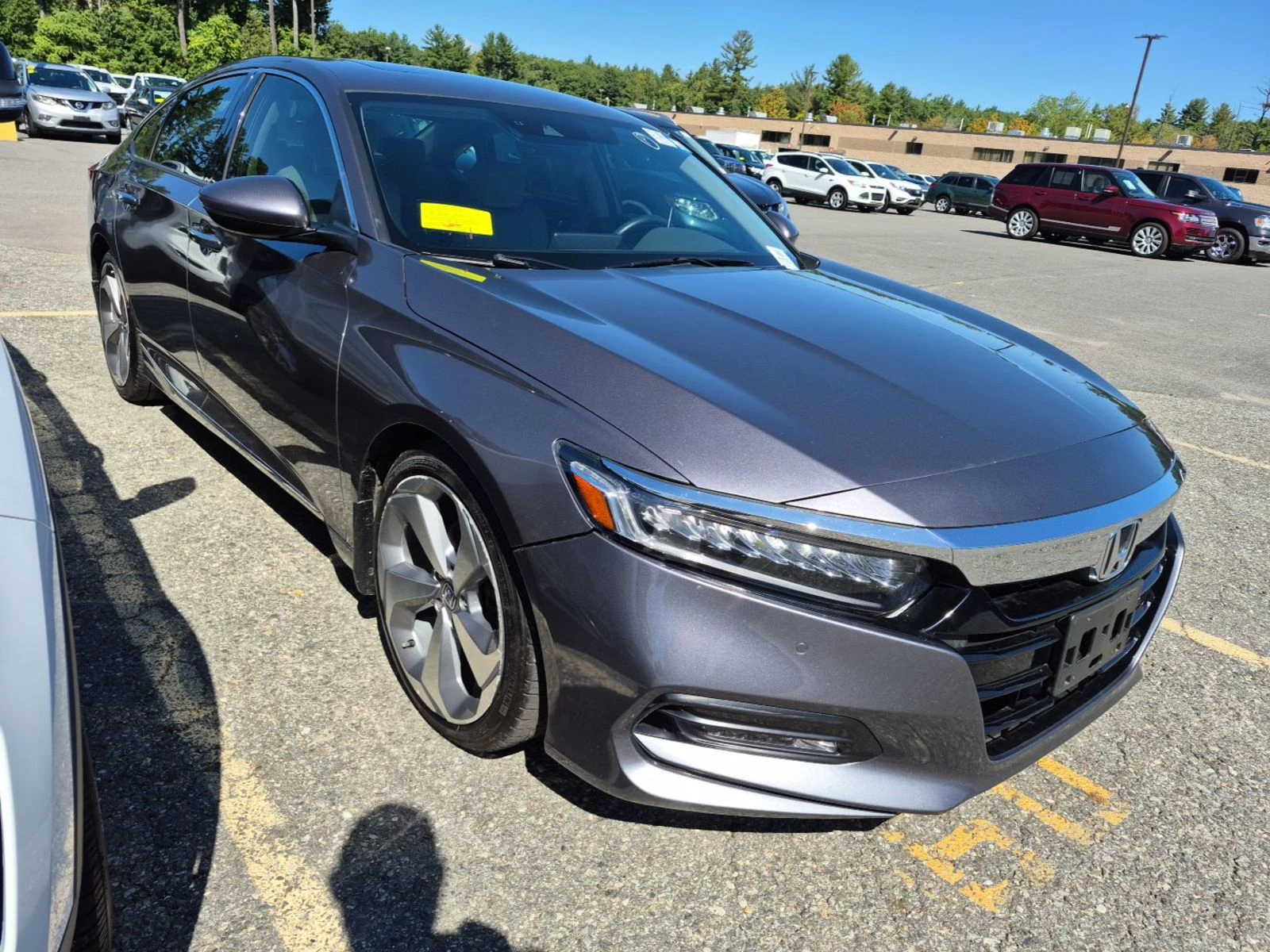
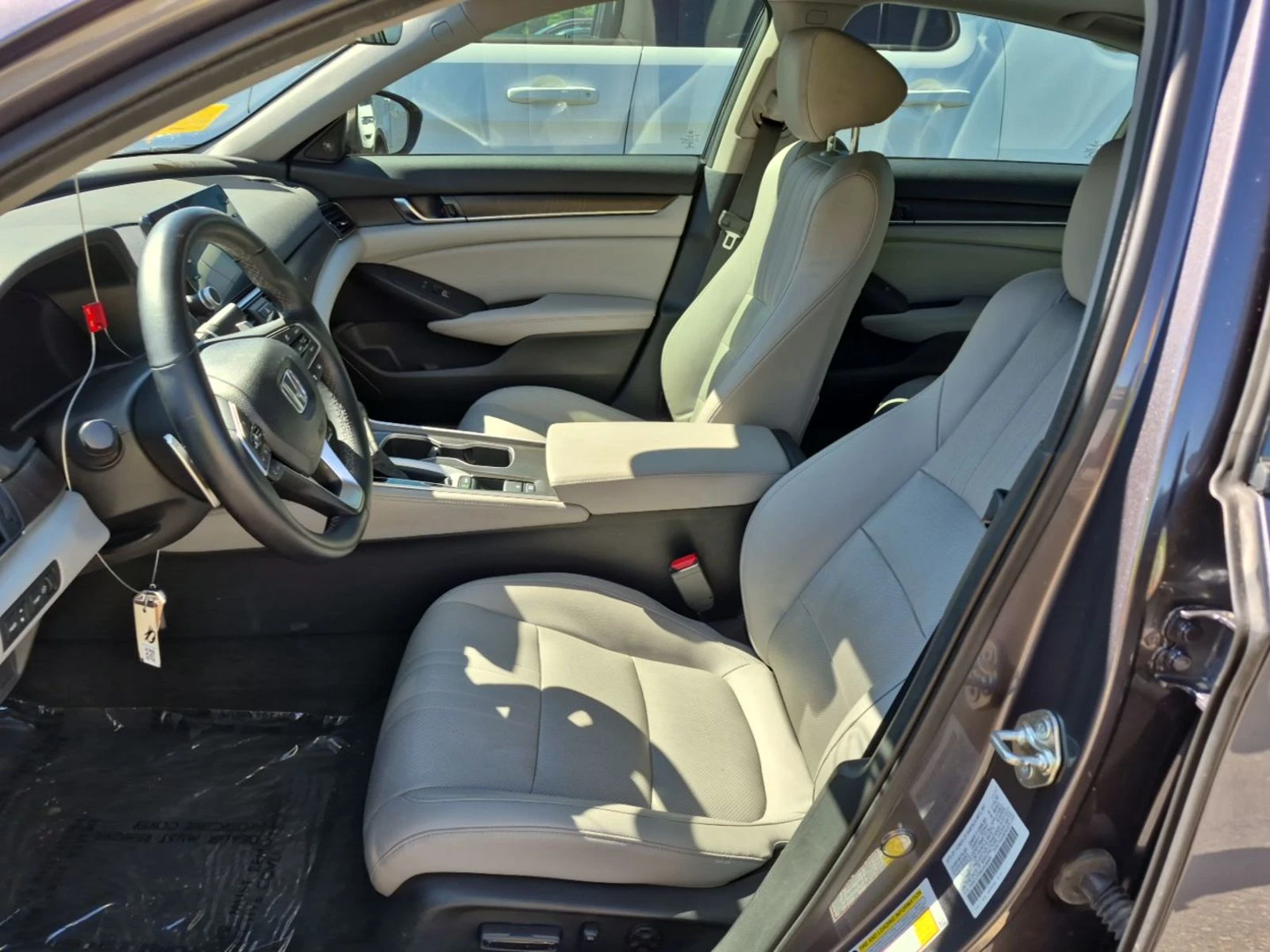
The read: this is the top Accord — Touring means leather, head-up display, adaptive cruise, the whole book — in that sharp current-gen body. 83k is fair for an '18, and the nameplate sells itself. Est. retail ~$18–21k against a $13,900 buy leaves genuine room. A loaded Accord in gray is the definition of an easy retail unit.
4. 2019 Honda Passport Touring — Run G-0049 · 29k mi · grade 4.1 · hammered $22,300
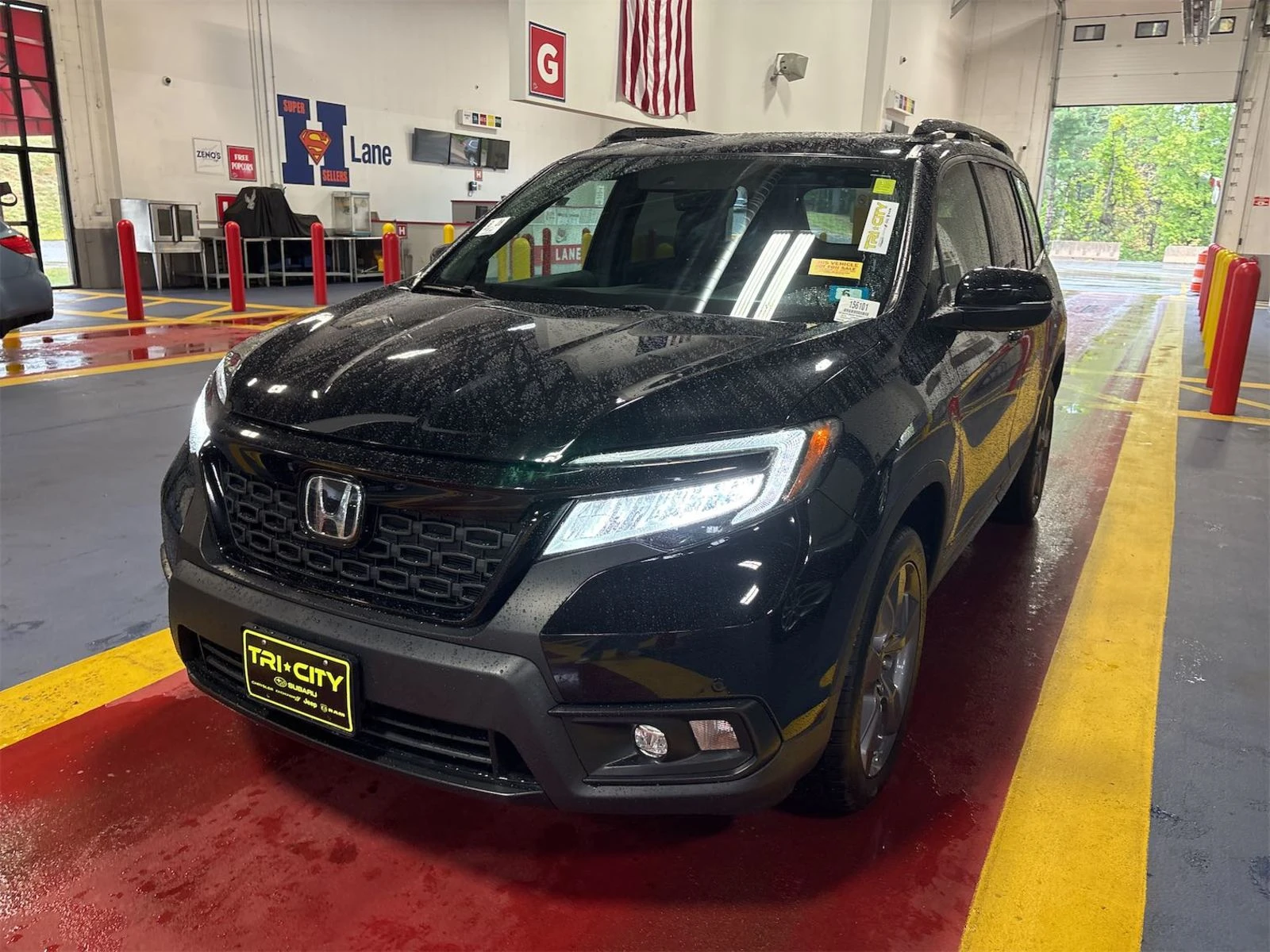
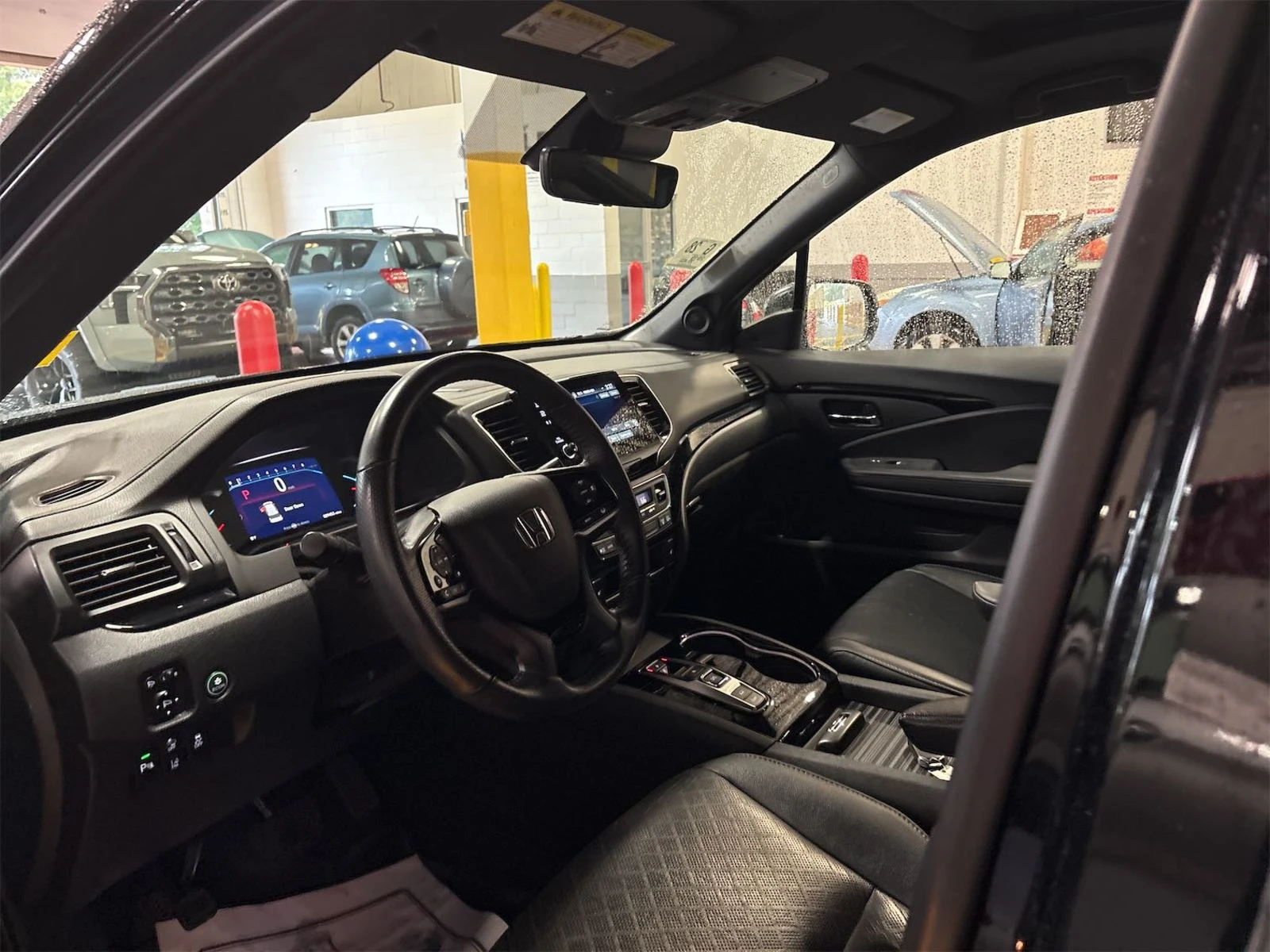
The read: the condition standout — 29,000 miles, grade 4.1, basically like-new inside and out. Passports hold value hard (est. retail ~$27–31k), and this one needs almost nothing before it's on the line. It's the highest buy-in of the five at $22,300, but a low-miles premium Honda SUV is the unit that sells the lot, not just itself — the car that pulls a shopper onto your website and makes them trust the rest of your inventory.
5. 2021 Toyota RAV4 LE — Run H-0028 · 54k mi · grade 3.5 · hammered $20,300
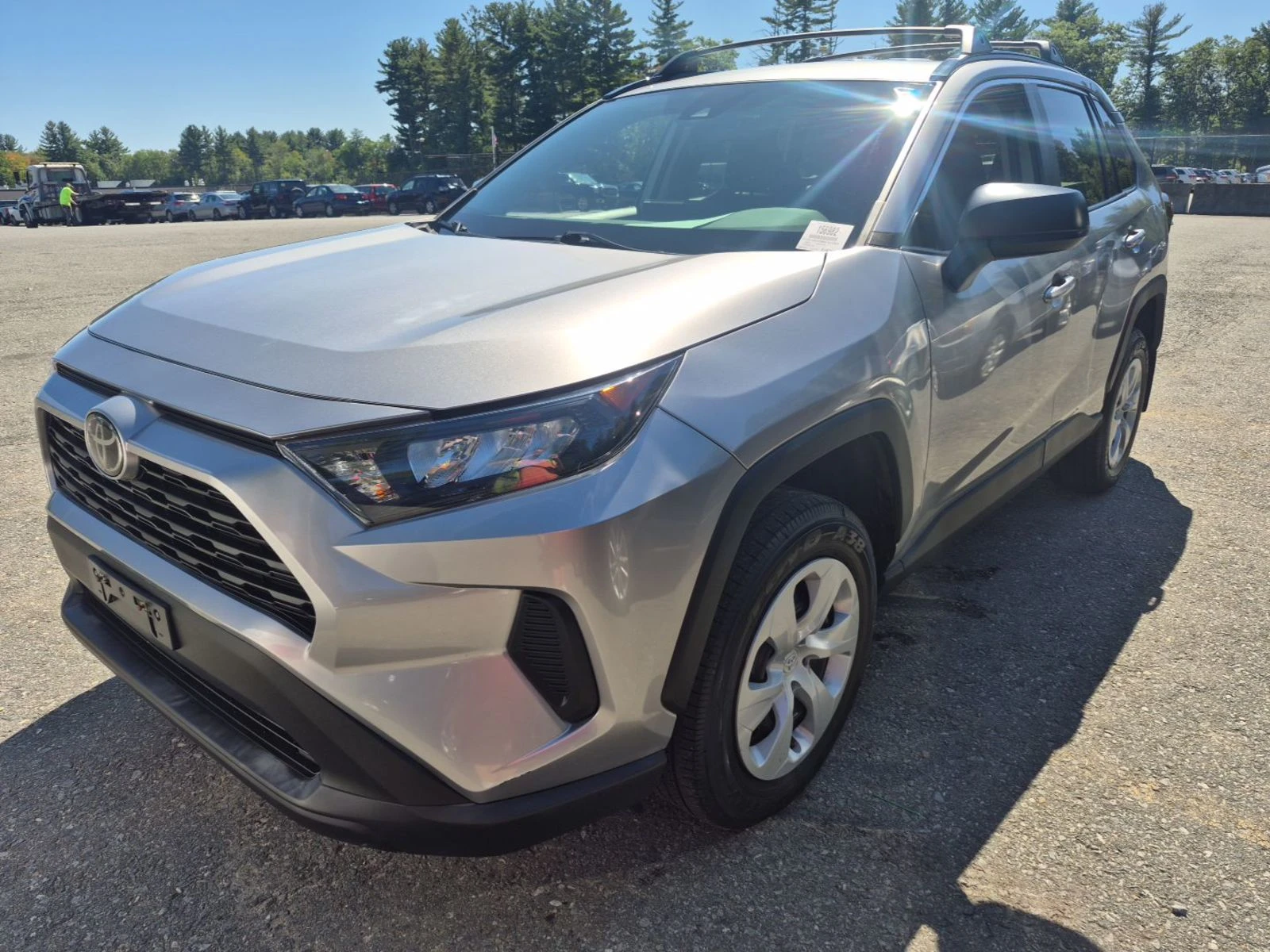
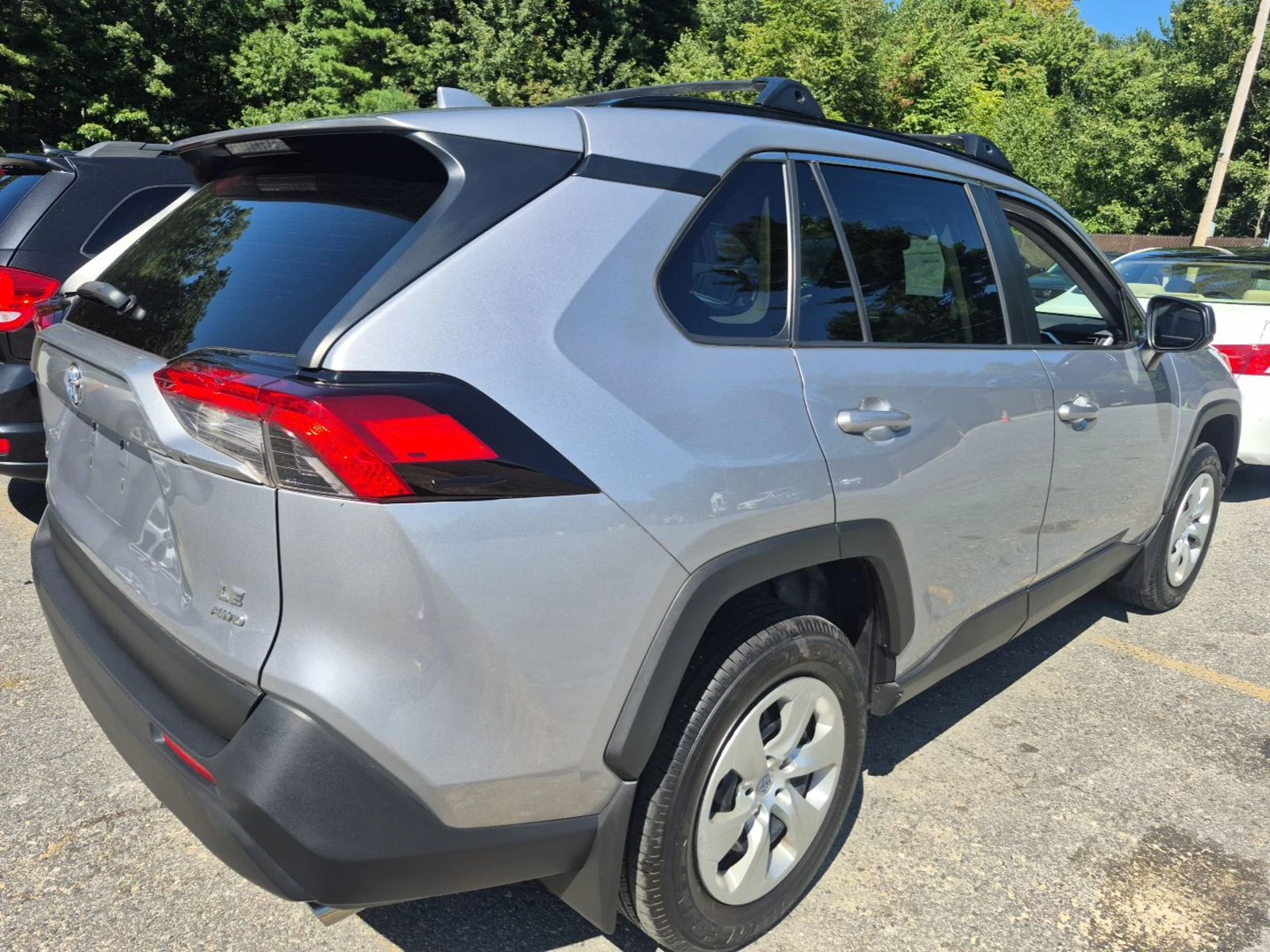
The read: the turn-speed play. The margin's tighter here (est. retail ~$24–27k against a $20,300 buy), but the RAV4 is the fastest-selling used vehicle in America — you don't carry a clean RAV4, you flip it. Speed is the profit. Base LE, AWD, silver: the exact bread-and-butter spec that a New England buyer walks on and drives off. If your days-to-turn is tight, a car like this earns more per month on the lot than a fatter-margin unit that sits.
What the five had in common
Here's the part worth internalizing: none of these penciled because it was cheap. The $22,300 Passport penciled as hard as the $5,300 Rogue. They shared the same four things — a model people want, a grade that means retail-ready, miles low for the age, and a price under local retail.
That's the read whether you're spending $5k or $22k, and it's the same discipline behind buying cars that sell fast and knowing what to stock in the first place. The lane doesn't reward the biggest bankroll — it rewards the dealer who did the math before the gavel dropped.
Frequently asked questions
How do you find good deals at a dealer auction?
Hunt for a mismatch: a car people want, in retail-ready condition, at a hammer price under your local retail. The cheapest car in the lane is rarely the best buy — the clean one nobody else did the math on is.
What is a condition grade?
A rough 0-to-5 read on condition. 4.5–5.0 retails as-is, 3.5–4.4 is retail-ready with light recon, 3.0–3.4 means budget the work before you bid, and below 3.0 is usually wholesale or a project.
How much can you make flipping an auction car?
It depends on recon, your days-to-turn, and your market — no honest fixed number exists. Think in terms of the spread between all-in cost and realistic retail: that's your room for recon and gross, not guaranteed profit.
What flips the fastest?
Bread-and-butter compact and midsize SUVs, reliable sedans, and popular trucks — the units everyone in your market is already shopping.
Cheapest car or cleanest?
The cleanest one that still pencils. A higher grade at a fair price beats a low grade at a cheap price for a lot that needs to turn and hold margin.
Bottom line
The buy is where the gross is made — but only if you know each unit's true cost when you price it: buy price, floor-plan carry, recon, all of it. Miss that and a great buy quietly turns into an average deal. And buying right only pays if you price right on the way out — the same read on the way in as on the way out.
That's the whole loop DealerVLO is built to close: itemized cost per car flowing into your deal gross, a live-comp price suggestion on the way out, and the paperwork filled from the deal. Enter the car once and know exactly what it cost you and what it should bring. It's $29/month flat, unlimited users, with a free 14-day trial a card starts, no charge until day 14. Read the lane, do the math, and let the software keep the score.