Buying a Car at Auction With No Keys: What a Missing Key Costs a Dealer
Auction policies rarely guarantee keys. How to read the key count, why a missing key is usually your cost, and how to build a replacement into your bid.
Part of the Buying & sourcing inventory guide: How to buy at dealer auctions without getting buried
Switching from another DMS? Compare DealerVLO to DealerCenter, Frazer, or Lot Wizard.
Assume a missing key is your cost, and build it into your bid before the car crosses the block. The arbitration rules most auctions follow don't mention keys, Copart says outright that it doesn't guarantee them, and a car with no key is also a car you couldn't start to check. Get a replacement quote by VIN, subtract it from your number, add a cushion when there's no key at all, and log the key on the car's cost.
This is for dealers buying at dealer and salvage auctions. If you bought a car at a public or government auction and need keys made for your own car, the replacement section below still applies, but the bidding math is written for a dealer who has to resell the car at a profit.
14-day free trial, then $29/mo · Cancel anytime
How a missing key shows up at the sale
Start with what the auction tells you, and read it literally. Online listings and condition reports often note whether keys are present, and a lane announcement can call out "no keys" on the block. What none of that does is promise you a working key at pickup.
Copart puts it plainly in its member terms (last revised July 9, 2026): "Copart does not guarantee that keys are available for any vehicle sold through Copart, regardless of whether keys are present in online vehicle images." In other words, a key in the photo is not a key in your hand. The written policy for America's Auto Auction Oklahoma says the same thing in fewer words: the auction "does not guarantee any warranty books or plates or keys."
So before you bid, look for three things: the key count on the condition report or listing, any announcement about keys, and your auction's own written policy. If the report is vague, treat the car as having no keys until you've counted them yourself. For the rest of what a condition report can hide, see condition report red flags.
Can you arbitrate a missing key?
Usually not, and you shouldn't price a car as if you can.
The NAAA arbitration guidelines that Manheim and many other auctions use (the version effective June 1, 2026) don't mention keys or fobs anywhere. What they do set out works against a key claim:
- An undisclosed mechanical defect on a vehicle under $50,000 has to cost $800 or more to repair before it's eligible for arbitration.
- As of 2026, vehicle accessories on model years 2022 and older aren't eligible for arbitration.
- Claim windows are short. For in-lane sales, an "A" claim is sale day only and a "B" claim is 7 calendar days; online sales have a 7-day industry minimum, and the sale day counts as day one.
ACV Auctions' arbitration policy (effective August 13, 2026) gives buyers a standard window of ten calendar days from purchase, and it doesn't mention keys either.
None of that means an auction will never help you. If the condition report said two keys or the car was announced with keys and you got none, you have a misrepresentation to raise. Do it at the gate before you leave, write it on the gate pass or release, and file it inside your auction's window. But when the report says nothing, or says no keys, the key is yours to replace. The arbitration guide covers how to file and what wins.
What a replacement actually involves
The cost and the hassle depend on what kind of key the car uses and whether you have one working key to start from.
The key types. Older cars may use a plain cut key. Many use a transponder key with a chip the car has to recognize, and many newer cars use a remote fob or a push-to-start smart key that has to be programmed to the car. The newer and more expensive the car, the more likely the key has to be programmed with the maker's security information, not just cut.
One key versus none. Having one working key makes the job easier. Consumer Reports noted in 2019 that most fobs an owner can program themselves require two current, working keys to begin with, so on a one-key car you're usually paying a professional anyway. With no working key, a professional has to make a key from scratch, and you couldn't start the car to check it before paying for that key.
Locksmith or dealer. An automotive locksmith can often come to your lot, which saves a tow. The franchise dealer may be the only option on some cars: in the same Consumer Reports piece, its analyst said European brands almost always send owners to a dealer. Before you hire a locksmith for a newer car, ask whether they're registered with the NASTF Vehicle Security Professional registry, the industry program that vets locksmiths and gives them access to automakers' vehicle security websites. A locksmith without it may not be able to get what your car needs.
What it costs. Get quotes. Call with the VIN, the key type and whether you have a working key, and ask for the total: the key or fob, cutting, programming and any trip charge. For a dated reference point only, Consumer Reports reported in 2019 that a fob could cost $50 to $400 depending on the brand, plus another $50 to $100 for programming. That was seven years ago and doesn't cover every make, so put your own quotes in the math, not that range.
Build it into your bid
A missing key is just another cost subtracted from your bid. The only difference is that a car with no key at all also needs a cushion for what you couldn't see.
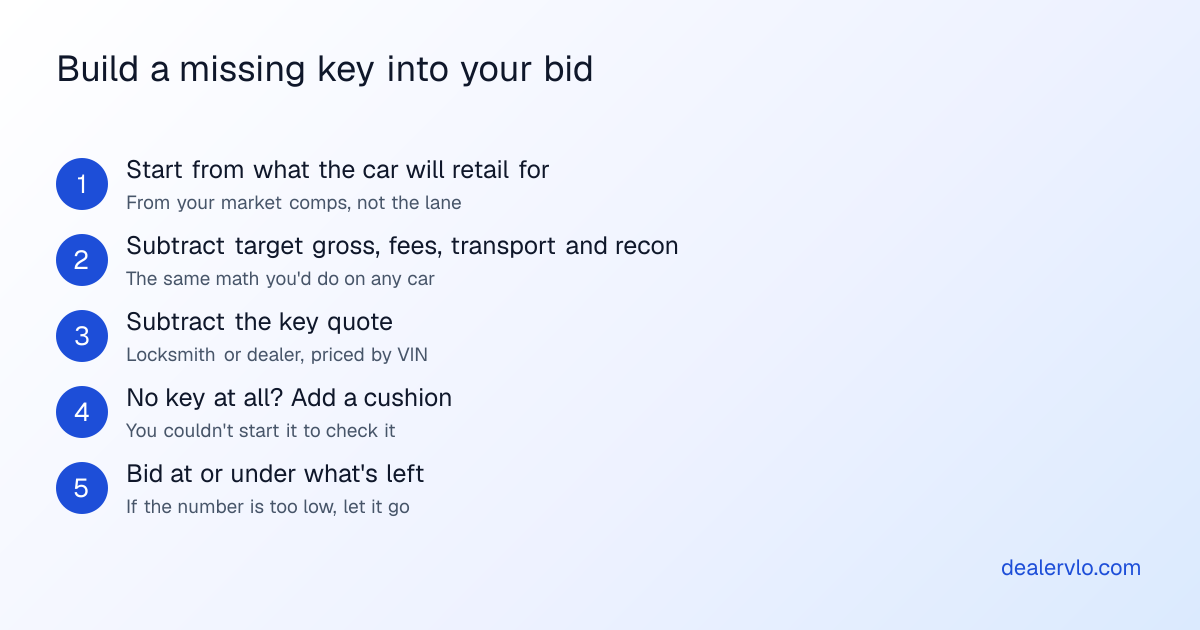
Here's one example car, with example numbers. Use your own.
- Expected retail: $14,500
- Target gross: $2,000
- Buy fee: $400
- Transport: $250
- Reconditioning: $900
With two keys, your ceiling is $14,500 − $2,000 − $400 − $250 − $900 = $10,950.
With one key, you'll want a second before the car hits the front line. Say your locksmith quotes $300 for this car. Your ceiling drops to $10,650.
With no keys, the key is a bigger job (say a $500 quote), and you also couldn't start the car to hear the engine or check the transmission. Add a cushion for that, here $500, and your ceiling is $9,950.
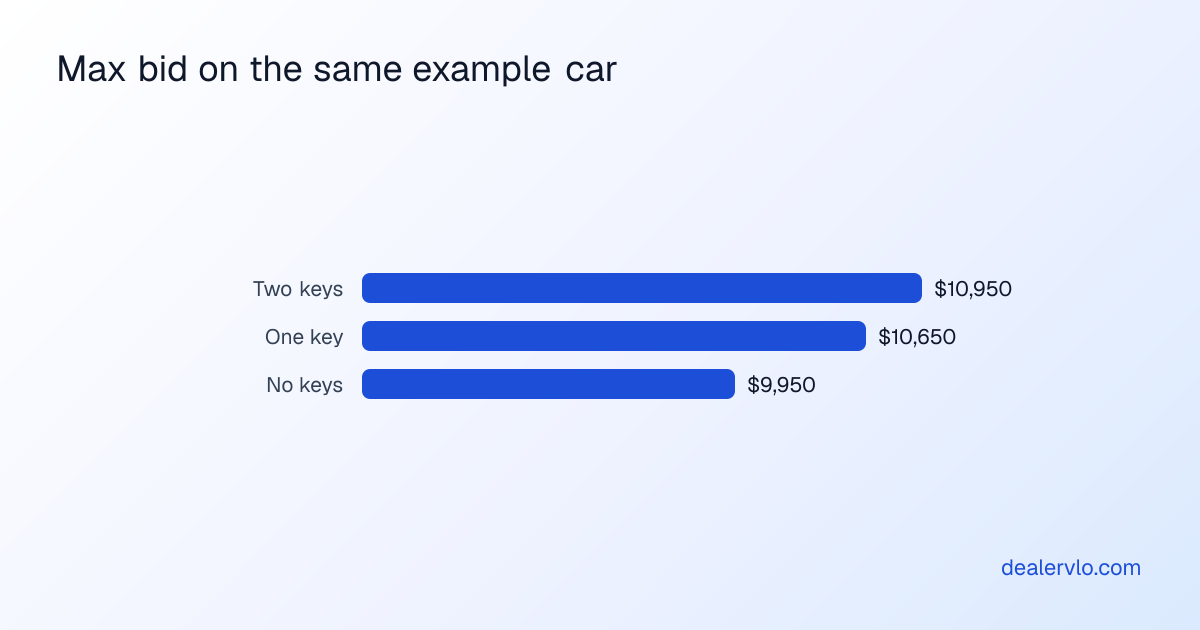
If the bidding goes past your no-key number, let the car go. Somebody else is either guessing low on the key or high on the retail.
Work out the most you can bid at the lane and still hit your target margin.
Open the Auction Profit CalculatorThe free Auction Profit Calculator takes a single reconditioning estimate, so fold the key quote into that number along with tires, detail and anything else the car needs. It works from a target margin percentage rather than a dollar gross, so expect its max bid to differ a little from the dollar example above.
One key vs. two at retail
A one-key car isn't a problem by itself. Whether to make the second key before you list it comes down to one comparison: the replacement quote against what the missing key costs you in the sale. That might be a buyer who asks for money off, a buyer who walks to a car that has both, or a slower sale while the car sits.
On a cheap car with a cheap key, make the key and remove the objection. On a car where the key quote is high and the price is low, you might sell it with one key and say so up front. Either way, tell the buyer how many keys come with the car. A buyer who finds out after the sale is a worse problem than a buyer who asked about it before.
A key routine at pickup and intake
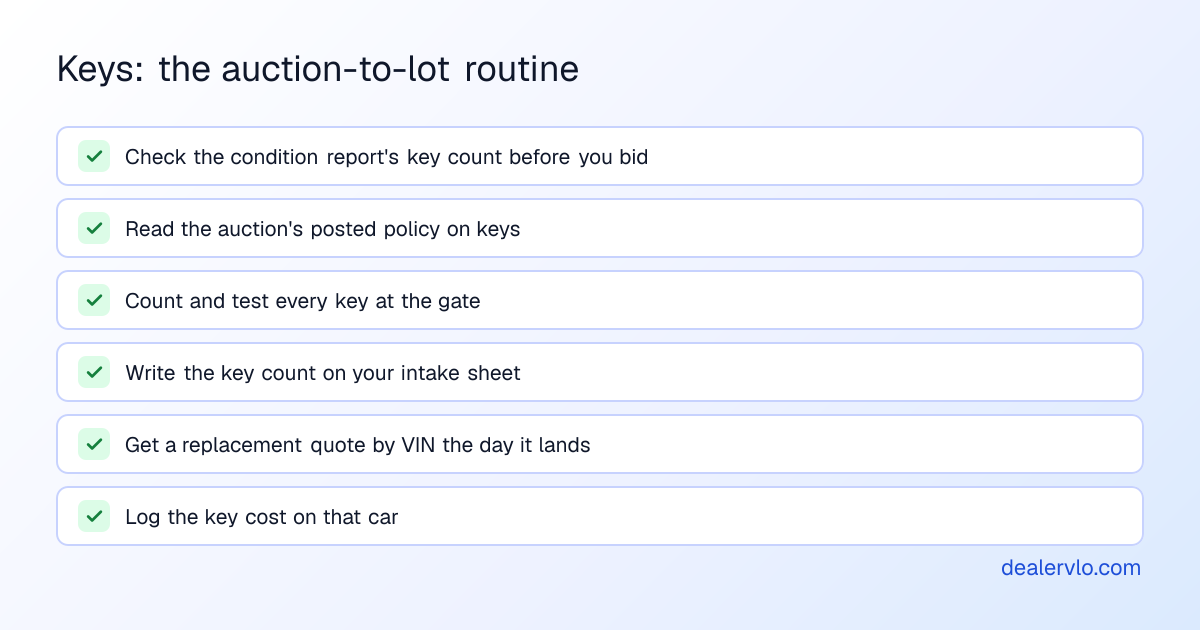
Most key problems are cheap to catch and expensive to discover later. Run the same routine on every auction car:
- Before you bid, note the key count on the condition report or listing and read the auction's posted policy.
- At the gate, count every key and fob, and test them: lock, unlock, start. If the count doesn't match what was represented, say so before you leave and get it in writing.
- At intake, write the key count on the car's intake sheet with everything else you check. The vehicle intake process has the full list.
- The day it lands, call for a replacement quote by VIN if you need one, so the key is done before the car is photographed and listed.
- On the books, log the key as a cost line on that car.
Then store the keys like the inventory they are. A key left in a car or on an open hook is how cars walk off a lot after hours; see after-hours lot security for key-control habits that hold up.
14-day free trial, then $29/mo · Cancel anytime
Where DealerVLO fits
DealerVLO doesn't connect to any auction and doesn't track keys. It won't tell you how many keys a car has or where they are; that's your intake sheet and your key box. What it does is keep the money straight once the car is yours.
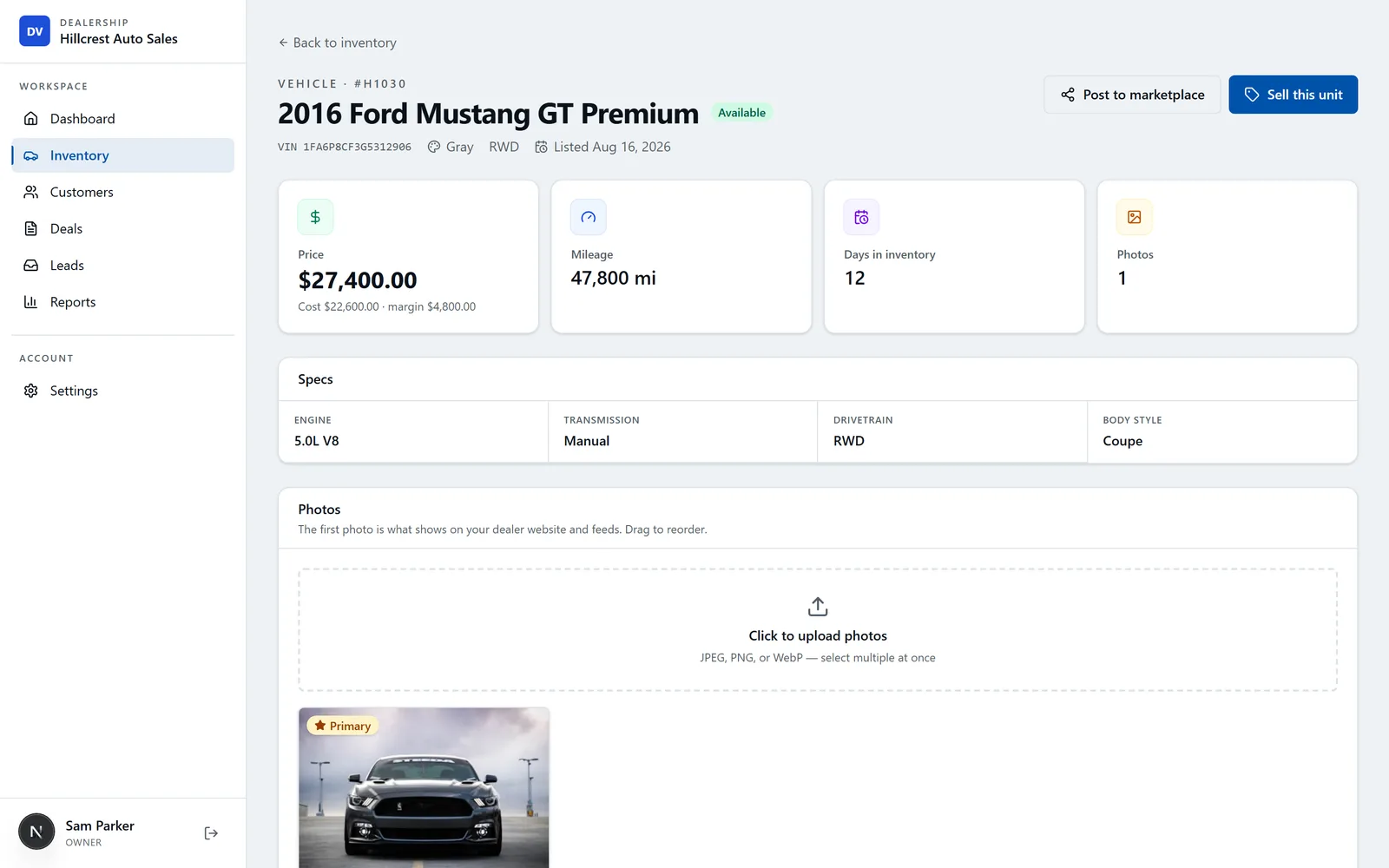
When you add the car, you enter what you paid for it, and VIN decode fills in the car's details. On a phone, "Scan VIN" reads the door-jamb barcode so you don't type the VIN at the gate. After that, every cost that belongs to the car goes on it as a cost line with a vendor, a description and an amount: the auction buy fee, transport, the history report you bought for it, its recon, and the replacement key. Those lines roll into the car's all-in cost, so the gross you see when you sell it reflects what the car actually cost, key included.
That matters because a missing key is easy to lose track of. Pay the locksmith out of petty cash and log it as a general shop expense, and the car looks $300 more profitable than it was. Log it on the car and you can see which cars carried an extra cost and whether your no-key bids are paying off.
Frequently asked questions
Can you buy a car at a dealer auction with no keys?
Yes, and plenty of dealers do. Treat the missing key as a cost you'll pay, not a problem the auction will fix: get a replacement quote by VIN before the sale if you can, subtract it from your bid, and add a cushion when there's no key at all, because a car with no key is also a car you couldn't start to check.
Can I arbitrate a car that's missing its keys?
Don't count on it. The NAAA arbitration guidelines many auctions follow (the version effective June 1, 2026) don't mention keys, Copart's member terms say it doesn't guarantee keys even when they appear in photos, and at least one America's Auto Auction location's written policy says it doesn't guarantee keys. Read your own auction's posted policy. If the condition report or the announcement promised keys and you didn't get them, raise it at the gate the same day and in writing.
How much does it cost to replace a missing key fob?
It depends on the make, the key type and who does the work, so get a quote by VIN from an automotive locksmith and the franchise dealer before you bid. For a dated reference point, Consumer Reports reported in 2019 that a fob could run $50 to $400 depending on the brand, plus $50 to $100 to program it. Prices have moved since, so use your own quotes in your math.
Should I sell a used car with only one key?
You can. Compare the cost of a second key with what the missing key will cost you in the sale: a buyer who asks for money off, a slower sale, or one more objection to answer. If the replacement quote is small next to that, make the second key before the car goes on the front line. Either way, tell the buyer how many keys come with the car.
Why does it matter whether the car has one key or none?
With one working key, a locksmith or dealer can usually add a second, and Consumer Reports noted that most fobs an owner can program themselves need two working keys to start with. With no working key, you need a professional and you can't start the car to check how it runs before you pay for the key, so your bid needs room for both the key and whatever you couldn't see.
How do I track key replacement costs on a car?
Log the key as its own cost line on that car, with the vendor (the locksmith or dealer), a description such as "second smart key, cut and programmed" and the cost. That way it lands in the car's all-in cost and the gross you see on the deal, instead of disappearing into a general shop expense.
Bottom line
A missing key is a known cost wearing a disguise. The auction's arbitration rules almost never cover it, so price it yourself: read the key count, read the policy, get a quote by VIN, and take it off your bid, with a cushion when there's no key at all because you couldn't start the car. Count keys at the gate, log the key cost on the car, and a no-key car can still be a good buy, just at a no-key price.
DealerVLO keeps every one of those costs on the car it belongs to, from the buy fee to the locksmith, so your gross per deal is real. It's $29 a month flat with unlimited users; see what's included. For the bigger list of ways auction buys go wrong, read auction buying mistakes dealers make.
14-day free trial, then $29/mo · Cancel anytime