Can a Dealer Sell a Used Car With an Open Recall? The Law, the Risk, and a Recall Workflow
Can a dealer sell a used car with an open recall? Federal law treats new and used cars differently. Where dealers get in trouble, and a recall check by VIN.
Part of the Compliance, taxes & deal paperwork guide: What goes in a used-car deal jacket: the complete checklist
Run the VINs on your lot often enough and one will come back with an open safety recall. Then the question comes up: can a dealer sell a used car with an open recall, or does that car have to sit until a franchise store fixes it? Nearly every search result is written for the buyer.
This is the dealer-side answer: what federal law says, where dealers get in trouble, and a recall workflow for every car you buy. It's an operator's read, not legal advice; for your state, talk to your attorney or your state dealer association.
14-day free trial, then $29/mo · Cancel anytime
Can a dealer sell a used car with an open recall? The short answer
Under federal law, generally yes for used cars, and no for new ones.
The federal stop-sale rule covers new vehicles. When a manufacturer notifies a dealer about a recall on a new vehicle in the dealer's possession, the dealer may sell it only after the remedy is done. There's no matching federal rule for a used car on an independent lot.
But "legal federally" is not the same as "safe to do any way you like." State consumer-protection laws, state attorneys general, and the FTC's rules on advertising all still apply. A buyer who later learns you knew about an open recall is a complaint waiting to happen.
Used car dealer open recall law: new cars vs used cars
The rule lives in 49 U.S.C. 30120. Subsection (i) is titled "Limitation on Sale or Lease of New Vehicles or Equipment, or Rental." It applies when the manufacturer has notified a dealer about "a new motor vehicle" in the dealer's possession at the time of notification, and it also covers rental companies' fleets. Those vehicles can be sold only after the defect is remedied. Used cars on a used-car lot aren't in that language.
Congress has looked at closing the gap. The Used Car Safety Recall Repair Act, S.4053 in the 118th Congress, would have barred dealers from selling, leasing, or loaning used vehicles with open recalls to consumers. It was introduced on March 22, 2024 and referred to the Senate Commerce Committee, the last action on its record. It's a bill, not a law.
Some consumer advocates go further. The Consumers for Auto Reliability and Safety group argues that selling unrepaired recalled used cars already violates state deceptive-practices law, negligence law, and warranty law. That's an advocacy position, not settled law, but it's how a buyer's lawyer would frame a complaint.
States differ too. Don't rely on a national summary, including this one: check with your state dealer board, attorney general's office, or dealer association.
Where dealers actually get in trouble
The cleanest federal example is the FTC's recall cases. In January 2016 the FTC announced settlements with GM, Jim Koons Management, and Lithia Motors, and in March 2017 it approved final orders against CarMax, Asbury, and West-Herr. The charge in each case wasn't selling a recalled car. It was touting rigorous inspections and safety while not disclosing that some cars had unrepaired recalls.
The orders bar those companies from claiming their used vehicles are safe, repaired for safety issues, or rigorously inspected unless the cars are free of open recalls or the recall risk is clearly disclosed. State attorneys general have gone further. In December 2022, New York's attorney general announced a multistate agreement with CarMax over failing to disclose open safety recalls on used vehicles before sale. CarMax agreed to pay $1 million and to show customers documentation of any open recall and get their signature on it before presenting any sales paperwork.
The lesson for a small lot:
- Your ads. "Safe," "fully inspected," "certified," or a 150-point checklist on a car with an open recall is the exact pattern the FTC went after.
- Your silence. If you ran the VIN and saw the recall, not telling the buyer is the fact pattern consumer groups and state AGs care about most.
- Your paperwork. If it isn't in writing and signed, it's your word against theirs.
The FTC Buyers Guide doesn't cover this for you. According to the FTC's dealer guide to the Used Car Rule, the guide only points shoppers to ftc.gov/usedcars to learn how to check for recalls. For the broader picture of what the FTC is watching at small lots, see FTC dealer compliance in 2026.
A recall check by VIN for every car you buy
The fix is a habit, not a lawyer. To check open recalls on your used car inventory, run every VIN at three points.
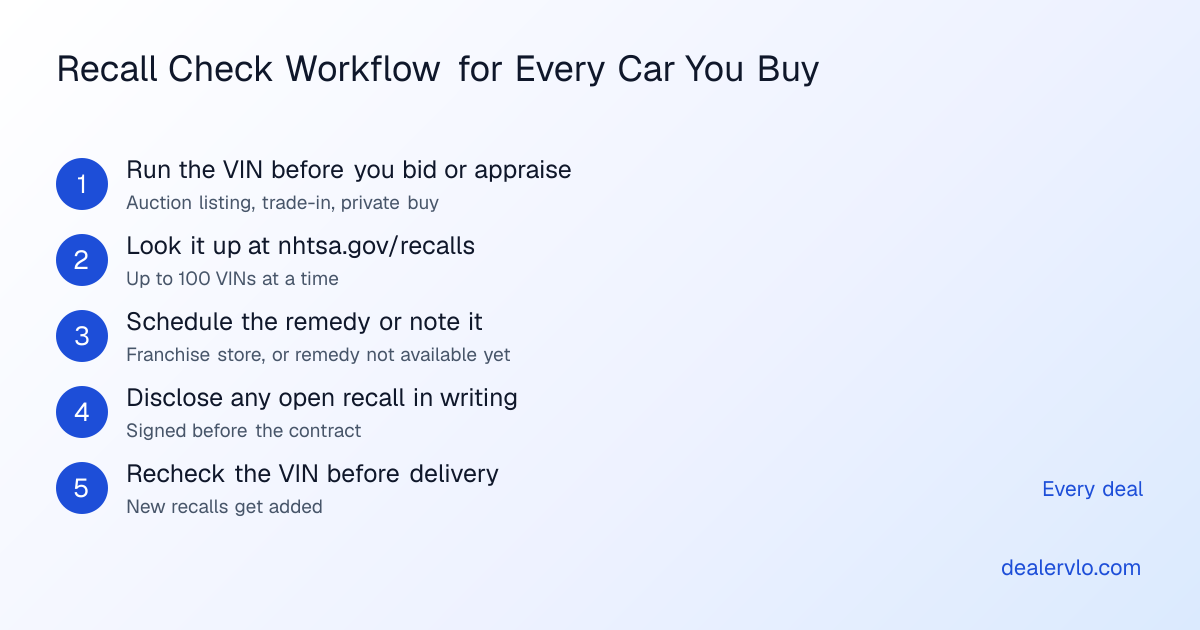
Before you bid. Check the VIN on an auction car before the lane, alongside the condition report. A recall with no remedy available can tie up a car for weeks, which belongs in your bid. The condition report red flags guide covers the rest of the pre-bid checks. Don't assume arbitration covers a recall; the arbitration guide explains what those windows do cover.
At trade appraisal. Same check, before you put a number on the trade.
Before you list, and again before delivery. NHTSA's recall lookup takes a VIN or license plate and shows unrepaired safety recalls on that specific vehicle. Per NHTSA, it won't show recalls already repaired, some recently announced recalls where not all VINs have been identified, recalls more than 15 years old (unless the manufacturer offers more coverage), or recalls from small manufacturers. VINs are added continuously, so check again before the car leaves. You can search up to 100 VINs at a time, enough to run the whole lot in one pass.
For a quick first look, the free VIN decoder below lists NHTSA's recall campaigns for a car's year, make, and model.
Decode any VIN free — year, make, model, trim, engine — straight from NHTSA.
Open the VIN DecoderThose campaigns are model-level, not VIN-specific: a given car may already have had the fix. Confirm the exact VIN at nhtsa.gov. In DealerVLO, adding a car decodes the VIN and builds the vehicle from NHTSA data. DealerVLO does not check recalls per VIN inside the app, so the NHTSA lookup stays part of your process.
Who fixes the recall, and what it costs you
The remedy is the manufacturer's job. Under 49 U.S.C. 30120(a), the manufacturer must remedy the defect "without charge when the vehicle or equipment is presented for remedy." The free-remedy requirement doesn't apply if the car's first purchaser bought it more than 15 calendar years before the recall notice. In practice, you take the car to a franchised dealer for that brand, and NHTSA's site tells owners to contact their local dealership to fix the recalled part for free.
The catch is time. When a remedy isn't ready, federal regulations at 49 CFR 577.7 have the manufacturer send a first notice anyway and a second one once the remedy is available. In between, NHTSA tells owners to follow any interim safety guidance from the manufacturer.
The recall repair may be free, but the waiting isn't. The car isn't selling, your money is tied up in it, and you may pay to get it to and from a franchise store. Run your own numbers on the holding cost calculator.
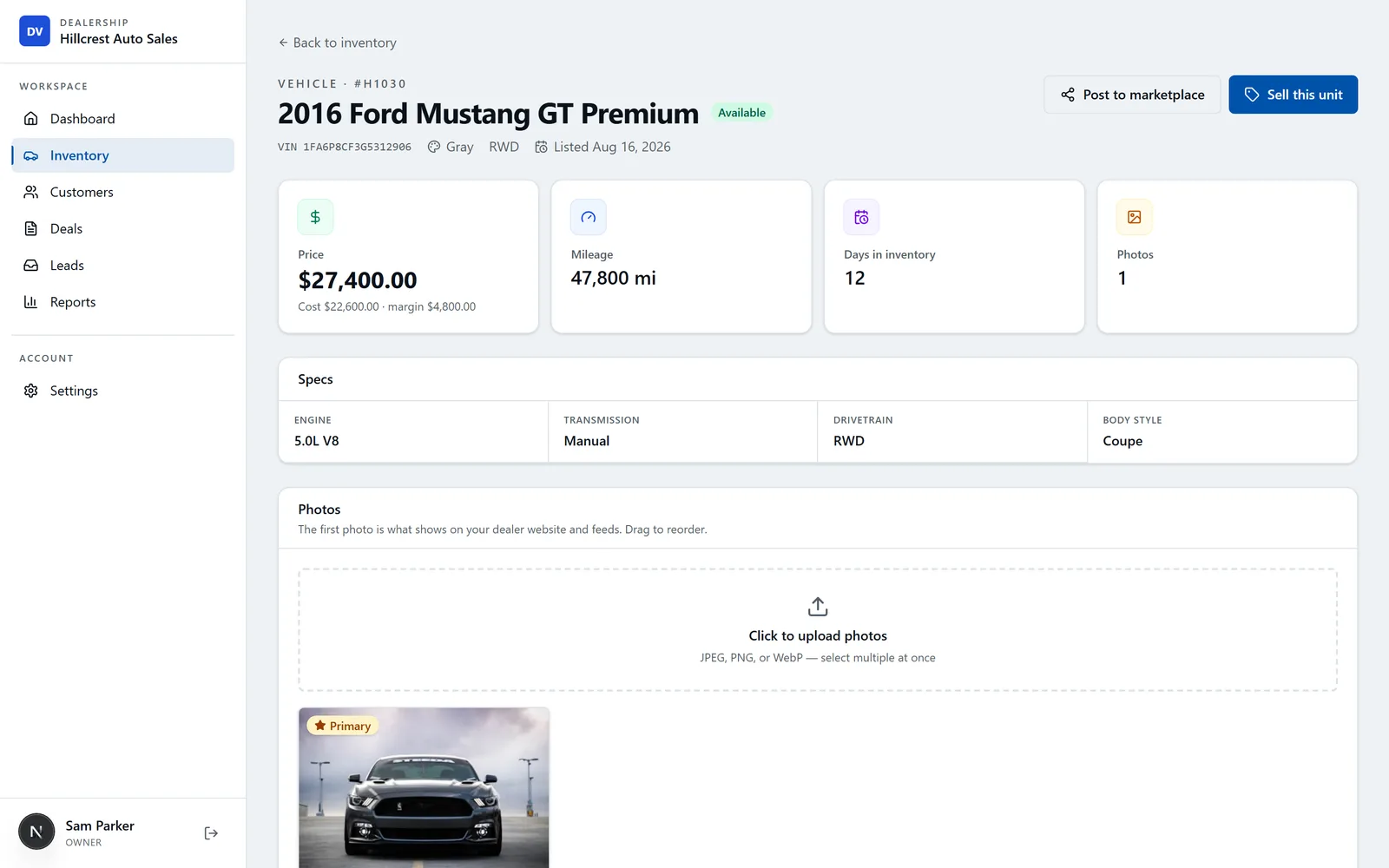
DealerVLO shows each car's cost, margin, and days on lot next to its specs. Every car has a line-item cost list, so transport to the franchise store, or any recall-related repair you paid for, goes on its own line and rolls into that car's all-in cost and margin. Days in inventory count on every car, and at 60 days a car waiting on a part gets an "aging, consider repricing" flag, with a dashboard count of units aged 60+ days.
14-day free trial, then $29/mo · Cancel anytime
Fix it, disclose it, or wholesale it
Every recalled car ends up in one of three places. The right call depends on your gross, your market, and the recall itself.
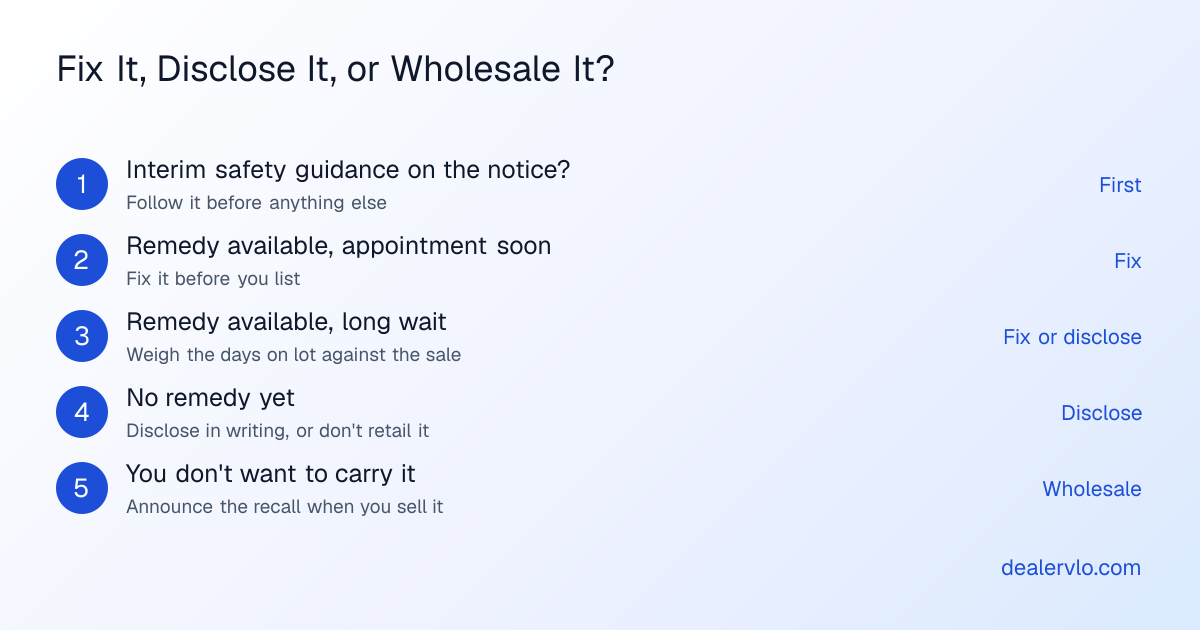
Fix it when the remedy is available and the franchise store can take the car soon. This is the default. It costs you mostly days, and it takes the question off the table.
Disclose it when there's no remedy yet, or the wait is longer than the car can afford to sit. Read the recall first: one that comes with interim safety instructions is a different conversation from a minor label fix, and some you shouldn't retail until they're done.
Wholesale it when you don't want to carry the risk or the days. Announce the recall honestly when you sell it, and compare the two nets first with the wholesale vs. retail calculator.
In DealerVLO, the inventory aging report buckets cars 0-30, 31-60, 61-90, and 90+ days, so a recalled car waiting on a part can't hide in the back row. DealerVLO doesn't mark prices down automatically or send aging alerts; the flag shows on the car, and the call is yours.
How to write an open recall disclosure (used car recall disclosure)
If you sell a car with an open recall, put it in writing, separate from the sales contract, and get it signed before the contract. Dealer associations publish forms for exactly this. The Virginia Automobile Dealers Association, for example, posts a used vehicle recall status disclosure form (marked as educational, not legal advice). It has the buyer initial one recall status, such as an open recall with or without an available remedy, or a dealer that isn't franchised to do the repair, and sign that they got the information before the sale.
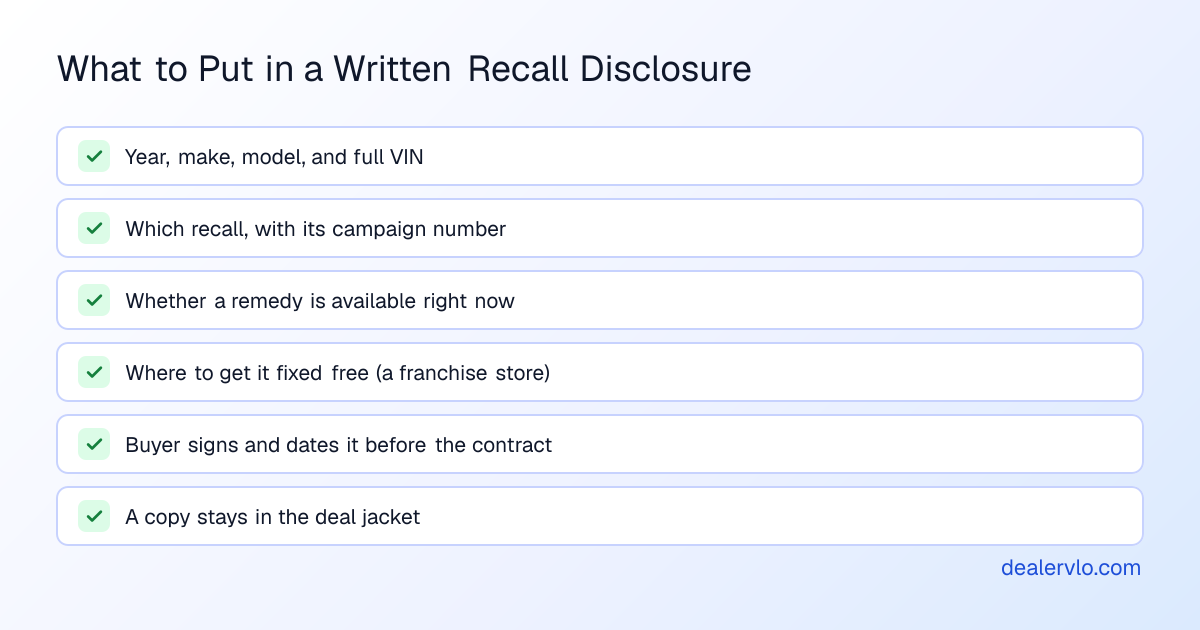
That's the same shape as the CarMax agreement above: documentation of the recall, signed, before any sales paperwork. Start from your own state association's form if it has one, and use it on every deal, not only the ones you're nervous about.
DealerVLO lets you upload your own fillable PDF forms; it maps the fields and fills them from the deal, so a fillable recall disclosure can pick up the buyer, year, make, model, and VIN like the rest of your paperwork. Deal documents can be e-signed in person or remotely. The FTC Buyers Guide prints from each vehicle's page, so it can hang on the car while it's for sale.
Where DealerVLO fits
End to end, for a recalled car:
- Buying and adding the car: VIN decode on every car you add one at a time, plus the free VIN decoder for a model-level recall list before you bid.
- Cost: a line-item cost list on every car for transport, recall-related work you paid for, and recon, rolling into all-in cost and margin.
- Time: days in inventory on every car, the 60-day aging flag, a dashboard count of aged units, and the aging report.
- Paperwork: the FTC Buyers Guide, your own uploaded disclosure form filled from the deal, and e-signatures.
What it doesn't do: DealerVLO does not check recalls per VIN inside the app, pull Carfax or AutoCheck reports, connect to any auction, or book transport. Its deal compliance checklist covers items like an OFAC screen and Red Flags review, not recalls. Use NHTSA's lookup and the manufacturer's site for recall status. It's $29 a month flat, unlimited users, in a browser.
Frequently asked questions
Can a dealer sell a used car with an open recall?
Under federal law, generally yes. The federal stop-sale rule in 49 U.S.C. 30120(i) covers new vehicles in a dealer's possession when the recall notice arrives, plus rental fleets, not used cars on an independent lot. State consumer-protection law, state attorneys general, and the FTC's advertising rules still apply, so check your state's rules and disclose in writing. This is an operator's read, not legal advice.
Is it illegal to sell a car with open recalls?
For a new car, yes: federal law says the dealer can sell it only after the recall remedy is done. For a used car there's no general federal ban, though a bill to create one, the Used Car Safety Recall Repair Act (S.4053), was introduced in the Senate in March 2024 and referred to committee. A used sale that hides a recall or calls the car safe still carries real risk under state law.
Are dealers required to fix recalls before selling?
Franchised dealers must remedy recalls on new vehicles before delivery. Federal law doesn't require an independent dealer to fix an open recall on a used car before selling it, but state law can add duties and dealer associations publish written disclosure forms. Check with your state dealer board or association.
What happens if a dealership sells you a car with an open recall?
The buyer can still get the recall remedied free at a franchised dealer for that brand, unless the car's first purchaser bought it more than 15 calendar years before the recall notice. For the selling dealer, the exposure comes from how the sale was made: hiding a recall you knew about, or advertising the car as safe or fully inspected, draws complaints and enforcement.
Can a dealership refuse to fix a recall?
The legal duty to remedy belongs to the manufacturer, which must remedy the defect without charge when the vehicle is presented, subject to the age limit. A franchise store may not be able to do it right away, usually because parts aren't available yet. If a store won't schedule it, call the manufacturer's customer line with the VIN and the recall number.
How can I check if a car has been recalled?
Run the 17-character VIN, or the license plate, through NHTSA's free lookup at nhtsa.gov/recalls. It shows unrepaired safety recalls from certain manufacturers over the past 15 years, and you can check up to 100 VINs at once. It won't show recalls already repaired, some very recent recalls, or small manufacturers' recalls, so recheck before delivery.
Bottom line
Federal law doesn't ban selling a used car with an open recall the way it bans it for new cars. The risk is in how you do it. Check every VIN before you buy and again before delivery, fix what you can, disclose the rest in writing, and never call a recalled car "safe" or "fully inspected" in an ad. For a recalled EV, the used EV playbook adds the battery checks on top.
I built DealerVLO for my own lot in Tewksbury, and it keeps the parts of this that live on your lot in one place: what each car really cost, how long it has sat, and the paperwork that goes with the deal. Try it free for 14 days.
14-day free trial, then $29/mo · Cancel anytime
Work out the most you can bid at the lane and still hit your target margin.
Open the Auction Profit Calculator