Can a Used Car Dealer Broker Cars? Three Deal Structures and Who Collects the Sales Tax
Can a used car dealer broker cars? The three ways dealers do it, who owns and titles the car in each, who collects sales tax, and what to ask your state first.
Part of the Compliance, taxes & deal paperwork guide: What goes in a used-car deal jacket: the complete checklist
Sooner or later a customer calls and says, "I don't want anything on your lot. Can you just find me a 2019 Tacoma?" Or another dealer offers you a cut for sending a buyer their way. Either way you end up asking what every newer dealer asks: can a used car dealer broker cars, and if you do, who collects the sales tax?
The honest answer is that "brokering" covers three different deals, each with its own paper trail, licensing question, and tax answer. This post walks through all three from an operator's seat, so you know which one you're doing before you take the money. I'm a dealer, not a lawyer or an accountant, so the last section is the list of questions to put to your state.
14-day free trial, then $29/mo · Cancel anytime
Can a used car dealer broker cars? What "brokering" really means
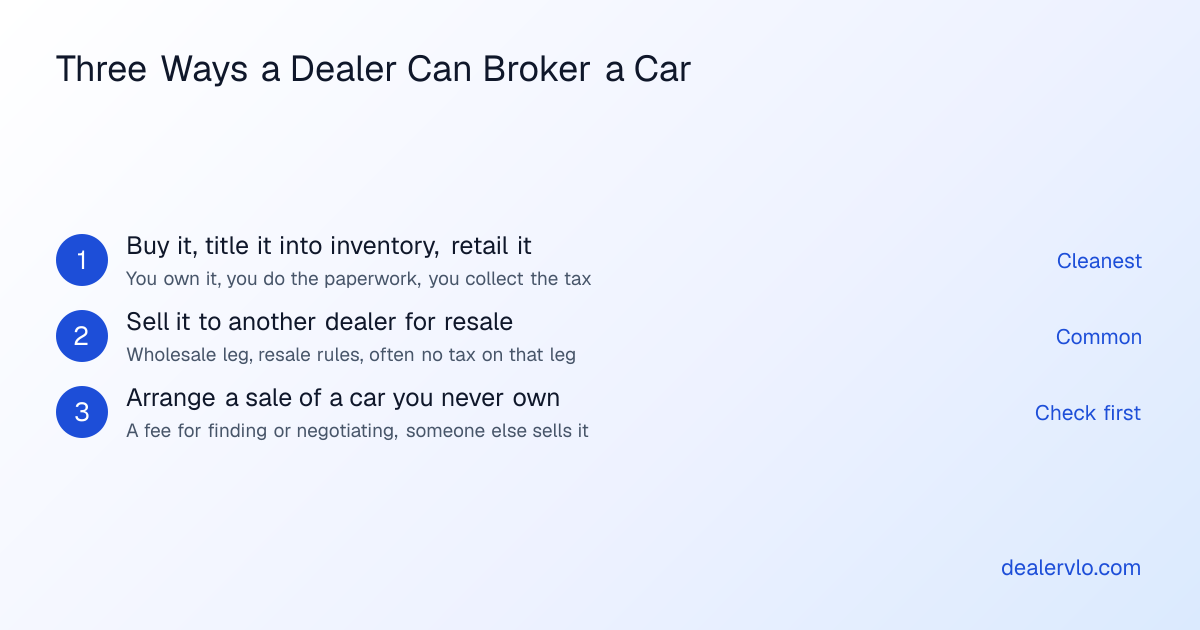
When dealers say "broker," they usually mean one of these:
- You buy the car, then sell it. You found it for a specific customer, but it passes through your inventory. Legally, that's a normal dealer sale.
- You sell it to another dealer. A wholesale deal. The other dealer will retail it.
- You never own it. You find the car, negotiate it, or send the buyer, and someone else sells it. You get a fee. This is brokering in the strict sense.
The rules for the third one are set state by state. Some states have a specific broker license, endorsement, or registration. In others, taking a fee for negotiating a sale is part of the definition of a dealer. That's why I won't give you a 50-state table: they go stale, and the only answer that protects you is your own state's.
Two examples, to show how differently states handle it. California's definition of a dealer covers someone who negotiates a sale for a commission or brokerage fee from either side, and the DMV says a dealer needs an autobroker's endorsement to broker retail sales, keeps a log of each one, and deposits consumer purchase money into a trust account. Florida's motor vehicle dealer statute goes another way: it defines a "motor vehicle broker" separately, as someone who procures cars for the public without storing, displaying, or taking ownership of them.
Structure 1: buy it and sell it (the clean way)
If a customer asks you to find a car, the simplest answer is to buy it yourself: at auction, from another dealer, or from a private seller. The title comes into your name, the car goes into inventory, and you retail it like any other unit.
On paper that isn't brokering. It's a dealer sale, so the full dealer rulebook applies: the FTC Buyers Guide, your state's title and registration paperwork, and whatever sales tax your state has you collect. You build the same deal jacket you'd build for any car on the lot.
The trade-off is risk. You own the car until the customer takes it, and if they walk, you have a Tacoma you didn't plan to stock. So treat a "find me one" request like a pre-sold unit: a real deposit, an agreed price, and a buy price that still works if you have to retail it to someone else. If you buy these at auction, the wholesale buying discipline still applies. Know your exit before you bid.
This is the structure DealerVLO is built around. Paste the VIN and the car builds itself in inventory, add reconditioning costs line by line so its all-in cost is real, and the days-on-lot clock starts. When the customer comes in, the deal jacket computes totals, trade equity, payment, and gross live, then fills the FTC Buyers Guide and your state's title and registration paperwork from that one deal.
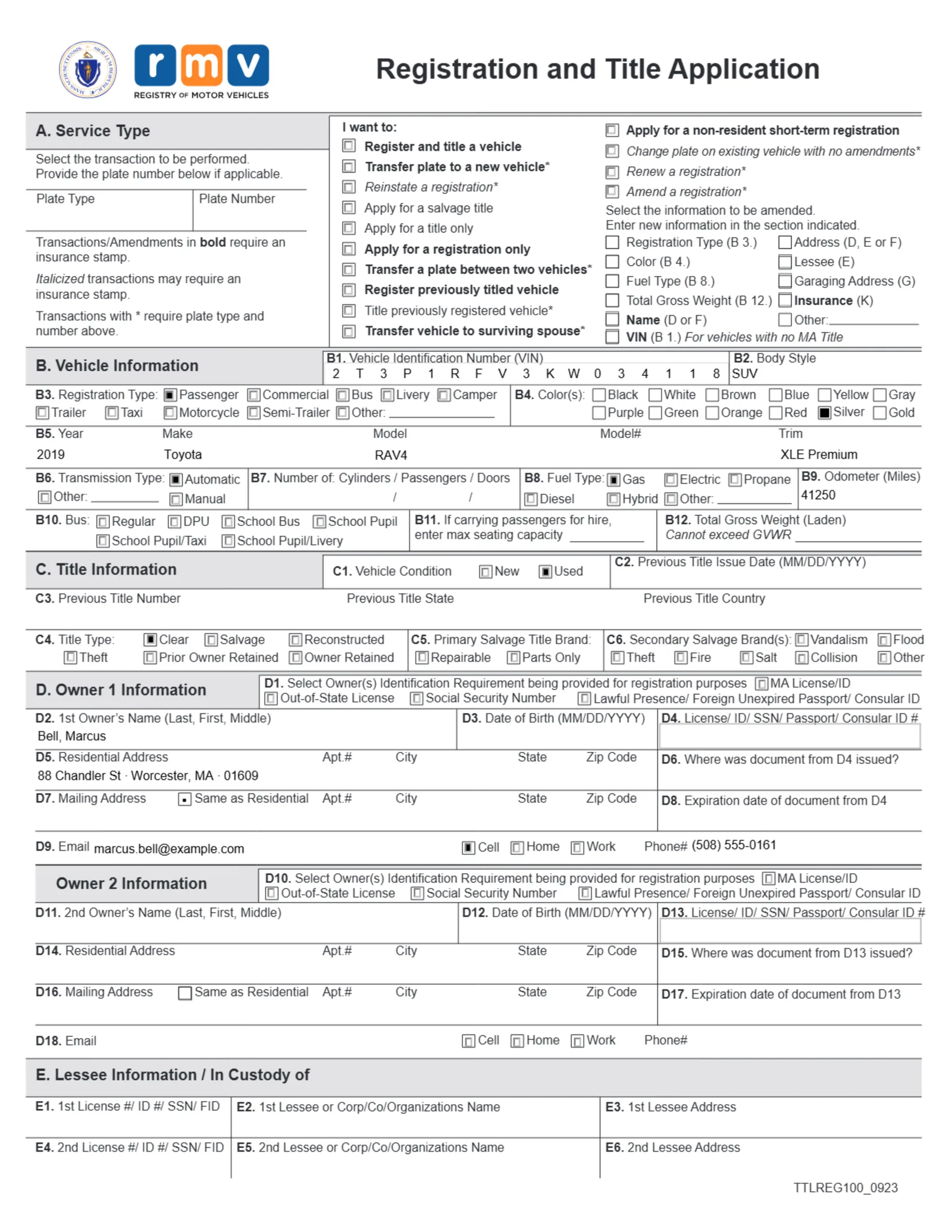
That's an official state form filled from the deal. In states that issue their form through a portal or as controlled paper, DealerVLO gives you a print-ready worksheet of the deal's values instead.
Structure 2: dealer-to-dealer and the resale exemption
The second structure is selling a car to another licensed dealer who will retail it. Maybe the customer you bought it for backed out, or a trade-in doesn't fit your lot. This is a wholesale sale, and the tax works differently than on a retail one.
In many states, a car a licensed dealer buys to hold for resale isn't taxed on that leg. The tax gets collected later, when the car is retailed to the person who'll drive it. Texas is a clear example: the Comptroller's motor vehicle tax guide for dealers says an independent dealer may acquire any used motor vehicle for resale and not owe motor vehicle tax, as long as it's held exclusively for resale.
What proves the resale differs by state: the buying dealer's license number on the bill of sale, a resale certificate, or a specific state form. Get it right, because if your paperwork doesn't show a resale, you could end up owing tax you never collected. Confirm the documentation with your revenue department and your accountant. If you're deciding whether to wholesale a car or keep it, the wholesale vs. retail calculator runs it both ways.
In DealerVLO, the car's all-in cost, every recon line included, is on its record, so you know what you're into it before you quote another dealer. If your state has a resale certificate or dealer-to-dealer form you use often, upload it as a fillable PDF, and DealerVLO maps the fields and fills it from the deal so you're not retyping VINs.
14-day free trial, then $29/mo · Cancel anytime
Structure 3: the true broker deal (finder's fees, cars you don't own)
This is the one dealers get in trouble with. You never own the car; someone else sells it to your customer, and you get paid by the buyer, the seller, or both. It raises questions the first two don't:
- Licensing. Does your license cover arranging a sale you're not a party to? In California it takes an endorsement. Your state may want a registration, or not allow it the way you picture it.
- Disclosure. Does the buyer know you're being paid, and by whom? Put the arrangement in writing and ask your state what has to be disclosed.
- Paperwork. The seller transfers the title, so the seller's paperwork controls. If that's a dealer, they issue the deal documents. If it's a private party, nobody in the chain may be doing dealer paperwork.
- Fees to and from unlicensed people. Paying someone for sending a buyer, or taking a fee from a private seller, raises its own licensing questions. Ask first.
- Your license itself. Never let someone else run deals through it. Florida's statute, for example, makes it unlawful for a dealer to let anyone other than a bona fide employee use the license to conduct sales.
The line between a licensed dealer arranging a sale and an unlicensed person flipping cars is the line regulators use against curbstoners. If your deal could look like curbstoning from outside, you want the paperwork to prove it isn't.
DealerVLO doesn't have a broker module, and a car you never own shouldn't be in your inventory. What it can do is hold the paper: upload your broker agreement or finder's-fee form as a fillable PDF, and DealerVLO fills it from the deal record so names and VINs match everywhere.
Who collects sales tax in each structure
Customers ask "do I have to pay sales tax on a used car?" The dealer's version: "who collects it, and is it me?" Usually whoever sells the car to the end buyer. The general pattern, not your state's rule:
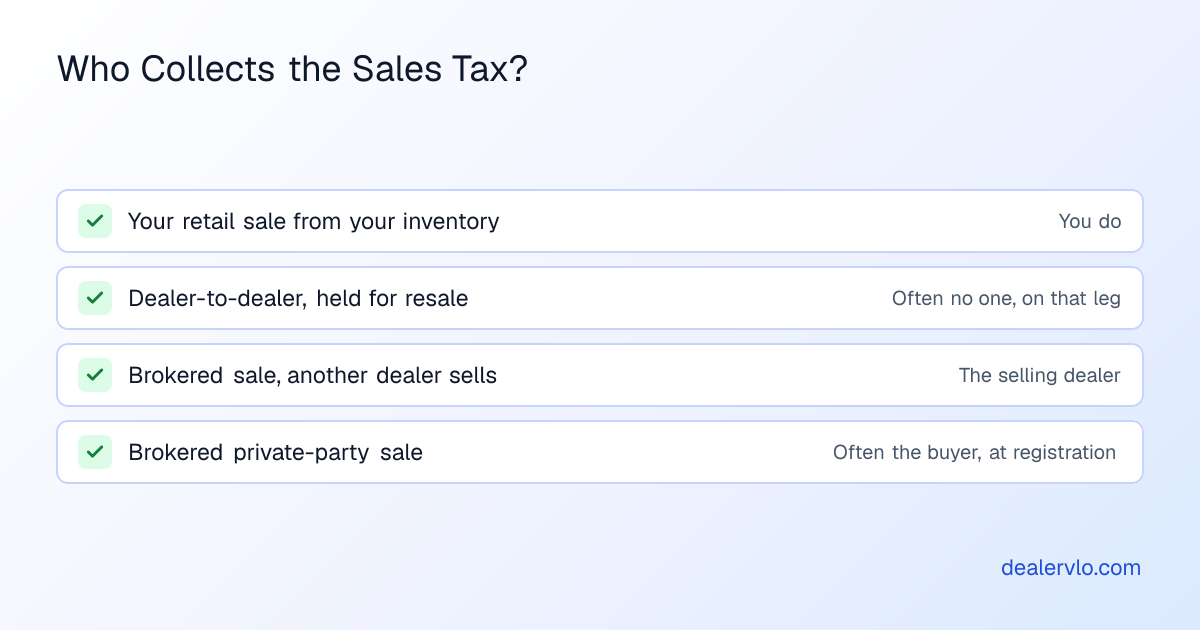
- Structure 1, your retail sale. You collect, under your state's rules. In Texas, for example, the seller collects the tax when it's a licensed dealer, for typical passenger vehicles. See our dealer tax posts for Texas, Florida, and Massachusetts.
- Structure 2, dealer to dealer. In many states, no tax on the resale leg; the retailing dealer collects later.
- Structure 3, another dealer sells. The selling dealer collects. You're not the seller.
- Structure 3, a private party sells. In many states the buyer pays at titling. That same Texas page puts the tax on the buyer when the seller isn't a Texas licensed dealer.
Customer lives in another state? Whose tax applies depends on the pair of states; see the out-of-state sale checklist.
In DealerVLO, the deal jacket recalculates the total as you enter price, fees, trade, and tax, so the paperwork matches your quote. To check a quote before the deal is written:
Build the whole deal — price, tax on the right base, doc, title, minus trade and down — into the out-the-door number and the monthly payment.
Open the Out-the-Door Price CalculatorWhere DealerVLO fits
Structure 1 is where DealerVLO does the most: VIN decode, recon costs rolling into the car's all-in cost, days on lot, then a deal jacket that fills the FTC Buyers Guide and state title and registration paperwork for all 50 states, with e-signatures. The sales report shows front- and back-end gross per deal, so a thin "found it for a customer" deal sits next to a normal retail deal and you can see if these are worth doing.
Structure 2 gets your cost basis and your uploaded resale forms, filled from the deal. Structure 3 gets document help only: your own broker agreement, uploaded and filled.
What it doesn't do: DealerVLO offers no legal or tax services, and it won't tell you whether your license covers brokering or a sale is exempt. That's your state's dealer licensing agency, your revenue department, and your accountant. It's $29 a month, flat, unlimited users.
Questions to ask your state before your first broker deal
Before structure 3, and before your first wholesale deal, call your state's dealer licensing agency with these. Write down who you spoke to and when. Still getting licensed? Start with the dealer license guide and the startup playbook.
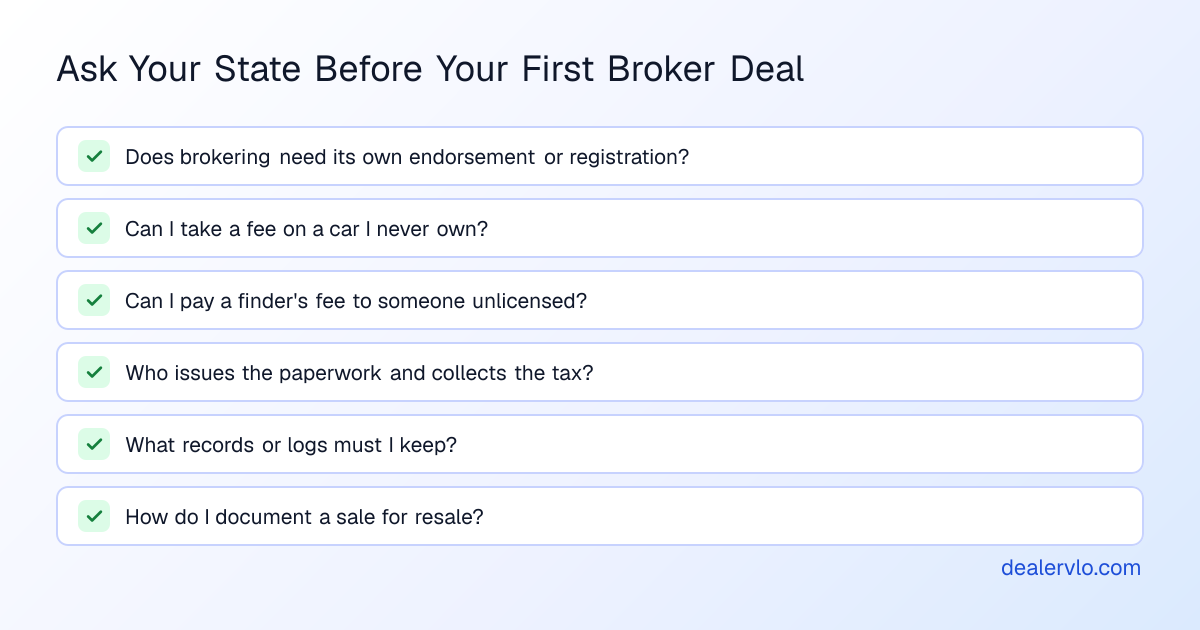
Take the tax side to your accountant: how to report a broker fee and document resales.
Then put the answers to work. If your state requires a specific broker agreement or resale form, upload it to DealerVLO once and it fills from each deal after that. For the state title forms DealerVLO fills, see automated dealer paperwork by state.
Frequently asked questions
Can a used car dealer broker cars?
Often, but it depends on your state and on what you mean by brokering. Buying a car and retailing it is a normal dealer sale, and selling to another dealer is a wholesale deal. Arranging the sale of a car you never own, for a fee, is true brokering, and some states regulate it separately. California, for example, requires an autobroker's endorsement on the dealer license to broker retail sales. Ask your state's dealer licensing agency first.
What is the difference between a car dealer and a car broker?
A dealer takes ownership of cars and sells them. A broker arranges a purchase for someone else without owning the car, for a fee. Florida's statute draws the line that way, defining a motor vehicle broker as someone who procures vehicles for the public without storing, displaying, or taking ownership of them. Other states draw it differently.
Can I be a car broker without a license?
Don't assume you can. In some states, taking a fee for negotiating a car sale is itself part of the legal definition of a dealer; California's definition works that way. Ask your state's dealer licensing agency before you take a single fee, and if you're already licensed, ask whether brokering needs its own endorsement or registration.
Does a dealer collect sales tax when selling a vehicle to another licensed dealer?
In many states, no. A car a licensed dealer buys to hold for resale is generally not taxed on that leg; the tax is collected when the car is retailed. Texas, for example, says an independent dealer may acquire a used vehicle for resale and not owe motor vehicle tax. Confirm how your state wants the resale documented.
Who collects sales tax when a car is brokered?
Usually whoever sells the car to the buyer. If another dealer sells it, that dealer handles the tax. If a private party sells it, in many states the buyer pays when registering the car. The broker in the middle typically isn't the seller, so get your state's answer in writing before the first deal.
Do car brokers make a lot of money?
It varies too much to put a number on. A broker fee is usually thinner than a retail gross because you aren't carrying, reconditioning, or owning the car. The trade-off is less capital tied up per deal. Whether it's worth it depends on your volume, your state's rules, and what the licensing costs you.
Bottom line
If a customer asks you to find a car, the cleanest way to "broker" it is usually not to broker it at all: buy it, title it into your inventory, and retail it with full paperwork. Dealer-to-dealer is the second clean path, as long as the resale is documented. The true broker deal, a fee on a car you never own, is where the licensing and tax questions live, so get your state's answer in writing before the first one.
If structure 1 is how you'll handle most of these, DealerVLO covers it end to end: inventory, recon cost, deal math, and state paperwork from one record. Start the free trial and run your next "find me one" deal through it.
14-day free trial, then $29/mo · Cancel anytime
Dump it at auction now or retail it? Compare the two nets and find the break-even day.
Open the Wholesale vs. Retail Calculator