How to Start a Used Car Dealership: A Step-by-Step Launch Playbook (2026)
The exact sequence: business structure → dealer license → location → bond → inventory → first legal sale. What to do and in what order.
Switching from another DMS? Compare DealerVLO to DealerCenter, Frazer, or Lot Wizard.
If you're asking how to start a used car dealership, you're not looking for vague motivational advice—you need to know the ordered sequence of actions that gets you from zero to your first legal sale. This is that playbook: the concrete steps, the decisions you'll make, and the order that keeps you from backtracking.
This guide walks you through the procedural launch sequence—what to do, when to do it, and what trips most dealers up along the way. For startup budgets, license fees, and the full cost breakdown, see our companion guide on what it costs to open a used car dealership. This article focuses on the how, not the how much.
Let's get into it.
14-day free trial, then $29/mo · Cancel anytime
Step 1: Decide Your Business Structure and Register the Entity
Most independent used-car dealers structure as Limited Liability Companies. An LLC gives you limited liability protection—your personal assets stay separate from business debts—and pass-through taxation, so profits flow to your personal return without double taxation. An LLC properly organized according to state law combines the liability protection of a corporation with the flexibility and tax benefits of a partnership.
Your other options are an S Corporation (similar liability protection, pass-through tax treatment) or a C Corporation (separate tax entity, but you'll face double taxation). Don't guess here—consult an attorney or accountant who understands dealer compliance in your state.
The registration sequence:
-
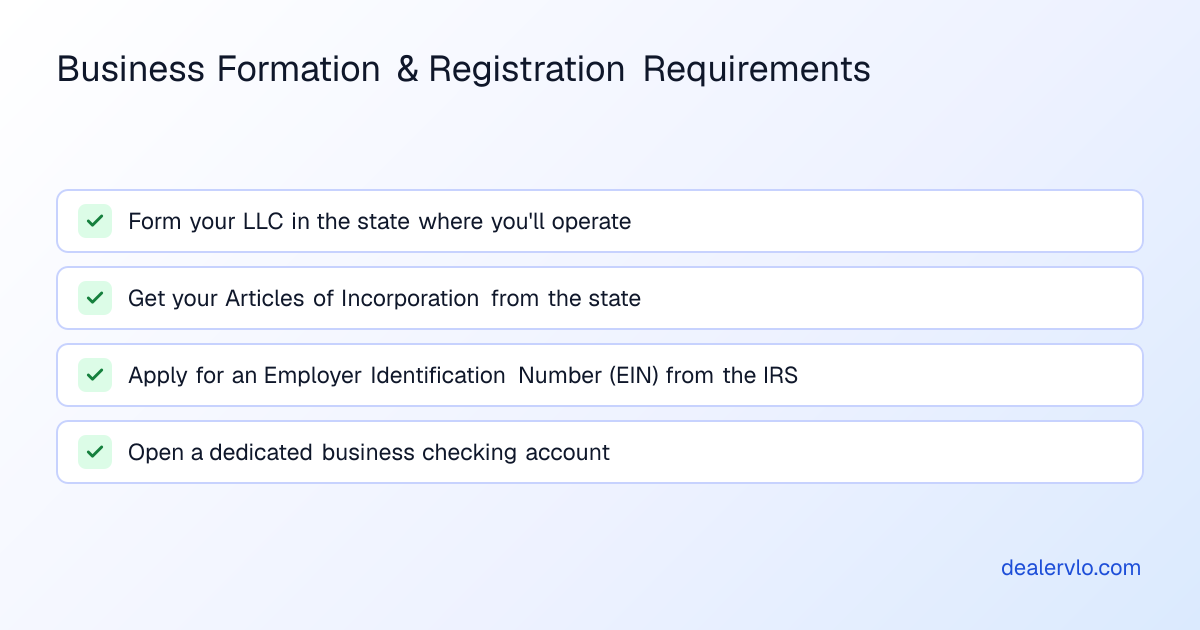
Form your LLC in the state where you'll operate. For a local retail operation, forming in your home state is usually simplest. Most states let you submit formation documents online; filing fees range from the low double digits to a few hundred dollars depending on the state.
-
Get your Articles of Incorporation. Your state will send you this official document once your LLC is approved. You'll need it to open a business bank account.
-
Apply for an Employer Identification Number (EIN) from the IRS. This is your business's tax ID; apply online at irs.gov—it's free and instant.
-
Open a dedicated business checking account. Use your EIN and Articles of Incorporation. Mixing personal and business money is a fast way to weaken your liability protection, so set up a clean separation from day one.
Why this order matters: You cannot apply for a dealer license without a registered business entity and EIN. You cannot secure a location lease or bond in your business name without a bank account. Get the entity paperwork done first.
Step 2: Find and Secure a Location That Will Pass Inspection
Your dealer license depends on passing a physical inspection of your "established place of business." Every state has specific square-footage, signage, and zoning requirements, and failing inspection can delay your approval by weeks or months.
Before you sign a lease or buy property, verify zoning. Contact your city or county zoning department and confirm the property is zoned for vehicle sales. This one phone call can save you from lease penalties and licensing delays.
Here's what the inspection typically looks for:
-
Lot size and surface. Ohio requires a display lot of at least 3,500 square feet with a hard surface (not dirt or gravel), separated from any residence or other business. Michigan requires 1,300 square feet for display plus 650 square feet of customer parking. Maine requires 5,000 square feet of display area with paved, graded gravel, or mowed grass surfaces kept plowed in winter.
-
Office space. Ohio requires a permanent office of at least 180 contiguous square feet with hard-surface walls. Michigan requires at least 150 square feet with standard office furniture, working utilities, a restroom, and a telephone listed in the business name. Washington requires a permanent, enclosed commercial building that's easily accessible and complies with all building codes and zoning ordinances.
-
Signage. Your sign must be permanent, durable, visible from the street, and display your exact business name as shown on your license application and bond. Most states require professionally installed signs—handwritten, paper, or vinyl banners are rejected. Washington mandates that letters be clearly visible to the major avenue of traffic. New York requires the sign to read "REGISTERED [your facility number] STATE OF NEW YORK MOTOR VEHICLE DEALER" in block letters at least 2 inches high, visible from the nearest roadway.
-
Office permanence. California allows a trailer coach office as long as it's not part of your inventory for sale. Most states prohibit tents, temporary structures, or residential spaces.
Timeline tip: Schedule your pre-lease zoning check and informal walkthrough with your licensing agency before committing to a property. Some states will offer guidance on what passes before you apply.
Step 3: Work Through the Dealer License and Surety Bond Application Process
Dealer licensing is a four-part sequence: gather documents, obtain your bond, submit your application, and pass the facility inspection.
Part 1: Gather Business Documents
You'll need:
- Photo IDs for all individuals listed on your application
- Business formation documents (Articles of Incorporation, LLC operating agreement)
- Sales tax ID or resale certificate (your state's Department of Revenue or Taxation and Finance issues this)
- Certificate of Authority or similar tax registration
In New York, you'll also need your Certificate of Registration from the Department of State and your filing receipt if you formed an LLC or corporation.
Part 2: Obtain Your Surety Bond
You must get your surety bond before you submit your dealer license application—the bond is part of the application package.
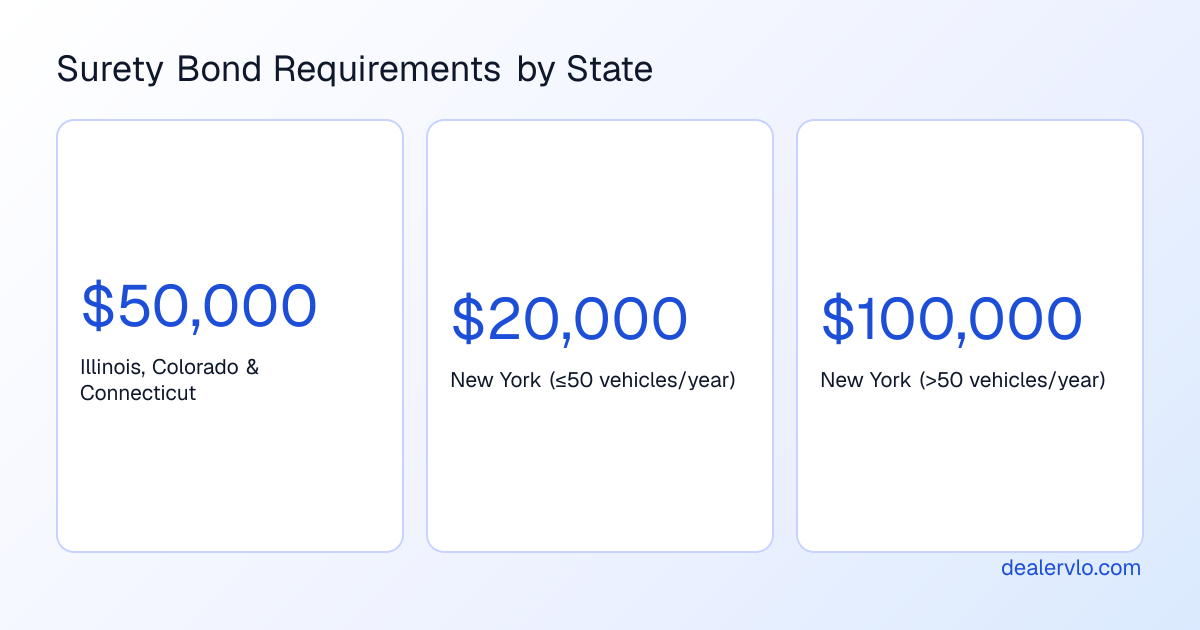
Bond amounts vary by state. Illinois, Colorado, and Connecticut all require a $50,000 bond. New York uses a tiered system: $20,000 if you sold 50 or fewer vehicles in the previous calendar year, $100,000 if you sold more than 50.
How the bond process works: You apply to a surety bond provider (there are dozens online). The underwriter will check your personal credit to determine eligibility and your rate—most use a soft check that won't impact your credit score. You'll provide information about your business, financial history, and the bond amount your state requires. Once approved, you pay the premium (usually a small percentage of the bond amount annually) and receive your bond certificate.
Part 3: Submit Your Complete Application
Fill out your state's dealer license application. Include all documents, your surety bond certificate, and any required fees. Some states accept online submissions; others require in-person or mail filing. Be prepared for background checks on yourself and any key personnel listed on the application.
California-specific requirement: You must pass a used-dealer test administered by the DMV. You get three attempts; if you fail all three, you must retake the dealer education program. There's a $16 re-test fee and a one-week waiting period between attempts.
New York-specific requirement: All motor vehicle dealers must enroll in and use the VERIFI electronic book of registry system.
Part 4: Pass the Facility Inspection
Once your application is received, an inspector will visit your location to confirm it meets the state's established-place-of-business standards. If everything checks out—signage, office size, lot surface, zoning compliance—the licensing agency will issue your Certificate of Registration, dealer plates, and any additional documents.
Timeline: Dealer licensing typically takes four to twelve weeks depending on your state. Start early, maintain compliance checklists, and confirm your location meets all requirements before the inspector arrives. New York licenses are issued for two years and renewed for subsequent two-year terms.
Step 4: Get Auction Access and Floor-Plan Approval
You can't stock a lot without inventory, and most independent dealers source from wholesale auctions. Physical auctions let you inspect cars in person; digital platforms like ACV Auctions let you review detailed condition reports and bid online.
ACV Auctions registration:
- Register for an ACV Auctions ID.
- Log in to the ACV Marketplace and apply for an account (and ACV Capital if you want floor-plan financing).
- Approval typically takes one to three business days.
- Register a payment method: ACH, credit card, or floor plan.
- Set your credit limit if you're using floor-plan financing.
Payment requirements: Unless you arrange financing, you must pay the total purchase amount within two business days after your bid is accepted. Payment is made by ACH, floor plan, or another financing arrangement acceptable to the auction.
Floor-plan financing basics: A floor-plan line of credit lets you buy inventory without tying up all your cash. The lender owns the vehicle until you sell it; you pay interest on each unit until it's sold. Approval depends on your creditworthiness, business plan, and dealer license. Many lenders integrate directly with auction platforms, so once you're approved, you can bid and finance in one transaction.
Other auction access: Manheim, ADESA, and regional auctions each have their own registration processes. Expect to provide your dealer license, bond, business bank account, and proof of insurance. Some auctions require a deposit or credit check before you can bid.
Add up the real first-year cost of getting licensed in your state.
Open the Dealer License Cost CalculatorStep 5: Source Your First 10–15 Cars
Your first inventory buys set the tone for your dealership. Buy too expensive and you'll tie up capital; buy too rough and you'll spend weeks in reconditioning.
Where to start:
- Wholesale auctions (physical or online). This is where most dealers build their initial stock. Inspect condition reports carefully, set strict buy limits, and stick to vehicles you understand.
- Trade-ins from other dealers. Once you're licensed, network with franchised dealers who wholesale their older trade-ins.
- Private-party purchases. If you buy from individuals, make sure you're complying with title transfer and sales tax collection rules in your state.
How many? Ten to fifteen units is a realistic first lot for most independents. It's enough to give customers choices without overextending your cash or credit line. Focus on vehicles that fit your market: if you're in a suburban area, reliable sedans and SUVs; if you're near a college town, budget compacts.
Reconditioning: Budget time and money for mechanical inspection, detailing, and any safety or emissions repairs required by your state. Some states mandate pre-sale inspections; others don't. Either way, selling a car that breaks down in the first week kills your reputation faster than anything else.
Inventory is the biggest slug of cash, but it's not the whole budget. Add every line — license and bond, the lot, insurance, software, and the working-capital reserve — before you commit:
Total the real cash to open — license & bond, inventory, the lot, insurance, software, and the working capital most checklists forget.
Open the Used Car Dealership Startup Cost CalculatorStep 6: Stand Up Your Systems—DMS, Deal Paperwork, Compliance
You cannot legally sell a car without the right forms, signatures, and data tracking. A dealer management system (DMS) centralizes inventory, deal paperwork, compliance, and customer records in one place.
What a DMS does for you:
- Tracks VINs, purchase dates, costs, and listing prices
- Generates buyer's orders, purchase agreements, and disclosure forms
- Manages title work and DMV submissions
- Stores customer data and financing documents
- Keeps you compliant with odometer disclosure, truth-in-lending, and privacy laws
If you're running off spreadsheets and Word templates, you're one missed signature away from a deal that won't fund or a compliance violation. For more on how DealerVLO handles deal paperwork and compliance, visit our dealer paperwork software page. Not sure what to buy on day one? Here's the software a brand-new used-car dealer actually needs — and what to skip.
Other systems you'll need:
- Insurance: Garage liability, dealer's open lot (inventory coverage), and general liability. Your lender will require proof before you can floor-plan.
- Accounting software: Track income, expenses, and cost-per-unit. QuickBooks or a similar platform integrated with your DMS keeps your books clean.
- CRM or lead tracking: Even if you're walk-in only at first, capture customer names, phone numbers, and follow-up notes. Repeat buyers and referrals build your business.
Compliance checklist:
- Odometer disclosure (federal law)
- Buyer's Guide sticker on every vehicle (FTC Used Car Rule)
- Truth-in-lending disclosures if you offer in-house financing
- Sales tax collection and remittance to your state
- Title transfer and lien recording
- Privacy notices (if required by your state)
14-day free trial, then $29/mo · Cancel anytime
Step 7: Close Your First Compliant Deal
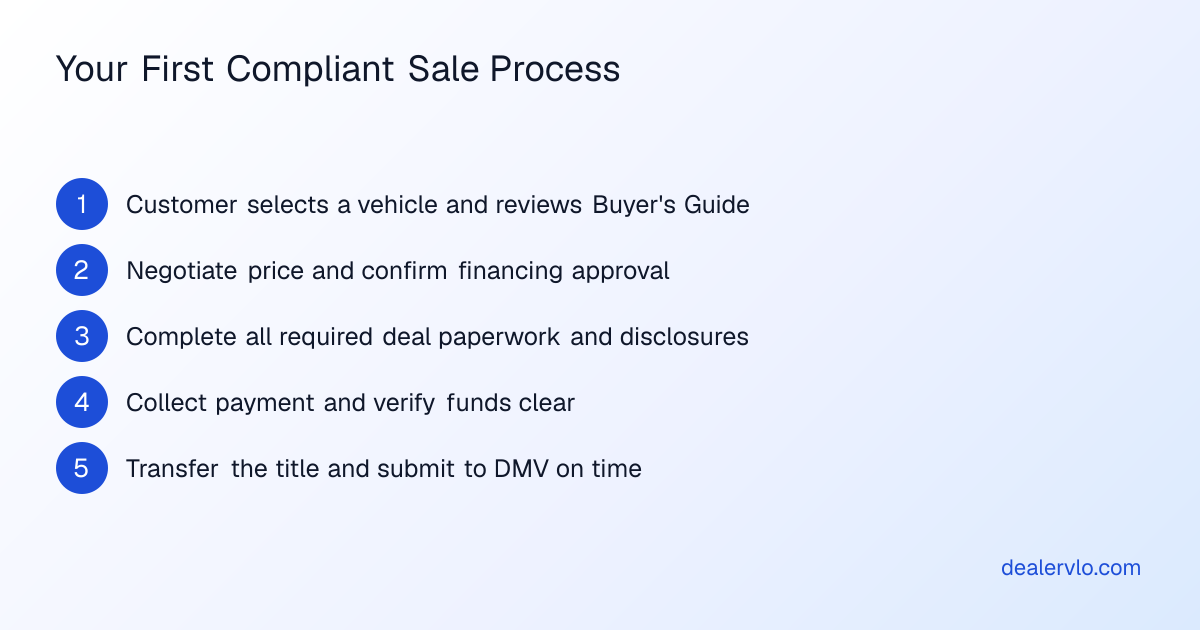
Your first sale is a test of every system you just set up. Here's the sequence:
- Customer selects a vehicle. Walk them through the Buyer's Guide, vehicle history report, and any reconditioning work you completed.
- Negotiate price and payment terms. If they're financing, confirm loan approval before you deliver the car.
- Complete the deal paperwork. Buyer's order, odometer statement, purchase agreement, truth-in-lending disclosure (if financing), sales tax forms, and any state-specific disclosures.
- Collect payment. Cash, certified check, or lender funding. Don't release the vehicle until funds clear.
- Transfer the title. Sign the title, complete your state's transfer form, and submit to the DMV within the required timeframe (usually 10–30 days depending on state).
- Deliver the vehicle. Hand over keys, registration documents, and copies of all signed paperwork.
- Record the sale in your DMS. Update inventory, log the transaction for tax reporting, and store all documents for your records.
Common first-deal mistakes:
- Missing a signature or date on the title
- Failing to collect sales tax
- Releasing the car before the lender funds the deal
- Not providing the buyer with required disclosure forms
- Forgetting to submit title transfer paperwork on time (late fees and penalties add up)
Run through a dry-run deal with a friend or family member before you transact with a real customer. It's the best way to catch gaps in your paperwork flow.
Step 8: Your First-90-Days Checklist
The first three months set your operational rhythm. Here's what to track:
Week 1–4:
- Confirm all inventory is logged in your DMS with accurate VINs, costs, and photos
- Set up your website or listing presence (Cars.com, Autotrader, Facebook Marketplace)
- Verify your business insurance is active and coverage limits are adequate
- Run a test deal end-to-end to validate your paperwork workflow
Week 5–8:
- Review your first five sales: average gross profit, days to sale, any title or paperwork issues
- Adjust your inventory mix based on what's moving (or not)
- Establish a reconditioning routine: which repairs you do in-house, which you outsource
- Set up a basic follow-up process for buyers (thank-you call, ask for referrals)
Week 9–12:
- Reconcile your floor-plan interest and curtailment schedule
- Confirm you're current on sales tax remittance and DMV title submissions
- Evaluate your marketing spend: what's driving traffic, what's not
- Build a cash-reserve plan for slow months (most new dealers underestimate seasonal swings)
- Schedule a compliance self-audit: are all Buyer's Guides posted, all disclosures signed, all titles transferred on time?
Ongoing:
- Track inventory turn (how many days each unit sits on your lot)
- Monitor gross profit per unit and total monthly operating expenses
- Stay current on state and federal compliance updates (sign up for DMV and FTC email alerts)
- Network with other dealers—local associations and online forums are goldmines for real-world advice
Bottom Line
Starting a used car dealership is a sequence problem, not a mystery. Form your business entity first, lock down a location that will pass inspection, work through the bond-and-license process in the right order, get auction access and financing lined up, source your first units, stand up a compliant DMS and paperwork system, close your first legal deal, and then refine your operations over the first ninety days.
Most launch delays come from skipping steps or doing them out of order—signing a lease before confirming zoning, buying inventory before your license is approved, or closing deals without compliant paperwork. Follow the sequence, check every box, and you'll be open for business faster and cleaner than dealers who guess their way through it.
14-day free trial, then $29/mo · Cancel anytime