California 3-Day Right to Cancel a Used Car: The Dealer's Guide
California's 3-day right to cancel a used car, from the dealer's side: who qualifies, how the days count, restocking fee math, refunds, trade-ins and paperwork.
Part of the Compliance, taxes & deal paperwork guide: What goes in a used-car deal jacket: the complete checklist
Switching from another DMS? Compare DealerVLO to DealerCenter, Frazer, or Lot Wizard.
As of October 1, 2026, every California buyer of a used car priced at $50,000 or less can bring it back within three days for any reason. It isn't an option you sell anymore, and it isn't something you can talk them out of at the desk. It's in the contract whether they want it or not.
Most of what's ranking on this right now is written for buyers, and a lot of it still describes the old 2-day option. This is the dealer's side: who's covered, how the three days actually count, what you can charge, how fast the money has to move, and what has to be in the deal jacket. I'm working from the statute itself (SB 766, which added Civil Code 1784.20 through 1784.44) as of October 2026. I'm a dealer, not your lawyer, so run your store's process past one.
14-day free trial, then $29/mo · Cancel anytime
What changed on October 1
The old Contract Cancellation Option Agreement under Vehicle Code 11713.21 was a 2-day option the buyer paid for, on used cars under $40,000. Most buyers never bought it. SB 766 repealed that section as of October 1, 2026.
The new right is different in three ways that matter at the desk:
- It's automatic. Every qualifying deal gets it. You can't charge for it, and the buyer doesn't have to ask.
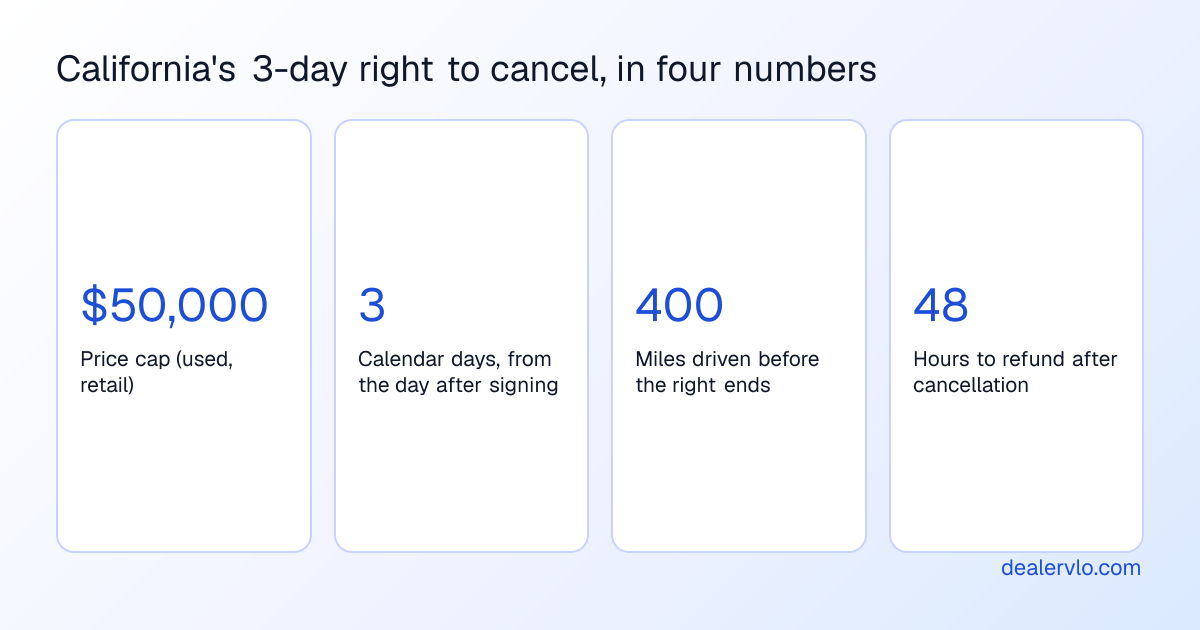
- The price cap went up. It covers used vehicles sold or leased at retail at $50,000 or less (Civil Code 1784.43(a)(1)(A)). That's most of an independent lot.
- The paperwork is fixed by statute. There's a required notice on the first page of the contract and a separate disclosure with specific contents. More on both below.
The broader CARS Act also changed price advertising, add-on sales and record keeping. I covered those in the California CARS Act compliance guide. This post sticks to the cancellation right, because it's the part that changes how a deal closes.
Which deals it covers
Retail sales and leases of used vehicles at $50,000 or less, by a licensed dealer, to a consumer. The statute carves out:
- Wholesale deals, and auction sales
- Fleet sales: more than one vehicle in a single transaction, bought primarily for business use
- Commercial buyers who take five or more vehicles from you a year
- Vehicles with a gross weight rating of 10,000 pounds or more, and motorcycles
- A lessee buying out the car they already lease
One thing the statute doesn't define is "price". It doesn't say whether the $50,000 line counts tax and fees. If you sell a lot of cars right around that number, that's a question for your attorney, not a guess.
How the three days count
This is where most of the confusion is, so take it slowly.
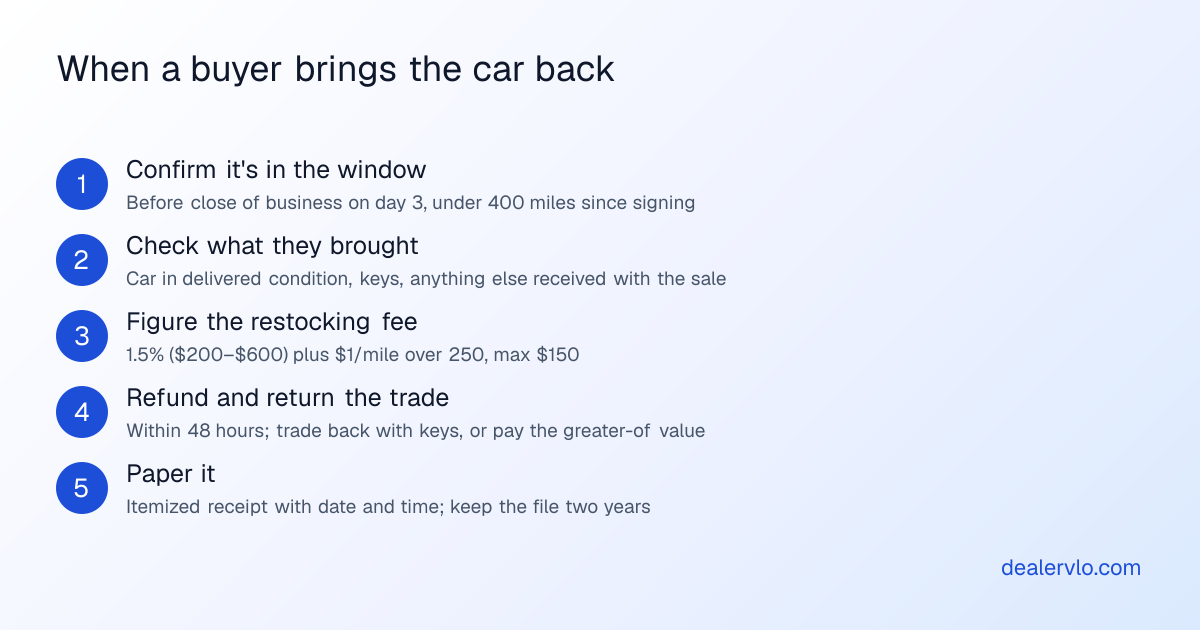
Civil Code 1784.31(i) says the period is three calendar days, starting the calendar day after the contract is signed. It ends at close of business on the last day. If your dealership is closed to the public on that last day, the window runs to the next day you're open.
So a buyer who signs on Monday has Tuesday, Wednesday and Thursday, until you close on Thursday. Sign on a Friday and it's Saturday, Sunday and Monday. If you're closed Sundays, that doesn't stop the count. But if Monday is a day you're closed, it carries to Tuesday.
Here's the wrinkle. DMV's dealer notice, OLIN 2026-10, says "three business days." DMV's own consumer page says three days including weekends, which matches the statute. The statute is what controls, and it's what the disclosure you hand the buyer should say. But a buyer who read the DMV notice may show up on what they think is day 3 and you think is day 5. Decide now, with your attorney, whether you'll argue that or just honor it. Don't decide in front of the customer.
The other hard limit is mileage. The right is gone once the car has been driven more than 400 miles between signing and the day they try to cancel (1784.43(a)(1)(B)). That makes the odometer reading at signing the most important number on the deal. Write it down, on the disclosure, every time.
The restocking fee, worked out
You can't charge for the right itself, but a buyer who cancels can owe a restocking fee in two parts (Civil Code 1784.31(g)):
- 1.5% of the sale price, with a floor of $200 and a ceiling of $600.
- If the car's been driven more than 250 miles since signing, $1 for every mile over 250, capped at $150.
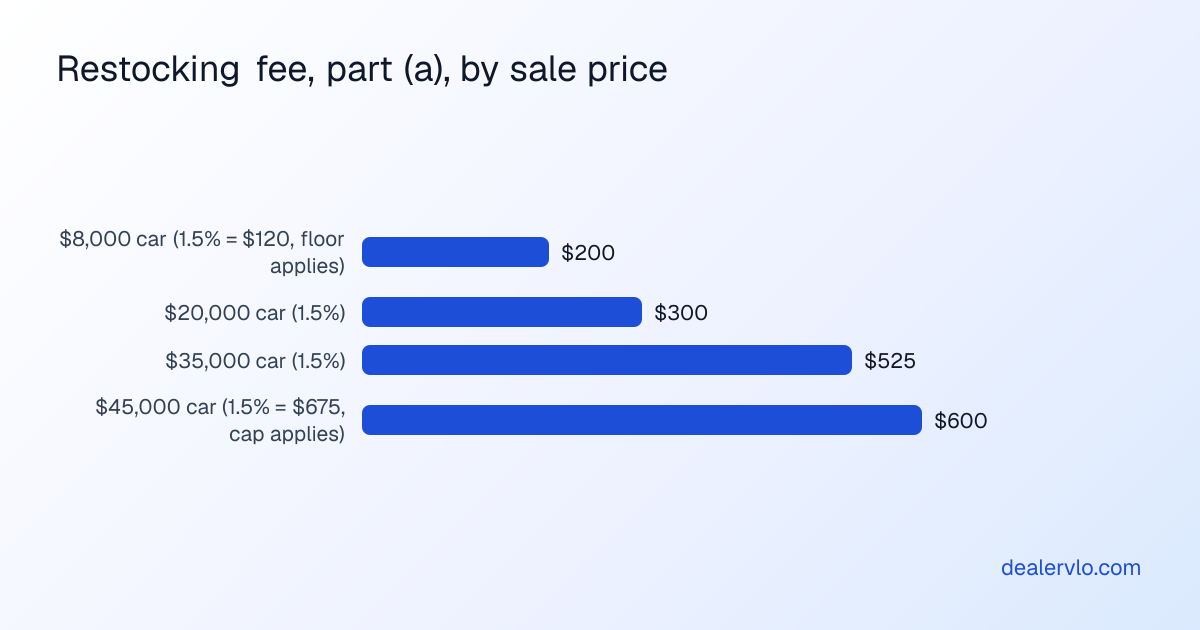
On a typical $12,000 car, part one is 1.5% of $12,000, which is $180. That's under the floor, so it's $200. If the buyer drove it 320 miles, that's 70 miles over 250, so add $70. Total: $270. On anything under about $13,333 you're at the $200 floor; at $40,000 and up you hit the $600 cap.
The fee can come out of the refund (1784.43(a)(2)), so you don't have to chase it.
In DealerVLO, the 3-Day Right to Cancel disclosure works out part one for that deal's sale price and prints it, so the number the buyer sees is the number you'll charge. It also prints the odometer at signing and the reading at which the right ends (signing mileage plus 400), so nobody has to do that math at the counter.
What the buyer has to bring back
The right only applies if the buyer personally brings back, during your business hours:
- The vehicle, in the condition you delivered it apart from reasonable wear and tear, and free of liens other than the ones from this sale
- Anything else they got in connection with the sale
- The restocking fee, unless you're taking it out of the refund
You can also ask them to sign the documents reasonably needed to cancel the deal and issue the refund. Have that cancellation packet ready before the first one walks in.
The refund, the trade-in and the financing
This is the part that needs a process, because the clock is short.
48 hours. Within 48 hours after the buyer exercises the right, you have to cancel the contract and give a full refund, minus the restocking fee (1784.43(d)(1)). You aren't on the hook for delays caused by their bank or card processor. If they paid by check, the refund can wait until two business days after the payment is verified.
The trade-in comes back with its keys. If you've already sold it or started the title transfer, you owe the buyer the greatest of: the agreed trade value on the contract, what you sold it for, or its fair market value. That can be reduced to pay off a loan the trade-in secured. If you sold it, you have to show them the sale document, with the buyer's personal information removed.
That's the real cost of the new right for an independent lot. It's a good reason not to flip a trade-in at auction the next morning. Hold it until the window closes, the same way you'd hold off on the title work for the sold car.
The financing gets unwound. The statute's wording is that you "cancel the contract." DMV's notice describes it as reversing the financing. If you sold the paper to a lender, talk to them now about how they handle a 3-day cancellation, not on the day one happens.
Paper it. Give the buyer an itemized receipt that shows the date and time of the cancellation, and keep the request, the refund proof and the trade-in return in the deal file. CARS Act records are kept two years from the date they're created (1784.44).
14-day free trial, then $29/mo · Cancel anytime
The paperwork on every covered deal
Three things, all set by statute rather than by DMV.
The first-page notice. Every purchase or lease contract has to show, clearly and conspicuously on page one, a fixed notice that starts "CALIFORNIA DOES NOT HAVE A COOLING-OFF PERIOD FOR NEW VEHICLES" and then explains the 3-day right on used cars at $50,000 or less (Civil Code 1784.43(e)). If you print contracts on purchased stock, check your forms. Paper printed before the CARS Act won't have it.
The separate disclosure. A document titled "3-Day Right to Cancel Used Car Purchase or Lease" (1784.43(b)), given separately from the contract. It has to name the parties and the vehicle and VIN, state the deadline, explain both parts of the restocking fee and the 400-mile rule, list what the buyer has to bring back, cover the documents they may need to sign, and spell out the trade-in rule. If the deal was negotiated mainly in Spanish, Chinese, Tagalog, Vietnamese or Korean (the Civil Code 1632 languages), the disclosure has to be given in that language too.
The wall notice. Every sales office, sales cubicle and room where you sign contracts needs the statutory notice posted in at least 36-point type (Vehicle Code 11709.2). The wording is in the statute. Print it from there, not from a forum post.
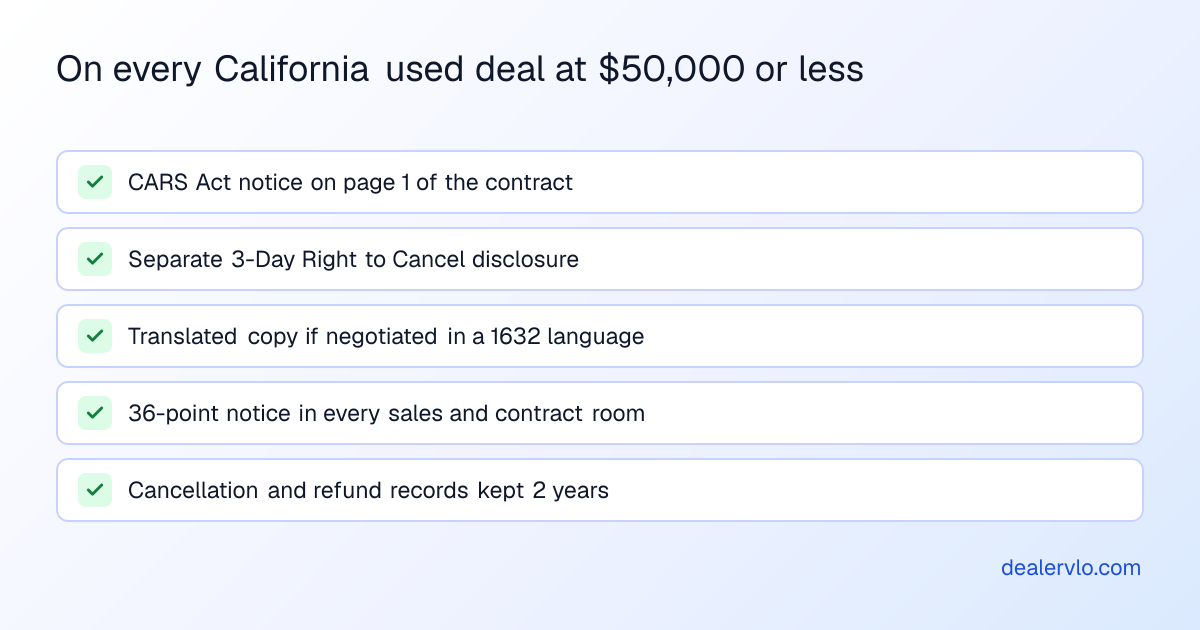
This is what the rest of a California deal jacket looks like now. The deal jacket checklist covers the federal pieces, like the FTC Buyers Guide and the odometer statement. The REG 343 guide covers the DMV side.
Where DealerVLO fits
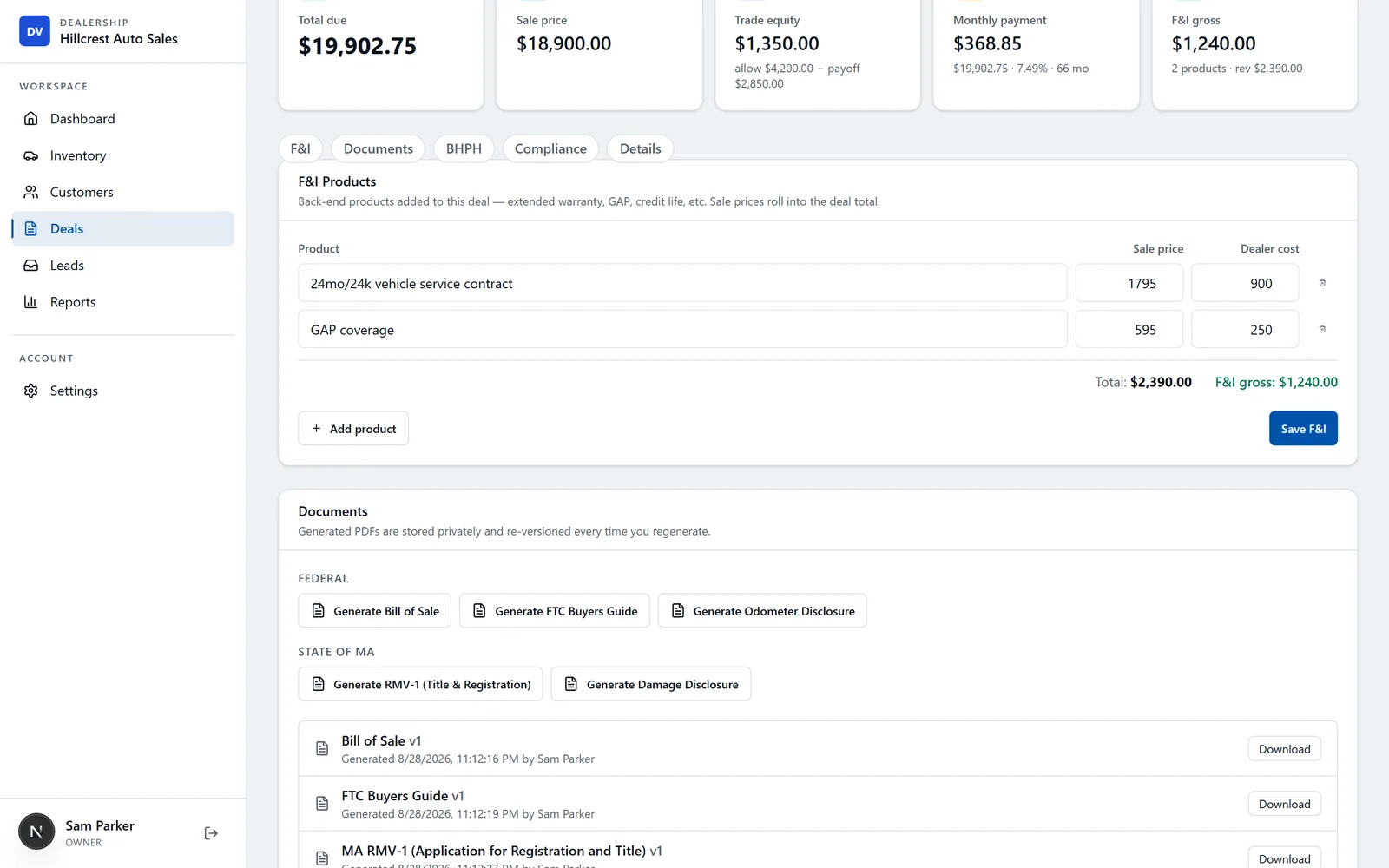
I built DealerVLO for my own lot in Massachusetts, where none of this applies. But California dealers run on it, and when the CARS Act took effect we built the paperwork in. Here's exactly what it does on a California deal:
- The 3-Day Right to Cancel disclosure generates as its own document on any used-car deal at $50,000 or less. It's filled from the deal: buyer and co-buyer, vehicle and VIN, the date the contract was signed, the last day to cancel, the odometer at signing and the mileage where the right ends, and the restocking fee for that sale price. It shows up on the deal's document checklist, so a jacket without it reads as incomplete.
- The first-page notice prints on DealerVLO's bill of sale and retail installment contract for California dealers, word for word from the statute.
- The language of negotiation. A California deal records the language it was mainly negotiated in. Choose one of the five 1632 languages and the disclosure gets a translated copy plus a Civil Code 1632 Language of Negotiation Acknowledgment. Have someone fluent read the translated copy before you rely on it, the same as you would with any translated form.
- REG 262. DealerVLO prints the deal's values onto a blank REG 262 you load in your printer. You still buy the security paper from the DMV, and signatures stay in ink.
What it doesn't do: it doesn't track an open cancellation window, log a return or time your refund. The deadline and the mileage cutoff are on the disclosure, and the process after that is yours. It doesn't make your wall sign. It doesn't translate your sales contract or produce a California finance contract, so keep using your purchase order or Rees-Levering contract for that. And it isn't legal advice.
Everything else in the deal is DealerVLO's normal work: the deal math, the doc fee set once and pre-filled on every deal, the FTC Buyers Guide and the state forms, and e-signatures for all of it. That's $29 a month, flat, unlimited users.
Build the whole deal — price, tax on the right base, doc, title, minus trade and down — into the out-the-door number and the monthly payment.
Open the Out-the-Door Price CalculatorFrequently asked questions
How many days does a buyer have to return a used car in California?
Three calendar days, starting the day after the contract is signed, ending at close of business on the third day (Civil Code 1784.31(i)). If you're closed to the public that day, it carries to your next open day. It applies to used vehicles at $50,000 or less and ends once the car's been driven more than 400 miles since signing.
Is it business days or calendar days?
The statute says calendar days. DMV's dealer notice OLIN 2026-10 says business days, and DMV's consumer page says three days including weekends. The statute controls, but given the conflict, agree on your store's policy with your attorney before a buyer tests it.
What restocking fee can I charge?
1.5% of the sale price, between $200 and $600, plus $1 a mile over 250 miles driven since signing, capped at $150 (Civil Code 1784.31(g)). You can deduct it from the refund. You can't charge for the right to cancel itself.
How fast do I have to refund?
Within 48 hours after the buyer cancels (1784.43(d)). Bank and card-processor delays aren't on you. On a check payment, you can wait until two business days after the payment is verified.
Did this replace the 2-day contract cancellation option?
Yes. The paid 2-day option under Vehicle Code 11713.21 (used cars under $40,000) was repealed as of October 1, 2026. The 3-day right is automatic and free to the buyer, apart from the restocking fee if they cancel.
What paperwork do I need?
The CARS Act notice on page one of the contract, the separate "3-Day Right to Cancel Used Car Purchase or Lease" disclosure (plus a translated copy when the deal was negotiated in a 1632 language), and the 36-point wall notice in every sales and contract room.
Does DealerVLO generate the 3-day disclosure?
Yes, on any California used-car deal at $50,000 or less, filled with that deal's deadline, odometer cutoff and restocking fee. The bill of sale and retail installment contract carry the first-page notice. It doesn't track cancellations or refunds, and it isn't legal advice.
Bottom line
The 3-day right turns every California used deal under $50,000 into a deal that isn't final for three days. You can't avoid it, so get the mechanics right. Write the odometer down at signing, put the real deadline and fee on the disclosure, hold trade-ins until the window closes, and have a 48-hour refund process with your lender before you need one.
The paperwork part shouldn't be something you retype. DealerVLO fills the disclosure from the deal and prints the first-page notice on the contract, alongside the rest of the jacket. Start the 14-day free trial and run your next California deal through it.
14-day free trial, then $29/mo · Cancel anytime
Get your annual turn rate and days' supply — and see what the same inventory could make at a faster turn.
Open the Inventory Turn Calculator