How to fill out the REG 343 in California
A field-by-field walkthrough of the California REG 343 (Application for Title or Registration) for licensed used car dealers — what goes in every section, who signs what, and the documents you attach. Verified against the official form as of September 2026.
Don't waste another second filling out the California REG 343.
Let DealerVLO fill out every form for you instantly.
Filing these every week? DealerVLO fills the REG 343 from the deal you already entered, $29/month flat. See pricing
Switching from another DMS? Compare DealerVLO to DealerCenter, Frazer, or Lot Wizard.
Filling out the CA REG 343 after a sale:
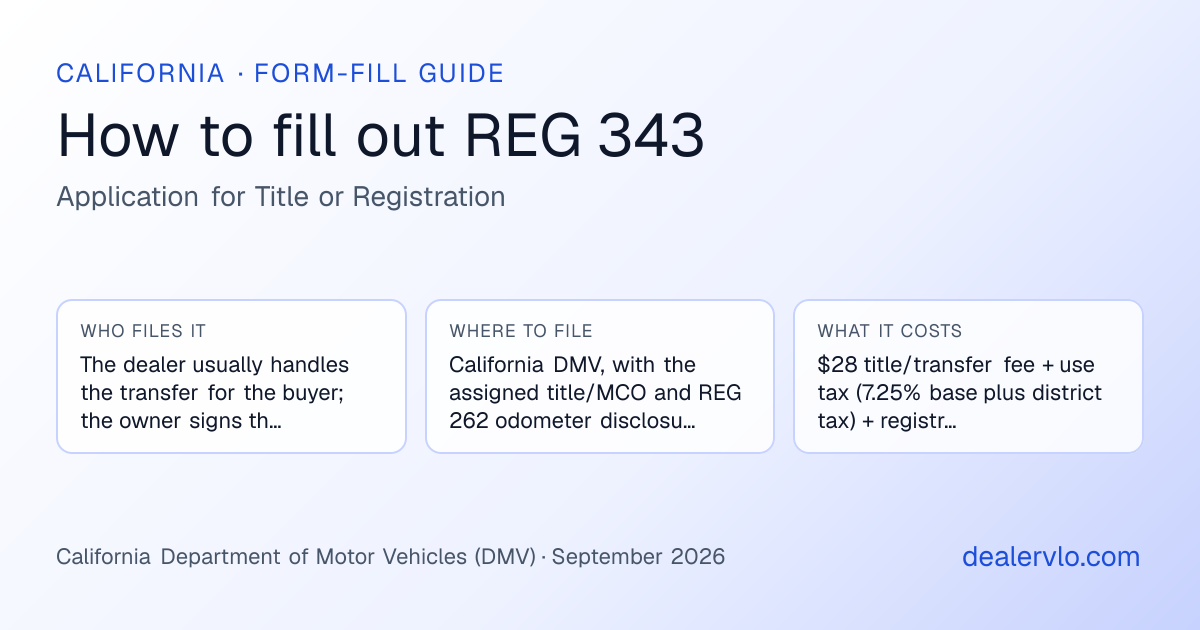
- What it is
- California's application to title/register a vehicle — used for out-of-state vehicles, first CA titling, and re-registration (not the routine in-state dealer sale, which uses REG 51)
- Who completes it
- The dealer usually handles the transfer for the buyer; the owner signs the certifications
- Where to file it
- California DMV, with the assigned title/MCO and REG 262 odometer disclosure
- Processing time
- Temporary registration at delivery when the dealer files; the title mails after processing
- Cost
- $28 title/transfer fee + use tax (7.25% base plus district tax) + registration fees (base $76, CHP $34, VLF 0.65% of value)
This guide is informational and does not replace the official California instructions. Always confirm the current form and procedure with California Department of Motor Vehicles (DMV) before you file.
See the CA REG 343 filled — from just a VIN
Enter a VIN, the buyer's name, and the price. We decode the vehicle and drop it onto the actual California REG 343 — the same fill DealerVLO produces from a deal. Watermarked preview; nothing is saved.
What the REG 343 is and why it matters
REG 343, the Application for Title or Registration, is how a vehicle gets onto California's rolls when there's no dealer report-of-sale to do it. For a dealer, that's most often an out-of-state vehicle — you bought it at auction in Arizona or Nevada and now it needs a California title — or a first-time registration. On a standard in-state used sale, the transfer runs on the REG 51 instead; this form covers the cases the REG 51 doesn't.
Two things trip people up, and both are California-specific. First, the cost section: California does NOT credit a trade-in against the tax — you owe use tax on the full price. Second, the base 7.25% rate is only the floor; district taxes stack on top and vary by where the vehicle is registered. This guide walks REG 343 section by section (current REV. 12/2022) and flags each place California differs from the state you might be used to.
REG 343 is California's general application to title and register a vehicle — but it isn't the form for every dealer sale. On a routine in-state used-car sale, a California dealer reports the transaction on the Report of Sale–Used Vehicle (REG 51) and files the transfer that way. REG 343 is the form you reach for when there's no dealer report-of-sale driving the title: registering an OUT-OF-STATE vehicle in California (the common case for dealers buying at out-of-state auctions), a first-time California title, or re-registering after salvage. The odometer disclosure and bill of sale usually ride on the REG 262 alongside it.
Documents to have before you start
Gather these before you complete the REG 343. A missing attachment is the number-one reason the California Department of Motor Vehicles (DMV) bounces a title application back.
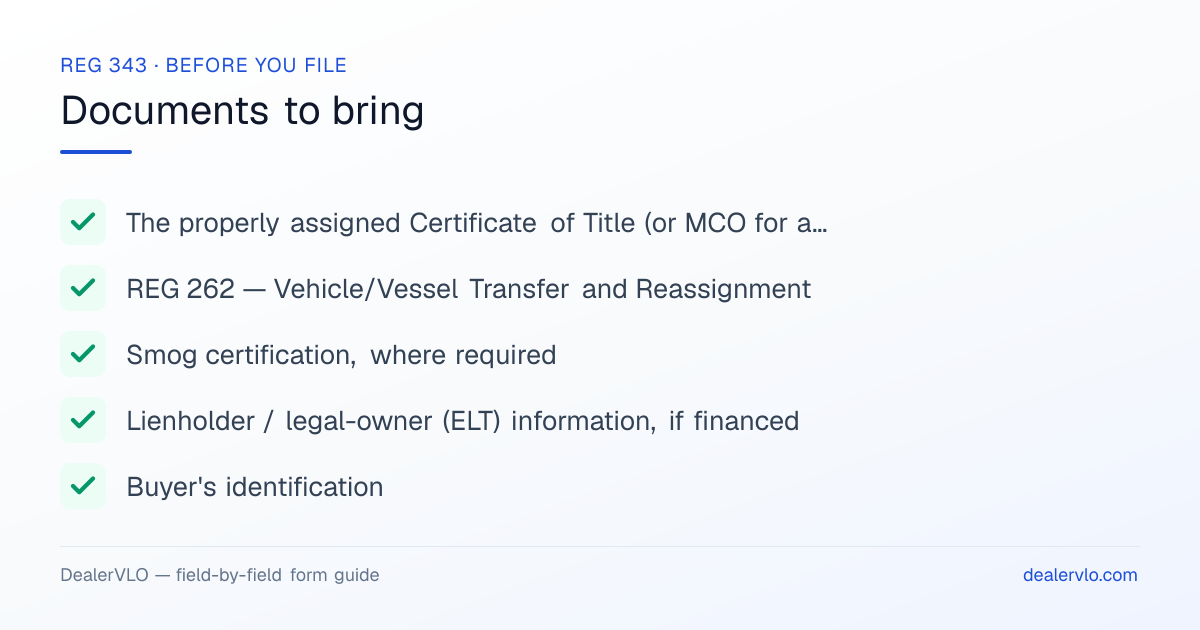
- The properly assigned Certificate of Title (or MCO for a new unit) — Ownership transferred to the buyer. For an out-of-state vehicle, the out-of-state title.
- REG 262 — Vehicle/Vessel Transfer and Reassignment — Carries the federal odometer disclosure and bill of sale. It's security paper (not downloadable) — order from the DMV; complete it in ink with the full VIN.
- Smog certification, where required — Required for most out-of-state and used vehicles being registered in California.
- Lienholder / legal-owner (ELT) information, if financed — Entered in Section 3 so the lien is recorded; enter "None" if there's no lienholder.
- Buyer's identification — Driver license or ID number, entered in Section 2.
- Out-of-state documentation, if applicable — A VIN verification and any tax paid to another state (credited toward California use tax) for a vehicle coming from outside California.
REG 343, section by section
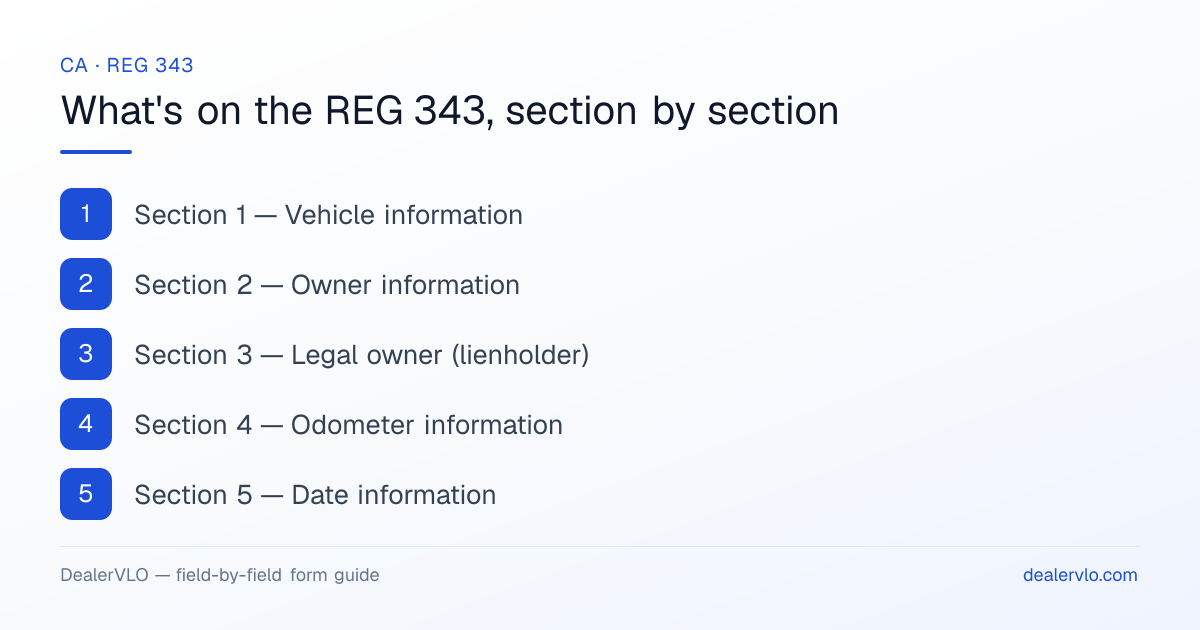
Section 1 — Vehicle information
Identifies the vehicle: VIN, make, year, model, fuel type, body type, and vehicle type (auto, commercial/pickup, motorcycle, trailer coach, off-highway). A commercial vehicle over the weight thresholds triggers extra forms and a possible motor-carrier permit, so the weight questions here matter for trucks.
| Field | Who fills it |
|---|---|
VIN Must match the title and the VIN plate. | You (dealer) |
Make, year model, model/series, body type | You (dealer) |
Fuel type | You (dealer) |
Vehicle type + commercial weight questions Commercial over the thresholds adds REG 4008 / motor-carrier steps. | You (dealer) |
Section 2 — Owner information
The buyer — the registered owner. Enter the true full name, driver license/ID number, and physical California address (plus a mailing address if different). Co-owners go on with the AND/OR joinder that decides whether one or both must sign to transfer later. Each owner signs on the reverse (Section 9).
| Field | Who fills it |
|---|---|
True full name of owner | Buyer |
Driver license / ID number + state | Buyer |
Physical residence/business address County of residence or where garaged sets the district tax. | Buyer |
Co-owner(s) with AND/OR designation | Buyer |
Section 3 — Legal owner (lienholder)
The lienholder, if the vehicle is financed. If there's none, you must write "None" — leaving it blank is a defect that bounces the application. An electronic-lien lender's ELT number goes here too.
| Field | Who fills it |
|---|---|
Legal owner / lienholder name Write "None" if there is no lienholder — don't leave blank. | You (dealer) |
ELT (electronic lienholder ID) | You (dealer) |
Lienholder address | You (dealer) |
Section 4 — Odometer information
The mileage reading as of the sale, with the ACTUAL-mileage certification. The discrepancy checkboxes ("not the actual mileage" / "exceeds mechanical limits") are there for a branded odometer — get this consistent with the REG 262 and the title.
| Field | Who fills it |
|---|---|
Odometer reading Match the REG 262 and the title disclosure. | You (dealer) |
Miles / kilometers + ACTUAL certification | You (dealer) |
Odometer discrepancy (if branded) | You (dealer) |
Section 5 — Date information
When the vehicle was purchased and, for a vehicle coming from out of state, when it entered California and was first operated here. These dates drive the deadlines and whether California use tax applies.
| Field | Who fills it |
|---|---|
Date vehicle purchased / acquired | You (dealer) |
Date entered / first operated in California For out-of-state vehicles. | You (dealer) |
New / used; purchased inside or outside CA | You (dealer) |
Section 6 — Cost information
The value the use tax is based on. Check Purchase, Gift, or Trade and enter the amount. The total cost includes the vehicle price plus permanently attached accessories — and here's the California catch: a trade-in allowance does NOT reduce the taxable price. You report and pay use tax on the full selling price even if the buyer traded a car in. A gift uses market value and needs a REG 256.
| Field | Who fills it |
|---|---|
Purchase price (or gift market value / trade value) Trade-in does NOT reduce the taxable price in California. | You (dealer) |
Acquired from: dealer / private party / family | You (dealer) |
Permanently attached accessories Included in cost; excludes tax, insurance, finance, and warranty. | You (dealer) |
CA Use tax & title fee calculator
Free · no signup · updates as you type
California use tax is 7.25% base PLUS the district tax where the vehicle is registered (districts add roughly 0.10%–2.00% each, so the real rate is higher than 7.25%). California does NOT credit a trade-in — tax is on the full price — and the doc fee is taxable. Title/transfer fee is $28; registration adds a base fee (about $76), a CHP fee (about $34), and the Vehicle License Fee (0.65% of the vehicle's value), so total registration varies. The doc-preparation fee is capped (commonly $85 for dealers who file electronically). Confirm current rates with the California DMV and CDTFA.
Stop re-keying this onto the REG 343.
DealerVLO works out the sales tax on every deal and fills the official CA REG 343 from it — with the VIN, buyer, and sale price — along with the bill of sale and the FTC forms. One screen, no re-keying.
14-day free trial — no charge until day 14, then $29/month. Cancel any time.
Sections 7–8 — Out-of-state and military
For a vehicle coming from another state: whether sales tax was paid elsewhere (credited toward California use tax), how it was last registered, and what happens to the out-of-state plates. Section 8 covers active-duty military, who may qualify for an exemption (REG 5045).
| Field | Who fills it |
|---|---|
Sales tax paid to another state Credited toward California use tax. | You (dealer) |
Out-of-state plate disposition | Buyer |
Military service (if applicable) | Buyer |
Section 9 — Certifications and signatures
Every owner signs under penalty of perjury, consenting to service of process (CVC §1808.21). A business owner adds the printed business name and an authorized-representative signature. This is the last box — and "complete both sides" is printed on the form because a missing reverse side is a common rejection.
| Field | Who fills it |
|---|---|
Owner signature(s) + printed name | Buyer |
Telephone or email | Buyer |
Date | Buyer |
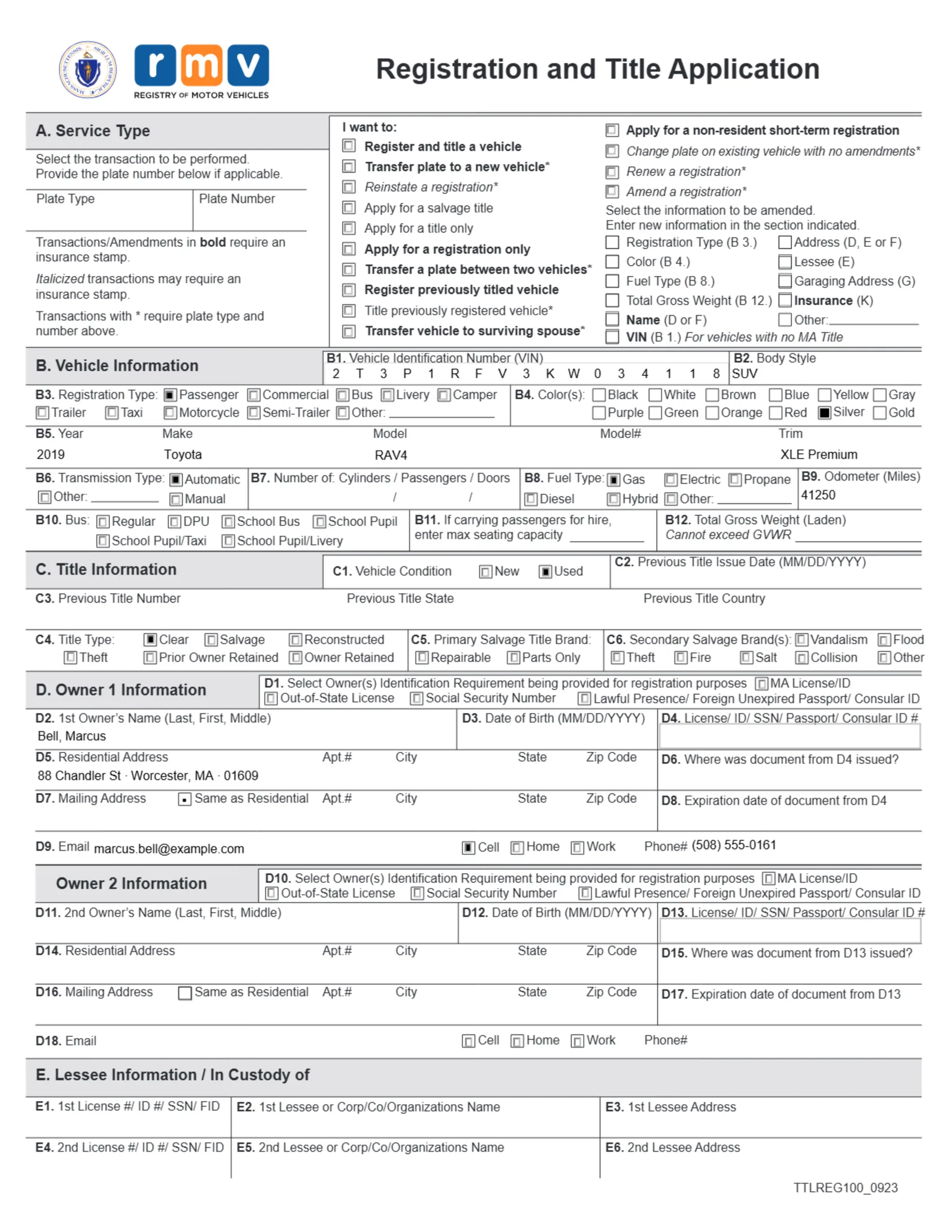
The REG 343 is one car's paperwork. A 20-second read on your lot, and the tax-and-fee math for the whole deal — built for dealers, no signup. Free calculators dealers actually use — no signup, no email.
DealerVLO fills the official California REG 343 straight from your deal — VIN-decoded vehicle, buyer, co-buyer, and sale price already in place. $29/month, free to try — cancel any time.
Common REG 343 mistakes that cause rejections
California is one of the few states that does NOT deduct a trade-in from the taxable price. You report and pay use tax on the full selling price, even when the buyer trades a car in. Using another state's trade-credit habit here understates the tax.
7.25% is the statewide floor; district taxes stack on top and vary by where the vehicle is registered, so the real rate is higher in most areas. Use the buyer's registration address and CDTFA's rate lookup — don't default to 7.25%.
If there's no lienholder, you must write "None" in Section 3. A blank there reads as incomplete and gets the application returned. Same idea on the REG 262: fill every field with the full VIN, and the signatures go on in ink.
REG 343 prints "complete both sides" because a missing reverse — especially the Section 9 signatures — is a routine rejection. Owners sign on the back; make sure every owner has signed before it goes in.
For a standard California in-state used-car sale, the transfer runs on the Report of Sale–Used Vehicle (REG 51), not REG 343. Reach for REG 343 when there's no dealer report-of-sale — an out-of-state vehicle, a first-time California title, or a re-registration.
Common questions
What is California REG 343 used for?+
REG 343 is the Application for Title or Registration — California's general form to title and register a vehicle. Dealers use it mainly for out-of-state vehicles being brought into California, first-time California titling, and re-registration after salvage. A routine in-state used sale is reported on the REG 51 instead.
REG 343 vs. REG 262 — what's the difference?+
REG 343 is the application to title/register the vehicle. REG 262 is a separate security-paper form that carries the federal odometer disclosure, the bill of sale, and a power of attorney. On a dealer transfer you typically file both — REG 343 as the application, REG 262 for the odometer and bill of sale. REG 262 isn't downloadable; order the blank forms from the DMV. DealerVLO can print a deal's values onto a blank REG 262 loaded in your printer, so you only add the ink signatures.
Does a trade-in lower sales tax in California?+
No. California does not credit a trade-in against the taxable price. You owe use tax on the full selling price of the vehicle even when the buyer trades one in — a notable difference from most other states.
What is the California car tax rate?+
The statewide base is 7.25%, but district taxes stack on top and vary by where the vehicle is registered (districts add roughly 0.10%–2.00% each). The actual rate in most areas is higher than 7.25%, so use CDTFA's rate lookup for the buyer's address.
How much are California title and registration fees?+
The title/transfer fee is $28. Registration adds a base fee (about $76), a CHP fee (about $34), and the Vehicle License Fee, which is 0.65% of the vehicle's value and depreciates over time — so the registration total varies by vehicle.
Is the doc fee taxable in California, and is it capped?+
Yes, the document-processing charge is taxable in California. It's also capped — commonly $85 for dealers who file electronically through a business-partner program (and less otherwise). Confirm the current cap, which is set by statute.
How long does a California dealer have to file the transfer?+
On a used-vehicle sale, the dealer generally submits the transfer application and fees to the DMV within 30 days of the sale and mails the dealer's notice within 5 days. The buyer's transfer fees are due within 10 days of the sale, with a penalty after 30 days.
Is there software that fills out the REG 343 automatically?+
Yes. Dealer management software like DealerVLO fills the California REG 343 from the deal you already entered — the VIN-decoded vehicle, buyer, co-buyer, lienholder, and sale price are placed for you instead of hand-writing them. For most states that's the official DMV form itself; where a state issues its form only through its own dealer portal, you get a print-ready worksheet with every value already in place. It's $29/month flat with a 14-day free trial, and the same deal also generates your federal documents (Bill of Sale, FTC Buyers Guide, odometer disclosure) and any other state's title forms.
- Title application forms in every state
- California used car dealer license
- California dealer plates
- How to fill out Arizona Form 96-0236
- All dealer guides
- E-signatures and e-titling for California dealers
- California certificate of repossession (REG 119)
- California lien release (REG 166)
- California REG 262 transfer and odometer disclosure
- California CARS Act dealer compliance
- How much is a dealer's license? Cost in every state
Stop filling out the REG 343 by hand.
DealerVLO fills the official CA REG 343 straight from your deal jacket — VIN-decoded vehicle, buyer, co-buyer, lienholder, and sale price already in place. Print, sign, and file in about 90 seconds. $29/month. 14-day free trial, cancel any time.
Curious how it works? See how DealerVLO auto-fills every dealer document — bill of sale, FTC Buyers Guide, odometer disclosure, and state title & registration paperwork for all 50 states, from one deal.
Bond amounts, fees, and form rules change. Get a short email when your state does. No spam, unsubscribe anytime.