How to get dealer plates in California
What California dealer plates cost, the types you can get, how to apply, and the rules on using them. Verified as of October 2026.
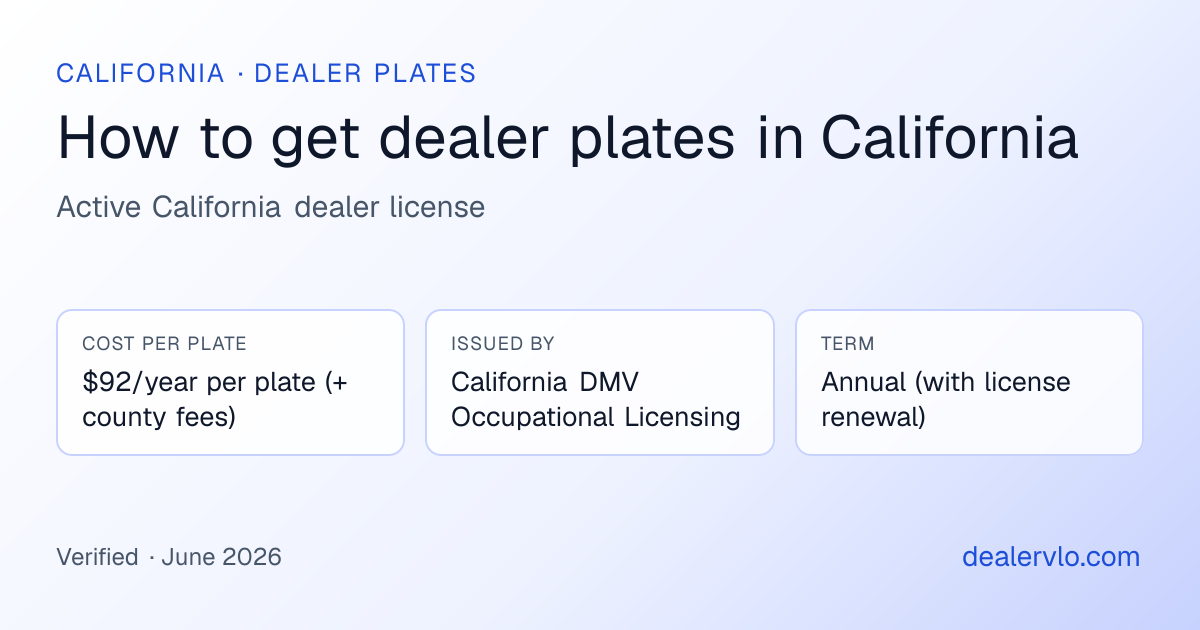
CA dealer plates at a glance:
- Issued by
- California DMV Occupational Licensing
- Cost per plate
- $92 per plate per year (+ county fees)
- Requirement
- Active California dealer license
- Use them for
- Cars you own or lawfully possess; test drives up to 7 days
- Term
- Renews with your dealer license
Informational only — confirm current fees and rules with the California DMV (Occupational Licensing) before you apply.
Plates are the easy part. These take 20 seconds and tell you what your inventory is costing you while it sits. Free calculators dealers actually use — no signup, no email.
DealerVLO tracks your inventory, deals, and paperwork so the plates are the only thing left on your list. $29/month, free to try — cancel any time.
What California dealer plates are
California dealer plates are what the Vehicle Code calls special plates. They carry your dealer number and let you drive cars you own or lawfully possess without registering each one (Vehicle Code §§11714–11715). DMV Occupational Licensing issues them, the same unit that issues your dealer license.
They're optional. You don't need plates to get licensed, and they cost $92 each per year plus county fees. The rules that trip dealers up are about who may drive on them: owners and officers can drive for any purpose, regular employees only on the job, and a test-driving customer for up to seven days.
Other California forms dealers file
- Form REG 343: California title application
- California certificate of repossession (REG 119)
- California lien release (REG 166)
- California REG 262 transfer and odometer disclosure
Also for California: California dealer license
Same form in other states: Title applications · Repossession · Lien release · Odometer disclosure
Types of CA dealer plates
$92 per plate plus any county fees. Each plate shows your dealer number and its own identifying number. You move them between cars you own or lawfully possess.
The motorcycle version, at $94 per plate plus county fees.
These aren't dealer plates. When you sell a car that has no plates, you attach the temporary plates the report-of-sale system issues. They're good until the buyer gets plates and a registration card, or 90 days from the sale, whichever comes first (Vehicle Code §4456).
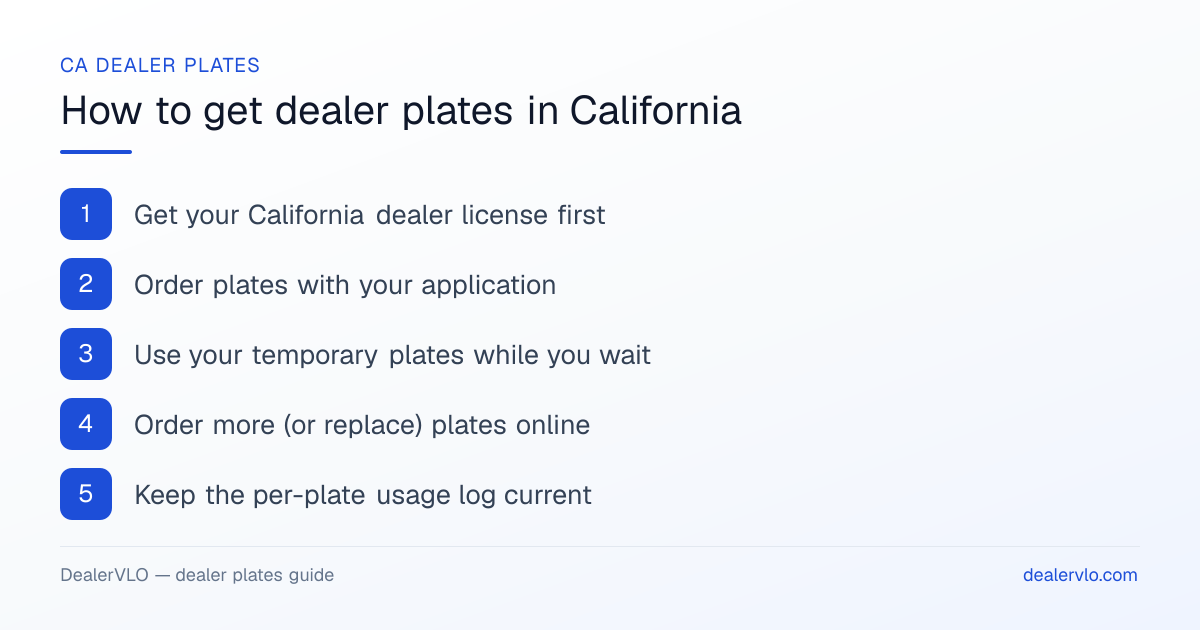
How to get dealer plates in California
- 1
Get your California dealer license first
Only licensed dealers can get special plates. The established place of business, bond, dealer education, exam, and Live Scan all come first. See our California dealer license guide for the full list.
- 2
Request plates with your application or renewal
Plates are optional. If you want them, order them and pay $92 per plate ($94 for motorcycle plates) plus any county fees for your business location.
- 3
Keep the registration card with each plate
Each plate comes with a registration card. The Vehicle Code says to keep the card, or a copy, with the vehicle wearing that plate (§11715(f)).
- 4
Order more or replace plates on form OL 22
For extra sets, or to replace lost or stolen plates, stickers, or registration cards, send form OL 22 with the fees to Occupational Licensing. Report lost or stolen plates to your local police or sheriff too.
- 5
Renew or surrender plates with your license
Plate fees are part of your license renewal. If you aren't renewing every plate, file form OL 247 and surrender the plates, registration cards, and unused stickers you no longer need.
Rules on using CA dealer plates
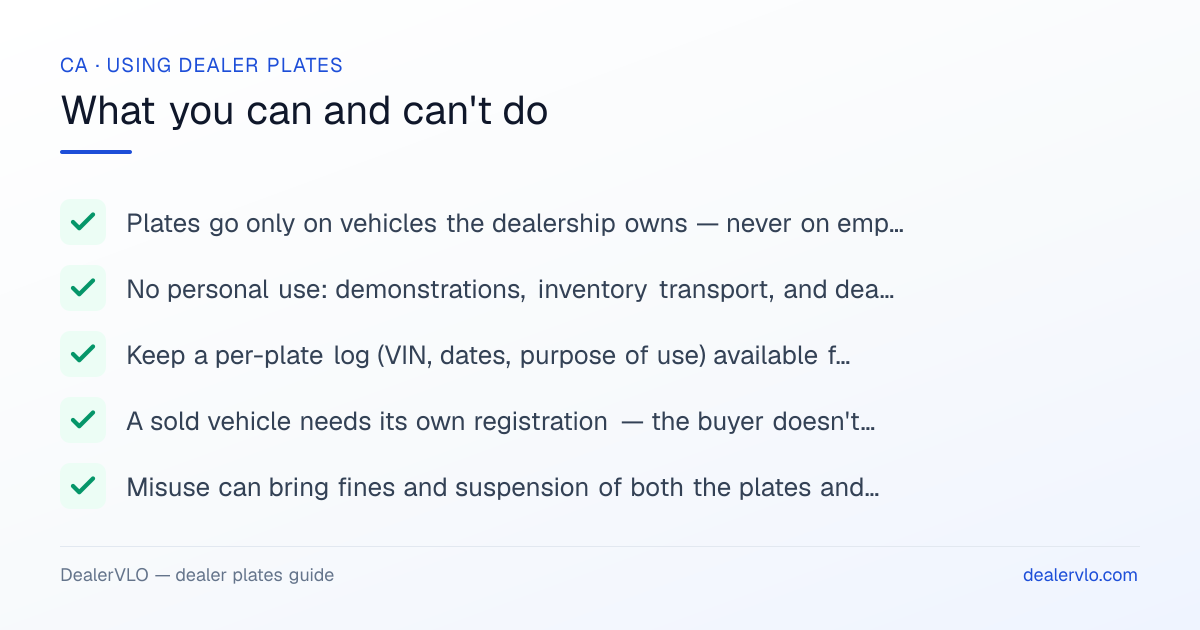
- Only on vehicles the dealership owns or lawfully possesses (13 CCR §201.00(a))
- Owners, general partners, LLC managers, and corporate officers who actively run the business may drive for any purpose. A general, business, or sales manager qualifies only if nobody fills those roles
- Regular employees may drive only within the course and scope of their job
- Any licensed driver may drive if one of those owner-level people is in the car. A member of their household may drive alone only to pick them up or drop them off
- A prospective buyer may test drive for up to 7 days. If no salesperson rides along, the driver must carry your letter of authorization naming the vehicle, the time period, and the driver
- Keep the plate's registration card, or a copy, in the vehicle (Vehicle Code §11715(f))
- Never on work or service vehicles, or on a truck hauling more than one load of cars for sale. No rentals or leases either, except cars leased to your salespeople for display or demonstration
- Any use the regulation doesn't list is prohibited (13 CCR §201.00(i))
Common questions
How much are dealer plates in California?+
$92 per plate per year, plus county fees where they apply. Motorcycle dealer plates are $94. You pay when you order and again at each license renewal for every plate you keep.
How do I get dealer plates in California?+
Get your dealer license from DMV Occupational Licensing first. Then order plates and pay $92 each plus county fees. For more plates later, or replacements, file form OL 22 with Occupational Licensing.
How many dealer plates can a California dealer get?+
The Vehicle Code doesn't set a number. You can order one set or several, paying $92 for each plate. Order what your inventory and staff actually use, since you pay for every plate again at renewal.
Can I use California dealer plates for personal driving?+
It depends on who you are. Owners, general partners, LLC managers, and corporate officers who actively run the business may drive on dealer plates for any purpose, which includes personal driving. Regular employees can't. They may drive on the plates only within the course and scope of their job (13 CCR §201.00).
Can employees drive cars with dealer plates in California?+
Yes, while they're working: moving inventory, running a car to the shop, delivering a car. Outside the job, an employee may drive only if an owner-level person from the regulation is in the car. A household member of an owner-level person may drive alone only to pick them up or drop them off.
How long can a customer test drive on a California dealer plate?+
Up to 7 days (Vehicle Code §11715(a); 13 CCR §201.00(f)). A salesperson doesn't have to ride along. If one doesn't, the customer must carry your letter of authorization naming the vehicle, the time period, and who may drive.
What should be in the car if I get pulled over on dealer plates in California?+
The registration card for that plate, or a copy. The Vehicle Code requires you to keep it with the vehicle. A test-driving customer without a salesperson, or a driver using the plate for a special event, also needs your letter of authorization. Beyond that, an officer is checking whether the driver and the use are allowed under the rules above.
Do buyers drive off on my dealer plates?+
No. If the car has no plates when you sell it, attach the temporary license plates from the report-of-sale system. They're valid until the buyer receives plates and a registration card, or 90 days from the sale, whichever comes first.
- California used car dealer license guide
- Used car dealer license guides by state
- Dealer license cost calculator
- How to fill out Form REG 343 (California)
- E-signatures and e-titling for California dealers
- California certificate of repossession (REG 119)
- California lien release (REG 166)
- California REG 262 transfer and odometer disclosure
- California CARS Act dealer compliance
- Dealer plates in every state: what they are and how to get them
- Dealer temporary tags: rules by state
- Title application forms in every state
Plates on the car? Run the rest of the deal in DealerVLO.
Inventory, the deal jacket, and every CA + federal form your sales need — filled automatically from one deal. $29/month. 14-day free trial, cancel any time.