How to fill out the REG 262 in California
A field-by-field walkthrough of the California REG 262 (Vehicle/Vessel Transfer and Reassignment Form) for licensed used car dealers — what goes in every section, who signs what, and the documents you attach. Verified against DMV's Vehicle Industry Registration Procedures Manual and its REG 262 revision bulletin (VIN 2025-09) as of October 2026.
Don't waste another second filling out the California REG 262.
Let DealerVLO fill out every form for you instantly.
Filing these every week? DealerVLO fills the REG 262 from the deal you already entered, $29/month flat. See pricing
Switching from another DMS? Compare DealerVLO to DealerCenter, Frazer, or Lot Wizard.
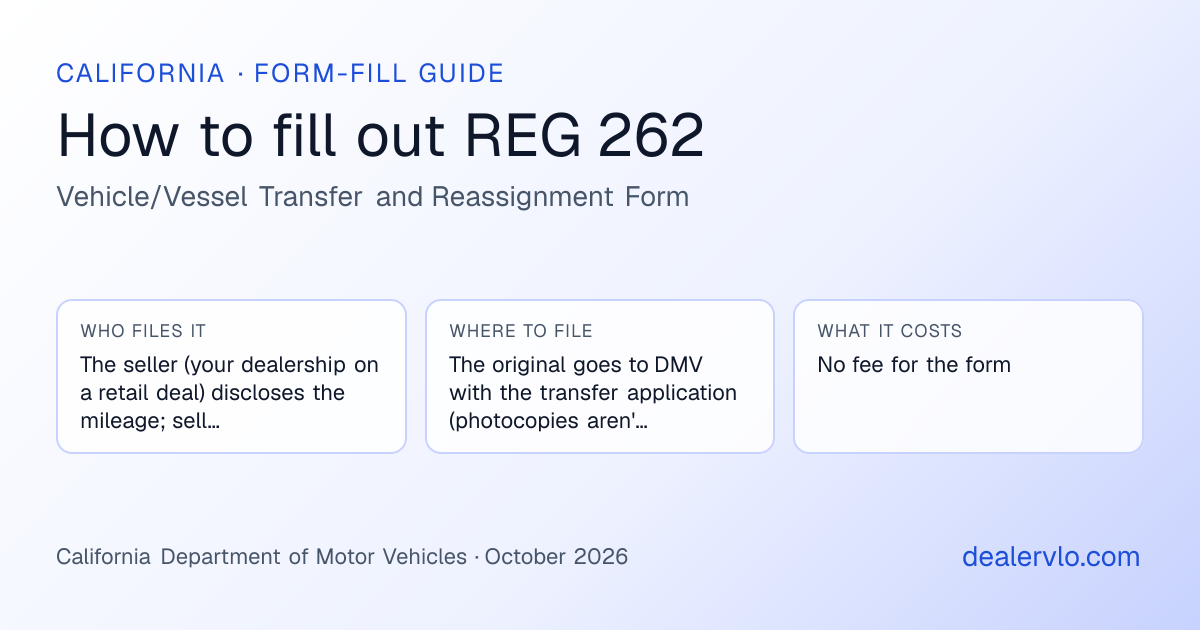
Filling out the CA REG 262 after a sale:
- What it is
- California's separate odometer disclosure, with an optional bill of sale and power of attorney, on DMV security paper
- Who completes it
- The seller (your dealership on a retail deal) discloses the mileage; seller and buyer both sign the same form in ink
- Where to file it
- The original goes to DMV with the transfer application (photocopies aren't accepted); dealers keep a copy for 5 years
- Processing time
- None of its own. It goes with the title paperwork
- Cost
- No fee for the form
This guide is informational and does not replace the official California instructions. Always confirm the current form and procedure with the California Department of Motor Vehicles before you file.
The REG 262 is one car's paperwork. A 20-second read on your lot, and the tax-and-fee math for the whole deal — built for dealers, no signup. Free calculators dealers actually use — no signup, no email.
DealerVLO fills the official California REG 262 straight from your deal: it prints onto the blank REG 262 you load in your printer, placing the VIN, year and make, your dealership as seller with its dealer number and address, the buyer's name in the Section 2 bill of sale, the buyer's address and driver license number in Section 4, the sale date and price, the odometer reading in whole miles, and its status box. The buyer's printed name and signature in Section 4, the plate, the gift box and Section 5 stay for hand entry, as DMV requires. The overlay is calibrated to the REG 262 REV 10/2011 layout; on newer REV 1/2025 stock, print one deal on plain paper first and hold it against a blank form to check alignment. $29/month, free to try — cancel any time.
What the REG 262 is and why it matters
REG 262 is the Vehicle/Vessel Transfer and Reassignment Form. On most California dealer sales, the mileage goes on the title: the owner discloses it on the front, and each dealer discloses it in the Dealer Transactions Only section on the back. The REG 262 is where the disclosure goes when the title can't carry it.
DMV's Vehicle Industry Registration Procedures Manual says when: the title is a noncomplying title, the title isn't available at the time of transfer, a REG 227 is part of the application, the odometer section on the title or a REG 397 has an error or alteration, or there are multiple transfers. On a dealer deal the dealer is the seller and the new registered owner is the buyer. This guide walks the form section by section, covers who writes what by hand, and the federal rules behind it (49 CFR Part 580).
REG 262 is California's odometer disclosure statement, with a bill of sale and a power of attorney on the same page. DMV's September 2025 industry bulletin (VIN 2025-09) announced REG 262 REV 1/2025, in production from November 2025: it references the REG 227, drops "Daytime" from the phone fields, and adds a privacy statement. Earlier revisions stay acceptable until supplies run out. There's no PDF to download. DMV lists the REG 262 among the forms that may not be reproduced, and the original has to go in with the title paperwork.
Documents to have before you start
The REG 262 rides with the transfer application, so the paperwork around it has to agree with it.
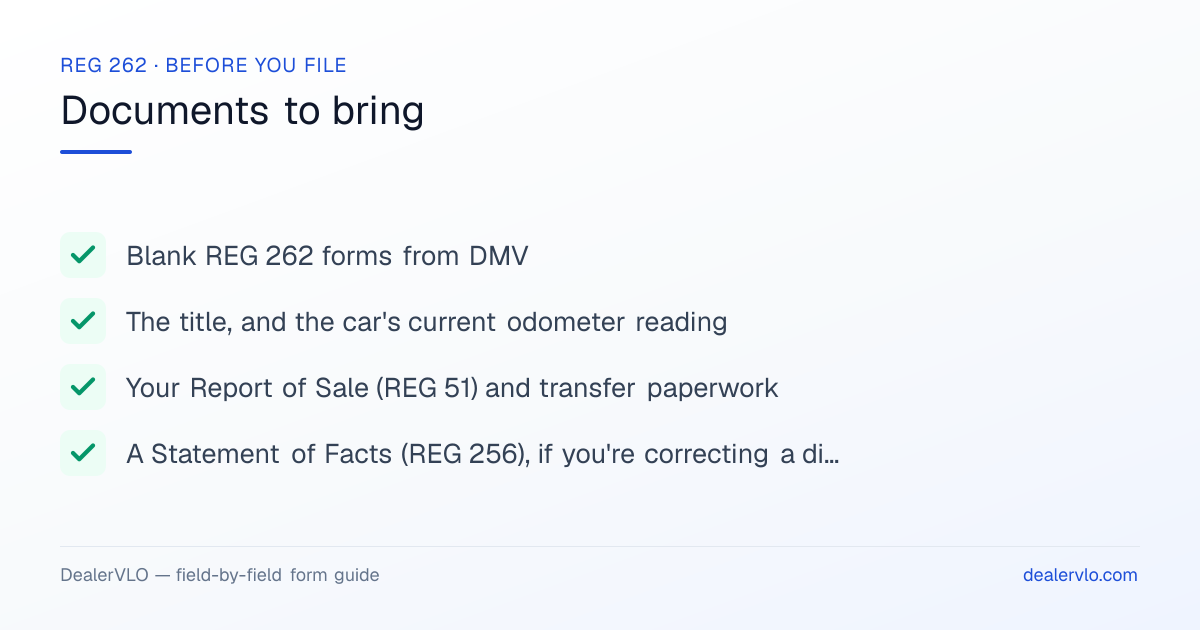
- Blank REG 262 forms from DMV — It isn't downloadable and may not be reproduced. DMV's Form Orders page says businesses order forms in bulk on letterhead (form number, title, quantity, street address, contact name, phone) from the Materials Management Section, which processes requests within 21 working days when the form is in stock.
- The title, and the car's current odometer reading — Read the odometer on the day of sale. The REG 262 exists because something about the title won't carry the disclosure, so know which case you're in before you start.
- Your Report of Sale (REG 51) and transfer paperwork — DMV's manual gives dealers 30 days from the date of sale to submit the transfer application and fees on a used vehicle without penalties. See the REG 343 guide for the out-of-state and first-title cases.
- A Statement of Facts (REG 256), if you're correcting a disclosure — When the title's odometer section has an error, DMV wants a REG 262 for the disclosure plus a REG 256 explaining why it's separate.
REG 262, section by section
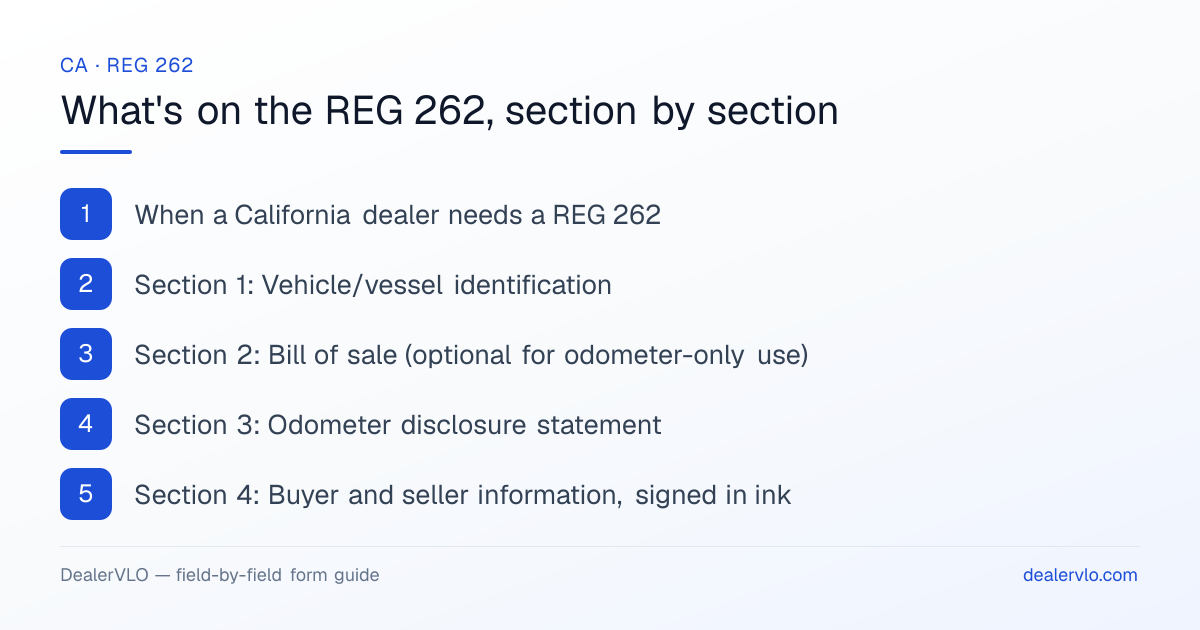
When a California dealer needs a REG 262
Under DMV manual section 5.075, the REG 262 carries the odometer disclosure when the title is noncomplying, the title is unavailable at the time of transfer, a REG 227 (Application for Replacement or Transfer of Title) is part of the application, the odometer section of a complying title or a REG 397 has an error or alteration, or there are multiple transfers. Two dealer-specific cases from the manual: when the dealer reassignment section on the title runs out of room, a REG 262 is required and should show the dealer's name and number (section 11.040). And when the dealer section is already completed and another disclosure is needed, a separate REG 262 goes in (section 5.070). On multiple transfers, each transfer gets its own REG 262 signed by that buyer and seller. DMV's hardship policy of taking only the last buyer and seller is for private parties and doesn't apply to dealer transactions.
| Field | Who fills it |
|---|---|
Noncomplying or unavailable title Disclosure goes on a REG 262 signed by both parties. | You (dealer) |
Dealer reassignment section full Include your dealer name and number. | You (dealer) |
Error on the title's odometer section REG 262 plus a REG 256. | You (dealer) |
Section 1: Vehicle/vessel identification
The top row identifies the vehicle: VIN, year model, make, and the license plate. DMV's manual is blunt about one thing: the complete VIN must be shown or the application comes back as incomplete. Copy it from the title, all 17 characters, and fill the form in ink, not pencil.
| Field | Who fills it |
|---|---|
Vehicle identification number The complete VIN or DMV returns it. | You (dealer) |
Year model and make | You (dealer) |
License plate number | You (dealer) |
Section 2: Bill of sale (optional for odometer-only use)
Section 2 is a bill of sale provided for convenience: the seller's name, the buyer's name, the date of sale, and the selling price, or the gift value if it's a gift. DMV says this section doesn't have to be completed when the REG 262 is used only for the odometer disclosure. If you do use it as a bill of sale, the seller's signature in Section 4 is required.
| Field | Who fills it |
|---|---|
Seller name (your dealership) | You (dealer) |
Buyer name(s) | You (dealer) |
Date of sale | You (dealer) |
Selling price | You (dealer) |
Gift value Only if the vehicle was a gift. Not a retail sale. | You (dealer) |
Section 3: Odometer disclosure statement
This is the part the form exists for. The seller writes the odometer reading at the time of sale in whole miles. 49 CFR 580.5 says the reading doesn't include tenths. With no box checked, the seller certifies the reading is the actual mileage. One box certifies the mileage is in excess of the odometer's mechanical limits (it has rolled over). The other certifies the reading is not the actual mileage, the "warning, odometer discrepancy" case. Both seller and buyer sign for this section. DMV's manual says errors or alterations void the odometer disclosure, so a mistake means a fresh form, not a correction.
| Field | Who fills it |
|---|---|
Odometer reading (no tenths) Read it on the day of sale. | You (dealer) |
Mileage in excess of mechanical limits Odometer rolled over. | You (dealer) |
Not the actual mileage (odometer discrepancy) Known discrepancy or no valid reading. | You (dealer) |
Section 4: Buyer and seller information, signed in ink
Section 4 holds the buyer rows and the seller rows: printed name, signature, date, driver license / ID number (your dealer number goes there for the dealership), mailing address, city, state, ZIP, and phone. The form carries a certification under penalty of perjury under California law. DMV's manual section 5.025 sets the hand-entry rules: odometer disclosure needs original signatures from the seller and buyer, and signatures by power of attorney aren't accepted. The printed name and signature of an individual buyer or seller must be done by hand in ink. A business can show its name handprinted, typed, or computer-generated, but the authorized agent's countersignature has to be handwritten in ink. When the title shows several owners, one seller's and one buyer's original signature is enough.
| Field | Who fills it |
|---|---|
Buyer's printed name and signature By hand, in ink. | Buyer |
Buyer's date, DL/ID number, mailing address, phone | You (dealer) |
Seller's name (your dealership) A business name can be computer-generated. | You (dealer) |
Seller's countersignature Your authorized agent, by hand in ink. | You (dealer) |
Seller's date, dealer number, address, phone | You (dealer) |
Section 5: Power of attorney, and the federal secure POA rule
Section 5 is a power of attorney provided for convenience. DMV says it isn't needed when the form is used only for the odometer, but it's required when an attorney-in-fact signs the title for anything other than the odometer. It doesn't let anyone sign the odometer disclosure itself, since DMV rejects odometer signatures by power of attorney. The federal exception is narrower: 49 CFR 580.13 allows a power of attorney for mileage disclosure only on a form the state issues, printed by a secure process, when the title is held by a lienholder or lost. If you get one wrong, DMV's manual says to discard it and submit a new REG 262. If a REG 262's odometer section is voided but Section 2 or Section 5 was used, keep that original with the application anyway.
| Field | Who fills it |
|---|---|
Power of attorney (Section 5) Only when someone signs the title on another's behalf. By hand. | Buyer |
Filing the original, and the 5-year copy rule
The original REG 262 goes to DMV with the transfer application. DMV doesn't accept a photocopy of the disclosure, though copies are fine for the buyer and seller. 49 CFR 580.8 requires a dealer to keep a copy of every odometer statement it issues or receives for five years, at its primary place of business, filed so it can be pulled on request. An electronic copy counts. That includes the disclosures customers give you on trade-ins, where they're the seller and you're the buyer.
| Field | Who fills it |
|---|---|
Original to DMV with the transfer application | You (dealer) |
Dealer copy, kept 5 years Trade-in disclosures included. | You (dealer) |
Common REG 262 mistakes that cause rejections
DMV wants the original disclosure, and the REG 262 can't be reproduced. Use the blank security-paper forms DMV supplies.
Errors or alterations void the odometer disclosure. Start a new REG 262 and keep the original if its bill of sale or power of attorney section was used.
DMV returns the application as incomplete without the complete VIN in Section 1.
Each transfer needs its own REG 262 signed by that buyer and seller. DMV's last-buyer-and-seller shortcut is for private parties only.
Under 49 CFR 580.17, model year 2011 and newer need a disclosure until they're 20 years old. DMV's own manual applies the 20-model-year rule to transfers since January 1, 2021.
Common questions
Is the REG 262 California's odometer disclosure statement?+
Yes. The Vehicle/Vessel Transfer and Reassignment Form (REG 262) has an odometer disclosure statement in Section 3, plus an optional bill of sale (Section 2) and power of attorney (Section 5). On most sales the mileage goes on the title itself. The REG 262 is used when the title can't carry it: a noncomplying or unavailable title, a REG 227 application, an error in the title's odometer section, or multiple transfers.
Can I download a California odometer disclosure statement PDF?+
Not the REG 262. It's printed on DMV security paper, and DMV lists it among the forms that may not be reproduced. The original has to go to DMV with the transfer application. Dealers order blank stock from DMV. DMV's Bill of Sale (REG 135) and Power of Attorney (REG 260) are downloadable, but neither is an odometer disclosure.
Who signs the REG 262 on a dealer sale?+
Both sides, on the same form. On a dealer transaction DMV treats the dealer as the seller and the new registered owner as the buyer. Your dealership's name can be typed or computer-generated, but your authorized agent countersigns by hand in ink. The buyer hand-prints their name and signs in ink. Signatures by power of attorney aren't accepted for the odometer disclosure.
Which vehicles need an odometer disclosure in California?+
DMV's manual says a vehicle transferred on or after January 1, 2021 that is less than 20 model years old needs an odometer disclosure. That matches 49 CFR 580.17: model year 2010 and older are exempt, and model year 2011 and newer need one until they're 20 years old. Vehicles over 16,000 lbs GVWR and vehicles that aren't self-propelled are exempt.
What if I make a mistake on the REG 262?+
Start a new one. Errors or alterations void the odometer disclosure. DMV's manual says to keep the original REG 262 with the application when its bill of sale or power of attorney section was completed. If the error is on the title's odometer section instead, submit a REG 262 for the disclosure and a Statement of Facts (REG 256) explaining why it's separate.
How long do California dealers keep odometer statements?+
Five years. 49 CFR 580.8 requires dealers to keep a copy of every odometer statement they issue or receive, at their primary place of business, in an order that allows systematic retrieval. An electronic copy is acceptable.
What's the penalty for a false odometer statement?+
Under federal law, 49 U.S.C. 32710, a person who violates the odometer rules with intent to defraud is liable for three times the actual damages or $10,000, whichever is greater, plus costs and attorney fees. The buyer has two years from when the claim accrues to sue. The REG 262 also carries a certification under penalty of perjury under California law.
Is there software that fills out the REG 262 automatically?+
Yes. Dealer management software like DealerVLO fills the official California REG 262 from the deal you already entered: it prints onto the blank REG 262 you load in your printer, placing the VIN, year and make, your dealership as seller with its dealer number and address, the buyer's name in the Section 2 bill of sale, the buyer's address and driver license number in Section 4, the sale date and price, the odometer reading in whole miles, and its status box. The buyer's printed name and signature in Section 4, the plate, the gift box and Section 5 stay for hand entry, as DMV requires. The overlay is calibrated to the REG 262 REV 10/2011 layout; on newer REV 1/2025 stock, print one deal on plain paper first and hold it against a blank form to check alignment. Signatures stay blank for ink. It's $29/month flat with a 14-day free trial, and the same deal also generates your federal documents (Bill of Sale, FTC Buyers Guide) and your state title paperwork.
- How to fill out the California REG 343 title application
- Odometer disclosure statements by state
- How to get a California used car dealer license
- California dealer plates
- E-signatures and e-titling for California dealers
- California certificate of repossession (REG 119)
- California lien release (REG 166)
- California CARS Act dealer compliance
- Title application forms in every state
- How much is a dealer's license? Cost in every state
Stop filling out the REG 262 by hand.
DealerVLO fills the official CA REG 262 straight from your deal jacket: it prints onto the blank REG 262 you load in your printer, placing the VIN, year and make, your dealership as seller with its dealer number and address, the buyer's name in the Section 2 bill of sale, the buyer's address and driver license number in Section 4, the sale date and price, the odometer reading in whole miles, and its status box. The buyer's printed name and signature in Section 4, the plate, the gift box and Section 5 stay for hand entry, as DMV requires. The overlay is calibrated to the REG 262 REV 10/2011 layout; on newer REV 1/2025 stock, print one deal on plain paper first and hold it against a blank form to check alignment. $29/month. 14-day free trial, cancel any time.
Curious how it works? See how DealerVLO auto-fills every dealer document — bill of sale, FTC Buyers Guide, odometer disclosure, and state title & registration forms for all 50 states, from one deal.
Bond amounts, fees, and form rules change. Get a short email when your state does. No spam, unsubscribe anytime.