E-Signatures & E-Titling by State: What Car Dealers Can Do Electronically
Can you close a car deal electronically in your state? What dealers can e-sign everywhere, and how e-titling, ELT and DMV e-filing work in 22 states.
Part of the E-signatures & e-titling guide: E-Signatures for Car Dealers: Get the Bill of Sale Signed Without the Printer
You agreed the deal, the numbers pencil, and now you're walking to the printer for the bill of sale, the odometer disclosure, the installment contract and the title application, to collect wet signatures you'll scan back in five minutes later. If the co-buyer isn't in the showroom, the whole thing waits.
Most of that can be electronic in every state. What changes from state to state is the title side: how you file title and registration, and how liens are held. This guide covers the part that's the same everywhere once, then goes state by state through 22 states. This isn't legal advice. Rules and local practice change, so confirm your process with your DMV, county office and attorney.
The part that's the same in every state
An electronic signature on a car deal is legally binding across the U.S. The federal ESIGN Act applies everywhere, and every state except New York has adopted the Uniform Electronic Transactions Act (UETA). New York has its own Electronic Signatures and Records Act (ESRA), and for a retail deal the practical result is the same.
An electronic signature holds when three things are true: the buyer agreed to sign electronically, they intended to sign, and the signed record is kept and can be reproduced. That covers the documents you control at the desk: the bill of sale / buyer's order, the retail installment contract on a financed deal, and the federal odometer disclosure where the system supports electronic disclosure.
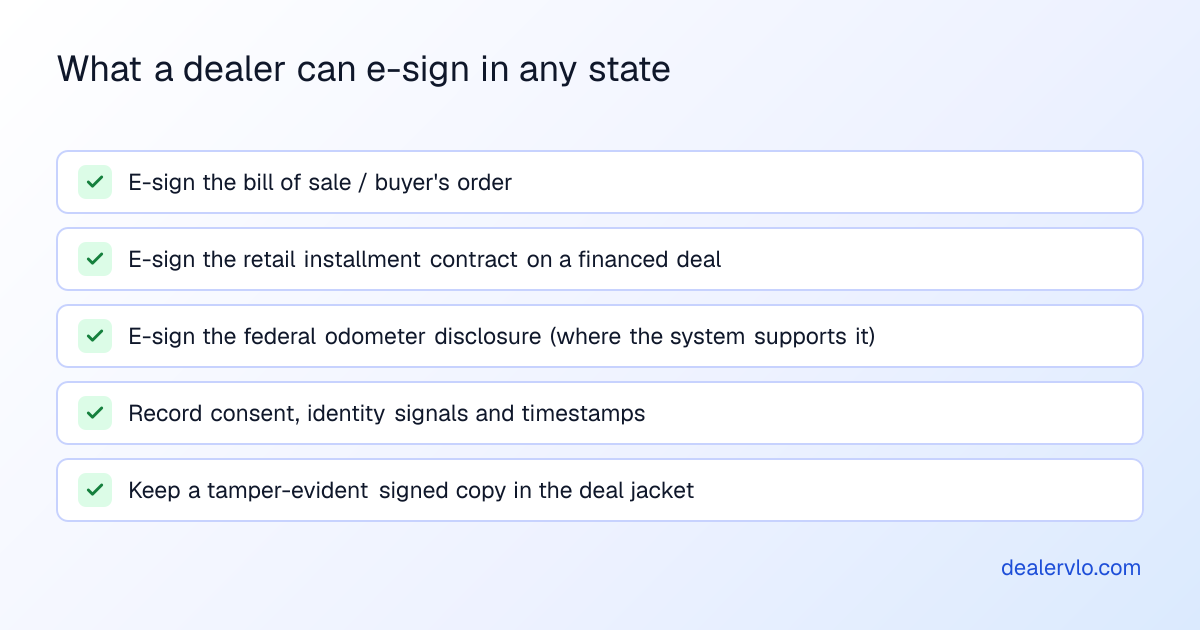
What makes an e-signature hold up isn't the signature image. It's the evidence around it: the buyer's recorded consent, their IP address and device, the timestamps, and a tamper-evident copy of the signed document. That's the difference between "we e-signed it" and a signature you can defend later.
In DealerVLO, that evidence is captured on every signing. You send the deal jacket for signature on a tablet at the desk or by a link to the buyer's and co-buyer's phones, and each signed PDF ends with a certificate of completion listing every signer. The details of how it works are in e-signatures for car dealers.
14-day free trial, then $29/mo · Cancel anytime
What differs by state: the title side
Three things vary, and they're what the state sections below cover:
- How title and registration get filed. Some states run a mandatory dealer system (Texas webDEALER, Georgia ETR, Maryland ERT, Wisconsin eMV PARTNER). Others route dealers through approved third-party providers, county offices, or, as in Missouri, have the buyer title the car at a license office.
- How liens are held. Electronic Lien and Title (ELT) programs keep the title electronic while a lien exists. Several states make ELT mandatory for lienholders above a volume threshold, which matters if you run buy-here-pay-here.
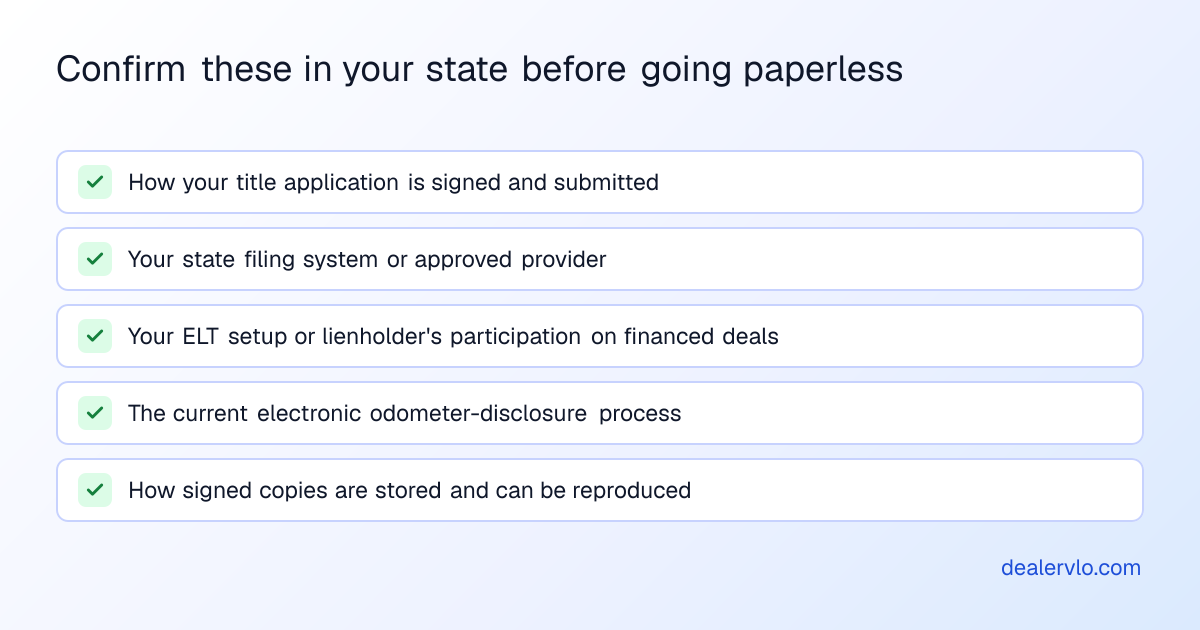
- Whether the title application takes an e-signature. That usually depends on how you file (state system, provider or counter), so it's the one item to confirm locally everywhere.
The 22 states at a glance
| State | Title & registration filing | Electronic liens (ELT) |
|---|---|---|
| Arizona | ADOT MVD, Authorized Third Party providers, AZ MVD Now | Mandatory for lienholders since 2010 |
| California | DMV Business Partner Automation (BPA); required for new-vehicle dealers | ELT for financed titles |
| Colorado | EVTR at point of sale (generally opt-in) | ELT (generally opt-in) |
| Florida | Optional Electronic Filing System (EFS) | Mandatory since Jan 1, 2013 for regular financers |
| Georgia | ETR, mandatory for dealers since Jan 1, 2018 | Not covered here |
| Illinois | ERT through approved service providers | Confirm with your lienholder |
| Indiana | Confirm with the BMV; electronic title option since July 1, 2025 | E-Lien mandatory at 12+ liens |
| Louisiana | Public Tag Agents (PTAs) | ELT through a participating PTA |
| Maryland | ERT, mandatory for dealers | Electronic Lien Services (ELS) |
| Michigan | Electronic filing through approved service providers | Required if you finance |
| Missouri | Buyer titles at a license office | ELT on the lienholder side |
| New Jersey | Dealer Online Services Program (DOSP) | ELT, moving toward mandatory |
| New York | Leans more on paper; confirm with the DMV | Electronic Lien Transfer Program |
| North Carolina | Confirm with the NCDMV | Generally mandatory if you finance |
| Ohio | County Clerks of Courts; ELT/ETA/ETS/OTG options | ELT option |
| Pennsylvania | Authorized agents / Online Messengers | Mandatory |
| South Carolina | Confirm with the SCDMV | Mandatory since 2017 for lenders with 50+ liens a year |
| Tennessee | County clerk | Voluntary, phased in |
| Texas | webDEALER, mandatory since July 1, 2025 (per TxDMV) | Not covered here |
| Virginia | Confirm with the DMV | Mandatory for lenders with 50+ liens a year |
| Washington | Standard DOL titling | Optional Electronic Titles Program |
| Wisconsin | eMV PARTNER or approved vendor, required per WisDOT | Liens listed through eMV PARTNER |
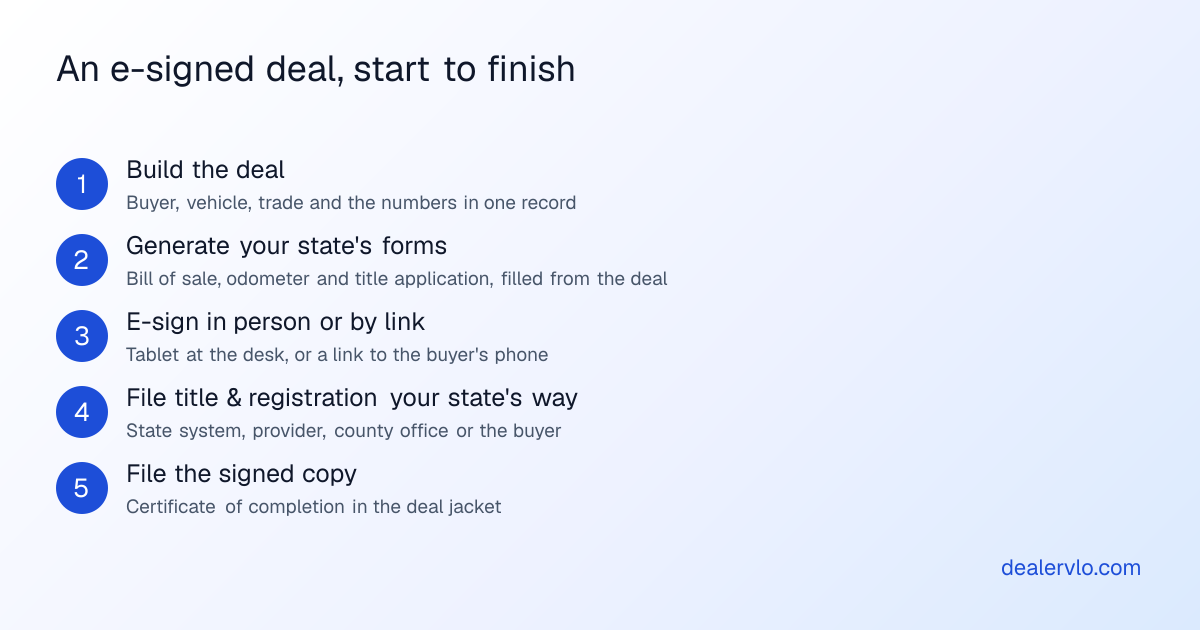
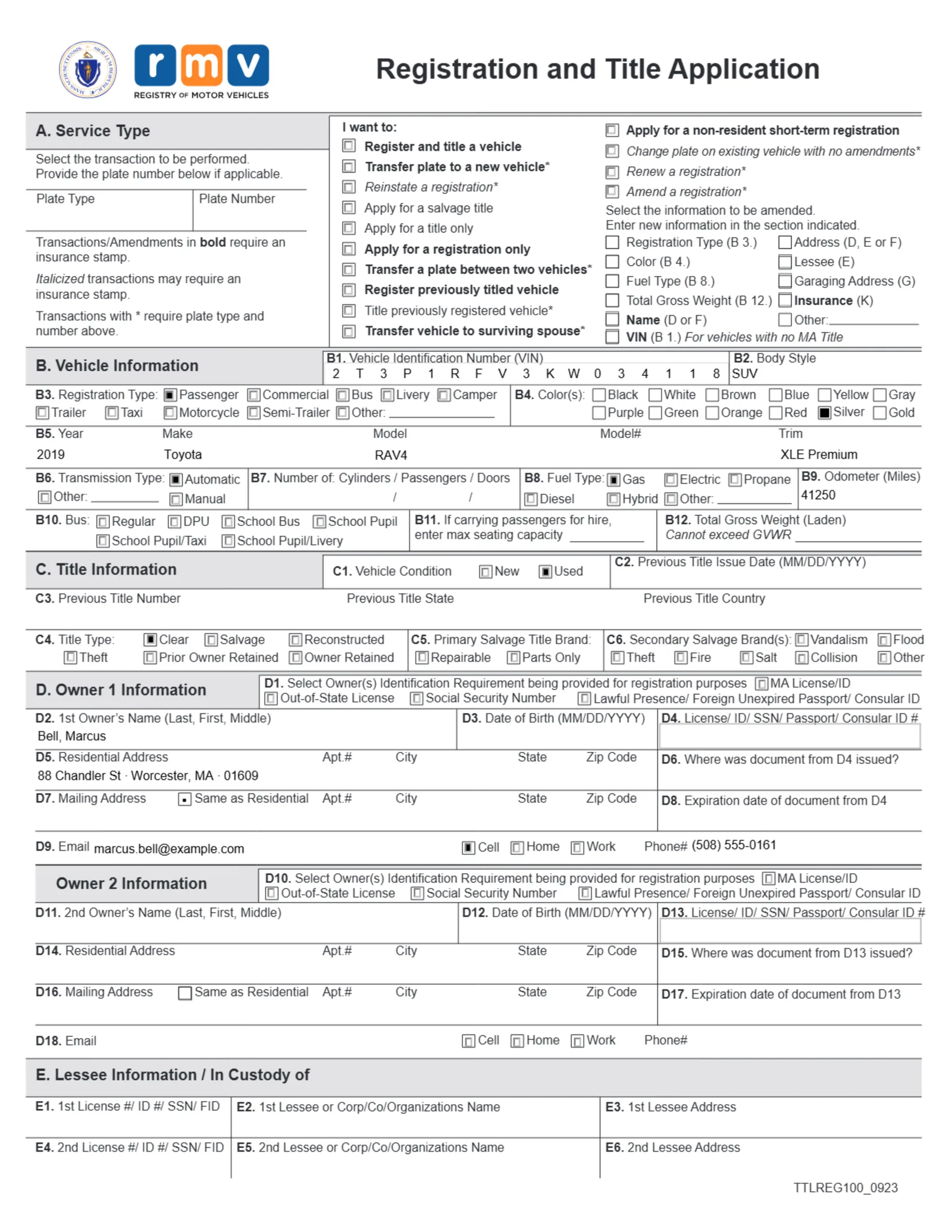
Whatever your state's filing path, the paperwork that feeds it is the same job: the right title application, filled correctly, signed cleanly. DealerVLO fills your state's title and registration application straight from the deal, for all 50 states, so the VIN and buyer aren't retyped into each form, and the signed copies stay in the deal jacket with everything else. See how dealer paperwork auto-fills by state.
State by state
Arizona
At a glance: e-signatures are valid under ESIGN and Arizona's UETA; title and registration run through ADOT MVD, a network of Authorized Third Party (ATP) providers and AZ MVD Now, and electronic lien transmission is mandatory for lienholders.
Arizona requires lienholders to transmit lien information electronically through an MVD-approved service provider, a mandate that took effect in 2010 (some categories, like mobile-home liens, are exempt). ATP providers are private businesses ADOT MVD authorizes to process title and registration on its behalf, alongside AZ MVD Now online, and many dealers handle title work through an ATP rather than a state office.
Whether the title application accepts an electronic signature depends on whether you process through an ATP or an MVD office, and on MVD's current requirements.
Confirm locally: your ATP or MVD workflow; how the 96-0236 is signed and submitted; your ELT setup for financed deals; the current electronic odometer-disclosure process.
Your form: How to fill out Form 96-0236
California
At a glance: e-signatures are valid under ESIGN and California's UETA; registration and titling run through the DMV's Business Partner Automation (BPA) program, and financed titles are held electronically through ELT.
BPA lets the DMV contract with qualified partners so a dealer can process registration and titling electronically from their own location. Per the DMV, new-vehicle dealers must participate; used-car dealers can enroll, so confirm your own obligation with the DMV. For a financed vehicle, ELT holds the ownership record electronically on the DMV database for the lienholder, and the owner gets a paper registration card.
Whether the REG 343 accepts an electronic signature depends on whether you process through a BPA provider or over the counter, and some California documents are controlled forms with their own handling requirements.
Confirm locally: how your BPA provider handles the REG 343; which California forms are controlled; that your lender is an ELT participant; the current odometer-disclosure process.
Your form: How to fill out Form REG 343
Colorado
At a glance: e-signatures are valid under ESIGN and Colorado's UETA; the state runs two generally opt-in programs, EVTR for point-of-sale title and registration and ELT for lienholders.
EVTR (Electronic Vehicle Title and Registration) lets you process title and registration at the point of sale, in any county, through a software vendor that interfaces with the Department of Revenue, which then mails plates and paperwork to the buyer. ELT lets the state and lienholders exchange title and lien data through an approved provider, with no paper title printed while a lien exists. Titles run through county clerks, so processing can vary by county.
How the DR 2395 is signed and submitted depends on your EVTR setup, so confirm it with the DMV or your county clerk.
Confirm locally: your EVTR setup and software vendor; how the DR 2395 is signed and submitted; your ELT setup for financed deals; the current electronic odometer-disclosure process.
Your form: How to fill out Form DR 2395
Florida
At a glance: e-signatures are valid under ESIGN and Florida's UETA; ELT has been mandatory since January 1, 2013 for those who regularly finance vehicles, and the Electronic Filing System (EFS) is an optional way to file title work.
Florida's ELT program replaces paper titles with electronic ones, with lien notifications and satisfactions sent electronically between FLHSMV and the lienholder. A licensed dealer may also file title and registration electronically through a certified EFS provider, who scans the documents and submits them to the county tax collector or license plate agent. EFS is optional, not required.
Whether the HSMV 82040 accepts an electronic signature depends on your filing path, a certified EFS provider or over the counter, and your county's current process.
Confirm locally: how your tax collector accepts the HSMV 82040; whether you'll use a certified EFS provider; that your lender is an ELT participant; the current odometer-disclosure process.
Your form: How to fill out Form HSMV 82040
Georgia
At a glance: e-signatures are valid under ESIGN and Georgia's UETA; dealers have been required to file title and registration electronically through the Electronic Title Registration (ETR) program since January 1, 2018.
Through ETR, a dealer submits the title application and the Title Ad Valorem Tax (TAVT) payment to the customer's county tag office electronically instead of on paper. TAVT is a one-time title tax that replaced the old sales-tax-plus-annual-ad-valorem model on most purchases, and it's calculated and submitted with the title application through ETR. A handful of transaction types fall outside ETR, so confirm the edge cases with your county tag office.
Whether the MV-1 accepts an electronic signature depends on your ETR process and the tag office's current requirements.
Confirm locally: your ETR provider and how it handles the MV-1; the current TAVT rate and how it's collected; which transactions fall outside ETR; the current electronic odometer-disclosure process.
Your form: How to fill out Form MV-1 (Georgia)
Illinois
At a glance: e-signatures are valid under ESIGN and Illinois's UETA; the Electronic Registration and Title (ERT) program lets dealers file title, registration and the ST-556 sales-tax return electronically through approved service providers.
The Secretary of State and Department of Revenue partner with approved service providers, which act as the intermediary between the dealer and the Secretary of State for title, registration and ST-556 filings. Many dealers file this way because it's faster than paper; whether it's required for your situation is worth confirming with the Secretary of State, which maintains the current approved-provider list.
Whether the VSD 190 accepts an electronic signature depends on whether you file through an ERT provider or on paper.
Confirm locally: which ERT service provider you'll use; how it handles the VSD 190 and signatures; your lienholder's electronic-lien participation on financed deals; the current electronic odometer-disclosure process.
Your form: How to fill out Form VSD 190
Indiana
At a glance: e-signatures are valid under ESIGN and Indiana's UETA; the BMV's E-Lien program is mandatory for a dealer who is also a lienholder on 12 or more vehicles, and since July 1, 2025 buyers can choose an electronic title.
E-Lien transmits title and lien data electronically to a lienholder's approved service provider instead of printing a paper title. A dealer that is also a lienholder on 12 or more vehicles, which describes many buy-here-pay-here lots, must enroll; below that it's opt-in. As of July 1, 2025, the BMV also began offering customers the option of an electronic or paper title.
How title work, including Form 205, is signed and submitted depends on your process and the BMV's current requirements.
Confirm locally: whether you must enroll in E-Lien (12+ liens); your electronic title and registration provider; how the Form 205 is signed and submitted; the current electronic odometer-disclosure process.
Your form: How to fill out Form 205
Louisiana
At a glance: e-signatures are valid under ESIGN and Louisiana's UETA; title and registration run through private, state-authorized Public Tag Agents (PTAs), with ELT for liens arranged through a participating PTA.
PTAs process titles, registrations and plates on the Office of Motor Vehicles' behalf, as an alternative to an OMV field office. A licensed used-car dealer isn't eligible to be a PTA, so dealers route through a PTA or an Auto Title Company. On financed deals, the OMV, PTAs and lienholders can exchange title data paperlessly through ELT when a lienholder contracts with a participating PTA. PTAs may charge a convenience fee of up to about $23 per transaction on top of state fees.
How the DPSMV 1799 is signed and submitted depends on your PTA and the OMV's current requirements.
Confirm locally: your PTA and any convenience fee; whether ELT applies to your financed deals; how the DPSMV 1799 is signed and submitted; the current electronic odometer-disclosure process.
Your form: How to fill out Form DPSMV 1799
Maryland
At a glance: e-signatures are valid under ESIGN and Maryland's UETA; title and registration filing runs through the MVA's Electronic Registration and Titling (ERT) program, mandatory for licensed dealers and title service agents, with Electronic Lien Services (ELS) for liens.
Through ERT, dealers file title applications online and can issue plates and registration to the buyer in real or near-real time, using one of the MVA's contracted vendors (CVR, Title Technologies and Vitu have been the approved providers). Because ERT is mandatory, this side of a Maryland deal is already electronic by requirement.
The VR-005 is filed through ERT, and whether an electronic signature is accepted on it depends on your vendor and the MVA's current rules.
Confirm locally: your ERT vendor; how the VR-005 is signed and submitted; your ELS setup for financed deals; the current electronic odometer-disclosure process.
Your form: How to fill out Form VR-005
Michigan
At a glance: e-signatures are valid under ESIGN and Michigan's UETA; title and registration can be filed electronically through approved service providers, and ELT enrollment is required for dealers who finance or are frequently the secured party.
The Department of State's ELT program holds lien and title data electronically, and dealers can file title applications and registrations through approved service providers. A dealer offering in-house financing (buy-here-pay-here) or frequently listed as the secured party generally must enroll in ELT and get an electronic lienholder number; a dealer who never holds paper isn't required to.
The RD-108 is filed electronically through a service provider or on paper, and whether an electronic signature is accepted depends on that path and the Department of State's current rules.
Confirm locally: your electronic filing provider; whether ELT enrollment applies if you finance; how the RD-108 is signed and submitted; the current electronic odometer-disclosure process.
Your form: How to fill out Form RD-108
Missouri
At a glance: e-signatures are valid under ESIGN and Missouri's UETA; there's no dealer point-of-sale title submission, because the buyer titles the car at a license office, and ELT exists on the lienholder side.
Per the Department of Revenue, a dealership can issue a temporary tag but doesn't submit the buyer's title and registration paperwork; the customer takes it to a license office and titles it there. Buyers generally have 30 days from purchase to title and pay sales tax, with an escalating penalty if late. On the lienholder side, Missouri's ELT program processes lien releases and title data electronically; confirm any dealer requirements with the DOR.
Because the buyer does the titling, the dealer's job is a clean, correctly filled title assignment and paperwork, so the customer isn't sent back for a second trip.
Confirm locally: the buyer's titling steps and 30-day deadline; any dealer ELT requirements; how the title assignment and documents are signed; the current electronic odometer-disclosure process.
Your form: How to fill out Form 108
New Jersey
At a glance: e-signatures are valid under ESIGN and New Jersey's UETA; titling and registration can be filed electronically through the MVC's Dealer Online Services Program (DOSP), and ELT has been moving toward mandatory for lienholders that record liens regularly.
DOSP lets licensed dealers submit titling and registration transactions to the Motor Vehicle Commission electronically through approved program providers instead of on paper; enrollment has volume and setup requirements to confirm with the MVC. On the finance side, ELT has lienholders exchange lien and title data with the MVC electronically. Its thresholds and deadlines have been rolling out, so confirm the current requirement with the MVC rather than assuming.
The OS/SS-UTA is filed through DOSP or on paper, and whether an electronic signature is accepted depends on that path.
Confirm locally: your DOSP eligibility and provider; how the OS/SS-UTA is signed and submitted; your lienholder's ELT participation; the current electronic odometer-disclosure process.
Your form: How to fill out Form OS/SS-UTA
New York
At a glance: e-signatures rest on ESIGN and New York's own Electronic Signatures and Records Act (ESRA), since New York never adopted UETA; electronic titling is partial, with an Electronic Lien Transfer Program for liens.
ESRA, enacted in 2000, lets an electronic signature stand in for a handwritten one with the same legal effect, and for a retail deal the practical result matches UETA states. The Electronic Lien Transfer Program lets participating lienholders exchange lien data with the DMV electronically, but broader titling has leaned more on paper than in states like Florida or California. The DMV has been changing its processes, so confirm the current status rather than assume it's fully paperless.
Ask the DMV directly how the MV-82 is signed and how much can be handled electronically versus on paper.
Confirm locally: how the DMV accepts the MV-82 and signatures; which title and registration steps can be done electronically; your lienholder's participation in Electronic Lien Transfer; the current electronic odometer-disclosure process.
Your form: How to fill out Form MV-82
North Carolina
At a glance: e-signatures are valid under ESIGN and North Carolina's UETA; the Electronic Lien and Title (ELT) system is generally mandatory for businesses that finance vehicles, including buy-here-pay-here dealers.
Dealers that record liens exchange lien and title data with the NCDMV electronically through an approved service provider. If you don't finance, you're not the target of the rule. The exact effective date and any per-lien fee are set by the state and can change, so confirm the current requirement and cost with the NCDMV rather than taking a number from a third-party source.
How the MVR-1 is signed and submitted depends on your process and the NCDMV's current requirements.
Confirm locally: whether you must use ELT if you finance; your approved service provider and any per-lien fee; how the MVR-1 is signed and submitted; the current electronic odometer-disclosure process.
Your form: How to fill out Form MVR-1
Ohio
At a glance: e-signatures are valid under ESIGN and Ohio's UETA; titles are processed through the county Clerks of Courts, and dealers who title regularly can register for one of several electronic options.
Ohio processes vehicle titles through the county Clerks of Courts on the Automated Title Processing System (ATPS). Dealers who submit titles regularly can register with the Ohio Department of Public Safety, through a participant agreement, for Electronic Lien and Title (ELT), Electronic Title Assignment (ETA), the Electronic Title System (ETS) or the Ohio Title Gateway (OTG). Which one fits depends on your volume and setup.
How title documents are signed and submitted depends on the option you use and the Clerk of Courts' current requirements. On financed deals, confirm your lienholder participates in ELT.
Confirm locally: which electronic titling option to use; the DPS participant agreement; how title documents are signed and submitted; the current electronic odometer-disclosure process.
Your form: How to fill out Form BMV 3774
Pennsylvania
At a glance: e-signatures are valid under ESIGN and Pennsylvania's UETA; PennDOT runs a mandatory Electronic Lien and Title (ELT) program, and many dealers file through authorized agents and Online Messengers.
Under the mandatory ELT program, PennDOT holds the title record and lien notation electronically instead of mailing a paper certificate, so financed deals are handled electronically by default. Many dealers process title and registration through an authorized agent or Online Messenger, a private business PennDOT contracts with to provide title and registration services over an online connection, rather than a counter visit.
Whether the MV-1 accepts an electronic signature depends on the agent or messenger you use and PennDOT's current requirements.
Confirm locally: your authorized agent or Online Messenger; how the MV-1 is signed and submitted; that your lienholder participates in ELT; the current electronic odometer-disclosure process.
Your form: How to fill out Form MV-1 (Pennsylvania)
South Carolina
At a glance: e-signatures are valid under ESIGN and South Carolina's UETA; the SCDMV's ELT system has been mandatory since 2017 for lenders placing 50 or more liens a year, and South Carolina charges an Infrastructure Maintenance Fee (IMF) instead of sales tax at titling.
Lenders participate in ELT through a direct interface with the SCDMV or an approved third-party provider, and titles with liens are held electronically. Separately, the IMF is 5% of the sale price capped at $500, so a vehicle around $10,000 or more owes the flat $500, and IMF-subject sales are exempt from state and local sales tax.
How the Form 400 is signed and submitted depends on your process and the SCDMV's current requirements; confirm that and the current IMF rules with the SCDMV.
Confirm locally: your ELT setup or provider; the current IMF rules; how the Form 400 is signed and submitted; the current electronic odometer-disclosure process.
Your form: How to fill out Form 400
Tennessee
At a glance: e-signatures are valid under ESIGN and Tennessee's UETA; titles are processed through county clerks rather than a central DMV, with a voluntary, phased-in ELT program.
Tennessee's Department of Revenue oversees titles, but transactions are processed through the county clerk, so specifics, including how documents are signed and accepted, can vary a little by county. The voluntary ELT program lets participating lenders manage liens electronically while the state keeps the title electronically, and it applies to eligible titles going forward.
How the RV-F1315201 is signed and accepted, and whether ELT is available for a given financed deal, are worth confirming with your county clerk.
Confirm locally: your county clerk's title process; whether ELT is available for your financed deals; how the title application is signed and accepted; the current electronic odometer-disclosure process.
Your form: How to fill out Form RV-F1315201
Texas
At a glance: e-signatures are valid under ESIGN and Texas UETA; title and registration run through TxDMV's webDEALER, mandatory since July 1, 2025 per TxDMV.
webDEALER is the state's system for electronically processing title and registration for vehicle sales, and per TxDMV, dealers without a webDEALER account can't complete sales transactions. So the title half of a Texas deal is electronic by requirement; the signing half is where e-signatures come in. The Form 130-U is processed through webDEALER.
Whether your county tax assessor-collector accepts an electronic signature on the 130-U or wants wet ink varies by local practice, so confirm with the county or TxDMV, and check your lender's e-signature rules on financed deals.
Confirm locally: how your county accepts the 130-U; that your webDEALER account is active; the current electronic odometer-disclosure process; your lender's e-signature requirements.
Your form: How to fill out Form 130-U
Virginia
At a glance: e-signatures are valid under ESIGN and Virginia's UETA; the DMV's Electronic Lien Program (ELP) is mandatory for financial institutions recording 50 or more auto liens a year and voluntary below that.
ELP is a paperless exchange of vehicle and title information between DMV Headquarters and lienholders: the DMV holds the title electronically, and when the lien is satisfied the lienholder sends an electronic release. Participants contract with a DMV-approved third-party vendor and join through the DMV's application forms.
How the VSA 17A is signed and submitted depends on your process and the DMV's current requirements; confirm that, and whether you must join ELP, with the Virginia DMV.
Confirm locally: whether you must join ELP; your DMV-approved vendor; how the VSA 17A is signed and submitted; the current electronic odometer-disclosure process.
Your form: How to fill out Form VSA 17A
Washington
At a glance: e-signatures are valid under ESIGN and Washington's UETA, adopted around 2020; the Department of Licensing's Electronic Titles Program is optional for lenders, and there's no distinctive statewide mandatory dealer e-filing system.
The Electronic Titles Program lets lenders hold the title record electronically, through one of a handful of approved third-party vendors, while a lien exists; when the lien is released electronically, the DOL prints and mails a paper title to the owner.
Because Washington's dealer titling is largely standard, how the TD-420-001 is signed and submitted is worth confirming with the DOL.
Confirm locally: your titling workflow with the DOL; whether you'll use the Electronic Titles Program; how the TD-420-001 is signed and submitted; the current electronic odometer-disclosure process.
Your form: How to fill out Form TD-420-001
Wisconsin
At a glance: e-signatures are valid under ESIGN and Wisconsin's UETA; per WisDOT, Wisconsin law requires dealers and secured parties to process many title and registration applications electronically.
Dealers use WisDOT's eMV PARTNER web system, with automatic fee calculation, real-time record updates and immediate lien listing, or an approved third-party vendor such as CVR, DDI, DLRdmv, Auto Data Direct or VITU.
Whether the MV1 accepts an electronic signature depends on the eMV PARTNER or vendor workflow you use and WisDOT's current requirements, so confirm that, along with any exemptions, with WisDOT.
Confirm locally: your eMV PARTNER or vendor setup; how the MV1 is signed and submitted; any exemptions from electronic processing; the current electronic odometer-disclosure process.
Your form: How to fill out Form MV1
14-day free trial, then $29/mo · Cancel anytime
Frequently asked questions
Can a car dealer sign a deal electronically in every state?
Yes. The federal ESIGN Act applies nationwide, and every state except New York has adopted UETA; New York's ESRA gives an electronic signature the same legal effect. It holds when the buyer agreed to sign electronically, intended to sign, and the signed record is kept and reproducible. This isn't legal advice; confirm your process with your DMV and attorney.
What part of a car deal differs by state?
The title side: how a dealer files title and registration (a mandatory state system, third-party providers, county offices, or the buyer titling at a license office, as in Missouri), and how liens are held. The signing side works the same everywhere.
Which states require dealers to file title and registration electronically?
Of the 22 states here, Texas (webDEALER, per TxDMV since July 1, 2025), Georgia (ETR, since January 1, 2018), Maryland (ERT) and Wisconsin (eMV PARTNER or an approved vendor, per WisDOT). Several others make electronic liens mandatory for lienholders, which matters if you finance. Requirements change, so confirm with your state.
Does the title application need a wet signature?
It depends on the state and how you file: a state system, a third-party provider, or over the counter. Whether your DMV, county office or provider accepts an electronic signature on the title application is the one thing to confirm locally.
Can DealerVLO e-sign car deal paperwork?
Yes. DealerVLO e-signs the deal jacket in person on a tablet or by a link emailed to the buyer and co-buyer, with an ESIGN/UETA audit trail and a certificate of completion on every signed PDF, and it fills your state's title and registration application from the deal for all 50 states. You still file title and registration through your state's process.
Bottom line
The signing side of a car deal can be electronic in every state today. The title side is where states differ, and in several of them (Texas, Georgia, Maryland, Wisconsin) it's already electronic by requirement. Find your state above, make the one call to confirm how your title application is signed and filed, and check your lender's rules on financed deals.
After that, the printer, the pen and the scanner mostly drop out of the deal. If you want the paperwork filled and signed in one place, start a free DealerVLO trial and run a real deal from your state on your own numbers.
Paste a VIN, the buyer, and the price — see the official title & registration form filled in for 23 states, free, no signup.
Open the State Form Auto-Fill