How to fill out the Form VSA 17A in Virginia
A field-by-field walkthrough of the Virginia Form VSA 17A (Application for Certificate of Title and Registration) for licensed used car dealers — what goes in every section, who signs what, and the documents you attach. Verified against the official form as of July 2026.
Don't waste another second filling out the Virginia Form VSA 17A.
Let DealerVLO fill out every form for you instantly.
Filing these every week? DealerVLO fills the Form VSA 17A from the deal you already entered, $29/month flat. See pricing
Switching from another DMS? Compare DealerVLO to DealerCenter, Frazer, or Lot Wizard.
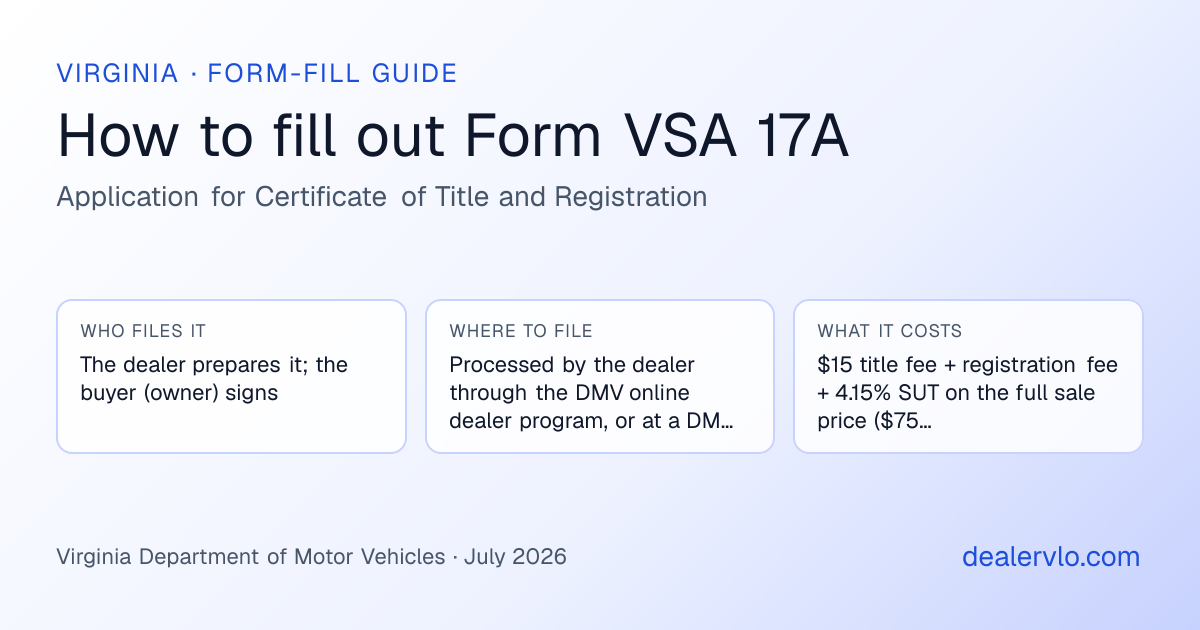
Filling out the VA Form VSA 17A after a sale:
- What it is
- Virginia's combined application for title and registration
- Who completes it
- The dealer prepares it; the buyer (owner) signs
- Where to file it
- Processed by the dealer through the DMV online dealer program, or at a DMV customer service center
- Processing time
- Online dealers process at the point of sale; paper titles mail in a few weeks
- Cost
- $15 title fee + registration fee + 4.15% SUT on the full sale price ($75 minimum, no trade-in credit)
This guide is informational and does not replace the official Virginia instructions. Always confirm the current form and procedure with Virginia Department of Motor Vehicles before you file.
See the VA Form VSA 17A filled — from just a VIN
Enter a VIN, the buyer's name, and the price. We decode the vehicle and drop it onto the actual Virginia Form VSA 17A — the same fill DealerVLO produces from a deal. Watermarked preview; nothing is saved.
What the Form VSA 17A is and why it matters
Form VSA 17A is how a vehicle gets titled and registered in Virginia. On a dealer sale, the dealer prepares it for the buyer, collects the Motor Vehicle Sales and Use Tax (SUT) at delivery, and processes the transaction — electronically through the DMV's online dealer program at most dealerships, or on paper at a DMV customer service center.
Virginia's SUT is where dealers from other states get burned: it's 4.15% of the full sale price with no deduction for a trade-in, and it carries a $75 statutory minimum. The title fee itself is a modest $15. This guide walks every section a dealer fills and flags the tax rules that differ from the states around it.
VSA 17A is the Virginia DMV's combined title and registration application. Most Virginia dealers process it electronically as online dealers through the DMV's dealer program — printing registrations and temporary plates on demand — but the paper form and the electronic transaction capture the same fields. The tax trap to know before you touch it: Virginia's 4.15% Motor Vehicle Sales and Use Tax gives no trade-in credit, and it has a $75 minimum.
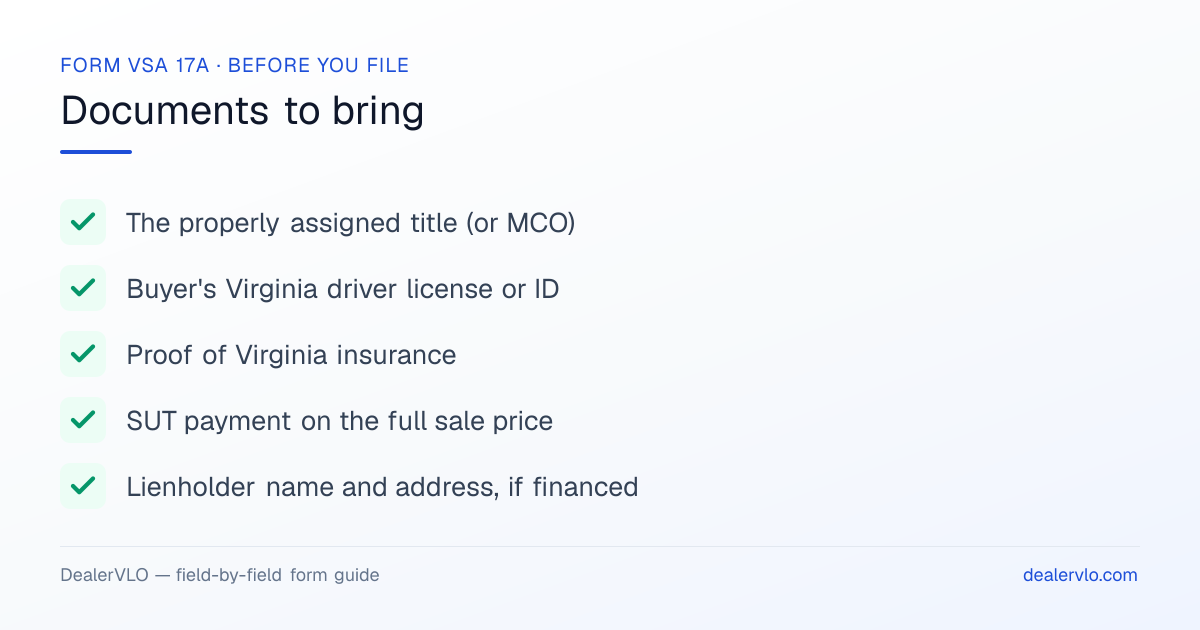
Documents to have before you start
Gather these before you complete the Form VSA 17A. A missing attachment is the number-one reason the Virginia Department of Motor Vehicles bounces a title application back.
- The properly assigned title (or MCO) — Assigned to the buyer with the odometer disclosure completed.
- Buyer's Virginia driver license or ID — Name and address must match the application.
- Proof of Virginia insurance — Virginia verifies coverage; the vehicle must be insured (or the uninsured motor vehicle fee paid) to register.
- SUT payment on the full sale price — 4.15% of the sales price — no trade-in deduction in Virginia — with a $75 minimum. The dealer collects it at delivery.
- Lienholder name and address, if financed — So the lien is recorded on the new Virginia title.
- Payment for title and registration fees — $15 title fee plus the registration fee for the plate type and weight.
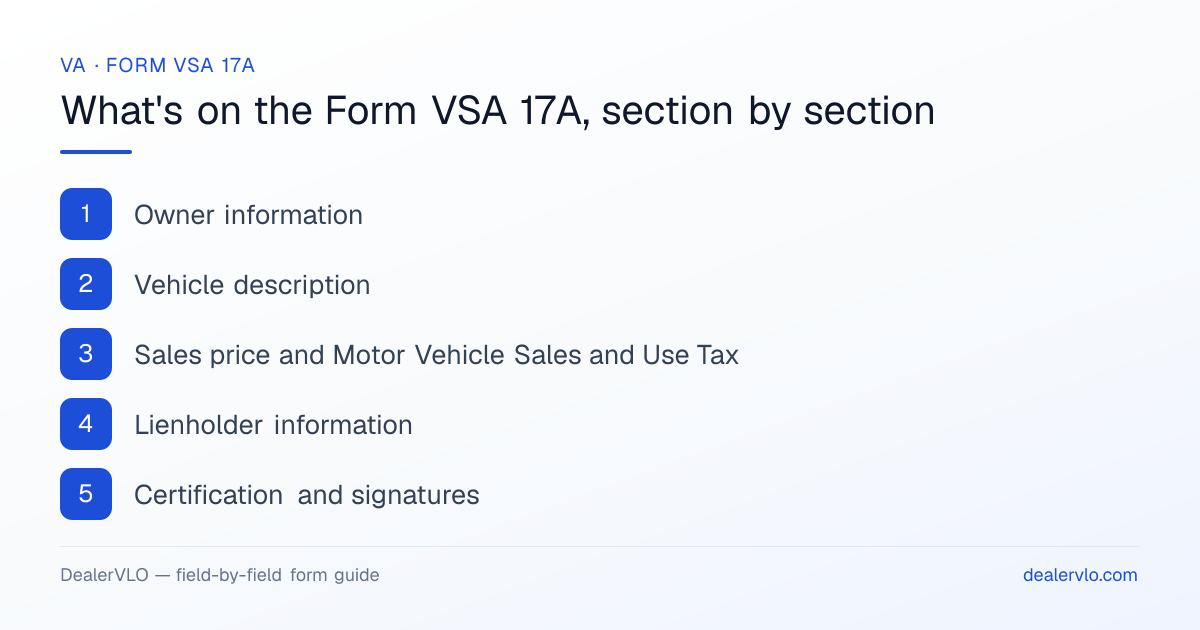
Form VSA 17A, section by section
Owner information
The buyer — the new owner. Enter the legal name, Virginia address, date of birth, and driver license or SSN exactly as they appear on the buyer's credentials. Joint owners choose the ownership conjunction, including survivorship wording if they want it.
| Field | Who fills it |
|---|---|
Owner's full legal name From the buyer's license — match it exactly. | You (dealer) |
Virginia residence address | You (dealer) |
Driver license number / SSN and date of birth | Buyer |
Co-owner and survivorship designation (if any) | You (dealer) |
Vehicle description
Identifies the vehicle. The VIN on the VSA 17A must match the assigned title and the vehicle's VIN plate; on electronic dealer transactions the VIN is validated as you enter it.
| Field | Who fills it |
|---|---|
VIN Must match the title and the VIN plate. | You (dealer) |
Year, make, model, body type | You (dealer) |
Odometer reading Must match the disclosure on the assigned title. | You (dealer) |
Empty weight / gross weight (sets the registration fee) | You (dealer) |
Sales price and Motor Vehicle Sales and Use Tax
Virginia's SUT is 4.15% of the sale price, with a $75 minimum — and unlike most states, Virginia allows no trade-in deduction: the tax is computed on the full price even when the deal has a trade. The dealer collects it at delivery and remits it with the title transaction.
| Field | Who fills it |
|---|---|
Sales price Match the buyer's order — tax is on this full amount. | You (dealer) |
SUT due (4.15%, $75 minimum) No trade-in credit in Virginia. | You (dealer) |
VA SUT & title fee calculator
Free · no signup · updates as you type
Virginia's SUT is 4.15% of the FULL sale price — no trade-in credit — with a $75 minimum, so a cheap unit still owes $75. Title fee $15; registration varies by vehicle weight and plate type. Confirm with the VA DMV.
Stop re-keying this onto the Form VSA 17A.
DealerVLO runs this math on every deal and drops it — with the VIN, buyer, and sale price — straight onto the official VA Form VSA 17A, the bill of sale, and the FTC forms. One screen, no re-keying.
14-day free trial — no charge until day 14, then $29/month. Cancel any time.
Lienholder information
Cash deal? Leave it blank. Financed? Record the lender's name and address so the lien is recorded on the new title — Virginia uses electronic lien and title for most lenders, so the paper title typically isn't printed until payoff.
| Field | Who fills it |
|---|---|
Lienholder name Blank for a cash sale. | You (dealer) |
Lienholder address | You (dealer) |
Certification and signatures
The owner certifies the application — including the insurance certification, which in Virginia carries real teeth (registering an uninsured vehicle without paying the uninsured motor vehicle fee suspends the registration). The buyer signs; the dealer's information ties the application to the sale.
| Field | Who fills it |
|---|---|
Owner signature and date | Buyer |
Co-owner signature (if any) | Buyer |
Selling dealer name and dealer number | You (dealer) |
The Form VSA 17A is one car's paperwork. A 20-second read on your lot, and the tax-and-fee math for the whole deal — built for dealers, no signup. Free calculators dealers actually use — no signup, no email.
DealerVLO fills the official Virginia Form VSA 17A straight from your deal — VIN-decoded vehicle, buyer, co-buyer, and sale price already in place. $29/month, free to try — cancel any time.
Common Form VSA 17A mistakes that cause rejections
Virginia gives no trade-in credit on the Motor Vehicle Sales and Use Tax — the 4.15% applies to the full sale price. Dealers who move in from trade-credit states routinely under-collect here. Quote the tax on the full price from the first pencil.
The SUT has a $75 statutory floor. On a cheap unit — a $1,000 winter beater computes to $41.50 — the buyer still owes $75. Collect the floor amount, not the computed amount, whenever the computation comes in under it.
The application includes an insurance certification, and Virginia enforces it — an uninsured vehicle registered without paying the uninsured motor vehicle fee gets its registration suspended and the owner fined. Verify the buyer's coverage is bound before delivery.
Virginia registration fees step by vehicle weight. An estimated weight that lands in the wrong band means collecting the wrong fee and correcting the transaction later. Pull the empty weight from the title or VIN decode.
Virginia's online dealer program lets participating dealers process title and registration electronically and print registrations and temporary plates on demand. If you're doing volume on paper, you're adding days to every deal — get set up as an online dealer.
Common questions
What is Form VSA 17A used for?+
VSA 17A is the Virginia DMV's Application for Certificate of Title and Registration — the form (or electronic transaction) that titles and registers a vehicle after a sale or an out-of-state move. Dealers prepare it on every retail sale, most of them electronically through the DMV's online dealer program.
Where do I get the Virginia VSA-17A form?+
The VSA-17A comes from the Virginia DMV. On a dealer sale the dealership fills out the title & registration application from the deal, collects the SUT and fees, and processes it (often through the DMV's dealer channel) — the buyer doesn't file a blank. Dealers running a lot generate it filled from their software instead of hand-copying it.
How much is the Virginia title fee?+
$15 — one of the lowest in the country. The registration fee (based on vehicle weight and plate type) and the 4.15% Motor Vehicle Sales and Use Tax are on top of it.
Does Virginia give trade-in credit on vehicle sales tax?+
No. Virginia's Motor Vehicle Sales and Use Tax is 4.15% of the full sale price with no deduction for a trade-in — one of the few states that works this way. There's also a $75 minimum tax, so inexpensive vehicles pay at least $75.
Who collects the Virginia SUT on a dealer sale?+
The dealer — collected at delivery and remitted with the title transaction. On casual (private) sales the DMV collects it at titling, based on the price or the vehicle's value.
What is Virginia's online dealer program?+
A DMV program that lets participating dealers process title and registration transactions electronically from the dealership — including printing registration cards and temporary plates on demand — instead of couriering paper to a customer service center. Most franchise and higher-volume independent dealers use it.
Who signs the VSA 17A?+
The buyer (and any co-owner) signs the certification, which includes the insurance certification. The dealer prepares the application and supplies the dealer information.
Is there software that fills out the Form VSA 17A automatically?+
Yes. Dealer management software like DealerVLO fills the Virginia Form VSA 17A from the deal you already entered — the VIN-decoded vehicle, buyer, co-buyer, lienholder, and sale price are placed for you instead of hand-writing them. For most states that's the official DMV form itself; where a state issues its form only through its own dealer portal, you get a print-ready worksheet with every value already in place. It's $29/month flat with a 14-day free trial, and the same deal also generates your federal documents (Bill of Sale, FTC Buyers Guide, odometer disclosure) and any other state's title forms.
- How to get a used car dealer license in Virginia
- Dealer plates in Virginia
- How to fill out NC Form MVR-1
- All dealer guides
- E-signatures and e-titling for Virginia dealers
- Virginia rebuilt vehicle disclosure (VSA 59)
- Title application forms in every state
- How much is a dealer's license? Cost in every state
Stop filling out the Form VSA 17A by hand.
DealerVLO fills the official VA Form VSA 17A straight from your deal jacket — VIN-decoded vehicle, buyer, co-buyer, lienholder, and sale price already in place. Print, sign, and file in about 90 seconds. $29/month. 14-day free trial, cancel any time.
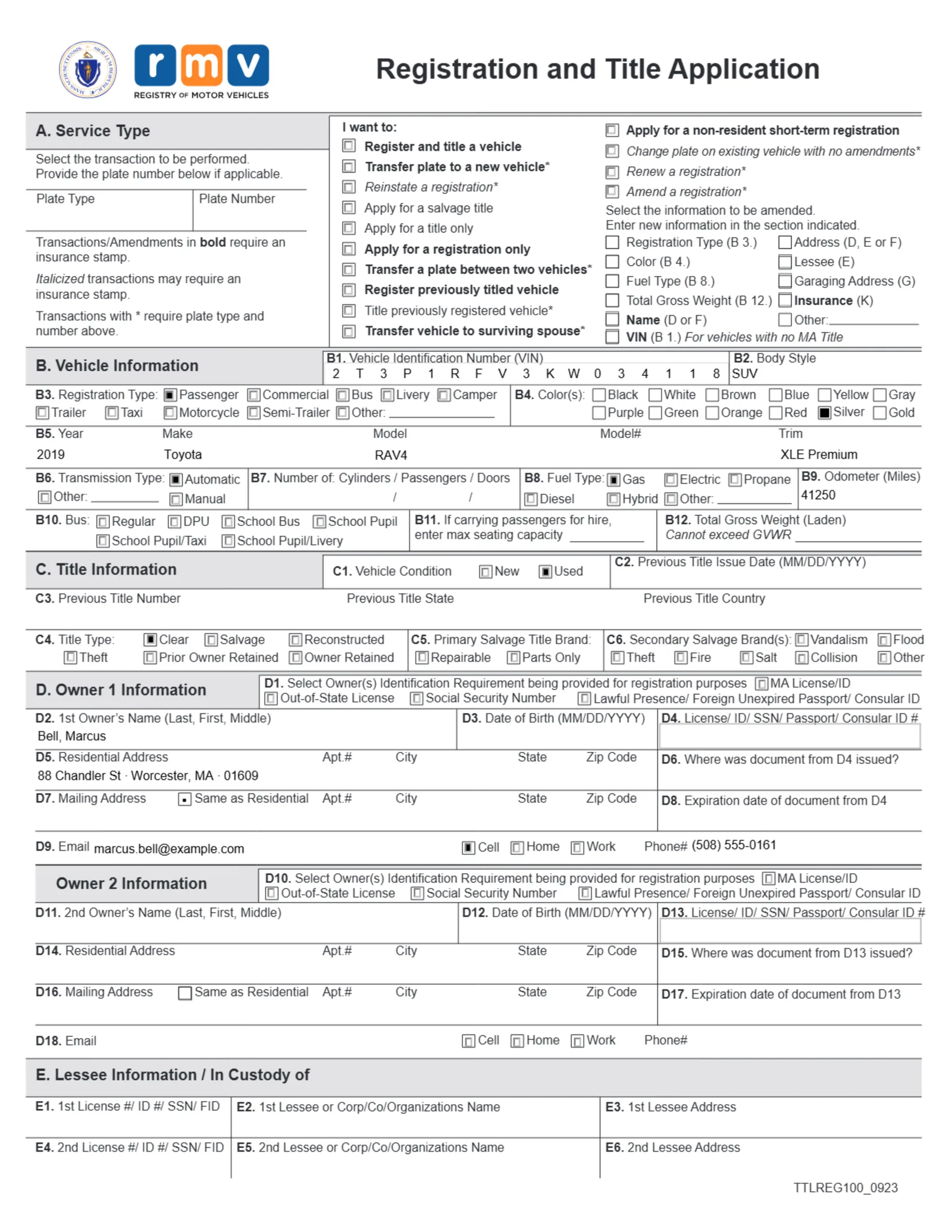
Curious how it works? See how DealerVLO auto-fills every dealer document — bill of sale, FTC Buyers Guide, odometer disclosure, and state title & registration forms for all 50 states, from one deal.
Bond amounts, fees, and form rules change. Get a short email when your state does. No spam, unsubscribe anytime.