How to fill out the Form MVR-1 in North Carolina
A field-by-field walkthrough of the North Carolina Form MVR-1 (Title Application) for licensed used car dealers — what goes in every section, who signs what, and the documents you attach. Verified against the official form as of July 2026.
Don't waste another second filling out the North Carolina Form MVR-1.
Let DealerVLO fill out every form for you instantly.
Filing these every week? DealerVLO fills the Form MVR-1 from the deal you already entered, $29/month flat. See pricing
Switching from another DMS? Compare DealerVLO to DealerCenter, Frazer, or Lot Wizard.
Filling out the NC Form MVR-1 after a sale:
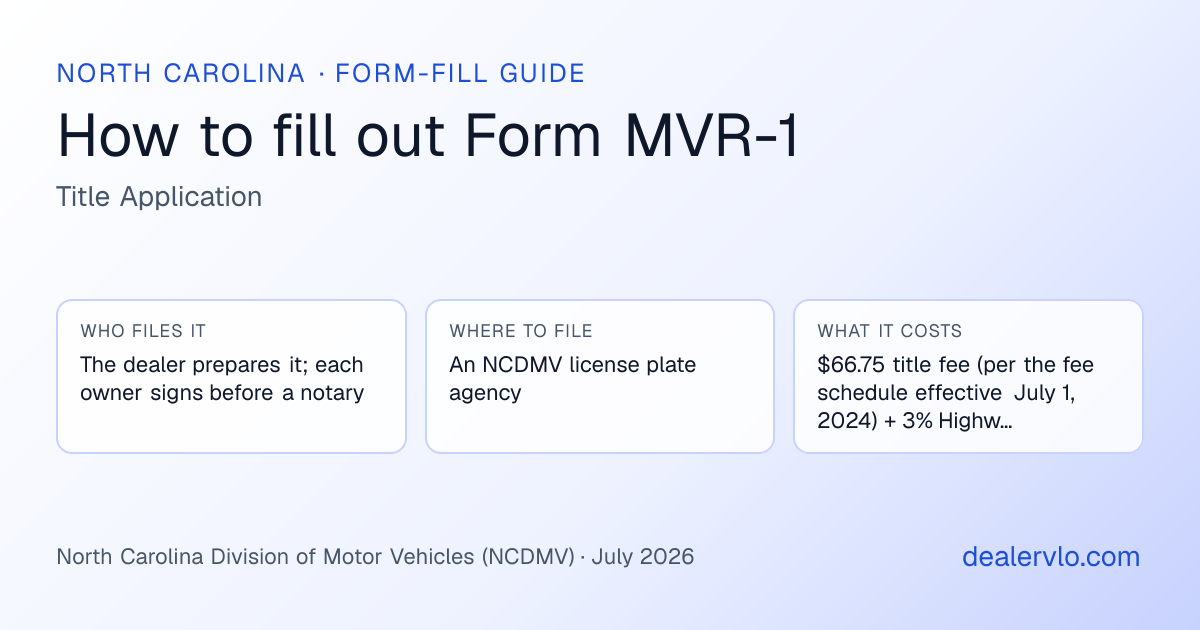
- What it is
- North Carolina's application for a certificate of title
- Who completes it
- The dealer prepares it; each owner signs before a notary
- Where to file it
- An NCDMV license plate agency
- Processing time
- Registration at the counter; the title typically mails in a few weeks
- Cost
- $66.75 title fee (per the fee schedule effective July 1, 2024) + 3% Highway Use Tax + plate fee
This guide is informational and does not replace the official North Carolina instructions. Always confirm the current form and procedure with North Carolina Division of Motor Vehicles (NCDMV) before you file.
See the NC Form MVR-1 filled — from just a VIN
Enter a VIN, the buyer's name, and the price. We decode the vehicle and drop it onto the actual North Carolina Form MVR-1 — the same fill DealerVLO produces from a deal. Watermarked preview; nothing is saved.
What the Form MVR-1 is and why it matters
Form MVR-1 is how a vehicle gets titled in North Carolina. On a dealer sale, the dealer prepares it for the buyer and the package — application, assigned title, Highway Use Tax, and fees — is filed at an NCDMV license plate agency.
Two things make North Carolina different. First, the MVR-1 must be notarized — each owner signs in front of a notary, which is why most dealerships keep one on staff. Second, North Carolina charges a 3% Highway Use Tax instead of sales tax on vehicles, collected at titling and computed on the price you put on this application. This guide walks every section a dealer fills.
MVR-1 is the NCDMV's application for a North Carolina certificate of title — and it's one of the few title applications left that must be notarized. It's filed at an NCDMV license plate agency (the contracted local offices that handle title and registration work), most of which keep a notary on site. North Carolina charges a 3% Highway Use Tax instead of sales tax on vehicles, collected when the title issues.
Documents to have before you start
Gather these before you complete the Form MVR-1. A missing attachment is the number-one reason the North Carolina Division of Motor Vehicles (NCDMV) bounces a title application back.
- The properly assigned title (or MCO) — Assigned to the buyer with the odometer disclosure completed.
- A notary — Each owner's signature on the MVR-1 must be notarized. Most license plate agencies have one on site; most dealerships notarize at delivery.
- Buyer's North Carolina driver license or ID — Name and address must match the application.
- Proof of North Carolina insurance — NC requires liability coverage from an NC-licensed insurer to register.
- Damage disclosure, where required — North Carolina requires a damage disclosure statement (MVR-181) for late-model vehicles at transfer.
- Lienholder name and address, if financed — So the lien is recorded on the new NC title.
- Payment for the Highway Use Tax and fees — 3% HUT plus the $66.75 title fee and the plate/registration fee.
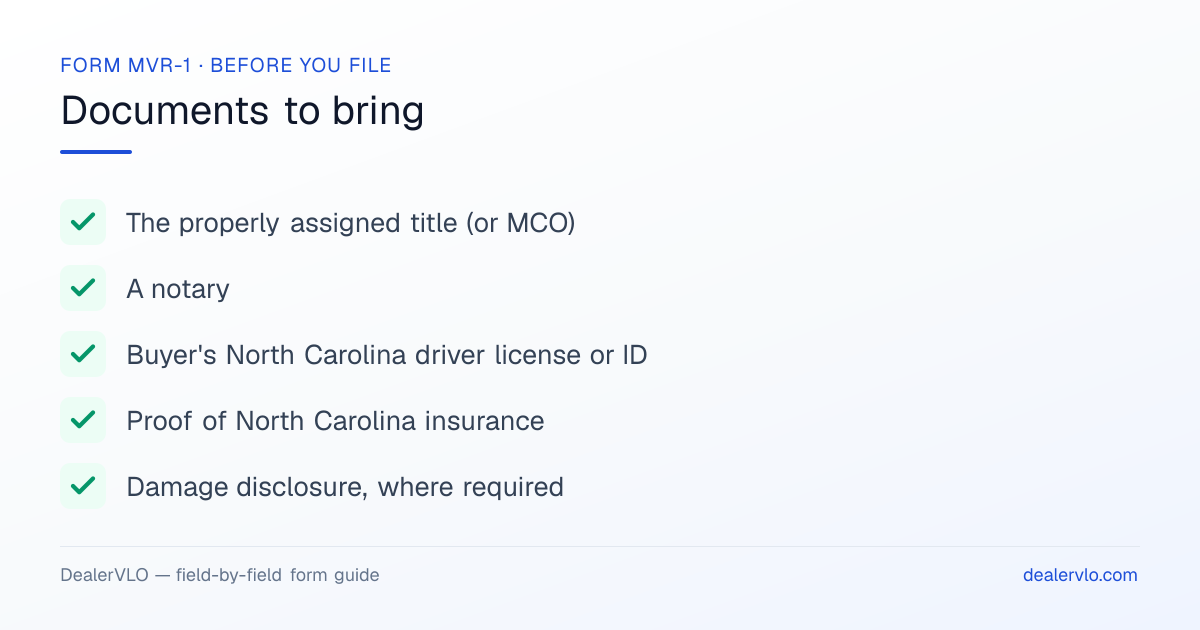
Form MVR-1, section by section
Owner information
The buyer — the new owner. Enter the full legal name, North Carolina address, and driver license number exactly as they appear on the buyer's license. Joint owners both appear, and both must sign — before a notary.
| Field | Who fills it |
|---|---|
Owner's full legal name From the buyer's license — match it exactly. | You (dealer) |
North Carolina residence address Also drives the county property-tax listing that rides with NC registration. | You (dealer) |
Driver license number and date of birth | Buyer |
Co-owner (if any) Every owner listed must sign and be notarized. | You (dealer) |
Vehicle description
Identifies the vehicle. The VIN on the MVR-1 must match the assigned title and the vehicle's VIN plate — the license plate agency checks character by character.
| Field | Who fills it |
|---|---|
VIN Must match the title and the VIN plate. | You (dealer) |
Year, make, model, body style | You (dealer) |
Odometer reading Must match the disclosure on the assigned title. | You (dealer) |
Fuel type | You (dealer) |
Purchase price and Highway Use Tax
North Carolina's 3% Highway Use Tax replaces sales tax on vehicle sales and is collected when the title issues. On a dealer sale it's 3% of the purchase price less the trade-in allowance. Two caps exist but rarely apply to retail deals: new residents bringing in an already-titled vehicle pay at most $250, and certain commercial (Class A/B) vehicles cap at $2,000.
| Field | Who fills it |
|---|---|
Purchase price Match the buyer's order / bill of sale. | You (dealer) |
Trade-in allowance Subtracted before the 3% is applied. | You (dealer) |
Highway Use Tax due 3% of the difference on a standard retail deal. | You (dealer) |
NC HUT & title fee calculator
Free · no signup · updates as you type
Standard retail deal shown. New residents titling an already-titled vehicle cap at $250, and certain Class A/B commercial vehicles cap at $2,000 — neither typically applies to a retail sale. Plate/registration fee varies by plate type. Informational only; confirm current fees with the NCDMV.
Stop re-keying this onto the Form MVR-1.
DealerVLO runs this math on every deal and drops it — with the VIN, buyer, and sale price — straight onto the official NC Form MVR-1, the bill of sale, and the FTC forms. One screen, no re-keying.
14-day free trial — no charge until day 14, then $29/month. Cancel any time.
Lienholder information
Cash deal? Leave it blank. Financed? Record the lender's name and address so the lien is recorded on the new title. North Carolina participates in electronic lien and title, so many lenders hold the title electronically until payoff.
| Field | Who fills it |
|---|---|
First lienholder name Blank for a cash sale. | You (dealer) |
Lienholder address | You (dealer) |
Second lienholder (rare) | You (dealer) |
Owner signatures — notarized
The part that makes North Carolina unusual: each owner signs the MVR-1 in the presence of a notary, and the notary completes the acknowledgment. An un-notarized MVR-1 is dead on arrival at the license plate agency. The dealer's information ties the application to the sale.
| Field | Who fills it |
|---|---|
Owner signature(s) Signed in front of a notary — every listed owner. | Buyer |
Notary acknowledgment Completed by the notary — dealership staff notary or the license plate agency's. | At the counter |
Selling dealer name and dealer number | You (dealer) |
The Form MVR-1 is one car's paperwork. A 20-second read on your lot, and the tax-and-fee math for the whole deal — built for dealers, no signup. Free calculators dealers actually use — no signup, no email.
DealerVLO fills the official North Carolina Form MVR-1 straight from your deal — VIN-decoded vehicle, buyer, co-buyer, and sale price already in place. $29/month, free to try — cancel any time.
Common Form MVR-1 mistakes that cause rejections
The MVR-1 must be notarized — it's the most common rejection at the license plate agency. Notarize at delivery with your dealership's notary, or have the buyer sign at the agency where a notary is on site. Never let a buyer sign at home and mail it in.
Every owner listed on the application must sign and be notarized. A title application for 'John and Jane' with only John's notarized signature bounces.
NCDMV's fee schedule effective July 1, 2024 puts the certificate of title at $66.75 — up from the $56 that older guides still quote. Quote the current fee in your deal recap or eat the difference at the counter.
North Carolina charges Highway Use Tax, not sales tax, on vehicles — 3% of price less trade-in, collected at titling. It has its own caps (new-resident $250, certain commercial vehicles $2,000) that don't work like sales-tax exemptions. Compute it as HUT.
North Carolina requires a damage disclosure statement (MVR-181) for late-model vehicles at transfer. File it with the title package so the application doesn't bounce.
Common questions
What is NC Form MVR-1 used for?+
MVR-1 is the North Carolina Division of Motor Vehicles' Title Application — the form filed to get a North Carolina certificate of title after a sale or an out-of-state move. Dealers prepare it on every retail sale; it's filed at an NCDMV license plate agency.
Does the MVR-1 have to be notarized?+
Yes. Each owner listed on the application must sign in the presence of a notary. Most NCDMV license plate agencies have a notary on site, and most dealerships notarize at delivery.
How much is the North Carolina title fee?+
$66.75 per the NCDMV fee schedule effective July 1, 2024 (older guides still quote the previous $56 fee). The plate/registration fee and the 3% Highway Use Tax are on top of that.
What is the North Carolina Highway Use Tax?+
North Carolina charges a 3% Highway Use Tax instead of sales tax on vehicle sales, collected when the title is issued. On a dealer sale it's 3% of the purchase price minus the trade-in allowance. New residents bringing in an already-titled vehicle pay a maximum of $250, and certain Class A/B commercial vehicles cap at $2,000.
Does a trade-in reduce the Highway Use Tax?+
Yes — on a dealer sale the trade-in allowance is subtracted from the purchase price before the 3% is computed. Enter the allowance on the MVR-1 so the buyer is taxed only on the difference.
Where do I file the MVR-1?+
At an NCDMV license plate agency — the contracted local offices that process title and registration work across the state. The agency collects the Highway Use Tax, title fee, and plate fee, issues the registration, and the title mails from Raleigh.
Is there software that fills out the Form MVR-1 automatically?+
Yes. Dealer management software like DealerVLO fills the North Carolina Form MVR-1 from the deal you already entered — the VIN-decoded vehicle, buyer, co-buyer, lienholder, and sale price are placed for you instead of hand-writing them. For most states that's the official DMV form itself; where a state issues its form only through its own dealer portal, you get a print-ready worksheet with every value already in place. It's $29/month flat with a 14-day free trial, and the same deal also generates your federal documents (Bill of Sale, FTC Buyers Guide, odometer disclosure) and any other state's title forms.
Stop filling out the Form MVR-1 by hand.
DealerVLO fills the official NC Form MVR-1 straight from your deal jacket — VIN-decoded vehicle, buyer, co-buyer, lienholder, and sale price already in place. Print, sign, and file in about 90 seconds. $29/month. 14-day free trial, cancel any time.
Curious how it works? See how DealerVLO auto-fills every dealer document — bill of sale, FTC Buyers Guide, odometer disclosure, and state title & registration forms for all 50 states, from one deal.
Bond amounts, fees, and form rules change. Get a short email when your state does. No spam, unsubscribe anytime.