How to fill out the HSMV 82040 in Florida
A field-by-field walkthrough of the Florida HSMV 82040 (Application for Certificate of Title With/Without Registration) for licensed used car dealers — what goes in every section, who signs what, and the documents you attach. Verified against the official form as of June 2026.
Don't waste another second filling out the Florida HSMV 82040.
Let DealerVLO fill out every form for you instantly.
Filing these every week? DealerVLO fills the HSMV 82040 from the deal you already entered, $29/month flat. See pricing
Switching from another DMS? Compare DealerVLO to DealerCenter, Frazer, or Lot Wizard.
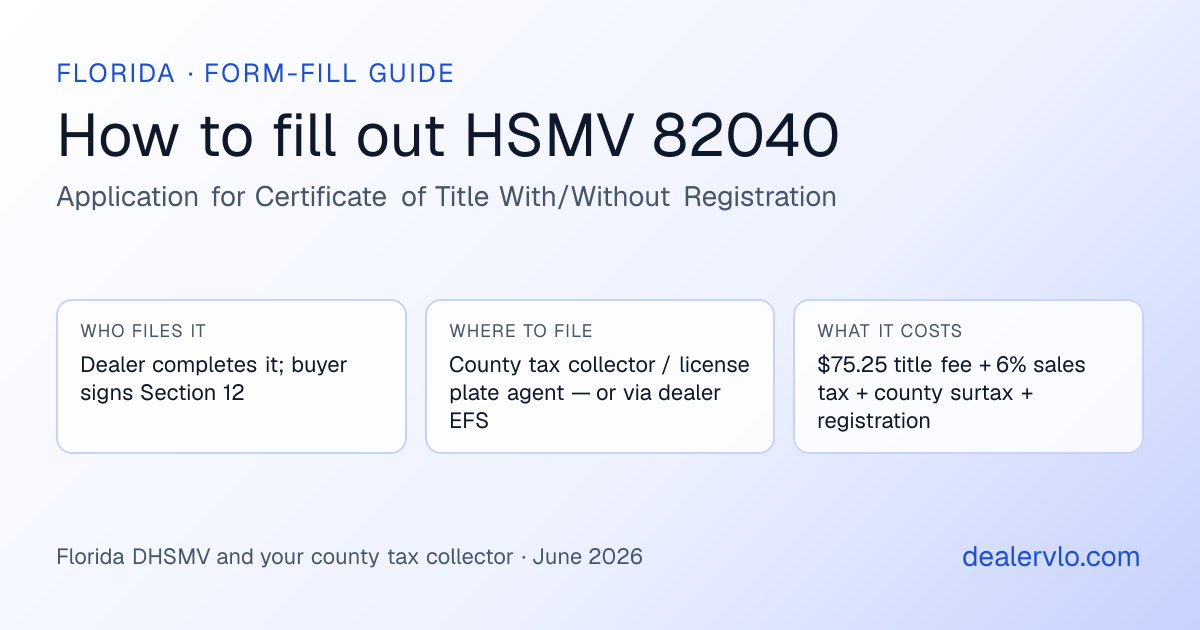
Filling out the FL HSMV 82040 after a sale:
- What it is
- Florida's application for a certificate of title (with or without registration)
- Who completes it
- Dealer completes it; buyer signs Section 12
- Where to file it
- County tax collector / license plate agent — or via dealer EFS
- Processing time
- Plates same day; title issued electronically or mailed
- Cost
- $75.25 title fee + 6% sales tax + county surtax + registration
This guide is informational and does not replace the official Florida instructions. Always confirm the current form and procedure with the Florida DHSMV and your county tax collector before you file.
See the FL HSMV 82040 filled — from just a VIN
Enter a VIN, the buyer's name, and the price. We decode the vehicle and drop it onto the actual Florida HSMV 82040 — the same fill DealerVLO produces from a deal. Watermarked preview; nothing is saved.
What the HSMV 82040 is and why it matters
HSMV 82040 is the form that titles a vehicle in Florida — with or without registration. As a licensed dealer you complete it for the buyer and submit it, with the assigned title and the tax and fees, to the county tax collector or license plate agent. Until it's filed, the buyer doesn't have a Florida title.
Florida gives you 30 days from the sale to transfer the title before late penalties hit. Two things trip dealers up the most: the Section 8 VIN verification (required on used vehicles not currently titled in Florida) and the discretionary county surtax, which applies only to the first $5,000 of the price. Many Florida dealers file electronically through an approved EFS (Electronic Filing System) provider, but the data on the 82040 is the same either way.
HSMV 82040 is the Florida title application. FLHSMV revises it periodically and renumbers sections between revisions — this guide groups the form by function (owner, vehicle, tax, VIN verification, signatures). Follow the section labels on your copy rather than the numbers, and note there are MV (motor vehicle), MH (mobile home), and VS (vessel) variants — you want the motor-vehicle version.
Documents to have before you start
Gather these before you complete the HSMV 82040. A missing attachment is the number-one reason the the Florida DHSMV and your county tax collector bounces a title application back.
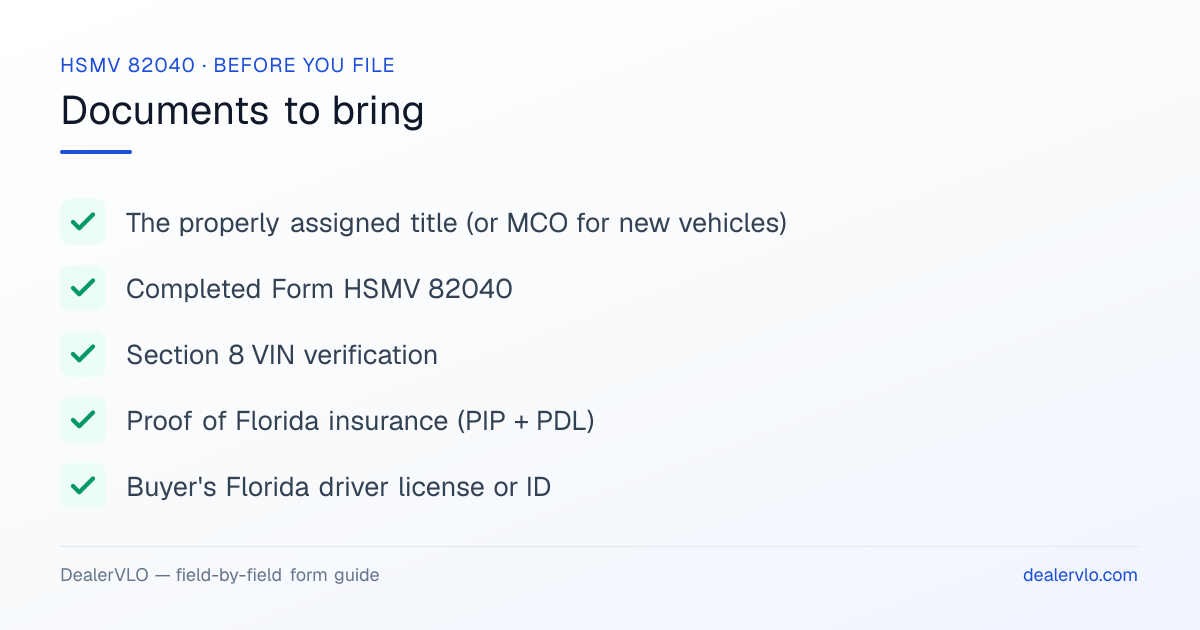
- The properly assigned title (or MCO for new vehicles) — Florida title assigned on the reverse, or an out-of-state title; include the federal odometer disclosure and your dealer reassignment if applicable.
- Completed Form HSMV 82040 — Motor-vehicle version, signed by all applicants in the signature section.
- Section 8 VIN verification — Required on used vehicles not currently titled in Florida. A licensed Florida dealer (you), a Florida notary, law enforcement, or a tax collector/LPA employee can complete it.
- Proof of Florida insurance (PIP + PDL) — Required to register the vehicle (not to title only) — shown at the tax collector office.
- Buyer's Florida driver license or ID — The customer number / ID goes on the application.
- Sales tax, surtax, title, and registration fees — The dealer collects sales tax and surtax and remits to the Florida Department of Revenue.
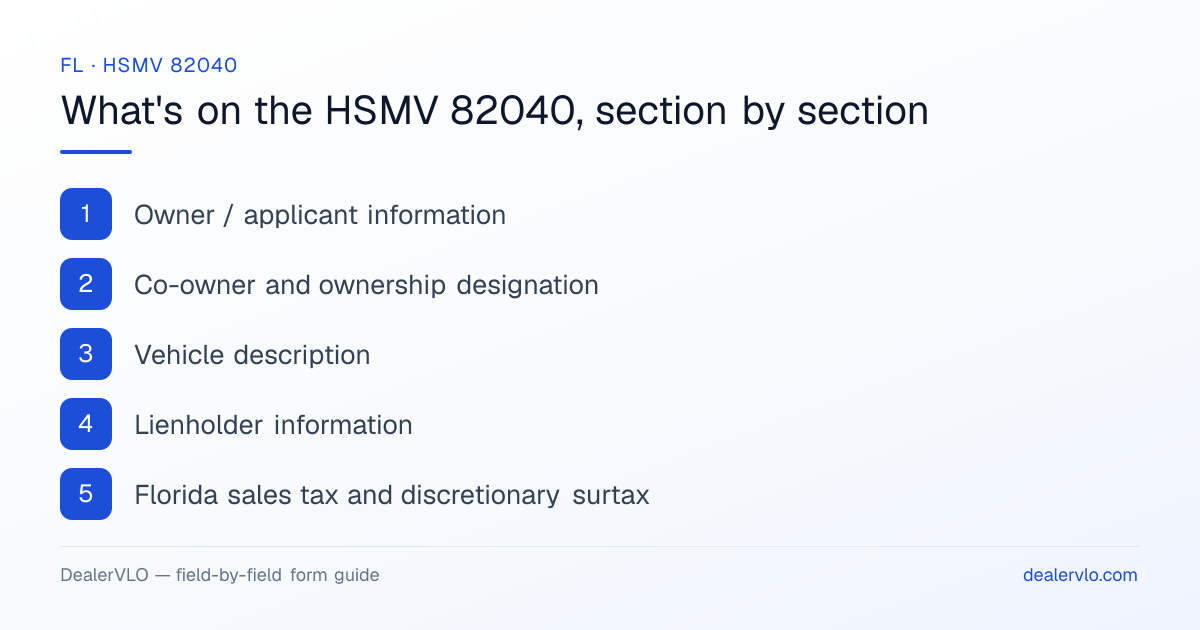
HSMV 82040, section by section
Owner / applicant information
The buyer — the new owner — not your dealership. Enter the legal name, date of birth, Florida driver-license/ID number, and address exactly as they appear on the buyer's license.
| Field | Who fills it |
|---|---|
Owner's full legal name From the buyer's license — match it exactly. | You (dealer) |
Date of birth, sex, FL DL/ID number | Buyer |
Residence / physical address | You (dealer) |
Mailing address (if different) | You (dealer) |
Co-owner and ownership designation
If there's a second buyer, enter them here and set how the two owners hold title. The "or" / "and" connector matters: "or" lets either owner sign to sell later; "and" requires both.
| Field | Who fills it |
|---|---|
Second owner's name + DOB + ID Only if there's a co-buyer. | You (dealer) |
Ownership connector ("or" / "and") Confirm the buyers' intent. | You (dealer) |
Vehicle description
Identifies the vehicle. Most of it comes off the assigned title — verify the VIN character-for-character against the title and the vehicle.
| Field | Who fills it |
|---|---|
VIN Match the title and the vehicle exactly. | You (dealer) |
Year, Make, Body type, Color | You (dealer) |
Weight / GVW (if applicable) | You (dealer) |
Odometer reading + status Must match the disclosure on the assigned title. | You (dealer) |
License plate / decal (transfer or new) Plates follow the owner in Florida — transfer or issue new. | Buyer |
Lienholder information
Cash deal? Leave it blank. Financed? Record the lender so the lien is noted and the title (usually electronic in Florida) routes correctly.
| Field | Who fills it |
|---|---|
First lienholder name Blank for a cash sale. | You (dealer) |
Lienholder FEID / ID number | You (dealer) |
Lienholder mailing address | You (dealer) |
Electronic title indicator Florida titles with a lien are typically held electronically. | You (dealer) |
Florida sales tax and discretionary surtax
Florida charges 6% state sales tax on the purchase price, plus the buyer's county discretionary surtax — but the surtax applies ONLY to the first $5,000 of the price. A trade-in taken by the dealer reduces the taxable amount. The dealer collects the tax and remits it to the Florida Department of Revenue.
| Field | Who fills it |
|---|---|
Purchase price Match the buyer's order / bill of sale. | You (dealer) |
Trade-in allowance (dealer trade) Subtracted from the price before tax. | You (dealer) |
6% state sales tax | You (dealer) |
County discretionary surtax (first $5,000 only) Rate varies by the buyer's county; some counties have none. | You (dealer) |
Tax exemption / reason (if applicable) E.g. out-of-state delivery, exempt entity. | You (dealer) |
FL Sales tax & title fee calculator
Free · no signup · updates as you type
6% state sales tax on price less trade-in, plus your county's discretionary surtax — which applies ONLY to the first $5,000 (rate varies by county; some counties have none). Title fee $75.25 for a Florida title, $85.25 if the vehicle comes from out of state; registration/plate fees vary. Informational only; the county tax collector collects the final amount.
Stop re-keying this onto the HSMV 82040.
DealerVLO runs this math on every deal and drops it — with the VIN, buyer, and sale price — straight onto the official FL HSMV 82040, the bill of sale, and the FTC forms. One screen, no re-keying.
14-day free trial — no charge until day 14, then $29/month. Cancel any time.
Section 8 — VIN physical verification
Florida requires the VIN to be physically verified on used vehicles not currently titled in Florida. As a licensed Florida dealer you can complete this yourself — a real advantage over the buyer, who would otherwise need a notary, law enforcement, or a tax-collector employee. For an out-of-state title, it must be done by law enforcement, a Florida notary, or an out-of-state dealer on company letterhead.
| Field | Who fills it |
|---|---|
VIN as physically inspected Confirm it matches the title and the form. | You (dealer) |
Verifier name, title, and signature A licensed FL dealer, notary, LEO, or tax-collector/LPA employee. | You (dealer) |
Section 12 — certification and signatures
All applicants sign here, certifying the application under penalty of perjury. The buyer(s) sign as the new owner(s); don't pre-sign.
| Field | Who fills it |
|---|---|
Applicant / owner signature(s) | Buyer |
Co-owner signature (if any) | Buyer |
The HSMV 82040 is one car's paperwork. A 20-second read on your lot, and the tax-and-fee math for the whole deal — built for dealers, no signup. Free calculators dealers actually use — no signup, no email.
DealerVLO fills the official Florida HSMV 82040 straight from your deal — VIN-decoded vehicle, buyer, co-buyer, and sale price already in place. $29/month, free to try — cancel any time.
Common HSMV 82040 mistakes that cause rejections
Used vehicles not currently titled in Florida — especially out-of-state cars — must have the VIN physically verified in Section 8. As a licensed Florida dealer you can do it yourself; just don't forget it, because a missing verification stops the title cold.
The county surtax applies only to the first $5,000 of the purchase price — not the full amount. On a $20,000 car in a 1% surtax county, the surtax is 1% of $5,000 ($50), not 1% of $20,000. Overcharging it is a common error.
When you take a trade, Florida sales tax is computed on the price minus the trade-in allowance. Enter the trade so the buyer isn't taxed on the full price.
The VIN and odometer on the 82040 must match the assigned title and the vehicle. Verify all three against each other before filing.
Florida requires the title transfer within 30 days of the sale; late filing adds penalties. Filing through an EFS provider helps dealers stay inside the window.
For co-owners, the "or" vs "and" choice controls whether one owner or both must sign to sell later. Set it to match the buyers' intent.
Common questions
Is HSMV 82040 the Florida title application?+
Yes. Form HSMV 82040 is the Application for Certificate of Title With/Without Registration — the form used to title (and optionally register) a motor vehicle in Florida. There are separate variants for mobile homes and vessels; dealers use the motor-vehicle version.
Who fills out the 82040 — the dealer or the buyer?+
On a dealer sale, the dealer completes the form: owner information from the buyer's license, the vehicle description, the lien information, and the sales-tax computation, and as a licensed Florida dealer can complete the Section 8 VIN verification. The buyer signs the certification (Section 12) as the new owner.
What is Section 8 on the 82040 and who can complete it?+
Section 8 is the physical VIN verification, required on used vehicles not currently titled in Florida. It can be completed by a licensed Florida dealer, a Florida notary public, a law enforcement officer, or a tax collector / license plate agency employee. For an out-of-state title, it must be done by law enforcement, a Florida notary, or an out-of-state dealer on company letterhead.
How is Florida sales tax calculated on a dealer sale?+
Florida charges 6% state sales tax on the purchase price (less any dealer trade-in allowance), plus the buyer's county discretionary surtax — which applies only to the first $5,000 of the price. Example: a $20,000 vehicle in a 1% surtax county owes $1,200 state tax plus $50 surtax (1% of $5,000), for $1,250. The dealer collects and remits to the Florida Department of Revenue.
How long does a Florida dealer have to transfer the title?+
Within 30 days of the date of sale. After that, late penalties apply. Filing through an approved Electronic Filing System (EFS) provider helps dealers meet the deadline and issue plates faster.
Can Florida dealers file the title application electronically?+
Yes. Florida's Electronic Filing System (EFS) lets licensed dealers submit title and registration applications electronically through an approved provider, print temporary tags, and record electronic titles — instead of carrying paper 82040 forms to the tax collector. The information captured is the same as the paper form.
What does it cost to title and register a vehicle in Florida?+
Expect a title fee of about $75.25 for a Florida title ($85.25 for a vehicle coming from out of state), the 6% state sales tax plus county surtax on the taxable price, a small lien-recording fee if financed, and registration/plate fees that vary by vehicle weight and county. The county tax collector collects all of it.
Is there software that fills out the HSMV 82040 automatically?+
Yes. Dealer management software like DealerVLO fills the Florida HSMV 82040 from the deal you already entered — the VIN-decoded vehicle, buyer, co-buyer, lienholder, and sale price are placed for you instead of hand-writing them. For most states that's the official DMV form itself; where a state issues its form only through its own dealer portal, you get a print-ready worksheet with every value already in place. It's $29/month flat with a 14-day free trial, and the same deal also generates your federal documents (Bill of Sale, FTC Buyers Guide, odometer disclosure) and any other state's title forms.
- How to get a used car dealer license in Florida
- How to fill out Texas Form 130-U
- All dealer guides
- Florida dealer plates
- E-signatures and e-titling for Florida dealers
- How Florida car sales tax works on a dealer sale
- Florida rebuilt title: Statement of Builder (HSMV 84490)
- Title application forms in every state
- How much is a dealer's license? Cost in every state
Stop filling out the HSMV 82040 by hand.
DealerVLO fills the official FL HSMV 82040 straight from your deal jacket — VIN-decoded vehicle, buyer, co-buyer, lienholder, and sale price already in place. Print, sign, and file in about 90 seconds. $29/month. 14-day free trial, cancel any time.
Curious how it works? See how DealerVLO auto-fills every dealer document — bill of sale, FTC Buyers Guide, odometer disclosure, and state title & registration forms for all 50 states, from one deal.
Bond amounts, fees, and form rules change. Get a short email when your state does. No spam, unsubscribe anytime.