How to fill out the Form RD-108 in Michigan
A field-by-field walkthrough of the Michigan Form RD-108 (Application for Michigan Title and Registration — Statement of Vehicle Sale) for licensed used car dealers — what goes in every section, who signs what, and the documents you attach. Verified against the official form as of July 2026.
Don't waste another second filling out the Michigan Form RD-108.
Let DealerVLO turn your deal into a print-ready Form RD-108 worksheet instantly, with every value ready to copy onto the form or key into the state's system.
Filing these every week? DealerVLO builds the Form RD-108 worksheet from the deal you already entered, $29/month flat. See pricing
Switching from another DMS? Compare DealerVLO to DealerCenter, Frazer, or Lot Wizard.
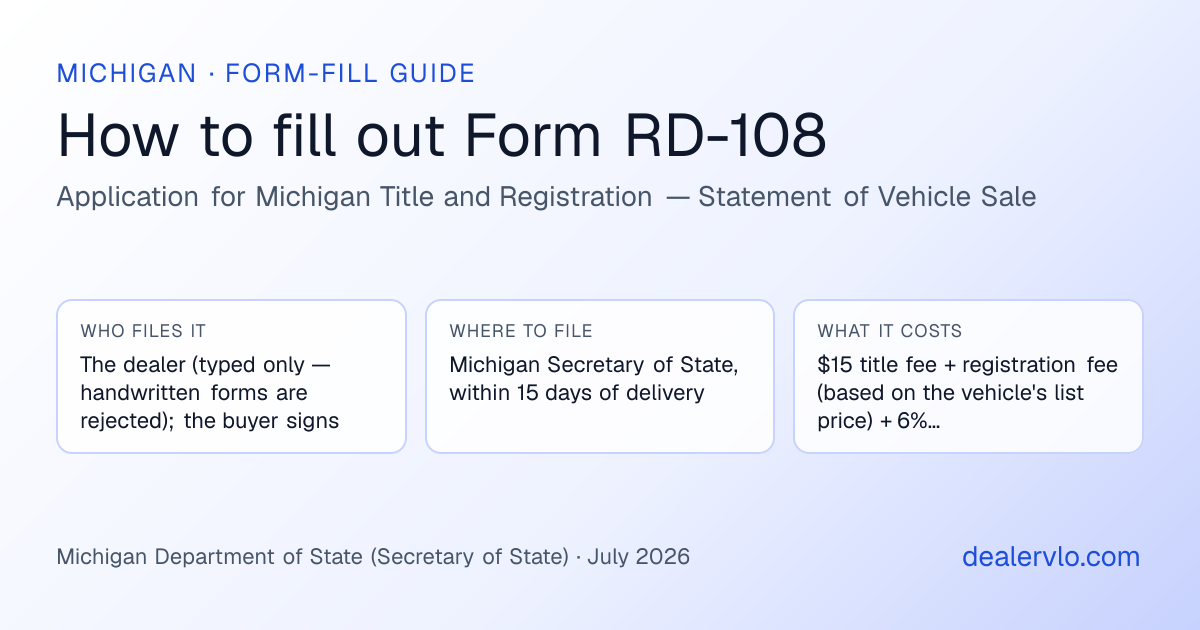
Filling out the MI Form RD-108 after a sale:
- What it is
- Michigan's dealer application for title and registration — also the official statement of the vehicle sale
- Who completes it
- The dealer (typed only — handwritten forms are rejected); the buyer signs
- Where to file it
- Michigan Secretary of State, within 15 days of delivery
- Processing time
- Branch processing is quick; the buyer's title typically mails within a few weeks
- Cost
- $15 title fee + registration fee (based on the vehicle's list price) + 6% sales tax
This guide is informational and does not replace the official Michigan instructions. Always confirm the current form and procedure with Michigan Department of State (Secretary of State) before you file.
See the MI RD-108 filled — from just a VIN
Enter a VIN, the buyer's name, and the price. We decode the vehicle and drop it onto a worksheet for the Michigan RD-108 — the same fill DealerVLO produces from a deal. Watermarked preview; nothing is saved.
What the Form RD-108 is and why it matters
Form RD-108 is how a Michigan dealer sale gets titled and registered. Unlike most states, the buyer never touches the process — the dealer completes the RD-108, collects the 6% sales tax and the title and registration fees, and files everything with the Secretary of State within 15 days of delivery.
Because the RD-108 is also the official statement of the sale, the money section is the part that gets audited: purchase price, trade-in allowance, doc fee, and the tax computed on the right base. Michigan restored full trade-in credit in 2024, so the tax math changed recently enough that plenty of templates floating around are wrong. This guide walks every section, current as written.
The RD-108 is a dealer-only form: Michigan retail buyers never file their own title application on a dealer sale. The dealer completes the RD-108, collects the tax and fees, and files the whole package with the Secretary of State within 15 days of delivery. It doubles as the statement of the sale itself — price, trade, fees, and tax all on one document — which is why the Secretary of State requires it to be typed, not handwritten.
Documents to have before you start
Gather these before you complete the Form RD-108. A missing attachment is the number-one reason the Michigan Department of State (Secretary of State) bounces a title application back.
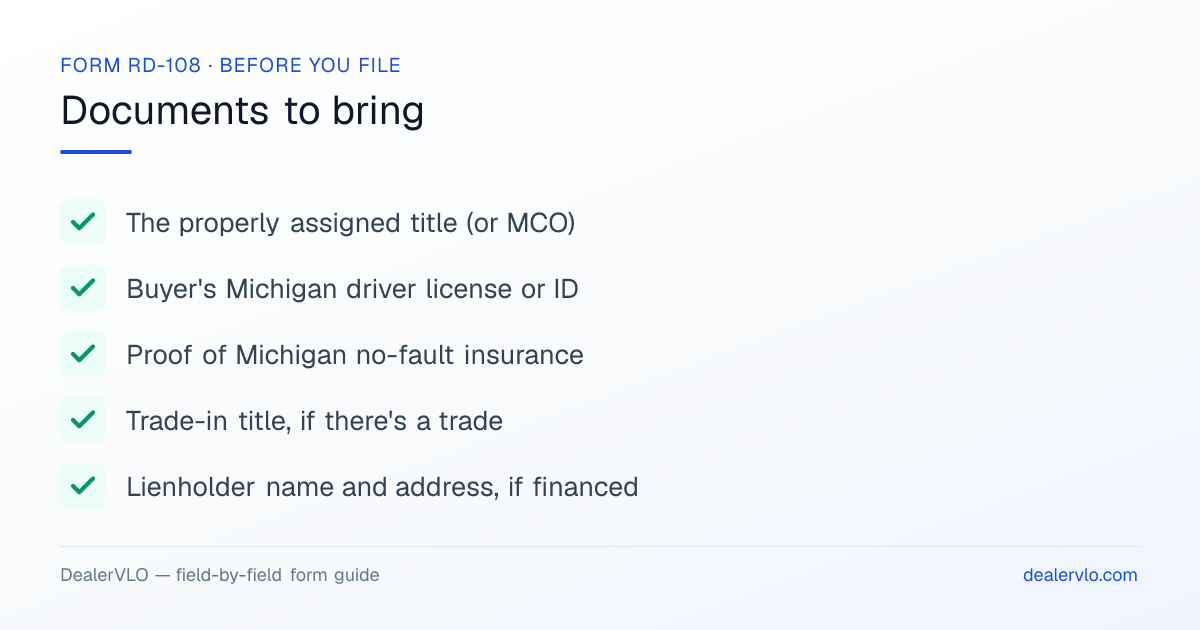
- The properly assigned title (or MCO) — Assigned to the dealership, with the odometer disclosure completed.
- Buyer's Michigan driver license or ID — Name and address must match the RD-108.
- Proof of Michigan no-fault insurance — Required to register — the policy must cover the vehicle being purchased.
- Trade-in title, if there's a trade — The trade's year, make, and VIN go on the RD-108 and drive the tax credit.
- Lienholder name and address, if financed — So the lien is recorded on the new Michigan title.
- Payment for tax and fees — The dealer collects the 6% sales tax, $15 title fee, and the registration fee at delivery and remits with the filing.
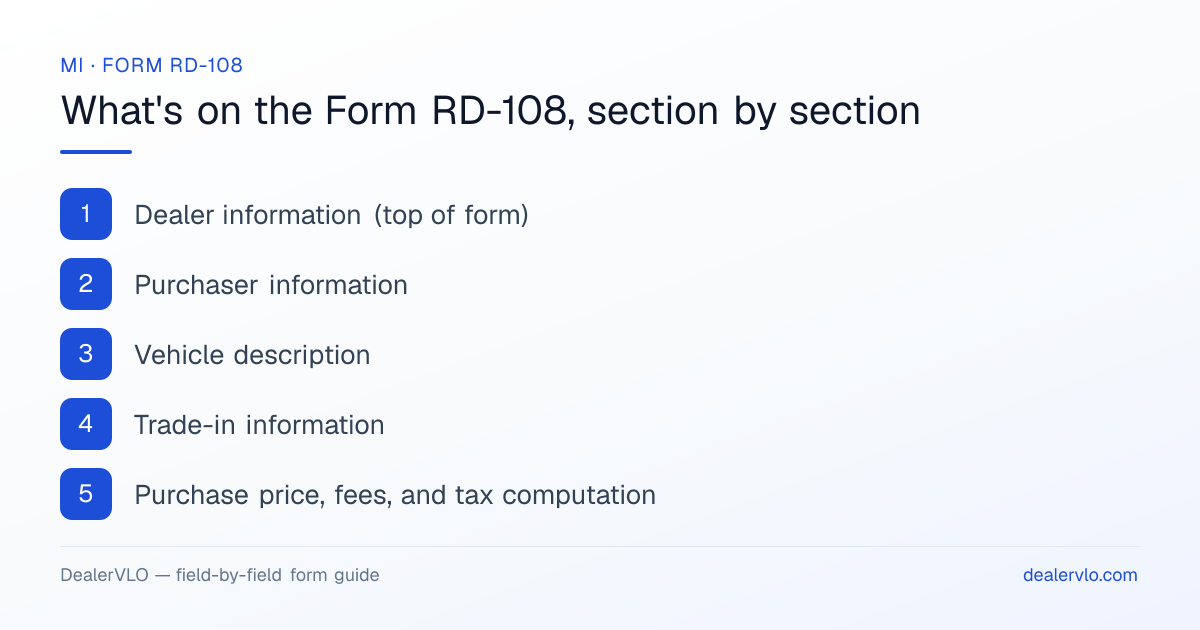
Form RD-108, section by section
Dealer information (top of form)
Identifies the selling dealership: dealer license number, sales tax license number, name, address, and phone. This block ties the RD-108 to your dealer account with the Secretary of State — errors here bounce the whole filing.
| Field | Who fills it |
|---|---|
Dealer name, address, phone | You (dealer) |
Michigan dealer license number | You (dealer) |
Sales tax license number | You (dealer) |
Purchaser information
The buyer — the person the title and registration will be issued to. Enter the legal name, Michigan address, and driver license number exactly as they appear on the buyer's license. Joint buyers both go on, with the ownership conjunction ("and" / "or") they choose.
| Field | Who fills it |
|---|---|
Purchaser's full legal name From the buyer's license — match it exactly. | You (dealer) |
Michigan address | You (dealer) |
Driver license number | Buyer |
Co-purchaser (if any) | You (dealer) |
Vehicle description
Identifies the vehicle being sold. The VIN must match the assigned title and the vehicle's VIN plate. Michigan registration fees are based on the vehicle's original list price (MSRP), so the base price field matters — it sets what the buyer pays for plates every year.
| Field | Who fills it |
|---|---|
VIN Must match the title and the VIN plate. | You (dealer) |
Year, make, model, body style | You (dealer) |
Odometer reading Must match the title disclosure. | You (dealer) |
Base / list price (for registration fee) Michigan plates are priced ad valorem on the original MSRP. | You (dealer) |
Trade-in information
If the deal has a trade, its year, make, VIN, and allowance go here — and the allowance is subtracted from the purchase price before the 6% tax. Michigan phased its trade-in credit cap up for years and removed it entirely in 2024, so the full allowance now counts.
| Field | Who fills it |
|---|---|
Trade-in year, make, VIN | You (dealer) |
Trade-in allowance Full credit against the taxable price (cap removed in 2024). | You (dealer) |
Purchase price, fees, and tax computation
The statement-of-sale section — the reason this form exists. Purchase price, doc fee, title fee, registration/plate fee, and the 6% sales tax on the taxable base (price plus doc fee, minus trade-in allowance). The Secretary of State and Treasury both audit against this block, so it must match the buyer's order to the penny.
| Field | Who fills it |
|---|---|
Purchase price of vehicle Match the buyer's order exactly. | You (dealer) |
Doc fee Taxable in Michigan — include it in the tax base. | You (dealer) |
6% sales tax On price + doc fee − trade-in allowance. | You (dealer) |
Title fee ($15) and registration fee | You (dealer) |
Total delivered price | You (dealer) |
MI Sales tax & title fee calculator
Free · no signup · updates as you type
MI tax is a flat 6% of price + doc fee − trade-in — Michigan taxes the doc fee, and full trade-in credit was restored in 2024. Title fee $15; the plate/registration fee is ad valorem on the vehicle's original MSRP, so it varies by vehicle. Confirm with the MI Secretary of State.
Stop re-keying this onto the Form RD-108.
DealerVLO runs this math on every deal and drops it — with the VIN, buyer, and sale price — straight onto the official MI Form RD-108, the bill of sale, and the FTC forms. One screen, no re-keying.
14-day free trial — no charge until day 14, then $29/month. Cancel any time.
Delivery date and signatures
The delivery date starts the 15-day filing clock. The buyer signs the application and the dealer's authorized representative signs for the dealership, certifying the sale statement.
| Field | Who fills it |
|---|---|
Date of delivery Starts the 15-day deadline to file. | You (dealer) |
Purchaser signature | Buyer |
Dealer / authorized agent signature | You (dealer) |
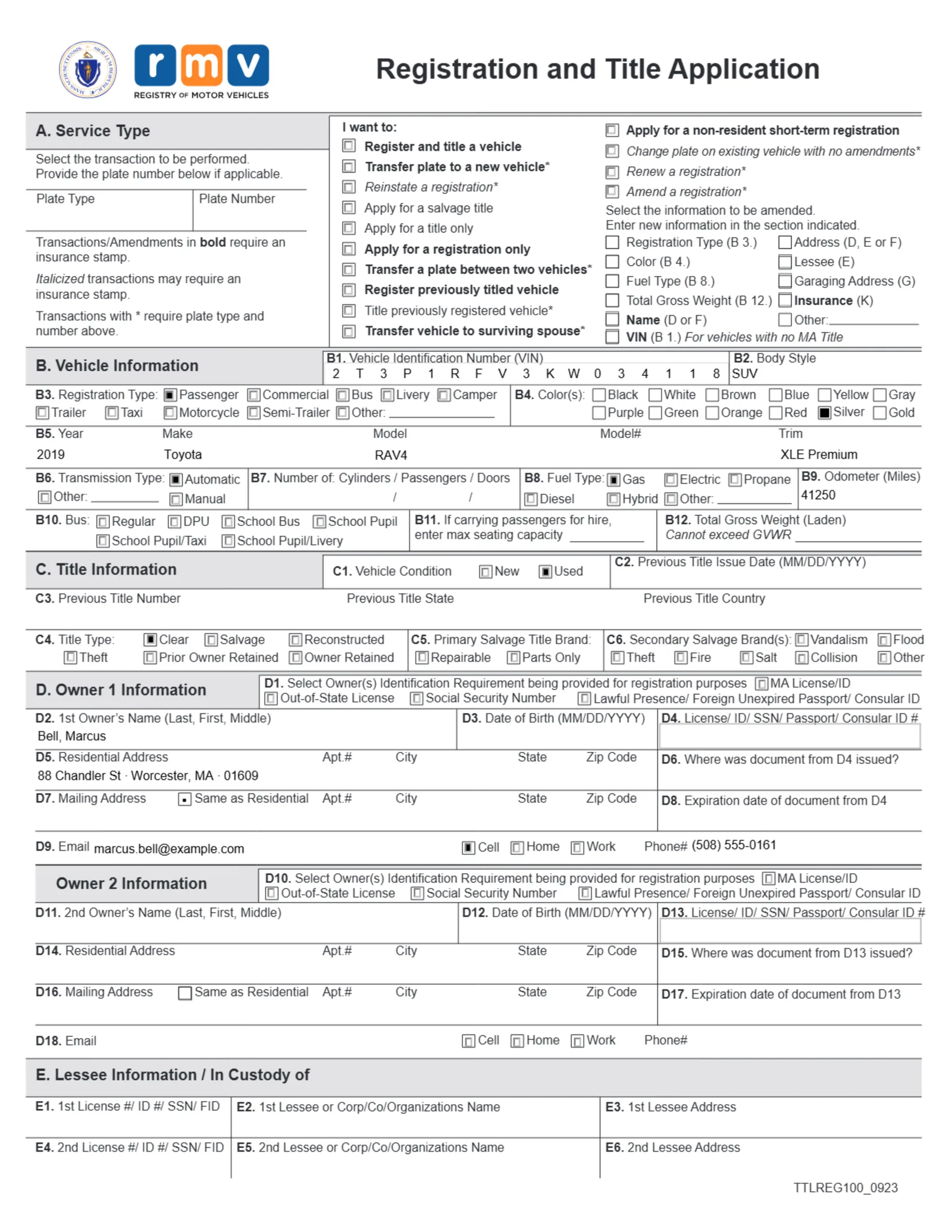
The Form RD-108 is one car's paperwork. A 20-second read on your lot, and the tax-and-fee math for the whole deal — built for dealers, no signup. Free calculators dealers actually use — no signup, no email.
DealerVLO turns your deal into a print-ready Michigan Form RD-108 worksheet — VIN-decoded vehicle, buyer, co-buyer, and sale price laid out and ready to key in or copy over. $29/month, free to try — cancel any time.
Common Form RD-108 mistakes that cause rejections
The Secretary of State requires the RD-108 to be typed — handwritten forms are rejected outright. Print it from your DMS filled, or type it; don't pen-and-ink it at the delivery desk.
The dealer must file the RD-108 package with the Secretary of State within 15 days of delivery. Late filings expose the dealership, not the buyer — build the filing into your delivery checklist.
Michigan capped the trade-in sales-tax credit for years and raised the cap annually — then removed it entirely in 2024. The full trade allowance now reduces the taxable price. Old worksheets with a capped credit overcharge the buyer.
Michigan taxes the doc fee. The 6% is computed on the price plus doc fee, minus the trade allowance — excluding the doc fee understates the tax and surfaces in a Treasury audit.
The RD-108 is the official statement of the sale. If the price, trade, or fees differ from the buyer's order, you've created a paper trail that contradicts itself. Generate both from the same deal record.
Common questions
What is Michigan Form RD-108 used for?+
The RD-108 (Application for Michigan Title and Registration — Statement of Vehicle Sale) is the form a Michigan dealer files to title and register a vehicle it sells. It's dealer-only: the buyer doesn't file anything, and the form doubles as the official statement of the sale — price, trade, fees, and tax.
Where do I get the Michigan RD-108 form?+
The RD-108 is issued by the Michigan Secretary of State — it isn't a blank you hand-copy. Because it has to be typed and doubles as the statement of sale, dealers generate it filled from the deal (VIN, price, trade, tax) and print it. If you're filling one by hand at the delivery desk, that's usually the sign to let your dealer software print it correct.
Does the RD-108 really have to be typed?+
Yes. The Michigan Secretary of State requires the RD-108 to be typed; handwritten forms are not accepted. Most dealers print it filled from their DMS.
How long does a Michigan dealer have to file the RD-108?+
15 days from the date of delivery. The dealer collects the tax and fees at delivery and submits the application package to the Secretary of State within that window.
How is Michigan sales tax calculated on a dealer sale?+
6% of the purchase price plus the doc fee, minus the full trade-in allowance. Michigan's old trade-in credit cap was removed in 2024, so the entire allowance now reduces the taxable base.
How much are Michigan title and registration fees?+
The title fee is $15. The registration (plate) fee is ad valorem — based on the vehicle's original list price (MSRP) — so it varies by vehicle. The dealer collects both with the tax at delivery.
Does the buyer ever go to the Secretary of State on a dealer sale?+
No. On a Michigan dealer sale the dealer handles the entire title and registration transaction through the RD-108 — the buyer signs at delivery, drives off with plates handled, and the new title arrives by mail.
Is there software that fills out the Form RD-108 automatically?+
Yes. Dealer management software like DealerVLO turns the deal you already entered into a print-ready Michigan Form RD-108 worksheet — the VIN-decoded vehicle, buyer, co-buyer, lienholder, and sale price laid out and ready to copy onto the form or key into the state's system. It's $29/month flat with a 14-day free trial, and the same deal also generates your federal documents (Bill of Sale, FTC Buyers Guide, odometer disclosure) and any other state's title forms.
Stop filling out the Form RD-108 by hand.
DealerVLO turns your deal jacket into a print-ready MI Form RD-108 worksheet — VIN-decoded vehicle, buyer, co-buyer, lienholder, and sale price laid out, so keying it in or copying it over takes minutes. $29/month. 14-day free trial, cancel any time.
Curious how it works? See how DealerVLO auto-fills every dealer document — bill of sale, FTC Buyers Guide, odometer disclosure, and state title & registration forms for all 50 states, from one deal.
Bond amounts, fees, and form rules change. Get a short email when your state does. No spam, unsubscribe anytime.