Do Car Dealers Need DocuSign? Built-In E-Sign vs. Paying Per Envelope
A used-car deal jacket is five to eight signable documents per car. Here's why per-envelope e-sign quietly taxes every sale — and what built-in e-signing changes.
Part of the E-signatures & e-titling guide: E-Signatures for Car Dealers: Get the Bill of Sale Signed Without the Printer
Switching from another DMS? Compare DealerVLO to DealerCenter, Frazer, or Lot Wizard.
Every dealer hits the same question the first time they try to stop chasing wet signatures across the desk: do I need DocuSign for this? It's a reasonable instinct — e-signing is a solved problem for the rest of the business world, and DocuSign is the name everyone knows. But before you bolt a general-purpose signing tool onto your lot, it's worth understanding how those tools are priced, because a car deal is not one document — it's a stack of them, and that changes the math.
Here's the honest version, from someone who signs deal jackets on his own lot: for the paperwork that comes out of a sale, a standalone per-envelope tool is usually the more expensive and more awkward way to do it. Not because the tool is bad — because it's priced for a world where you send one contract at a time.
14-day free trial, then $29/mo · Cancel anytime
The per-envelope math nobody runs before they sign up
Standalone e-signature services are typically priced per envelope or per document — you pay for each thing you send out for signature, sometimes inside a monthly plan with a cap. That model is perfect if you're a law firm sending one agreement, or a landlord sending one lease. It's a quiet tax on a used-car lot.
Why? Because a single car sale isn't one signature. Walk a normal deal jacket and count what actually needs signing:

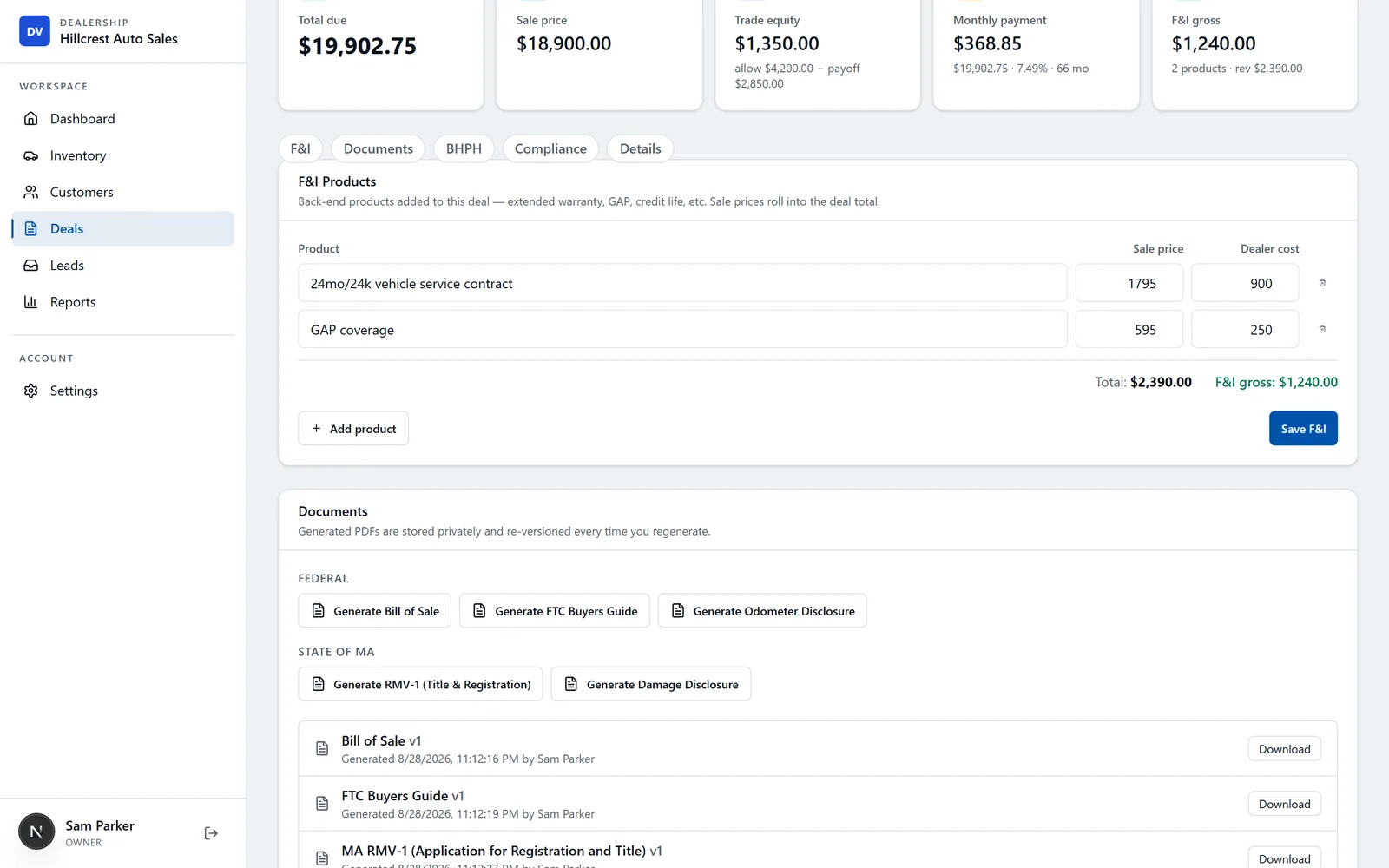
That's often five to eight documents per car — the bill of sale, the FTC Buyers Guide, the federal odometer disclosure, the retail installment contract on a finance deal, the state title and registration application, and a service-contract disclosure if there's a back-end product. Send those through a per-envelope tool and every car you sell is five to eight billable signing events. Multiply that by a month of deals and the "cheap" signing tool is a line item you're now watching. Worse, you're exporting finished PDFs out of your system, uploading them somewhere else, tagging signature fields by hand, and then filing the signed copies back — every single deal.
The pricing model, not the brand, is what decides whether e-signing is cheap or a slow leak. I've made this same argument about per-user and setup fees in a DMS: the sticker is the least interesting number; the model is where the real cost hides.
What "built in" actually means
When e-signing lives inside your DMS, the document you generate and the document you sign are the same object — so there's nothing to export, re-upload, or field-tag. On my lot the deal is entered once, the federal and state forms generate from it, and those same forms get signed right there.

Two ways it happens: in person on a tablet on the desk while the buyer is sitting there, or by emailing the buyer and co-buyer a secure link if they're finishing from home. Either way the signed PDF files back onto the deal as a new version — you're not managing a second inbox of signed copies.
And "built in" only counts if the record behind the signature holds up. A signature without an audit trail is just a picture. Here's the bar I'd hold any dealer e-sign to, standalone or built-in:

DealerVLO's e-sign is ESIGN/UETA-compliant with an explicit consent step, an IP-address / device / timestamp audit trail, and a certificate of completion carrying a SHA-256 document hash stamped onto every signed PDF — so the signed copy is tamper-evident and tied to who signed it and when. That's the same standard of record a good standalone tool gives you; the difference is it happens inside the deal jacket instead of a separate app, and there's no per-signature fee. It's part of the flat $29/month.
14-day free trial, then $29/mo · Cancel anytime
When a standalone tool still makes sense (being fair)
I'm not going to tell you DocuSign is useless — it isn't, and I'd be lying if I did. A general-purpose signing tool earns its keep for the documents that aren't a car deal: a consignment agreement, a vendor or employment contract, floor-plan paperwork, anything you send to someone who isn't a buyer sitting in your system.
Plenty of lots run both, and that's the right call. The DMS signs the deal paperwork at no per-signature cost because that's the high-volume, repetitive stack; the standalone tool handles the occasional one-off business document. What you're trying to avoid isn't standalone e-sign — it's paying per envelope to sign the exact paperwork your DMS already produces for you.
How to evaluate e-sign in any DMS
If you're shopping software, don't take "we have e-signatures" at face value. Ask three questions:
- Is e-sign included, or is there a per-document / per-envelope fee? Included-in-the-price is the whole point.
- Does it sign the whole jacket — federal docs, the retail installment contract, and the state title forms — or only a couple of them?
- What's the audit trail? Consent step, IP/device/timestamp, and a certificate of completion with a document hash. If a vendor can't answer that, the signature won't help you if a deal is ever questioned.
Run those against any option — including mine — and the answer falls out. For the paperwork a used-car sale actually produces, the built-in path is cheaper at any real volume and there's no second app in the loop. For everything else, keep the general tool. If you want the mechanics of how signing and e-titling actually work state by state, I wrote the full e-signature guide for car dealers separately.
Frequently asked questions
Do car dealers need DocuSign to e-sign paperwork? No. DocuSign is a fine general-purpose e-signature tool, but you don't need a separate one if your DMS already signs the deal jacket. DealerVLO has e-signatures built in for the whole jacket — bill of sale, FTC Buyers Guide, odometer disclosure, retail installment contract, and the state title forms — signed in person on a tablet or by emailing the buyer and co-buyer a secure link, with no per-signature fee. The thing to compare isn't the brand, it's the pricing model: a standalone signing tool usually charges per document or per envelope, which adds up on a deal jacket that's five to eight documents per car, while built-in e-signing is part of the flat software cost.
Is there dealer software with e-signatures built in? Yes. DealerVLO includes e-signing for the entire deal jacket at no extra charge — it's part of the flat $29/month, with unlimited users and no per-signature fee. You generate the federal and state documents from the deal, then sign them in person on a tablet or send the buyer and co-buyer a secure link; the signed PDF files back onto the deal as a new version. Not every DMS does this — some make you export the documents and sign them in a separate tool — so if built-in signing matters to you, ask a vendor directly whether e-sign is included and whether there's a per-document fee.
How much does it cost to e-sign a car deal? It depends entirely on the model. Standalone e-signature services are typically priced per envelope or per document (and sometimes capped by a monthly plan), so the cost scales with how many documents you send — and a single car sale is often five to eight signable documents. Built-in e-signing in a DMS is different: it's included in the software's flat price, so signing a full deal jacket costs the same whether it's three documents or eight. In DealerVLO there's no per-signature fee at all — it's part of the $29/month.
Are built-in dealer e-signatures legally valid? Electronic signatures are valid under the federal ESIGN Act and state UETA law when the signer consents to sign electronically and you keep a record of the signing. What makes a dealer e-signature defensible is the audit trail behind it. DealerVLO's e-sign includes a consent step, captures the IP address, device, and timestamp, and stamps every signed PDF with a certificate of completion and a SHA-256 document hash, so the signed copy is tamper-evident and tied to who signed it and when. That's the same standard of record a standalone tool provides — the difference is it happens inside the deal jacket instead of a separate app. This isn't legal advice; if you have a specific compliance question, ask an attorney licensed in your state.
When does a standalone e-signature tool still make sense? When you're signing things that aren't a car deal. A general-purpose tool like DocuSign is genuinely useful for consignment agreements, vendor and employment contracts, floor-plan paperwork, or anything you send to someone who isn't a buyer in your system. Built-in DMS e-signing is aimed at the deal jacket specifically — the documents that generate from a sale. Plenty of lots run both: the DMS signs the deal paperwork at no per-signature cost, and a standalone tool handles the occasional one-off business document. The point isn't that standalone tools are bad — it's that you shouldn't pay per envelope to sign the paperwork your DMS already produces.
Bottom line
For the paperwork a car sale actually generates, per-envelope e-signing is the expensive, awkward way to do a repetitive job — you pay per document on a jacket that's five to eight documents deep, and you babysit a second app on every deal. Built-in e-signing in your DMS makes that stack a non-event: generate, sign in person or by link, and the signed copy files itself back onto the deal with a real audit trail behind it. Keep a standalone tool for the odd business document if you want one — just don't pay per signature to sign what your software already made.
DealerVLO includes e-signing for the whole deal jacket — no per-signature fee, no second app — in the flat $29/month. Start a free trial and sign a real deal end to end.
14-day free trial, then $29/mo · Cancel anytime
Paste a VIN, the buyer, and the price — see the title & registration form filled in for 50 states, free, no signup.
Open the State Form Auto-Fill