How to fill out the Form MV-82 in New York
A field-by-field walkthrough of the New York Form MV-82 (Vehicle Registration/Title Application) for licensed used car dealers — what goes in every section, who signs what, and the documents you attach. Verified against the official form as of July 2026.
Don't waste another second filling out the New York Form MV-82.
Let DealerVLO fill out every form for you instantly.
Filing these every week? DealerVLO fills the Form MV-82 from the deal you already entered, $29/month flat. See pricing
Switching from another DMS? Compare DealerVLO to DealerCenter, Frazer, or Lot Wizard.
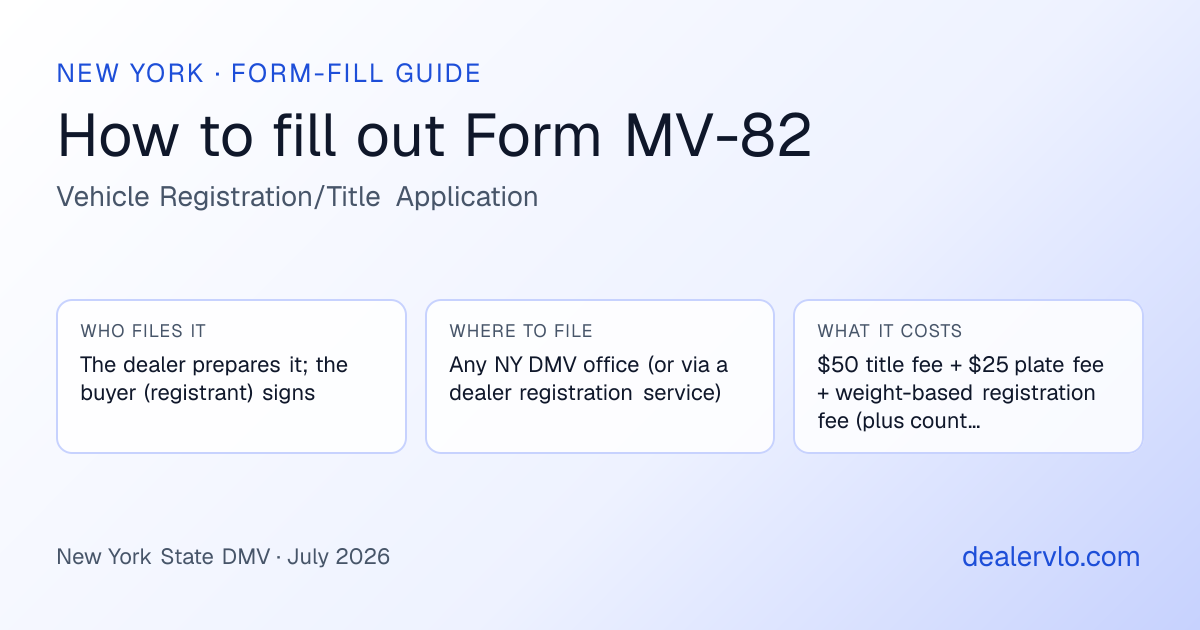
Filling out the NY Form MV-82 after a sale:
- What it is
- New York's combined registration and title application
- Who completes it
- The dealer prepares it; the buyer (registrant) signs
- Where to file it
- Any NY DMV office (or via a dealer registration service)
- Processing time
- Plates and registration at the counter; title arrives by mail (typically several weeks)
- Cost
- $50 title fee + $25 plate fee + weight-based registration fee (plus county use tax / MCTD fee where they apply)
This guide is informational and does not replace the official New York instructions. Always confirm the current form and procedure with New York State DMV before you file.
See the NY Form MV-82 filled — from just a VIN
Enter a VIN, the buyer's name, and the price. We decode the vehicle and drop it onto the actual New York Form MV-82 — the same fill DealerVLO produces from a deal. Watermarked preview; nothing is saved.
What the Form MV-82 is and why it matters
Form MV-82 is how a vehicle gets registered and titled in New York. On a dealer sale, the buyer can't put the car on the road until the MV-82 package is processed — the application itself, the dealer's MV-50 Retail Certificate of Sale as proof of ownership, a New York insurance ID card in the registrant's name, and proof of identity.
New York has no self-service temp tag the way Texas or Georgia does, so getting this package right the first time is what gets your buyer plates. Most dealers either walk it into a DMV office for the customer or run it through a registration service. This guide walks every section a dealer touches.
MV-82 is the New York DMV's all-purpose application: original registration, registration renewal, plate transfer, and title all run through it. On a dealer sale it travels with the MV-50 (Retail Certificate of Sale) — the dealer-issued proof of ownership for a used vehicle — and the buyer's NY insurance ID card. Don't confuse it with the MV-82B (boats) or MV-82SN (snowmobiles).
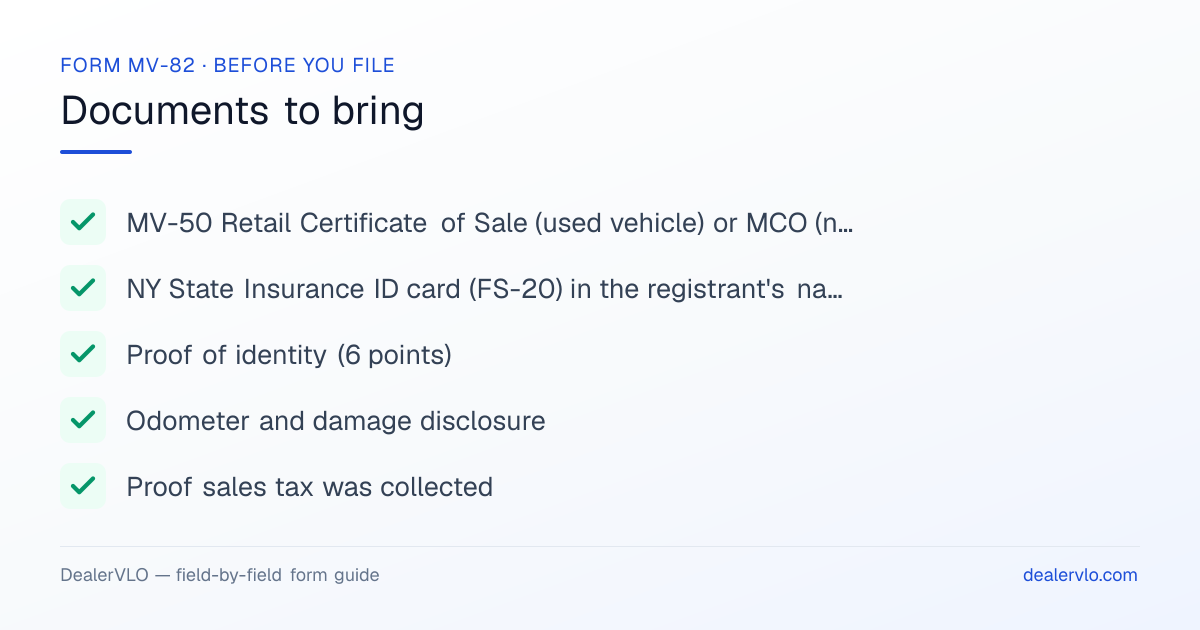
Documents to have before you start
Gather these before you complete the Form MV-82. A missing attachment is the number-one reason the New York State DMV bounces a title application back.
- MV-50 Retail Certificate of Sale (used vehicle) or MCO (new) — The dealer-issued MV-50 is the proof of ownership on a NY dealer sale — the buyer doesn't get the prior title handed to them.
- NY State Insurance ID card (FS-20) in the registrant's name — Issued by a NY-licensed insurer. The names on the insurance card and the MV-82 must match. No card, no registration.
- Proof of identity (6 points) — A NY driver license by itself covers the 6-point requirement.
- Odometer and damage disclosure — Completed as part of the sale paperwork (MV-50 / dealer disclosure).
- Proof sales tax was collected — On a dealer sale, the dealer collects NY sales tax (state 4% + local rate by the buyer's address) and it's cleared at the DMV when the registration is processed.
- Lienholder name and address, if financed — So the lien is recorded on the new NY title.
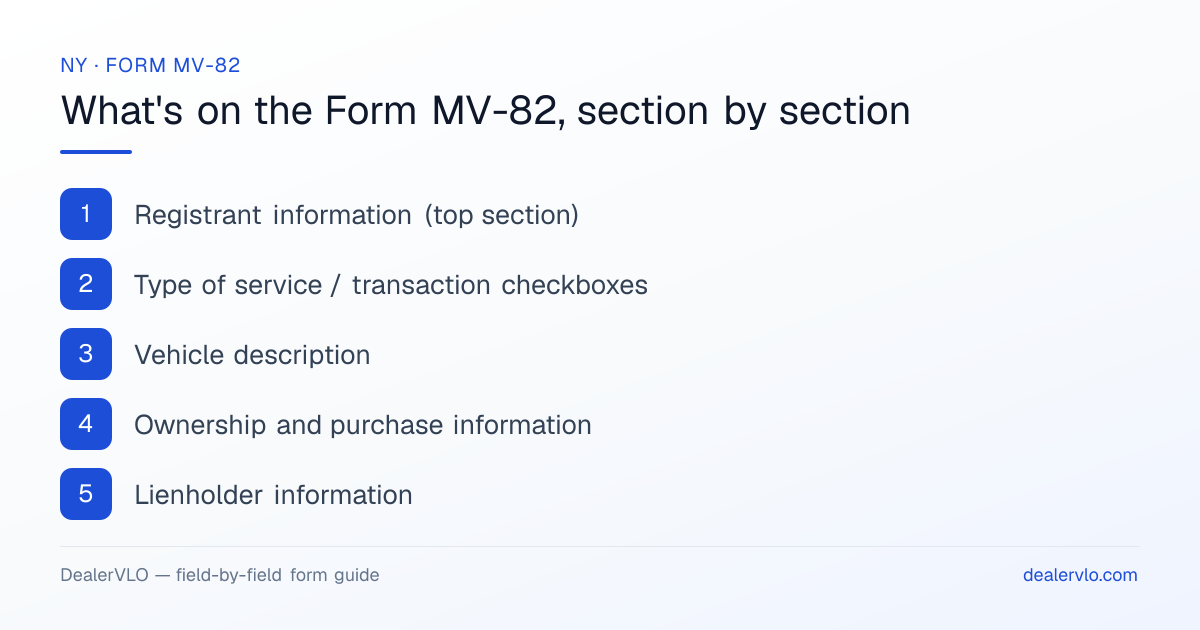
Form MV-82, section by section
Registrant information (top section)
The buyer — the person the vehicle will be registered to. Enter the name exactly as it appears on the proof of identity and the insurance card; a mismatch between the MV-82 and the FS-20 insurance card is the classic counter rejection. A co-registrant goes in the second name fields.
| Field | Who fills it |
|---|---|
Registrant's full legal name Match the license and the insurance ID card exactly. | You (dealer) |
Date of birth, gender, NY DMV ID / driver license number | Buyer |
Address where primary registrant resides Determines the local sales tax rate and county use tax. | You (dealer) |
Mailing address (if different) | You (dealer) |
Co-registrant name and ID (if any) | You (dealer) |
Contact phone / email | Buyer |
Type of service / transaction checkboxes
Tells the DMV what you're asking for. On a standard dealer sale, check original registration with title. If the buyer is transferring plates from a vehicle they already own, mark the transfer and enter the existing plate number.
| Field | Who fills it |
|---|---|
Registration type (original / renewal / transfer of plates) | You (dealer) |
Current plate number (if transferring plates) | Buyer |
Title-only vs registration + title A retail buyer almost always needs both. | You (dealer) |
Vehicle description
Identifies the vehicle. The VIN on the MV-82 must match the MV-50 (or MCO) and the vehicle's VIN plate. Weight matters in New York — passenger registration fees are based on vehicle weight, so enter it accurately.
| Field | Who fills it |
|---|---|
VIN Must match the MV-50 and the VIN plate. | You (dealer) |
Year, make, model, body type, color | You (dealer) |
Unladen / shipping weight Sets the registration fee tier. | You (dealer) |
Fuel type, cylinders | You (dealer) |
Odometer reading Must match the odometer disclosure on the sale documents. | You (dealer) |
Ownership and purchase information
How and when the registrant got the vehicle. On a dealer sale, the dealer's name and facility number tie the MV-82 to the MV-50 — the DMV cross-checks them.
| Field | Who fills it |
|---|---|
Date acquired / purchase date | You (dealer) |
Purchased from (dealer name + facility number) Must match the MV-50 header. | You (dealer) |
New / used checkbox | You (dealer) |
NY Sales tax & title fee calculator
Free · no signup · updates as you type
NY tax is 4% state plus the local rate for the buyer's county of residence — enter it (combined rates commonly run ~8%). Trade-in reduces the taxable amount. Registration is charged separately on vehicle weight, and buyers in the metropolitan commuter district (MCTD) pay a supplemental fee; confirm with the NY DMV.
Stop re-keying this onto the Form MV-82.
DealerVLO runs this math on every deal and drops it — with the VIN, buyer, and sale price — straight onto the official NY Form MV-82, the bill of sale, and the FTC forms. One screen, no re-keying.
14-day free trial — no charge until day 14, then $29/month. Cancel any time.
Lienholder information
Cash deal? Leave it blank. Financed? Record the lender's name and address so the lien is noted on the new title. New York charges a lien filing fee on top of the title fee.
| Field | Who fills it |
|---|---|
Lienholder name Blank for a cash sale. | You (dealer) |
Lienholder mailing address | You (dealer) |
Lien filing code (if the lender has one) Many NY lenders have a DMV lien filing code — use it when the lender provides one. | You (dealer) |
Certification and signature
The registrant certifies the information is true and that the vehicle won't be operated without insurance. The buyer signs — not the dealer — because the registrant is the one making the certification.
| Field | Who fills it |
|---|---|
Registrant signature and date | Buyer |
Co-registrant signature (if any) | Buyer |
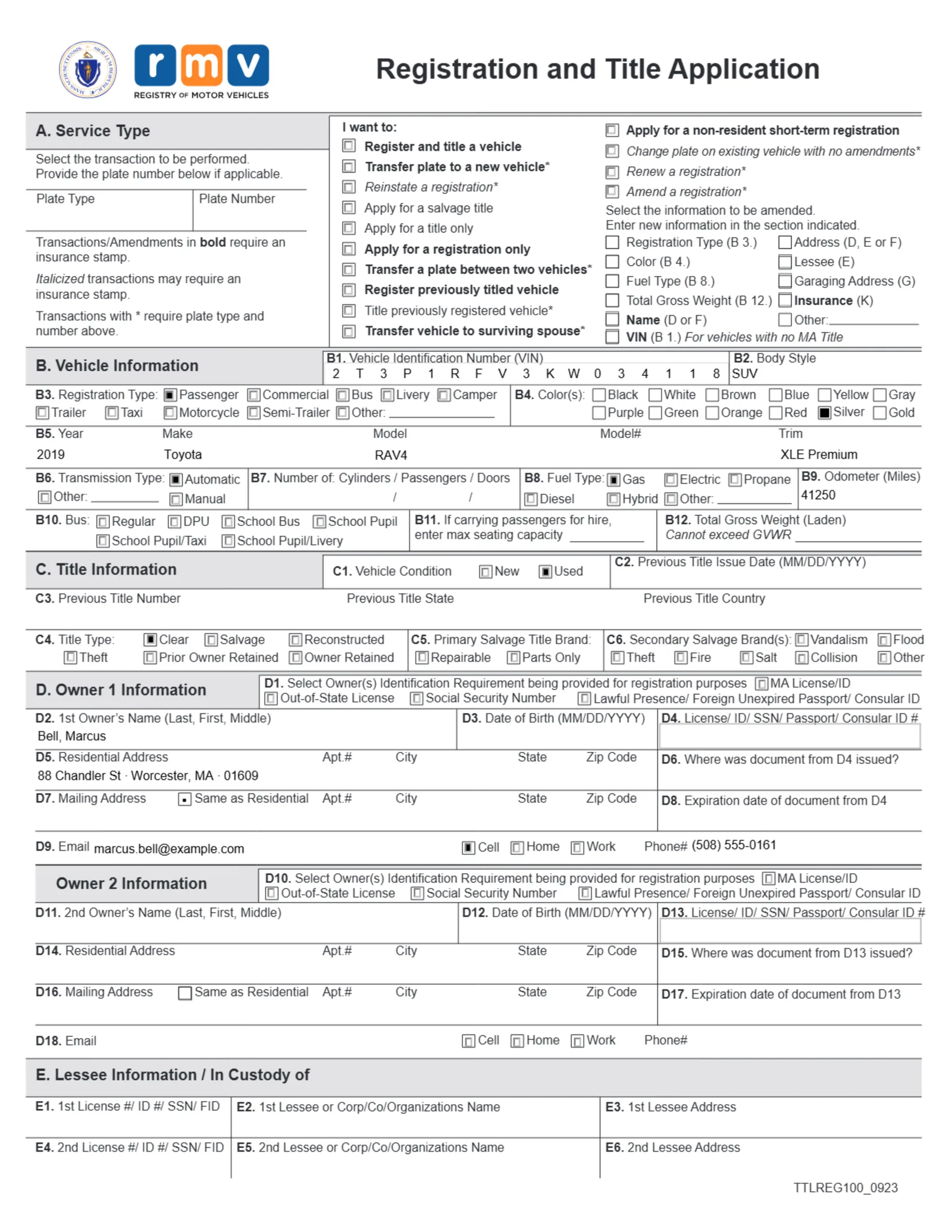
The Form MV-82 is one car's paperwork. A 20-second read on your lot, and the tax-and-fee math for the whole deal — built for dealers, no signup. Free calculators dealers actually use — no signup, no email.
DealerVLO fills the official New York Form MV-82 straight from your deal — VIN-decoded vehicle, buyer, co-buyer, and sale price already in place. $29/month, free to try — cancel any time.
Common Form MV-82 mistakes that cause rejections
The DMV matches the registrant name on the MV-82 against the proof of identity and the FS-20 insurance ID card. "Mike" on the insurance card and "Michael" on the application bounces at the counter. Fix the insurance card before you go.
On a NY dealer sale of a used vehicle, the buyer's proof of ownership is the dealer-issued MV-50 Retail Certificate of Sale — not the old title. Submit the MV-82 with the buyer's copy of the MV-50, completed and signed, or the application stalls.
NY passenger registration fees are weight-based. Enter the actual unladen weight from the VIN decode or door jamb — a wrong weight means the wrong fee and a corrected transaction later.
New York requires NY insurance from a NY-licensed insurer, in the registrant's name, effective on or before the registration date. An out-of-state policy card doesn't count.
NY sales tax on a vehicle is the state 4% plus the local rate for where the buyer resides — not where the dealership sits. Collect at the buyer's home-address rate.
Common questions
What is Form MV-82 used for?+
MV-82 is the New York DMV's Vehicle Registration/Title Application. It covers original registration, registration renewal, plate transfers, and title applications. On a dealer sale it's the form that gets the buyer plates and starts the new title.
Where do I get the New York MV-82 form?+
The MV-82 comes from the New York DMV. On a dealer sale you don't hand a buyer a blank — the dealership completes the registration/title application from the deal, pairs it with the MV-50, collects the tax and fees, and submits the package. Dealers who run a lot generate it filled from their software rather than re-keying it at the counter.
What goes with the MV-82 on a dealer sale?+
The dealer's MV-50 Retail Certificate of Sale (proof of ownership on a used vehicle), a New York State Insurance ID card in the registrant's name, proof of identity (6 points — a NY driver license alone qualifies), and payment for the title, plate, and registration fees. The dealer collects the sales tax.
How much does it cost to title and register a car in New York?+
The title fee is $50 and new plates are $25. The registration fee itself is based on vehicle weight (paid for a two-year period). Buyers in most counties also pay a county vehicle use tax, and buyers in the metropolitan commuter district pay an MCTD supplemental fee. Sales tax is 4% state plus the local rate where the buyer lives.
Who signs the MV-82 — the dealer or the buyer?+
The buyer. The registrant (and any co-registrant) signs the certification. The dealer's role is preparing the application and issuing the MV-50 that proves ownership.
Can a dealer register the vehicle for the buyer?+
Yes — dealers commonly handle the DMV transaction for the customer, either directly at a DMV office or through a registration/title service. New York has no buyer-printed temp tag, so the sale isn't really done until the registration is processed and plates are issued.
What is the MV-50 and how does it relate to the MV-82?+
The MV-50 (Retail Certificate of Sale) is the dealer-issued document that proves ownership when a NY dealer sells a used vehicle — the buyer uses it instead of the prior title. The MV-82 is the application; the MV-50 is the ownership evidence submitted with it. The dealer names and vehicle details on the two must match.
Is there software that fills out the Form MV-82 automatically?+
Yes. Dealer management software like DealerVLO fills the New York Form MV-82 from the deal you already entered — the VIN-decoded vehicle, buyer, co-buyer, lienholder, and sale price are placed for you instead of hand-writing them. For most states that's the official DMV form itself; where a state issues its form only through its own dealer portal, you get a print-ready worksheet with every value already in place. It's $29/month flat with a 14-day free trial, and the same deal also generates your federal documents (Bill of Sale, FTC Buyers Guide, odometer disclosure) and any other state's title forms.
Stop filling out the Form MV-82 by hand.
DealerVLO fills the official NY Form MV-82 straight from your deal jacket — VIN-decoded vehicle, buyer, co-buyer, lienholder, and sale price already in place. Print, sign, and file in about 90 seconds. $29/month. 14-day free trial, cancel any time.
Curious how it works? See how DealerVLO auto-fills every dealer document — bill of sale, FTC Buyers Guide, odometer disclosure, and state title & registration forms for all 50 states, from one deal.
Bond amounts, fees, and form rules change. Get a short email when your state does. No spam, unsubscribe anytime.