How to get dealer plates in New York
What New York dealer plates cost, the types you can get, how to apply, and the rules on using them. Verified as of October 2026.
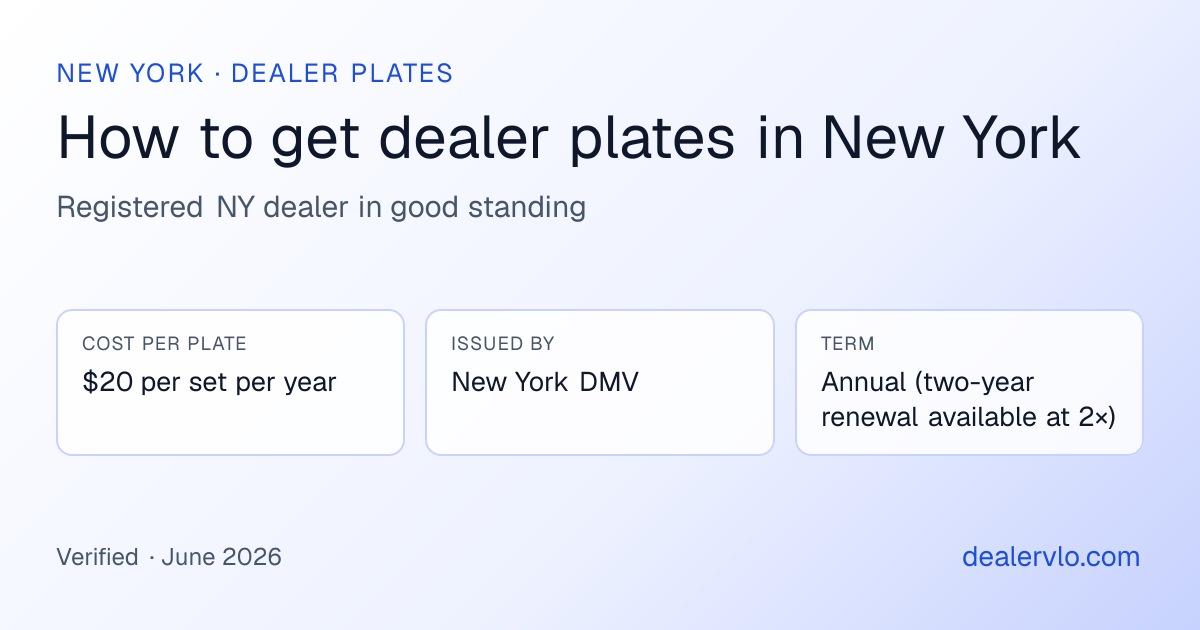
NY dealer plates at a glance:
- Issued by
- New York DMV, with your dealer registration
- Cost per plate
- $20 per set (one plate) per year
- Requirement
- NY DMV dealer registration (VTL §415)
- Use them for
- Vehicles held for sale or demo; 24-hour customer demos
- Term
- Expires with your dealer registration
Informational only — confirm current fees and rules with the New York DMV (Office of Vehicle Safety) before you apply.
Plates are the easy part. These take 20 seconds and tell you what your inventory is costing you while it sits. Free calculators dealers actually use — no signup, no email.
DealerVLO tracks your inventory, deals, and paperwork so the plates are the only thing left on your list. $29/month, free to try — cancel any time.
What New York dealer plates are
New York dealer plates come with your DMV dealer registration under Vehicle and Traffic Law §415. They're cheap: $20 a set per year, and a set is one plate. What matters more is the use rules. Dealer plates are only for vehicles you own or control and hold for sale or demonstration. A customer demo is capped at 24 hours, and a plate loan at 5 days.
Don't confuse dealer plates with the DMV's Dealer Plate Issuance Program. That program lets you hand customers their own registration plates at the sale, and it has its own requirements: a year as a registered retail dealer and 25 retail sales a year. Your dealer plates don't depend on it.
Other New York forms dealers file
Also for New York: New York dealer license
Same form in other states: Title applications · Odometer disclosure
Types of NY dealer plates
For vehicles you own or control and hold for sale or demonstration, plus everything transporter plates allow. $20 per set per year. Since 1993 a set is a single plate, and a properly used car needs only that one plate.
A separate registration for limited uses: weighing, testing, transporting, delivering, repossession, and similar moves of vehicles the registrant owns or controls. Same $20-per-set plate fee.
Not dealer plates. Approved dealers issue customers permanent registration plates and in-transit permits at the sale. You qualify after a year as a registered retail dealer, with 25 retail sales a year and a clean 12-month record. Apply on form MV-463.
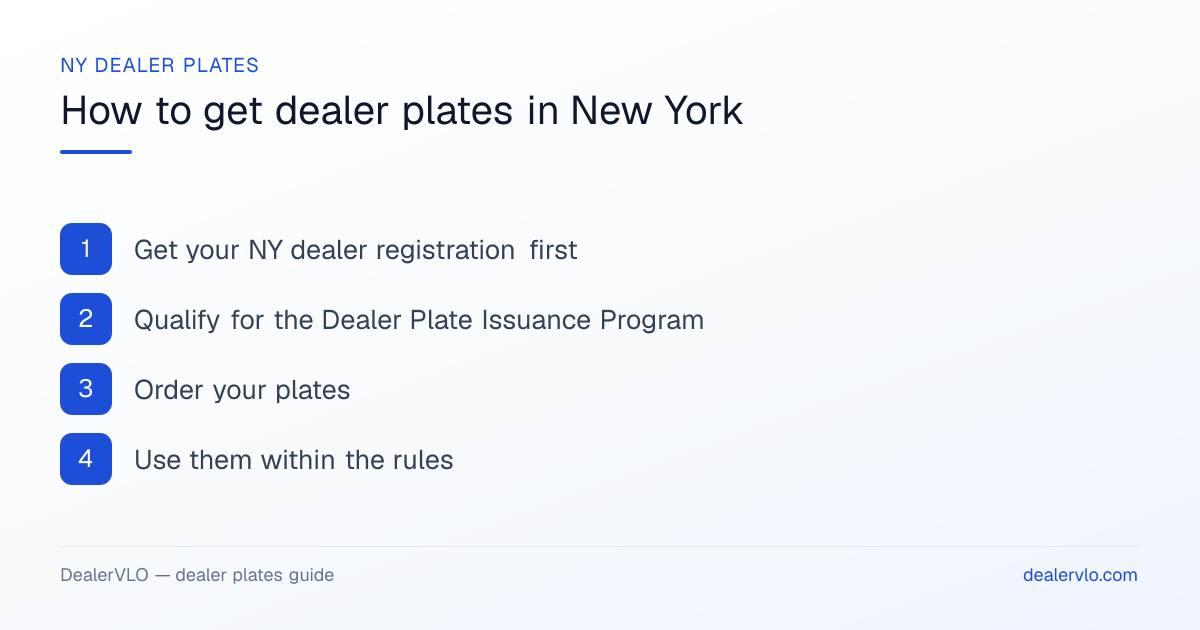
How to get dealer plates in New York
- 1
Register as a dealer with the DMV
File the Original Facility Application (VS-1) with your dealer bond and fees: a $37.50 application fee and $225 a year for the registration (two-year renewals cost twice the annual fee). See our New York dealer license guide for the full process.
- 2
Get your dealer plate letter
Once your facility is approved, the DMV sends your registration and, if you're getting plates, a dealer plate letter. The DMV decides how many sets you get, at $20 per set per year.
- 3
Put one plate on each car you're using
One plate per vehicle. A car used properly on a dealer plate is exempt from registration and inspection, so it doesn't need registration or inspection stickers. The DMV's VS-12 "Dealer Plate Use" placard explains the rules, and you can keep it in the car.
- 4
Write every plate loan on the MV-50
If a buyer leaves on your plate, enter the plate number on the MV-50 certificate of sale. Look at their insurance ID card before you hand the plate over. Loans max out at 5 days.
- 5
Renew plates with your registration
Plates expire the same day as your dealer registration. Renewal plates can go on the car during the 30 days before the expiration date.
Rules on using NY dealer plates
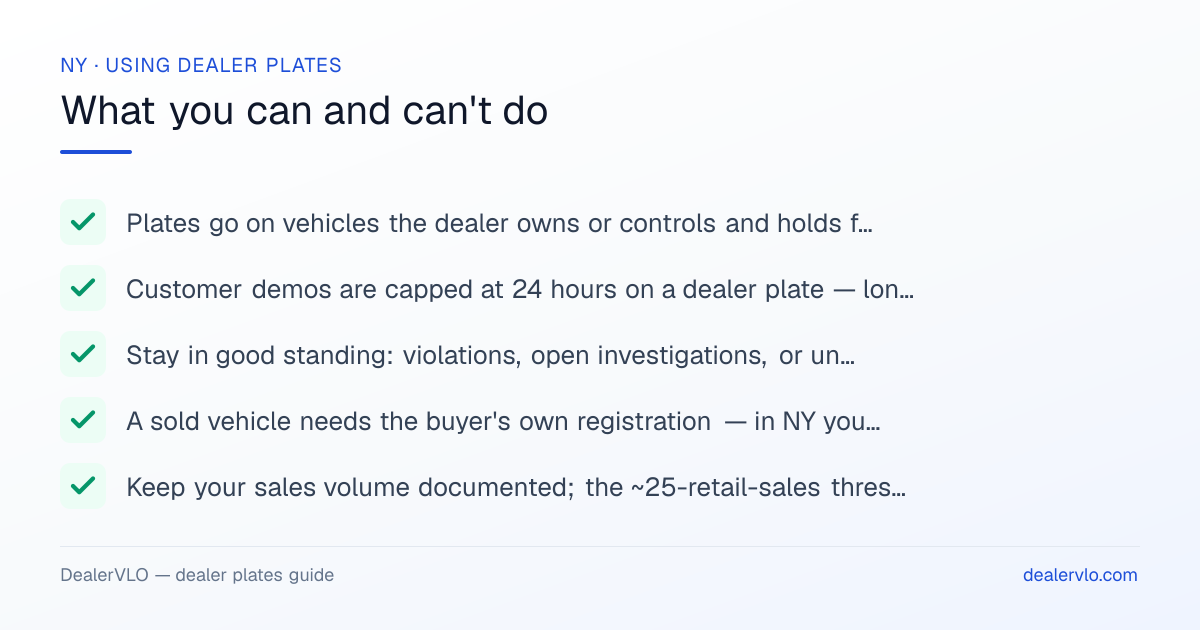
- Only on vehicles the dealership owns or controls and holds for sale or demonstration
- Never on cars rented to others, cars carrying passengers for hire, tow trucks or wreckers, or commercial vehicles used for anything other than selling or demonstrating that vehicle
- Never on cars owned by your family members or employees, or on service cars (15 NYCRR §78.21(b))
- A prospective buyer may use a car on your plate for up to 24 hours as a demonstration. Longer than that counts as a loan
- Loans max out at 5 days, the plate number goes on the MV-50, and the buyer shows an insurance ID card first. You can't renew a loan of the same car and plate to the same person
- Don't lend your plates or let anyone else use them in any other situation (15 NYCRR §78.21(g))
- Don't use the plates if your registration is revoked, suspended, or expired
- If you sold fewer than 5 vehicles in the last 12 months, the DMV can demand plates back within 10 days
Common questions
How much are dealer plates in New York?+
$20 per set per year, and a set is one plate. The fee is set by VTL §415(6). Plates issued for less than a full term are prorated. The dealer registration itself costs $225 a year plus a $37.50 application fee.
How do I get dealer plates in NY?+
Register as a dealer with the DMV: file the VS-1 facility application with your bond and fees, and pass the facility review. Plates come with the registration. Once you're approved, the DMV issues a dealer plate letter if you're getting plates. You don't need a year of history or a sales minimum for dealer plates. Those rules are for the separate Dealer Plate Issuance Program.
How many dealer plates can a New York dealer get?+
The law lets the DMV issue "one or more sets" as the commissioner decides. There's no published per-dealer number. Volume does count against you on the low end: if you sold fewer than 5 vehicles in the past 12 months, the DMV can make you return plates.
Can a customer test drive on a NY dealer plate?+
Yes, for up to 24 hours. That's a demonstration. Past 24 hours it's a loan, and a loan has its own rules: 5 days max, the plate number on the MV-50, and an insurance ID card shown first.
Can I drive my dealer plate car for personal use in New York?+
The law doesn't list personal use. It limits dealer plates to vehicles you own or control and hold for sale or demonstration. The regulation bans them on cars your family or employees own, and on service cars. A 1997 state Attorney General opinion read the law narrowly: no shuttling customers, no parts runs. Treat anything that isn't selling or demonstrating that car as a risk.
What counts as misuse of dealer plates in NY, and what's the penalty?+
Misuse includes using the plates on a car you don't hold for sale, a rental, a tow truck, or a family member's or employee's car. Lending a plate outside the 24-hour demo and 5-day loan rules counts too. The DMV can suspend or revoke your plates and your dealer registration for using plates contrary to law (VTL §415(9) and (10)). Civil penalties run up to $1,000 for a first violation and up to $1,500 for a second within 30 months.
What happens if I'm pulled over on dealer plates in New York?+
The DMV has told police that a car used properly on dealer plates needs only one plate and is exempt from registration and inspection, so no stickers are required. You can keep the DMV's VS-12 "Dealer Plate Use" placard in the car. If a buyer is driving on a loaned plate, the MV-50 with the plate number written on it is the record of the loan.
What's the difference between dealer plates and the Dealer Plate Issuance Program?+
Dealer plates are for your own inventory. The Dealer Plate Issuance Program lets you issue customers their permanent registration plates and in-transit permits at the sale. To join, you need a year as a registered retail dealer (with limited waivers) and good standing: no violations in 12 months, no open investigations, no unpaid penalties. You also need at least 25 retail sales a year (new-car dealers with the $50,000 bond are exempt) and locked plate storage. Apply on form MV-463. Processing takes 4 to 6 weeks.
- New York used car dealer license guide
- Used car dealer license guides by state
- Dealer license cost calculator
- How to fill out Form MV-82 (New York)
- E-signatures and e-titling for New York dealers
- New York odometer and damage disclosure (MV-103)
- Dealer plates in every state: what they are and how to get them
- Dealer temporary tags: rules by state
- Title application forms in every state
Plates on the car? Run the rest of the deal in DealerVLO.
Inventory, the deal jacket, and every NY + federal form your sales need — filled automatically from one deal. $29/month. 14-day free trial, cancel any time.