How to fill out the State Form 205 in Indiana
A field-by-field walkthrough of the Indiana State Form 205 (Application for Certificate of Title for a Vehicle) for licensed used car dealers — what goes in every section, who signs what, and the documents you attach. Verified against the official form as of September 2026.
Don't waste another second filling out the Indiana State Form 205.
Let DealerVLO fill out every form for you instantly.
Filing these every week? DealerVLO fills the State Form 205 from the deal you already entered, $29/month flat. See pricing
Switching from another DMS? Compare DealerVLO to DealerCenter, Frazer, or Lot Wizard.
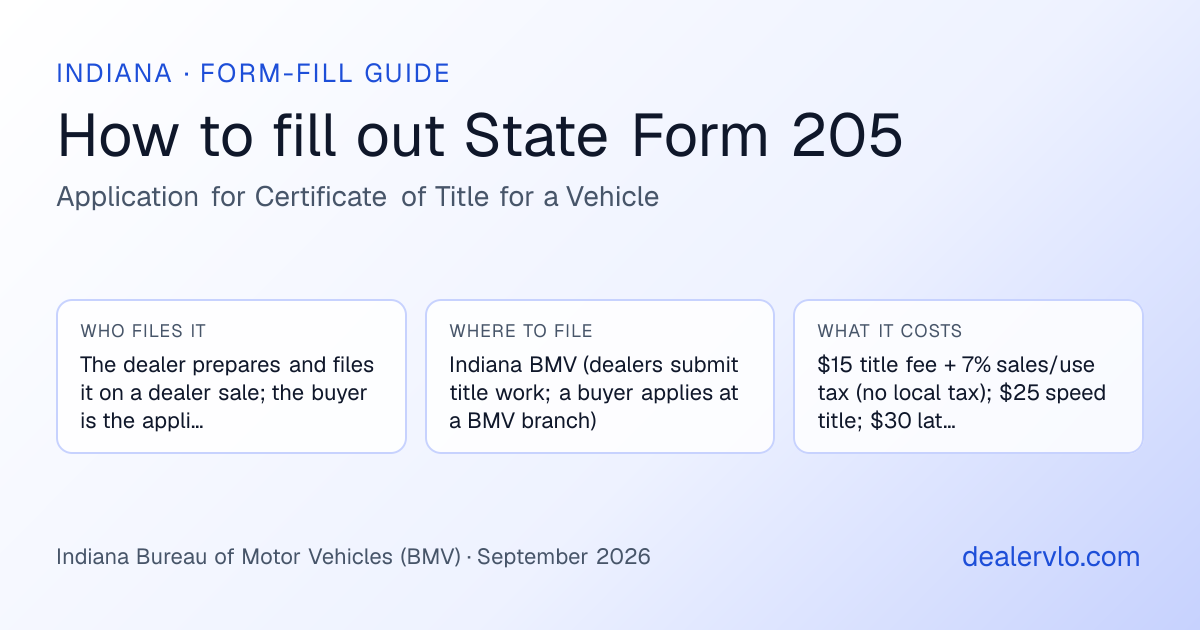
Filling out the IN State Form 205 after a sale:
- What it is
- Indiana's application to title a vehicle in the buyer's name — includes the sales/use tax affidavit
- Who completes it
- The dealer prepares and files it on a dealer sale; the buyer is the applicant and signs
- Where to file it
- Indiana BMV (dealers submit title work; a buyer applies at a BMV branch)
- Processing time
- Paper or electronic title; a speed (expedited) title is available for a fee
- Cost
- $15 title fee + 7% sales/use tax (no local tax); $25 speed title; $30 late-title penalty
This guide is informational and does not replace the official Indiana instructions. Always confirm the current form and procedure with Indiana Bureau of Motor Vehicles (BMV) before you file.
See the IN State Form 205 filled — from just a VIN
Enter a VIN, the buyer's name, and the price. We decode the vehicle and drop it onto the actual Indiana State Form 205 — the same fill DealerVLO produces from a deal. Watermarked preview; nothing is saved.
What the State Form 205 is and why it matters
State Form 205 is Indiana's Application for Certificate of Title — the form that puts a vehicle in the buyer's name. On a dealer sale the dealer usually prepares and files it for the buyer, along with the assigned title and the sales-tax affidavit that's built into the form.
The part that gets it right or wrong is the Gross Retail and Use Tax affidavit at the bottom: selling price, trade-in, the amount subject to tax, and the 7% tax itself. Indiana's a flat-rate, no-local-tax state, which keeps the math simple — but the trade-in rule has an edge (it only counts for a like-kind trade titled in the buyer's name), and the doc fee is taxable. This guide walks the current (R14 / 4-26) form section by section.
On an Indiana dealer sale the dealer generally prepares and submits the buyer's title work — the form has a dealer number and a sales-tax affidavit built for exactly that. The buyer is the named applicant and signs under penalty of perjury. Indiana gives a dealer up to 31 days to deliver the title, and a buyer must apply for their title within 45 days of buying the vehicle; miss it and a $30 administrative penalty attaches.
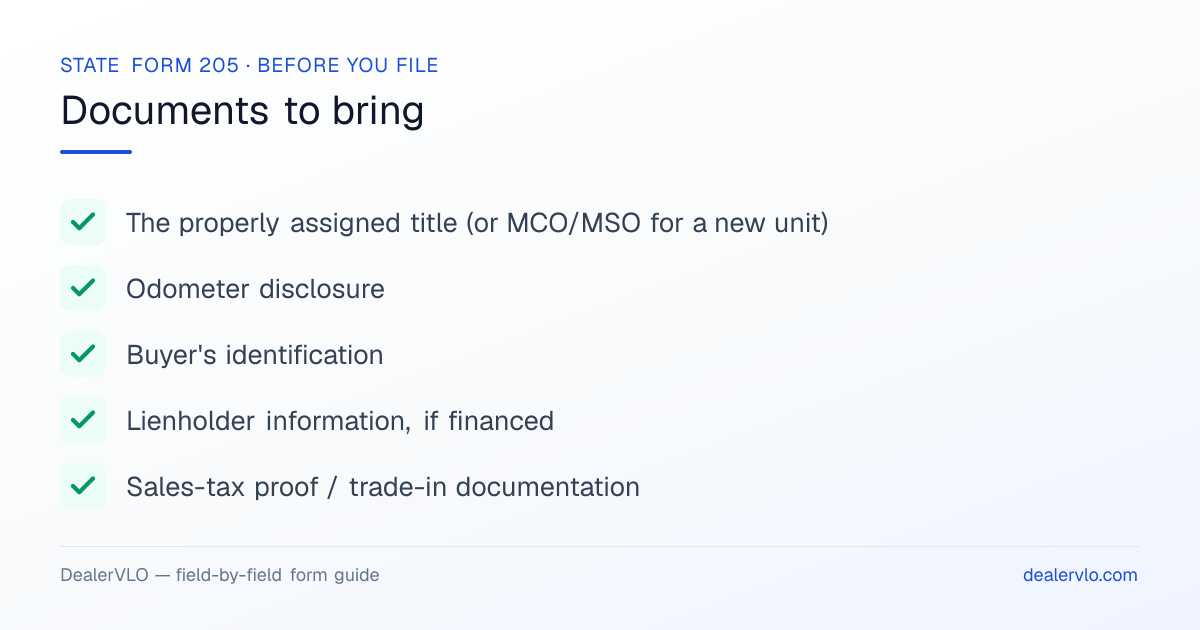
Documents to have before you start
Gather these before you complete the State Form 205. A missing attachment is the number-one reason the Indiana Bureau of Motor Vehicles (BMV) bounces a title application back.
- The properly assigned title (or MCO/MSO for a new unit) — Signed over to the buyer with the odometer disclosure completed; the prior title number goes on the application as the Former Title Number.
- Odometer disclosure — Federal disclosure on the title assignment; the reading is also entered on the application.
- Buyer's identification — The application requires the applicant's SSN or federal ID number (mandated by Indiana law).
- Lienholder information, if financed — First (and any second) lienholder name and address, plus the ELT number for an electronic-lien lender.
- Sales-tax proof / trade-in documentation — The selling price and any trade-in feed the tax affidavit; keep the buyer's order and trade paperwork with the file.
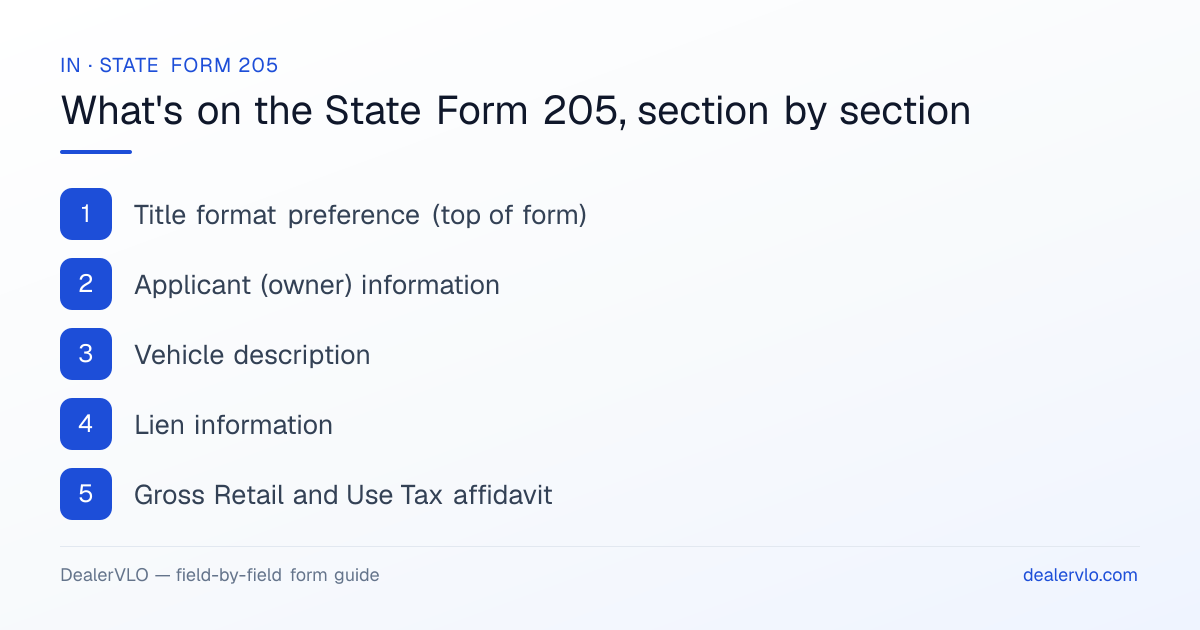
State Form 205, section by section
Title format preference (top of form)
Indiana issues either an electronic or a paper title. Pick one at the top; if it's left blank, the BMV defaults to an electronic title. A financed vehicle typically rides as an electronic lien anyway.
| Field | Who fills it |
|---|---|
Electronic or paper title Defaults to electronic if blank. | Buyer |
Applicant (owner) information
The buyer — the person the title is issued to. Enter the legal name and Indiana residence address, plus the SSN or federal ID number, which Indiana requires on the application. A co-owner goes on the second line with the ownership conjunction.
| Field | Who fills it |
|---|---|
SSN or federal ID number Required by Indiana law (IC 4-1-8-1). | Buyer |
Applicant's full legal name | Buyer |
Residence address, city, state, ZIP | Buyer |
Co-owner (if any) | Buyer |
Vehicle description
Identifies the vehicle. The VIN must match the assigned title and the VIN plate. The Former Title Number ties this application to the title you're surrendering, and the purchase date sets the buyer's 45-day clock to apply.
| Field | Who fills it |
|---|---|
VIN Must match the title and VIN plate. | You (dealer) |
Year, make, model, vehicle type, color | You (dealer) |
Odometer reading Must match the title's odometer disclosure. | You (dealer) |
Former title number The surrendered title being transferred. | You (dealer) |
Purchase date Starts the buyer's 45-day deadline to apply for title. | You (dealer) |
Dealer number | You (dealer) |
Lien information
If the buyer financed, the first lienholder's name and address go here so the lien is recorded on the new title. An electronic-lien lender's ELT identification number is entered too; a second lien has its own block.
| Field | Who fills it |
|---|---|
First lienholder name & address So the lien is recorded on the title. | You (dealer) |
ELT identification number For an electronic-lien-and-title lender. | You (dealer) |
Second lienholder (if any) | You (dealer) |
Gross Retail and Use Tax affidavit
The tax section — and the reason a wrong number here comes back to bite. Enter the selling price, subtract a qualifying trade-in, and the amount subject to tax is what the 7% is figured on. Indiana's trade-in credit applies only to a like-kind trade (car for car) that's owned and titled in the buyer's name — any loan balance on the trade is not subtracted, and negative equity is not added. If a document (doc-prep) fee is charged, Indiana taxes it, so it's part of the taxable price.
| Field | Who fills it |
|---|---|
Selling price Match the buyer's order. A taxable doc fee is included in the price. | You (dealer) |
Less trade-in / discount Like-kind trade titled in the buyer's name only; loan balance not deducted. | You (dealer) |
Amount subject to tax Selling price − qualifying trade-in. | You (dealer) |
Amount of tax (7%) Flat 7% statewide — Indiana has no local vehicle sales tax. | You (dealer) |
IN Sales tax & title fee calculator
Free · no signup · updates as you type
Indiana sales/use tax is a flat 7% of the price after a qualifying trade-in, plus the taxable doc fee — there is no local vehicle sales tax. The trade-in credit applies only to a like-kind trade titled in the buyer's name; a loan balance on the trade is not deducted. Title fee $15 ($25 for a speed/expedited title); a $30 penalty applies if the buyer doesn't apply within 45 days. Indiana caps the dealer document-preparation fee (an enforcement threshold the Secretary of State resets each July — $261.72 as of July 1, 2026). Confirm current figures with the Indiana BMV.
Stop re-keying this onto the State Form 205.
DealerVLO works out the sales tax on every deal and fills the official IN State Form 205 from it — with the VIN, buyer, and sale price — along with the bill of sale and the FTC forms. One screen, no re-keying.
14-day free trial — no charge until day 14, then $29/month. Cancel any time.
Signatures
The applicant signs, certifying the application under penalty of perjury; co-owners each sign. This is the buyer's certification that everything above — name, VIN, price, tax — is true.
| Field | Who fills it |
|---|---|
Applicant signature + printed name | Buyer |
Co-owner signature (if any) | Buyer |
Date | Buyer |
The State Form 205 is one car's paperwork. A 20-second read on your lot, and the tax-and-fee math for the whole deal — built for dealers, no signup. Free calculators dealers actually use — no signup, no email.
DealerVLO fills the official Indiana State Form 205 straight from your deal — VIN-decoded vehicle, buyer, co-buyer, and sale price already in place. $29/month, free to try — cancel any time.
Common State Form 205 mistakes that cause rejections
Indiana's trade-in tax credit applies only to a like-kind trade (car for car) titled in the buyer's name. Trading a boat toward a car doesn't count, and you never subtract the balance owed on the trade — the credit is the vehicle's allowance, not the equity. Overstating it understates the tax and surfaces in an audit.
Indiana taxes the documentation-preparation fee. It belongs in the selling price that the 7% is figured on. (A separately stated convenience fee, by contrast, isn't taxed.) Excluding a taxable doc fee understates the tax.
A buyer must apply for the certificate of title within 45 days of acquiring the vehicle, or Indiana adds a $30 administrative penalty. Hand the buyer a complete package and file promptly on a dealer sale so the clock never becomes their problem.
Indiana requires the applicant's Social Security number or federal ID number on the title application. A blank there stalls the filing — capture it with the rest of the buyer's information up front.
The application's VIN must match the assigned title and the VIN plate, and the selling price must match the buyer's order. Generate the paperwork from one deal record so the VIN, price, and trade agree everywhere.
Common questions
What form do I use to title a vehicle in Indiana?+
Indiana State Form 205, the Application for Certificate of Title for a Vehicle, issued by the Indiana BMV. On a dealer sale the dealer generally prepares and submits it for the buyer, along with the assigned title and the built-in sales-tax affidavit.
Where do I get the Indiana title application?+
State Form 205 is published free by the Indiana Bureau of Motor Vehicles. You can download the official fillable PDF from the BMV's forms site — the download button at the top of this guide links straight to it.
How much is Indiana sales tax on a car?+
A flat 7% of the selling price after a qualifying trade-in. Indiana has no additional local or county sales tax on vehicles, so the rate is the same statewide.
Does a trade-in lower Indiana sales tax?+
Yes, but only for a like-kind trade (car for car) that's owned and titled in the buyer's name. The allowance reduces the taxable price; a loan balance owed on the trade is not deducted, and negative equity is not added.
Is the doc fee taxable in Indiana?+
Yes. A documentation-preparation fee is part of the taxable selling price in Indiana. A separately stated convenience fee is not taxed. Indiana also caps the doc-prep fee at an annually indexed amount ($261.72 as of July 1, 2026) that must be disclosed in writing.
How much does an Indiana title cost?+
The standard title fee is $15. A speed (expedited) title is $25. If a buyer applies more than 45 days after acquiring the vehicle, Indiana adds a $30 administrative penalty.
How long does a dealer have to deliver the title in Indiana?+
A dealer generally must deliver the title at the time of sale and may have up to 31 days to do so. Separately, a buyer who hasn't received a title can send a written demand after 21 days, which gives the dealer 10 more days to deliver it.
Is there software that fills out the State Form 205 automatically?+
Yes. Dealer management software like DealerVLO fills the Indiana State Form 205 from the deal you already entered — the VIN-decoded vehicle, buyer, co-buyer, lienholder, and sale price are placed for you instead of hand-writing them. For most states that's the official DMV form itself; where a state issues its form only through its own dealer portal, you get a print-ready worksheet with every value already in place. It's $29/month flat with a 14-day free trial, and the same deal also generates your federal documents (Bill of Sale, FTC Buyers Guide, odometer disclosure) and any other state's title forms.
- Title application forms in every state
- How to fill out Illinois Form VSD 190
- How to fill out Ohio BMV 3774
- How to fill out Michigan RD-108
- All dealer guides
- How to get a used car dealer license in Indiana
- Indiana dealer plates
- E-signatures and e-titling for Indiana dealers
- Indiana certificate of repossession (39738)
- Indiana odometer disclosure statement (State Form 43230)
- How much is a dealer's license? Cost in every state
Stop filling out the State Form 205 by hand.
DealerVLO fills the official IN State Form 205 straight from your deal jacket — VIN-decoded vehicle, buyer, co-buyer, lienholder, and sale price already in place. Print, sign, and file in about 90 seconds. $29/month. 14-day free trial, cancel any time.
Curious how it works? See how DealerVLO auto-fills every dealer document — bill of sale, FTC Buyers Guide, odometer disclosure, and state title & registration paperwork for all 50 states, from one deal.
Bond amounts, fees, and form rules change. Get a short email when your state does. No spam, unsubscribe anytime.