How to fill out the DPSMV 1799 in Louisiana
A field-by-field walkthrough of the Louisiana DPSMV 1799 (Vehicle Application) for licensed used car dealers — what goes in every section, who signs what, and the documents you attach. Verified against the official form as of September 2026.
Don't waste another second filling out the Louisiana DPSMV 1799.
Let DealerVLO fill out every form for you instantly.
Filing these every week? DealerVLO fills the DPSMV 1799 from the deal you already entered, $29/month flat. See pricing
Switching from another DMS? Compare DealerVLO to DealerCenter, Frazer, or Lot Wizard.
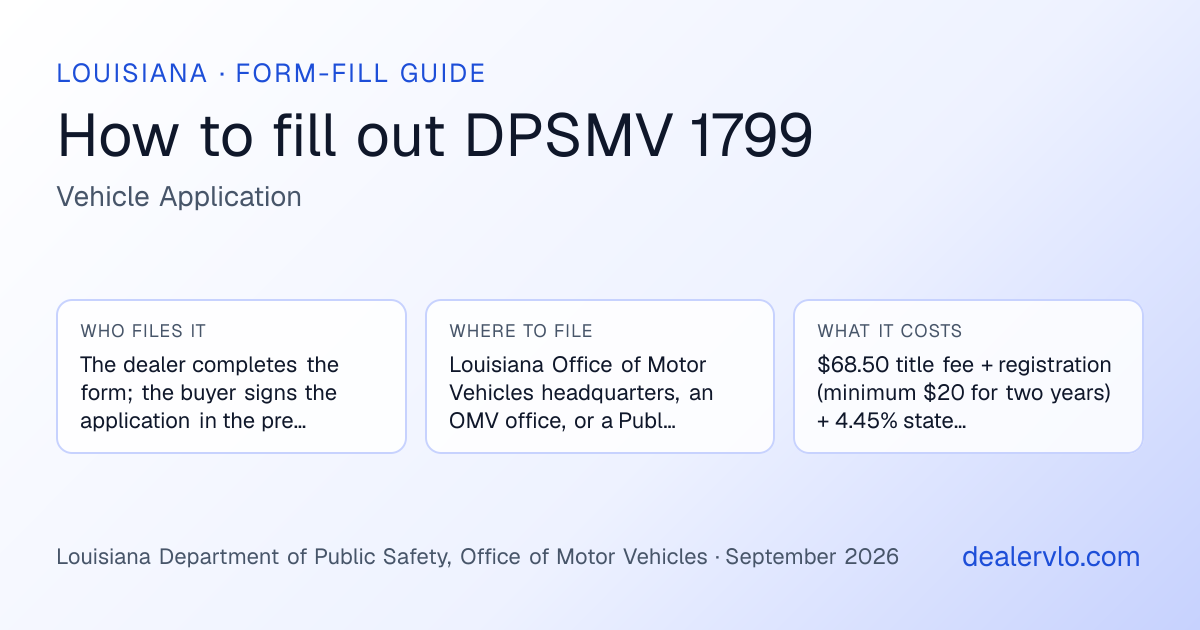
Filling out the LA DPSMV 1799 after a sale:
- What it is
- Louisiana's dealer application for title and registration, used for all dealer retail sales of new and used vehicles.
- Who completes it
- The dealer completes the form; the buyer signs the application in the presence of a notary.
- Where to file it
- Louisiana Office of Motor Vehicles headquarters, an OMV office, or a Public Tag Agent, within 40 days of delivery.
- Processing time
- Title should arrive within 30 days; contact OMV if not received to avoid replacement fees.
- Cost
- $68.50 title fee + registration (minimum $20 for two years) + 4.45% state sales tax + local sales tax (1.85–7%) on price minus trade-in.
This guide is informational and does not replace the official Louisiana instructions. Always confirm the current form and procedure with Louisiana Department of Public Safety, Office of Motor Vehicles before you file.
See the LA DPSMV 1799 filled — from just a VIN
Enter a VIN, the buyer's name, and the price. We decode the vehicle and drop it onto the actual Louisiana DPSMV 1799 — the same fill DealerVLO produces from a deal. Watermarked preview; nothing is saved.
What the DPSMV 1799 is and why it matters
Form DPSMV 1799 is how a Louisiana dealer retail sale gets titled and registered. The dealer completes every section—vehicle description, buyer address, purchase price, trade-in, and lien information—then submits the application, assigned title (or MSO), and invoice to the Office of Motor Vehicles or a Public Tag Agent within 40 days of the sale.
Because Louisiana calculates sales tax at the domicile of the purchaser, the DPSMV 1799 asks two critical address questions: whether the buyer resides within municipal limits and whether they live in a special tax district or ward. Get those wrong and you'll underpay or overpay local tax—and the dealer is on the hook to remit the correct amount within 40 days or face penalties beyond the 90-day hard deadline.
DPSMV 1799 is Louisiana's unified vehicle application for all dealer retail sales. The dealer completes it, collects state and local sales tax, and files with the Office of Motor Vehicles within 40 days of the sale date.
Documents to have before you start
Gather these before you complete the DPSMV 1799. A missing attachment is the number-one reason the Louisiana Department of Public Safety, Office of Motor Vehicles bounces a title application back.
- Assigned title or Manufacturer's Statement of Origin (MSO) — For new vehicles, MSO assigned from dealer to buyer. For used vehicles, title must be properly assigned and notarized.
- Original itemized invoice or bill of sale — Must show make, year, model, VIN, selling price, trade-in description (if any), and the dealer's current permit number. A separate bill of sale is not required if the selling price is on the title assignment.
- Completed DPSMV 1799 — Dealer completes all vehicle, buyer, and purchase sections; buyer signs.
- Odometer disclosure — If the vehicle is not exempt and the title back does not have an odometer disclosure statement, submit supplemental form DPSMV 1606.
- Lienholder information — Name and address if the vehicle is financed. Recording fees: $15 with UCC, $10 with other than UCC.
- Dealer permit number on invoice — Louisiana requires the dealer's current permit number on all invoices submitted with title applications.
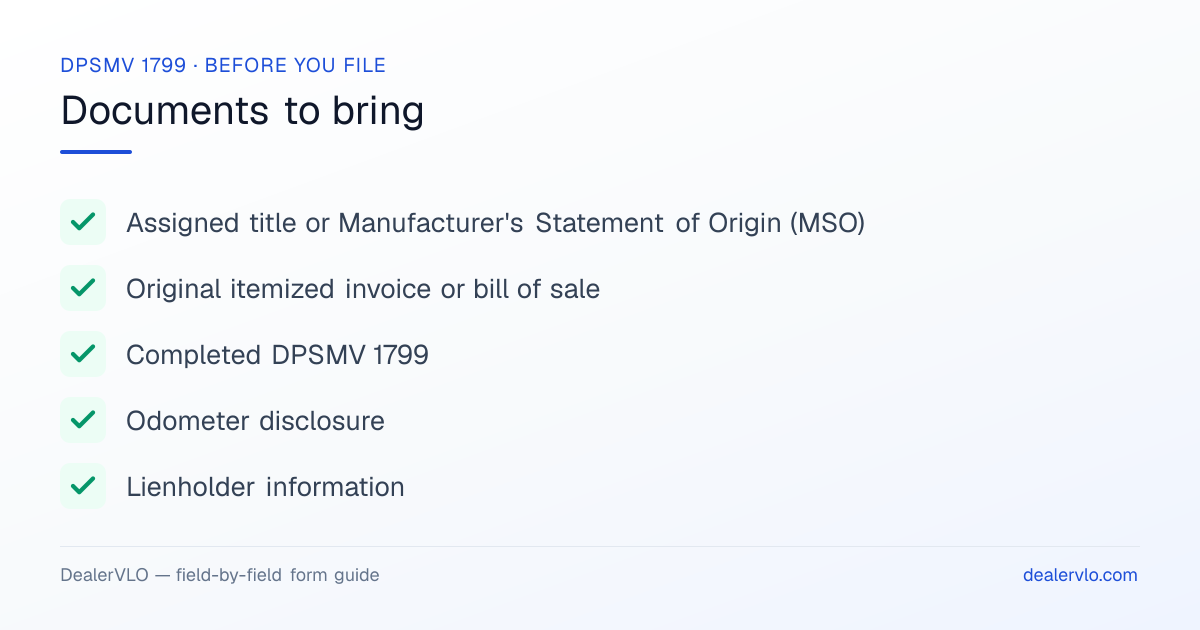
DPSMV 1799, section by section
Vehicle information
The top section captures vehicle identification. The dealer enters the VIN exactly as it appears on the title or MSO, followed by make, year, model, body type, and color. If the buyer is converting a registration or transferring a plate from another vehicle they own, enter the previous license plate number and the state that issued the prior title. This section must match the supporting title document character-for-character—any typo will delay processing or trigger a correction fee.
| Field | Who fills it |
|---|---|
VIN (Vehicle Identification Number) 17-character VIN from the title, MSO, or door jamb. Do not add spaces or dashes. | You (dealer) |
Make | You (dealer) |
Year | You (dealer) |
Model | You (dealer) |
Body type / Color Examples: 4-door sedan, pickup, SUV; color as shown on title. | You (dealer) |
License plate number (if transfer) Only if buyer is transferring an existing Louisiana plate. | You (dealer) |
Previous title state State that issued the title being surrendered. | You (dealer) |
Owner information and domicile address
Louisiana requires the buyer's current physical Louisiana address—not a P.O. box—as the primary address. If the buyer's mailing address is a P.O. box or out-of-state address, it must be shown separately as the mail-to address. Two critical questions follow: (1) Is the buyer residing within the corporate limits of a municipality? (2) Is the buyer residing within a special tax district or ward? These answers determine the local sales tax rate, which can range from 1.85% to 7%. Sales tax is based on the domicile of the purchaser, not the location of the dealer, so verify the buyer's actual residence—not where they want the car delivered.
| Field | Who fills it |
|---|---|
Owner name (individual or business) For joint owners, name exactly as they want it on title (e.g., 'John Doe and Jane Doe'). | You (dealer) |
Current physical Louisiana address Street address where buyer resides; required for tax jurisdiction. | You (dealer) |
Mailing address (if different) P.O. box or out-of-state mailing address goes here. | You (dealer) |
Are you residing within the corporate limits of a municipality? Yes/No. Affects municipal sales tax rate. | You (dealer) |
Are you residing within a special tax district or ward? Yes/No. Additional local tax may apply. | You (dealer) |
Purchase price, trade-in, and tax collection
The money section is what the Office of Motor Vehicles audits. Enter the actual selling price—the cash difference the buyer is paying after trade-in allowance. If the dealer accepted a trade-in, provide the VIN and license plate of the trade vehicle; Louisiana allows the trade-in allowance to be deducted from the taxable amount. Check the box indicating whether the dealer collected sales tax. Because dealers must remit state and local sales tax within 40 days (extendable to 90 days only if a trade-in title is delayed), accuracy here is critical. Underpayment triggers penalties; overpayment frustrates buyers.
| Field | Who fills it |
|---|---|
Purchase price Selling price of the vehicle before trade-in credit. Must match invoice. | You (dealer) |
Trade-in VIN 17-character VIN of the vehicle taken in trade, if any. | You (dealer) |
Trade-in license plate Plate number from the trade vehicle. | You (dealer) |
Did dealer collect tax? Yes/No indicator. Dealers typically collect and remit; check 'Yes.' | You (dealer) |
LA State tax & title fee calculator
Free · no signup · updates as you type
Louisiana automobile registration is 0.1% of vehicle value per year, minimum base $10,000, sold in two-year increments (minimum $20). Local sales tax is based on the buyer's domicile, not the dealer's location—verify the correct parish and municipal rate before remitting. Trade-in allowance reduces the taxable amount. Documentation fee taxability is unverified; confirm with OMV or your accountant. Lien recording adds $15 (UCC) or $10 (other).
Stop re-keying this onto the DPSMV 1799.
DealerVLO works out the sales tax on every deal and fills the official LA DPSMV 1799 from it — with the VIN, buyer, and sale price — along with the bill of sale and the FTC forms. One screen, no re-keying.
14-day free trial — no charge until day 14, then $29/month. Cancel any time.
Lienholder / legal owner information
If the vehicle is financed, provide the lender's legal name and mailing address. Louisiana charges a recording fee: $15.00 if the lien is recorded with a UCC filing, $10.00 otherwise. The lienholder name must match exactly what the finance company provides—middle initials, LLC vs. Inc., street vs. P.O. box—because OMV will mail the title directly to the lien holder and any mismatch can delay funding.
| Field | Who fills it |
|---|---|
Lienholder name Legal name of the finance company or bank. | You (dealer) |
Lienholder address Mailing address where OMV will send the title. | You (dealer) |
Lien recording method UCC ($15 fee) or other ($10 fee). | You (dealer) |
Odometer disclosure
If the vehicle is not exempt from federal odometer disclosure requirements and the back of the title does not already contain an odometer disclosure statement, you must submit a supplemental odometer statement (DPSMV 1606). Vehicles model year 2010 or older are generally exempt. Enter the exact mileage and check the appropriate exemption status box. An incorrect or missing odometer disclosure will stop the title from issuing.
| Field | Who fills it |
|---|---|
Mileage Exact odometer reading at delivery; whole miles only. | You (dealer) |
Odometer exemption status Check if vehicle is exempt (typically model year 2010 or older, or over 16,000 lbs GVWR). | You (dealer) |
Special declarations (reverse side)
The reverse of DPSMV 1799 has seven declaration sections: (A) Conversion, (B) Transfer of Plate, (C) Lost, Stolen, or Replacement Plate/Sticker, (D) Title Correction, (E) Farm Use Statement, (F) Out of State Declaration, (G) Disclosure of Salvage / Reconstructed / Water Damaged / Hail-Damaged. Most dealer retail sales will leave these blank. Use section (A) if the buyer is converting an existing registration, (B) if transferring a plate from another vehicle, (D) for a corrected title reissue, and (G) if the vehicle has a branded title history. Check OMV instructions for each scenario—filling these sections incorrectly can trigger rejection.
| Field | Who fills it |
|---|---|
Conversion declaration Check and complete if converting an existing registration. | You (dealer) |
Transfer of plate If buyer is transferring a plate from another vehicle they own. | You (dealer) |
Title correction request Describe the error being corrected; additional $68.50 fee applies. | You (dealer) |
Salvage / reconstructed / water / hail damage disclosure Required if the vehicle has a branded title. | You (dealer) |
Signatures and notarization
The buyer signs the application in the presence of a notary public, attesting: 'I have and will maintain, during this registration period, vehicle liability insurance (security) required by LRS Title 32:861-865. Failure to maintain as agreed will be a violation of law which may result in criminal prosecution and/or suspension of registration privileges.' The notary then signs, prints their name, provides their ID number, and affixes their seal. Louisiana requires notarization of the buyer's signature on the application. Two witnesses may also be required depending on parish practice—confirm with your notary. Do not submit the form without a complete notary block; it will be rejected.
| Field | Who fills it |
|---|---|
Applicant's signature Buyer signs in the presence of the notary, acknowledging insurance requirement. | Buyer |
Notary public signature Notary witnesses the buyer's signature and completes the notary block. | At the counter |
Notary printed name and ID number Notary's commission number must be legible. | At the counter |
Witness signatures Some parishes require two witnesses; confirm local practice. | At the counter |
The DPSMV 1799 is one car's paperwork. A 20-second read on your lot, and the tax-and-fee math for the whole deal — built for dealers, no signup. Free calculators dealers actually use — no signup, no email.
DealerVLO fills the official Louisiana DPSMV 1799 straight from your deal — VIN-decoded vehicle, buyer, co-buyer, and sale price already in place. $29/month, free to try — cancel any time.
Common DPSMV 1799 mistakes that cause rejections
Louisiana requires the dealer's current permit number on every invoice submitted with a title application. Print it on your invoice template so it never gets forgotten.
The primary address must be the buyer's current physical Louisiana street address. If they want mail sent to a P.O. box or out-of-state address, show it separately as the mailing address.
The MSO is a secure document; it must be assigned from the dealer to the buyer by name. An unassigned or incorrectly assigned MSO will be rejected.
If the vehicle is not exempt from odometer disclosure and the title itself doesn't have an odometer statement, you must submit DPSMV 1606. Vehicles model year 2010 or older are typically exempt.
If the title, plate, or sticker hasn't arrived within 30 days, contact OMV immediately. Departmental policy provides a free replacement within 60 days of issuance—wait longer and you'll pay a replacement fee.
Common questions
What is Louisiana form DPSMV 1799 used for?+
DPSMV 1799 is the vehicle application form that Louisiana dealers use to title and register every retail sale—new or used. The dealer completes the form, collects state and local sales tax, and files it with the Office of Motor Vehicles or a Public Tag Agent within 40 days of the sale.
How long does a Louisiana dealer have to file the DPSMV 1799?+
The dealer must file the completed DPSMV 1799 and remit sales tax within 40 days of the sale date. If a trade-in title is delayed, the deadline extends to 10 days after receiving the trade title, but cannot exceed 90 days total from the sale date. Missing the 90-day deadline triggers penalties under Louisiana R.S. 47:306(E).
Does Louisiana allow trade-in deduction when calculating sales tax?+
Yes. Louisiana calculates sales tax on the net difference: the selling price minus the trade-in allowance. Both the state 4.45% tax and local tax apply to this reduced amount, so always document the trade-in VIN and allowance accurately on the DPSMV 1799 and invoice.
Do I need to notarize the dealer invoice or bill of sale in Louisiana?+
For dealer sales, Louisiana law as of January 1, 2023, does not require notarization of the dealer's invoice or bill of sale. However, the title assignment itself must be notarized (or witnessed by an authorized agent), and the buyer's signature on the DPSMV 1799 application must be notarized.
How do I determine the correct local sales tax rate for a Louisiana vehicle sale?+
Louisiana sales tax is based on the buyer's domicile, not the dealer's location. Local rates range from 1.85% to 7%. The DPSMV 1799 asks whether the buyer resides within municipal limits and within a special tax district or ward—answer these questions based on the buyer's physical street address, then look up the combined parish and municipal rate for that address.
When is a supplemental odometer disclosure (DPSMV 1606) required?+
If the vehicle is not exempt from federal odometer requirements and the back of the title does not already contain an odometer disclosure statement, you must submit form DPSMV 1606. Vehicles model year 2010 or older are generally exempt from odometer disclosure.
Can I submit Louisiana dealer title documents electronically?+
No mandatory statewide electronic dealer portal exists for retail title transactions. Documents must be mailed or hand-delivered to OMV headquarters, processed at an OMV office, or submitted through a Public Tag Agent (a private business authorized by OMV to process titles and registrations).
Is there software that fills out the DPSMV 1799 automatically?+
Yes. Dealer management software like DealerVLO fills the Louisiana DPSMV 1799 from the deal you already entered — the VIN-decoded vehicle, buyer, co-buyer, lienholder, and sale price are placed for you instead of hand-writing them. For most states that's the official DMV form itself; where a state issues its form only through its own dealer portal, you get a print-ready worksheet with every value already in place. It's $29/month flat with a 14-day free trial, and the same deal also generates your federal documents (Bill of Sale, FTC Buyers Guide, odometer disclosure) and any other state's title forms.
- Title application forms in every state
- How to get a used-car dealer license
- How to fill out Form 130-U Texas
- How to fill out Form 108 Missouri
- How to get a used car dealer license in Louisiana
- E-signatures and e-titling for Louisiana dealers
- Louisiana odometer disclosure statement (DPSMV 1606)
- How much is a dealer's license? Cost in every state
Stop filling out the DPSMV 1799 by hand.
DealerVLO fills the official LA DPSMV 1799 straight from your deal jacket — VIN-decoded vehicle, buyer, co-buyer, lienholder, and sale price already in place. Print, sign, and file in about 90 seconds. $29/month. 14-day free trial, cancel any time.
Curious how it works? See how DealerVLO auto-fills every dealer document — bill of sale, FTC Buyers Guide, odometer disclosure, and state title & registration paperwork for all 50 states, from one deal.
Bond amounts, fees, and form rules change. Get a short email when your state does. No spam, unsubscribe anytime.