How to fill out the REG 166 in California
A field-by-field walkthrough of the California REG 166 (Lien Satisfied/Legal Owner/Title Holder Release) for licensed used car dealers — what goes in every section, who signs what, and the documents you attach. Verified against the official form and DMV's Vehicle Industry Registration Procedures Manual as of October 2026.
Don't waste another second filling out the California REG 166.
Let DealerVLO fill out every form for you instantly.
Filing these every week? DealerVLO fills the REG 166 from the deal you already entered, $29/month flat. See pricing
Switching from another DMS? Compare DealerVLO to DealerCenter, Frazer, or Lot Wizard.
Filling out the CA REG 166 after a sale:
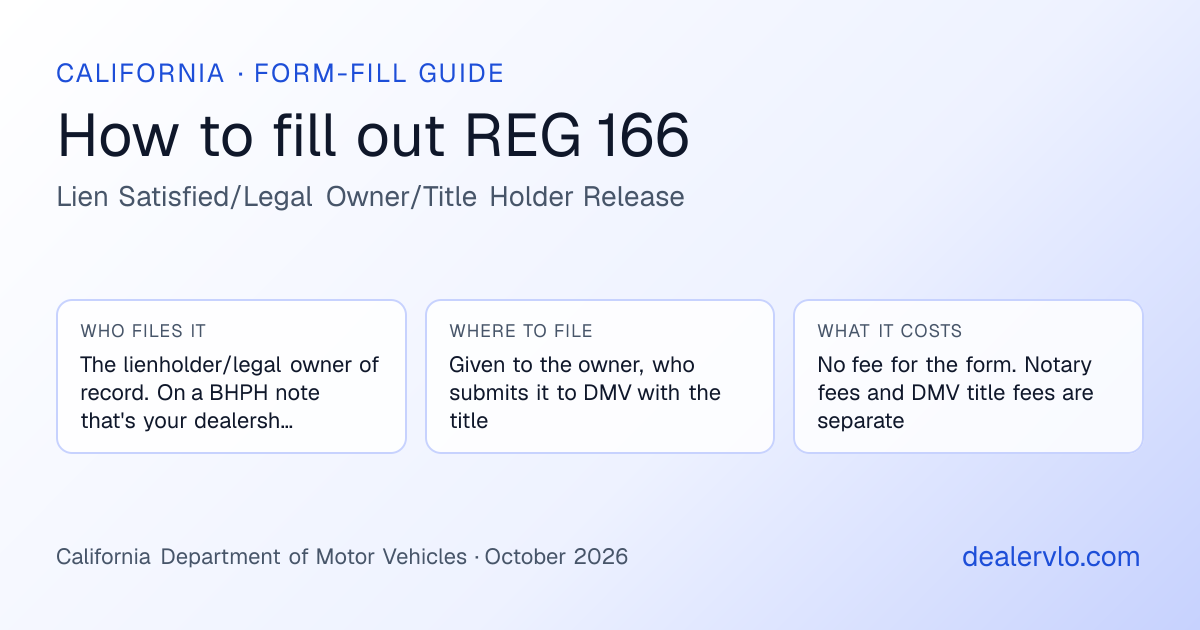
- What it is
- A notarized release of the lienholder's (legal owner's) interest, used in place of signing off on the title
- Who completes it
- The lienholder/legal owner of record. On a BHPH note that's your dealership, signed by an authorized agent before a notary
- Where to file it
- Given to the owner, who submits it to DMV with the title
- Processing time
- None of its own. DMV processes it with the title change
- Cost
- No fee for the form. Notary fees and DMV title fees are separate
This guide is informational and does not replace the official California instructions. Always confirm the current form and procedure with the California Department of Motor Vehicles before you file.
The REG 166 is one car's paperwork. A 20-second read on your lot, and the tax-and-fee math for the whole deal — built for dealers, no signup. Free calculators dealers actually use — no signup, no email.
DealerVLO fills the official California REG 166 straight from your deal: on a buy-here-pay-here note your dealership carries, the BHPH ledger prints it with the plate (when the deal recorded one), make, year and VIN, the buyer's last, first and middle name, and your dealership as lienholder with its business address, suite and daytime phone. The signature, date, agent's printed name and title, the mailing address (only used when different) and the notary section stay blank, and a co-owner goes on by hand since Section 2 has one name row. On a car two model years old or newer, DealerVLO doesn't offer the REG 166 and tells you to release on the title instead. $29/month, free to try — cancel any time.
What the REG 166 is and why it matters
REG 166 is California DMV's Lien Satisfied/Legal Owner/Title Holder Release. If you run buy-here-pay-here, your dealership is the legal owner on the title of every car you carry paper on, so when the customer pays off, you release your interest. On a paper title that's usually your signature on the title itself. REG 166 is the separate, notarized release for when that isn't the route.
The other side matters too. When you pay off a trade-in's loan, the lender releases its interest, not you, and on an electronic title that happens only through the lender's electronic notice to DMV. This guide walks the REG 166 section by section from the dealer's seat, including the two cases where DMV won't take it.
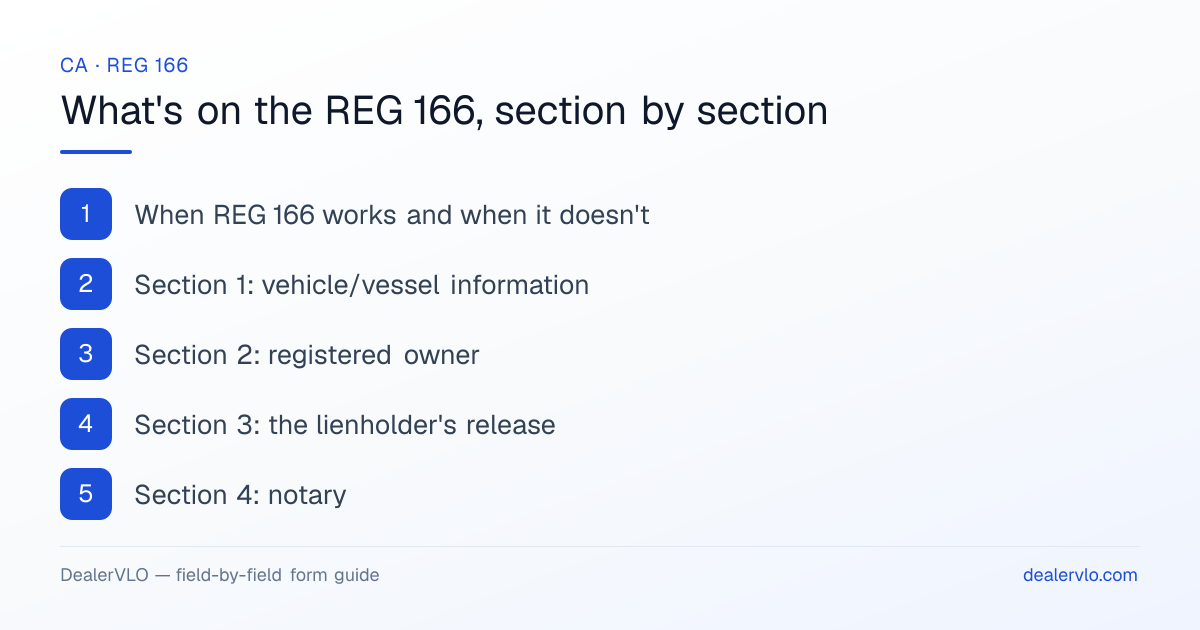
The current revision is REG 166 (REV. 12/2016). It's one page in four sections: the vehicle, the registered owner, the lienholder's release, and a notary acknowledgment. Two limits are printed at the top: it must be notarized unless an insurance company submits it for a salvage certificate, and it can't be used for a vehicle with a paperless title or a vehicle two model years or newer. For those, the release happens on the title or electronically.
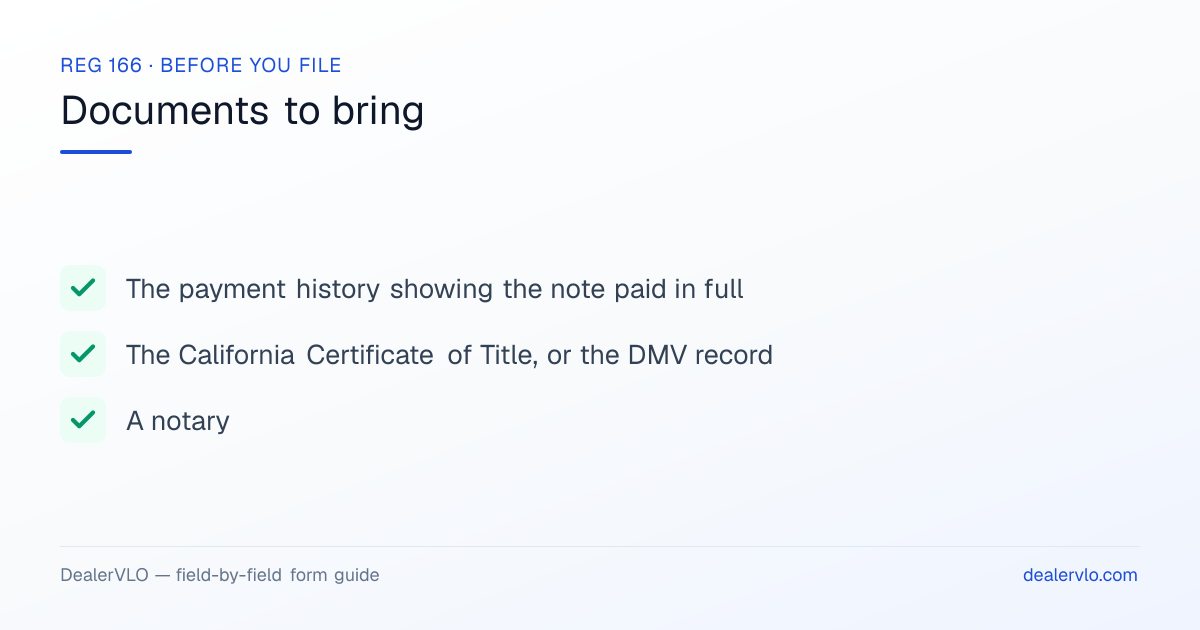
Documents to have before you start
The REG 166 goes to the owner, who submits it to DMV with the title. Check these before you print it, because two of them decide whether you can use it at all.
- The payment history showing the note paid in full — Section 3 certifies the lien "has been fully satisfied." Don't sign until the final payment has cleared.
- The California Certificate of Title, or the DMV record — Check the model year and whether the title is paperless. REG 166 can't be used for either a vehicle two model years or newer or one with a paperless title.
- A notary — Section 4 is a California notary acknowledgment. The agent signing for your dealership signs in front of the notary.
REG 166, section by section
When REG 166 works and when it doesn't
The form says it can't be used for a vehicle with a paperless title or a vehicle two model years or newer, and that the legal owner's interest on a vehicle two model years or newer can only be released on the Certificate of Title. DMV's procedures manual (§ 11.090) says the same: on those vehicles the title is the only document that releases the lien. On a paperless (electronic) title, DMV's 2016 bulletin VIN 2016-20 says paper can't release the lien at all. The lienholder notifies DMV electronically, and DMV refers customers who bring a REG 166 back to their lienholder. On an older vehicle with a paper title, you can sign the title's release line or use the REG 166. The manual says that when a REG 166 is used, "L/S att" is written on line 2 of the title, the lienholder's signature line.
| Field | Who fills it |
|---|---|
Two model years or newer Release on the title. Not REG 166. | You (dealer) |
Paperless (ELT) title Release electronically. Not REG 166. | You (dealer) |
Older vehicle, paper title Sign the title or use REG 166. | You (dealer) |
Section 1: vehicle/vessel information
Four boxes: the vehicle license plate (or CF number for a vessel), make, year model, and the full VIN. Copy them from the title or registration so they match DMV's record.
| Field | Who fills it |
|---|---|
Vehicle License Plate/CF Number | You (dealer) |
Make/Builder, Year Model | You (dealer) |
Vehicle/Vessel Identification Number All 17 characters. | You (dealer) |
Section 2: registered owner
Last, first, and middle name of the registered owner. The form says to print the name as it appears on the title/registration or contract. There's one name row. If the title names two owners, add the second by hand the way the title shows it.
| Field | Who fills it |
|---|---|
Last name, first name, middle name As on the title, registration, or contract. | You (dealer) |
Co-owner Not a separate row. DealerVLO prints the buyer only; add a co-owner by hand. | You (dealer) |
Section 3: the lienholder's release
The certification reads that the lien in the registered owner's name has been fully satisfied and has not been assigned to any other party, and that the undersigned lienholder (legal owner of record) releases its interest. That second part matters for BHPH dealers who sell paper: if you assigned the contract to a finance company, you can't sign this. Fill in your dealership's name exactly as it's listed as legal owner, the business address, a mailing address only if it's different, and a daytime phone. The signature line is "company name and authorized agent's signature," followed by the date, the agent's printed name, and the agent's title.
| Field | Who fills it |
|---|---|
Name of bank, finance company, or individual(s) having a lien Your dealership, as legal owner of record. | You (dealer) |
Business or residence address, apt./ste., city, state, ZIP | You (dealer) |
Mailing address (if different) Only when different. | You (dealer) |
Daytime telephone number | You (dealer) |
Signature of legal owner (company name and authorized agent's signature) Signed in front of the notary. | You (dealer) |
Date, printed name of authorized agent, title of authorized agent | You (dealer) |
Section 4: notary
The form must be notarized unless an insurance company submits it to obtain a salvage certificate (the form cites Vehicle Code § 5752). A BHPH payoff isn't that, so plan on a notary. Section 4 is California's standard acknowledgment: the notary fills in the county, date, and the signer's name and signs and seals it. The notary verifies the signer's identity, not the contents.
| Field | Who fills it |
|---|---|
Notary acknowledgment, signature, seal Completed by the notary. | At the counter |
Handing it over
The owner submits the REG 166 to DMV with the title. DMV's procedures manual treats it as an attachment to the title, marked "L/S att" on the lienholder's line. If you're holding the paper title as legal owner, give it to the customer together with the notarized REG 166.
| Field | Who fills it |
|---|---|
Notarized REG 166 + title to the owner | You (dealer) |
Submit to DMV | Buyer |
Trade-ins: the lender releases
When you pay off a trade-in's loan, the lender is the legal owner, and the lender releases. On an electronic title that happens only through the lender's electronic notice to DMV, so a REG 166 from the lender won't help you there. On a paper title, look for the lender's signature on the title's release line, or a notarized REG 166 on an older vehicle.
| Field | Who fills it |
|---|---|
Lender's release on the trade Collect it; you don't sign it. | You (dealer) |
Common REG 166 mistakes that cause rejections
The form and DMV's manual say the title is the only way to release the legal owner's interest on those. Sign the title.
Since DMV's VIN 2016-20, a lien on an electronic title can only be released through the ELT program. DMV will send your customer back to you.
Only an insurance company getting a salvage certificate is exempt. A dealer's release has to be notarized.
Section 3 certifies the lien hasn't been assigned to anyone else. If a finance company bought the contract, it releases, not you.
Section 2 has one name row. If the title names two owners, add the second exactly as the title shows it.
Common questions
What is the California REG 166 form?+
REG 166 is California DMV's Lien Satisfied/Legal Owner/Title Holder Release. The lienholder (legal owner of record) certifies the lien has been fully satisfied and not assigned to anyone else, releases its interest, and signs before a notary. The current revision is REG 166 (REV. 12/2016).
Does a California lien release need to be notarized?+
Yes. The REG 166 says it must be notarized unless an insurance company submits it to obtain a salvage certificate (Vehicle Code § 5752). Section 4 of the form is the notary acknowledgment.
Can I use REG 166 on a newer car?+
No. The form says it can't be used for a vehicle two model years or newer, and that the legal owner's interest on those can only be released on the Certificate of Title. DMV's procedures manual says the same.
Can REG 166 release a lien on an electronic (paperless) title?+
No. DMV's bulletin VIN 2016-20 says paper documentation can no longer release a lien recorded in the Electronic Lien and Title program, and offices refer the customer back to the lienholder. The lienholder notifies DMV electronically.
What does the owner do with the REG 166?+
Submit it to DMV with the title. DMV's procedures manual says that when a REG 166 releases the lienholder's interest, "L/S att" is written on line 2 of the title, the lienholder's signature line.
Who releases the lien on a trade-in I paid off?+
The trade's lender, as legal owner. On an electronic title it releases through DMV's ELT program; on a paper title it signs the title's release line or, on an older vehicle, gives a notarized REG 166.
Where do I download the REG 166?+
DMV publishes the fillable PDF at dmv.ca.gov (REG-166-R12-2016-ASB-WWW.pdf). The download link is at the top of this page.
Is there software that fills out the REG 166 automatically?+
Yes. Dealer management software like DealerVLO fills the official California REG 166 from the deal you already entered: on a buy-here-pay-here note your dealership carries, the BHPH ledger prints it with the plate (when the deal recorded one), make, year and VIN, the buyer's last, first and middle name, and your dealership as lienholder with its business address, suite and daytime phone. The signature, date, agent's printed name and title, the mailing address (only used when different) and the notary section stay blank, and a co-owner goes on by hand since Section 2 has one name row. On a car two model years old or newer, DealerVLO doesn't offer the REG 166 and tells you to release on the title instead. Signatures stay blank for ink. It's $29/month flat with a 14-day free trial, and the same deal also generates your federal documents (Bill of Sale, FTC Buyers Guide) and your state title paperwork.
- Vehicle lien release forms by state
- How to fill out the California REG 343
- Vehicle power of attorney forms by state
- How to get a California dealer license
- California dealer plates
- E-signatures and e-titling for California dealers
- California certificate of repossession (REG 119)
- California REG 262 transfer and odometer disclosure
- California CARS Act dealer compliance
- Title application forms in every state
- How much is a dealer's license? Cost in every state
Stop filling out the REG 166 by hand.
DealerVLO fills the official CA REG 166 straight from your deal jacket: on a buy-here-pay-here note your dealership carries, the BHPH ledger prints it with the plate (when the deal recorded one), make, year and VIN, the buyer's last, first and middle name, and your dealership as lienholder with its business address, suite and daytime phone. The signature, date, agent's printed name and title, the mailing address (only used when different) and the notary section stay blank, and a co-owner goes on by hand since Section 2 has one name row. On a car two model years old or newer, DealerVLO doesn't offer the REG 166 and tells you to release on the title instead. $29/month. 14-day free trial, cancel any time.
Curious how it works? See how DealerVLO auto-fills every dealer document — bill of sale, FTC Buyers Guide, odometer disclosure, and state title & registration forms for all 50 states, from one deal.
Bond amounts, fees, and form rules change. Get a short email when your state does. No spam, unsubscribe anytime.