How to fill out the REG 119 in California
A field-by-field walkthrough of the California REG 119 (Certificate of Repossession) for licensed used car dealers — what goes in every section, who signs what, and the documents you attach. Verified against the official form as of October 2026.
Don't waste another second filling out the California REG 119.
Let DealerVLO fill out every form for you instantly.
Filing these every week? DealerVLO fills the REG 119 from the deal you already entered, $29/month flat. See pricing
Switching from another DMS? Compare DealerVLO to DealerCenter, Frazer, or Lot Wizard.
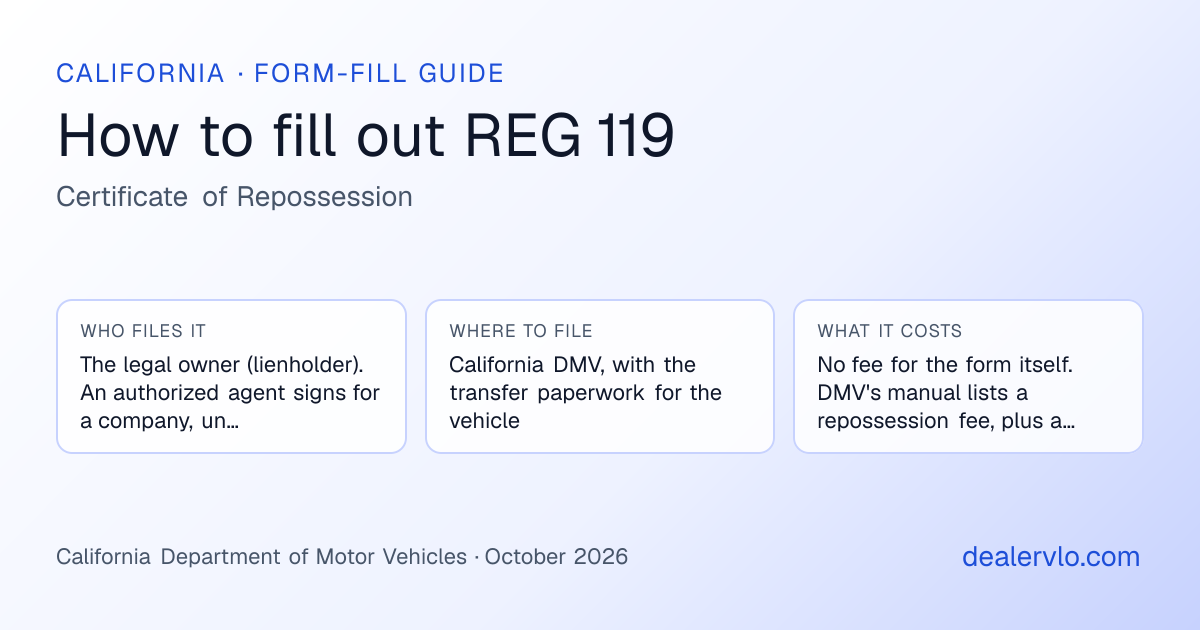
Filling out the CA REG 119 after a sale:
- What it is
- California DMV's form for the legal owner to certify a repossession and the vehicle's disposition
- Who completes it
- The legal owner (lienholder). An authorized agent signs for a company, under penalty of perjury
- Where to file it
- California DMV, with the transfer paperwork for the vehicle
- Processing time
- None of its own. It travels with the transfer
- Cost
- No fee for the form itself. DMV's manual lists a repossession fee, plus a transfer fee in some cases
This guide is informational and does not replace the official California instructions. Always confirm the current form and procedure with the California Department of Motor Vehicles before you file.
The REG 119 is one car's paperwork. A 20-second read on your lot, and the tax-and-fee math for the whole deal — built for dealers, no signup. Free calculators dealers actually use — no signup, no email.
DealerVLO fills the official California REG 119 straight from your deal: the plate (when the deal has one), VIN, year and make; your dealership as legal owner with its address and daytime phone; the Conditional Sale Contract box and the contract date (your sale date); and the buyer and co-buyer as defaulting debtors with the buyer's address. It prints from the servicing section of a BHPH deal where your dealership carries the note, for when you've taken a car back, not on every deal. The repossession date, method, reason and location, the disposition block, and the agent's name and title stay blank. $29/month, free to try — cancel any time.
What the REG 119 is and why it matters
REG 119 is California's Certificate of Repossession. The legal owner (the lienholder) uses it to certify that a vehicle was repossessed and to record what happened to it afterward: auction, sale, lease, or kept. DMV's procedures manual says the lienholder releases its interest on the REG 119, and that the REG 119 "is used to transfer title without the registered owner's endorsement." On a buy-here-pay-here note, your dealership is the legal owner and your buyer is the defaulting debtor.
This guide covers filling it out after the car is back: each section, the lien-type and disposition boxes, the certification you sign, and the paperwork DMV wants with it. It doesn't cover when or how you may repossess.
California doesn't call it an affidavit. DMV's form is the REG 119, Certificate of Repossession, current revision REV. 1/2019. It's one page in three sections: the vehicle, the repossession and what happened to the vehicle after, and the certification. It's signed under penalty of perjury and has no notary block.
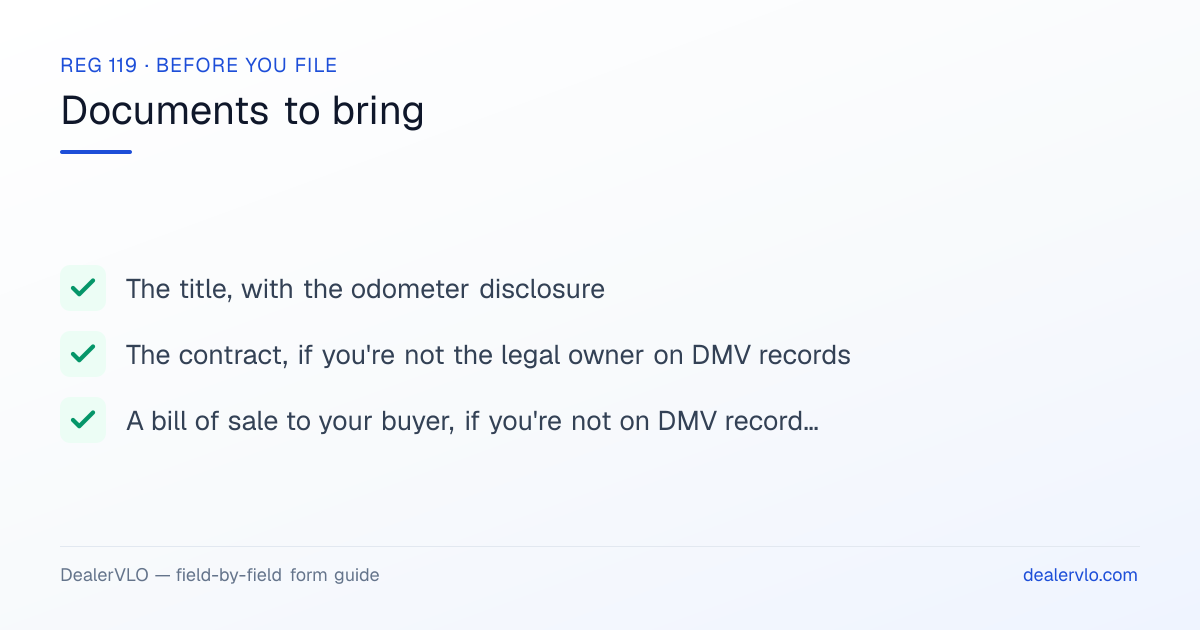
Documents to have before you start
Gather these before you complete the REG 119. A missing attachment is the number-one reason the the California Department of Motor Vehicles bounces a title application back.
- The title, with the odometer disclosure — The form notes: "Odometer disclosure for vehicle is required on Certificate of Title or separate odometer statement." DMV's manual says to use the title's odometer section if it has one, otherwise a REG 262.
- The contract, if you're not the legal owner on DMV records — The form says the original or a certified copy of the conditional sale contract or security interest agreement must accompany the certification.
- A bill of sale to your buyer, if you're not on DMV records and won't register it to yourself — DMV's manual section on repossessions where the legal owner isn't on record lists a bill of sale from the repossessor to the purchaser.
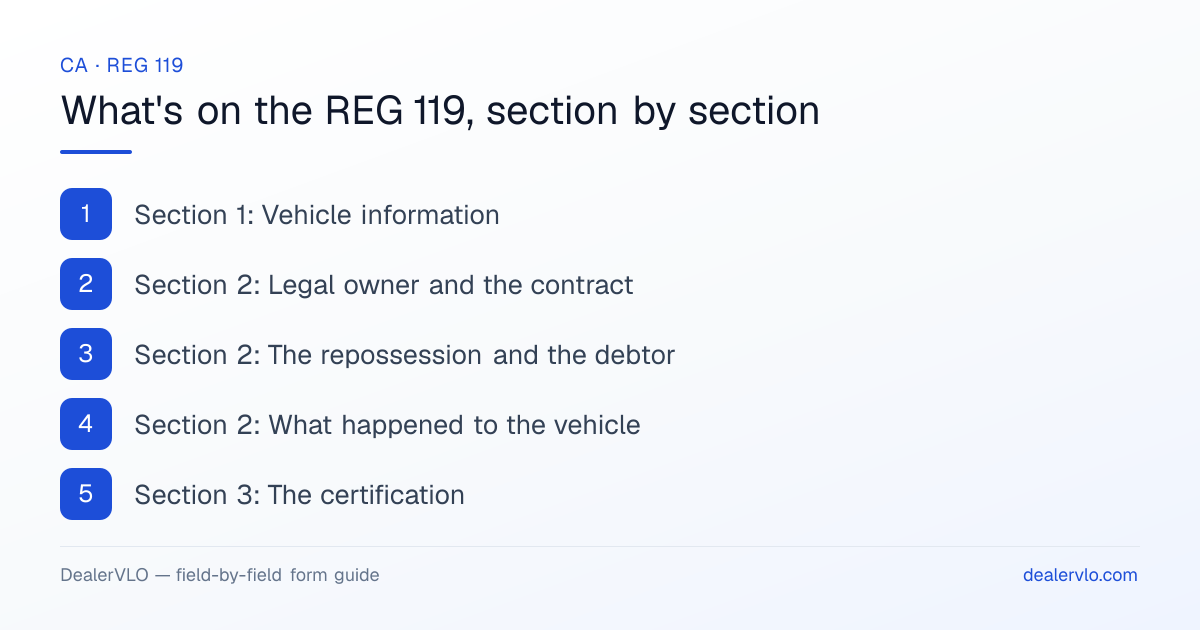
REG 119, section by section
Section 1: Vehicle information
Four boxes: license plate number, VIN, year model, and make. Copy them from the title and registration.
| Field | Who fills it |
|---|---|
Vehicle license plate number | You (dealer) |
Vehicle identification number (VIN) | You (dealer) |
Year model, make | You (dealer) |
Section 2: Legal owner and the contract
The legal owner is the "bank, finance company, etc., or individual having a lien on this vehicle": on a BHPH note, your dealership. Give its address with the street suffix and any unit number. Then check the lien or instrument type under which the default occurred, Conditional Sale Contract or Security Interest Agreement, and enter the date the contract was signed. Check the box that matches the document your buyer signed. Civil Code §2981 defines a conditional sale contract to include a contract to sell a motor vehicle on installments where the seller keeps title or a security interest, which is why DealerVLO checks that box on a BHPH deal.
| Field | Who fills it |
|---|---|
Legal owner name and address | You (dealer) |
Lien/instrument type: conditional sale contract or security interest agreement | You (dealer) |
Date contract/agreement signed/executed | You (dealer) |
Section 2: The repossession and the debtor
Enter the date of repossession and check the method: by a licensed repossession agency (B&PC §7500.2), voluntary surrender by the debtor, by the legal owner or a bona fide employee, or other (explain). Check the reason: failure to pay, or other (explain). Then the address where you took possession, and the defaulting debtor's name and address. With a co-buyer, name both debtors.
| Field | Who fills it |
|---|---|
Date of repossession | You (dealer) |
Method of repossession | You (dealer) |
Reason(s) for repossession | You (dealer) |
Address where possession was taken | You (dealer) |
Defaulting debtor(s) name and address | You (dealer) |
Section 2: What happened to the vehicle
Check one: delivered to auto auction for sale, sold through auto auction, sold at public sale, sold at private sale, leased/licensed, or retained. The footnotes tell you what goes in the next boxes. Disposition date: the sale or lease date, or the delivery date if you delivered it to an auction for sale. Name: the buyer or lessee, the auction's name if you delivered it to an auction for sale, or the buyer's name if it sold through an auction. Fill in the auction dealer number and the address.
| Field | Who fills it |
|---|---|
Vehicle was: auction, sale, lease, or retained | You (dealer) |
Disposition date | You (dealer) |
Name of auto auction, buyer, or lessee; auto auction dealer no.; address | You (dealer) |
Section 3: The certification
You certify that you, or the company you're authorized to represent, are the legal owner, and that the vehicle was repossessed and disposed of "after default under the terms of a valid lien contract/agreement, and in full accordance with all applicable California statutes." The form then has a paragraph for each lien type. Under Conditional Sale Contract, you further certify that at least 15 days' written notice of intent to sell (20 days if mailed from or to an address outside California) was given to everyone liable under the contract as Civil Code §2983.2 requires, and that the debtor hasn't cured, or couldn't cure, the default. Under Security Interest Agreement, the certification cites Commercial Code §§9611 through 9614 and §9623. The last statement is under penalty of perjury and also covers the California Military and Veterans Code and Title 50 of the United States Code. Read the full text on the form before you sign; if you can't certify it, don't sign it.
| Field | Who fills it |
|---|---|
Printed name and title of authorized agent | You (dealer) |
Daytime telephone number | You (dealer) |
Signature of legal owner (company name and authorized agent's countersignature), date | You (dealer) |
What goes with it, and the auction penalty waiver
DMV's manual says a California-registered repossession needs the REG 119 on top of the basic transfer requirements, plus repossession and transfer fees if the repossessor isn't the registered owner. For odometer disclosure, the lienholder can complete the title's separate odometer section, or use a REG 262 if the title doesn't have one. If you're not the legal owner on DMV records, add the original or certified copy of the contract, and a bill of sale to the buyer if the vehicle isn't being registered to you. If the repossession sells through a dealer running a wholesale auction, the manual says renewal penalties can be waived if all fees are paid within 60 days of the last auction date. The dealer requests the waiver on a Statement of Facts (REG 256).
| Field | Who fills it |
|---|---|
Title with odometer section, or REG 262 | You (dealer) |
Contract (legal owner not on DMV records) | You (dealer) |
REG 256 for a renewal penalty waiver (wholesale auction sale) | You (dealer) |
Common REG 119 mistakes that cause rejections
The REG 119 records both the repossession and what happened next. Check one disposition box and fill the date and name the footnotes call for.
Use the delivery date only when the vehicle was delivered to an auction for sale. If it sold, enter the sale date and the buyer's name.
The form says the original or a certified copy of the conditional sale contract or security interest agreement must go with it.
The form says odometer disclosure is required on the title or a separate odometer statement. Use the title's odometer section, or a REG 262 if there isn't one.
The signature line asks for the company name and the authorized agent's countersignature.
Common questions
What is the California affidavit of repossession?+
California's form is the REG 119, Certificate of Repossession. The legal owner (lienholder) certifies the repossession and the vehicle's disposition, under penalty of perjury. DMV's manual says the REG 119 is used to transfer title without the registered owner's endorsement. The current revision is REV. 1/2019.
Does the REG 119 need to be notarized?+
No. There's no notary block. The certification is signed under penalty of perjury under California law, with the company name and the authorized agent's countersignature.
What if my dealership isn't the legal owner on DMV records?+
The form says the original or a certified copy of the conditional sale contract or security interest agreement must accompany it. DMV's manual adds a bill of sale from you to the purchaser if the vehicle isn't being registered to you, and a repossession fee for the unrecorded transfer.
How do I report the odometer on a repossessed car in California?+
The form notes that odometer disclosure is required on the title or a separate odometer statement. DMV's manual says the lienholder can complete the title's separate odometer section; if the title doesn't have one, use a REG 262.
What goes in the disposition date if the car went to auction?+
If you delivered it to an auto auction for sale, enter the delivery date and the auction's name. If it sold through the auction, enter the sale date and the buyer's name.
Can renewal penalties be waived on a repo sold at a dealer auction?+
DMV's manual says that when a repossessed vehicle is sold through a dealer conducting a wholesale motor vehicle auction, renewal penalties may be waived if all fees are paid within 60 days of the last auction date. The dealer requests it on a Statement of Facts (REG 256).
Is there software that fills out the REG 119 automatically?+
Yes. Dealer management software like DealerVLO fills the official California REG 119 from the deal you already entered: the plate (when the deal has one), VIN, year and make; your dealership as legal owner with its address and daytime phone; the Conditional Sale Contract box and the contract date (your sale date); and the buyer and co-buyer as defaulting debtors with the buyer's address. It prints from the servicing section of a BHPH deal where your dealership carries the note, for when you've taken a car back, not on every deal. The repossession date, method, reason and location, the disposition block, and the agent's name and title stay blank. Signatures stay blank for ink. It's $29/month flat with a 14-day free trial, and the same deal also generates your federal documents (Bill of Sale, FTC Buyers Guide) and your state title paperwork.
- Affidavit of repossession forms by state
- Vehicle lien release form by state
- How to fill out California REG 343
- California used car dealer license
- California dealer plates
- E-signatures and e-titling for California dealers
- California lien release (REG 166)
- California REG 262 transfer and odometer disclosure
- California CARS Act dealer compliance
- Title application forms in every state
- How much is a dealer's license? Cost in every state
Stop filling out the REG 119 by hand.
DealerVLO fills the official CA REG 119 straight from your deal jacket: the plate (when the deal has one), VIN, year and make; your dealership as legal owner with its address and daytime phone; the Conditional Sale Contract box and the contract date (your sale date); and the buyer and co-buyer as defaulting debtors with the buyer's address. It prints from the servicing section of a BHPH deal where your dealership carries the note, for when you've taken a car back, not on every deal. The repossession date, method, reason and location, the disposition block, and the agent's name and title stay blank. $29/month. 14-day free trial, cancel any time.
Curious how it works? See how DealerVLO auto-fills every dealer document — bill of sale, FTC Buyers Guide, odometer disclosure, and state title & registration forms for all 50 states, from one deal.
Bond amounts, fees, and form rules change. Get a short email when your state does. No spam, unsubscribe anytime.