We-Owe Forms: How to Write, Cost and Close Out Promises at a Used-Car Lot
The dealer's guide to the we-owe (due bill): how to write one that can't be argued about, cost it into the deal, and close every promise.
Part of the Compliance, taxes & deal paperwork guide: What goes in a used-car deal jacket: the complete checklist
Switching from another DMS? Compare DealerVLO to DealerCenter, Frazer, or Lot Wizard.
A we-owe form — also called a due bill — is the written record of anything your dealership promised to deliver or fix after the customer drove off. A second key. A dent repair. Floor mats you didn't have in stock. A car wash. A bumper you said you'd repaint. If you promised it but the car left before it was done, it goes on a we-owe, signed by both parties, with a copy in the deal jacket.
The problem is that most we-owes are written in a way that invites arguments later. Vague language, no target date, no signature, no tracking. The repair gets done, but the customer swears you promised more. Or the repair doesn't get done, and the customer posts a review. Or you never costed it into the deal, so your reported gross is $400 higher than what you actually kept. We-owes are where gross and reviews leak, and the leak is completely avoidable if you treat the we-owe like the contract it is.
14-day free trial, then $29/mo · Cancel anytime
Why verbal promises fail — and the FTC says so
The Federal Trade Commission's Buyers Guide — the one you're required to put in every used car — includes this exact warning: "Spoken promises are difficult to enforce. Ask the dealer to put all promises in writing." That line is printed on every Buyers Guide, and it's there because verbal commitments evaporate the moment the customer drives off. If you told them you'd fix the brakes but didn't write it down, the customer has no proof, you have no record, and nobody agrees on what was actually promised.
A properly written we-owe becomes part of the deal paperwork, signed by both of you. If you don't complete it, the customer has your signature on a list of what you promised, and that's what they'll bring to small claims court, your state regulator, or a review site. File it in the deal jacket alongside the buyer's order and the as-is disclosure, and treat it as seriously as either one.
The moment you promise something to close a deal, write it down. If you can't describe it specifically enough to write it down, don't promise it yet.
How to write a we-owe that can't be argued about
A poorly written we-owe is where disputes start. The customer reads "fix brakes" and expects pads, rotors, calipers and lines. You budgeted pads only. Three weeks later you're arguing over what "fix" means. The Pennsylvania Independent Automobile Dealers Association has seen this pattern enough times to publish guidance: be specific, and write exactly what will be done and what is explicitly excluded.
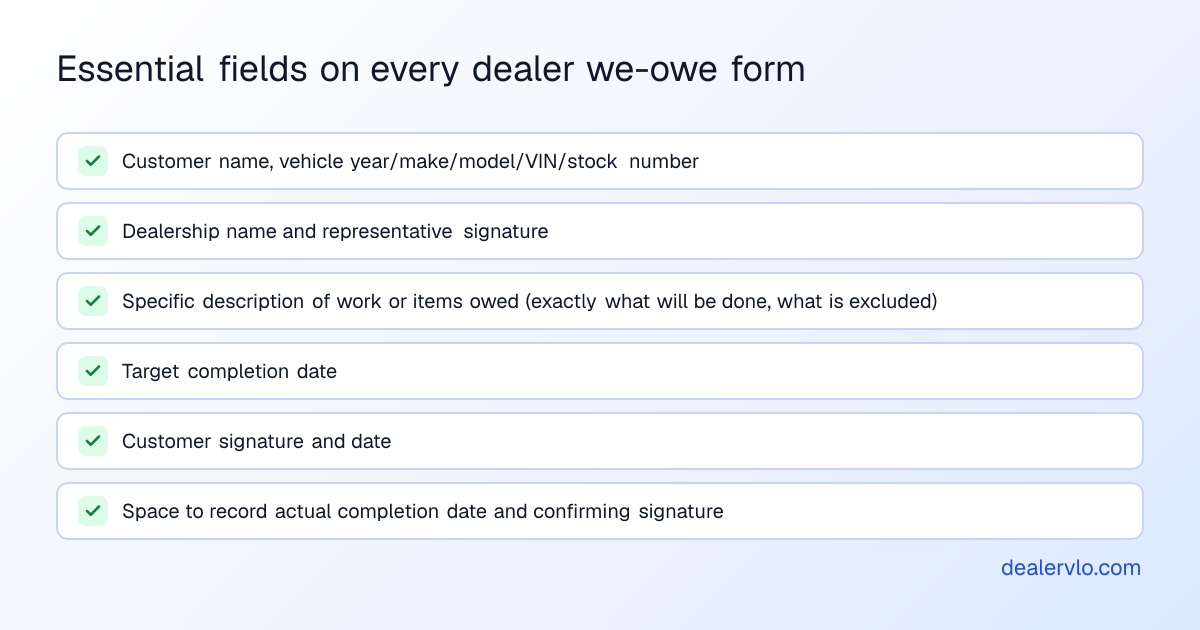
Every we-owe should describe five things:
-
Exactly what will be done. "Front brake pads only" is clear. "Fix brakes" is not. If the work involves a repair that might uncover other problems, describe the limit: "Inspect and repair the most probable cause of the check-engine light based on current diagnostic findings. Additional repairs identified during or after this repair are not included and will be subject to separate authorization." That language keeps your exposure defined.
-
What parts will be used, and what is excluded. If you're replacing a windshield wiper, say whether it's OEM or aftermarket. If you're repainting a bumper, say whether it includes blending the adjacent panels. The goal is to eliminate interpretation.
-
Who pays. Usually the dealer, at no charge to the customer. Write it.
-
A target completion date. "Within ten business days" or "by [specific date]" gives both parties a timeline. If the part is on back-order and you can't commit to a date, write that: "Part on factory back-order, estimated arrival [date], work to be completed within five business days of part arrival."
-
Signatures from both parties. You and the customer both sign. One copy goes to the customer, one stays in the deal jacket, and if the work involves your service department or a vendor, a third copy goes to whoever is doing the work.
Standard dealer we-owe forms are sold as three-part or four-part carbonless sets. Keep a pad at the desk and fill one out before the buyer leaves if anything is still owed.
DealerVLO doesn't ship a built-in we-owe form, but you can upload your own fillable PDF — whether that's a stock form from a dealer supply house or a template you built. DealerVLO maps the form fields and auto-fills them from the deal: customer name, vehicle year, make, model, VIN, date, salesperson. You add the specific description of the work, the target date, and any notes, then the form can be e-signed alongside the rest of the deal documents and stored in the digital deal jacket.
What not to promise on a we-owe
A we-owe should be used only for minor work that's part of the sales transaction. Examples: a dent repair, buffing scratches, a car wash, installing floor mats, replacing a wiper blade, delivering a second key that's being cut. The work should be something you can complete in a reasonable time frame — days, not weeks — with a defined scope and a known cost.
Do not use a we-owe to document major mechanical repairs. Transmission rebuilds, engine work, complex electrical diagnostics — these introduce scope creep, extended timelines, and customer expectations that you'll cover every related issue, not just the originally identified symptom. If a car needs major work, complete it before delivery or sell the vehicle as-is with full disclosure. Don't use a we-owe to close a deal on a car that isn't sale-ready.
The reason this matters is that when you write "fix transmission slip," and you replace the solenoid, and the slip comes back a week later for a different reason, the customer and the dealer will disagree on whether the we-owe obligation has been satisfied. The customer expected the car to shift correctly. You did the work you scoped. Neither of you is wrong, but the we-owe didn't define the limit, and now you're both stuck.
If the repair requires diagnosis, describe what you're committing to diagnose and repair, and what additional authorization will be required if the scope changes. If you can't describe the limit, don't commit yet.
14-day free trial, then $29/mo · Cancel anytime
Costing the we-owe into the deal before the buyer signs
Here's the gross leak most dealers miss: your salesperson promises a $400 bumper repaint to close the deal, the customer drives off, you send the car to the body shop, and the $400 never gets entered into the vehicle's cost. Your DMS reports a $2,200 front-end gross on that deal. Your actual gross, after the body shop invoice, was $1,800. Multiply that across a month of deliveries and your P&L shows phantom profit.
Used-car front-end gross benchmarks for 2026 range from around $1,400 to $3,800 per unit, depending on the source, the dealer segment, and whether reconditioning costs are backed out. Net profit per used unit after all costs typically runs $800 to $1,500. On those margins, an untracked $400 we-owe is a meaningful percentage of your net, and if you're making three or four we-owe promises a month, the cumulative error in your reported profit is real.
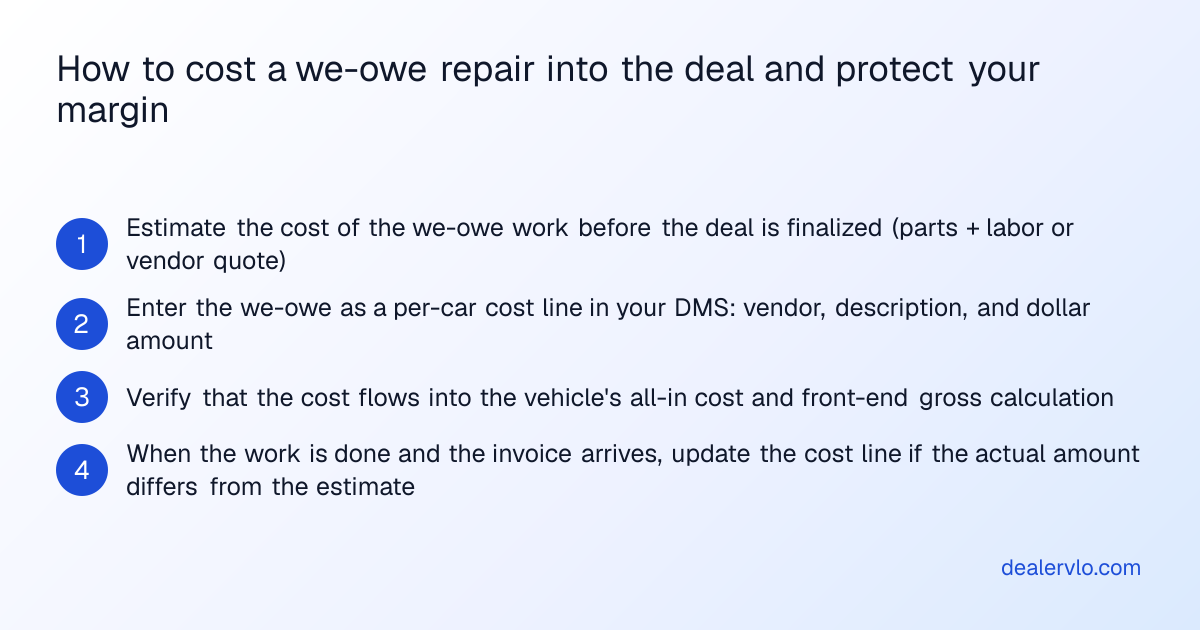
The fix is simple: estimate the cost of the we-owe work at the time the deal is being structured, and add that cost to the vehicle's all-in cost before you calculate gross. If the bumper repaint is $350, log it as a reconditioning line item before the deal is finalized. The gross shown on the deal sheet is then the gross you'll actually keep after the we-owe is closed.
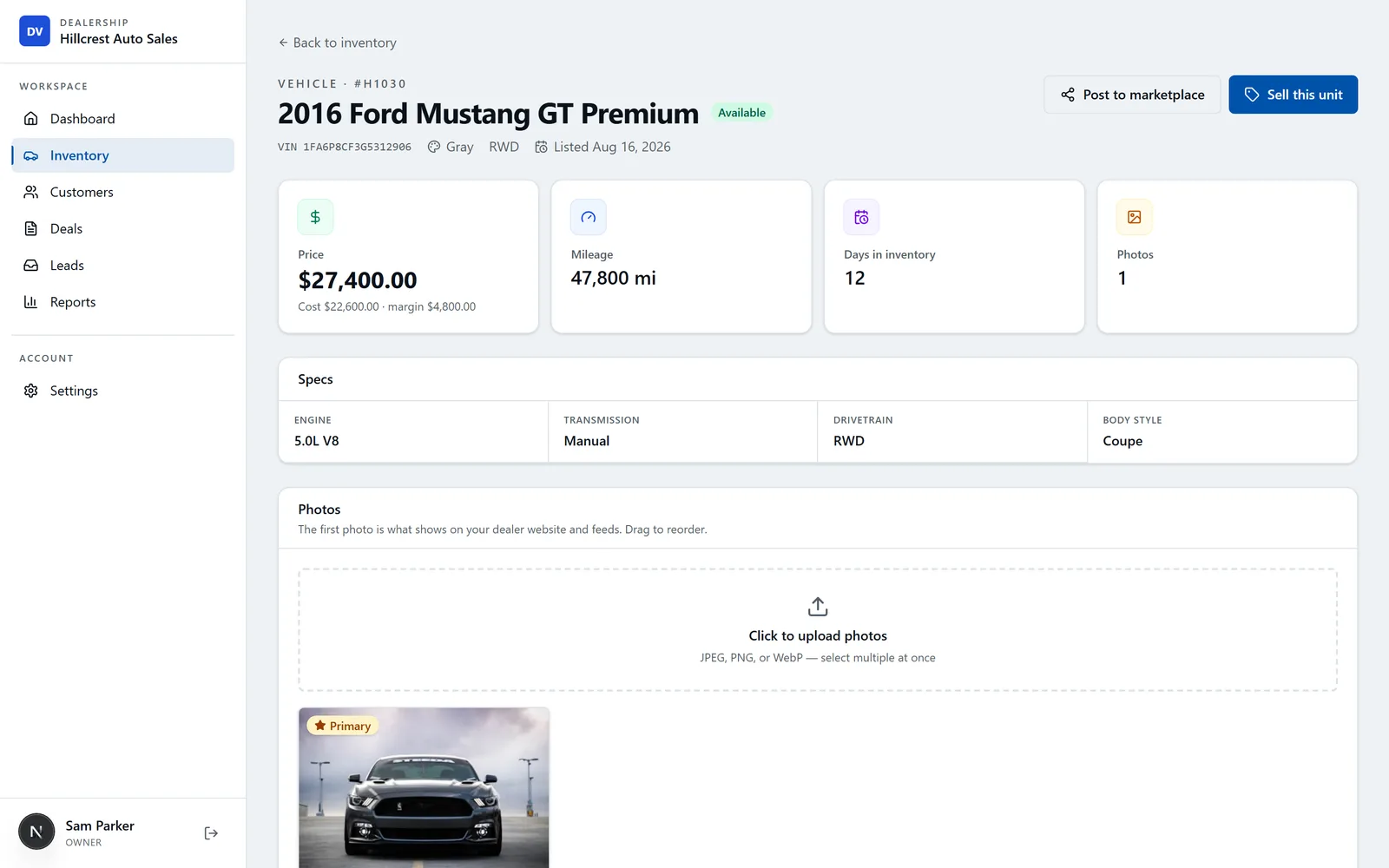
DealerVLO's per-car cost tracking is built for this. Every vehicle has cost lines where you log vendor work, parts, and labor. Each line includes the vendor name, a description, and the cost. When a we-owe repair is estimated, enter it as a cost line — for example, "We-owe: front bumper paint, $350, ABC Body Shop" — and that cost flows into the vehicle's all-in cost. The deal jacket calculates front-end gross live, so the margin shown in the jacket reflects the true all-in cost, including the we-owe. You can see a worked example of how per-car costs roll into margin in the reconditioning cost budget article.
Before you authorize the work: see whether a repair earns back its cost plus the holding days it adds.
Open the Recon ROI CalculatorTracking open we-owes until each is closed
A single we-owe can pass through four departments before it closes. Sales makes the commitment. Parts sources the item, which might require a dealer trade or a factory order with lead time. Service or your detailer installs it. And F&I filed the deal paperwork a week ago. The only record of the promise is whatever Sales wrote down on the we-owe slip, and if nobody is tracking it, the customer calls three weeks later asking when the work will be done, and nobody knows who was supposed to handle it.
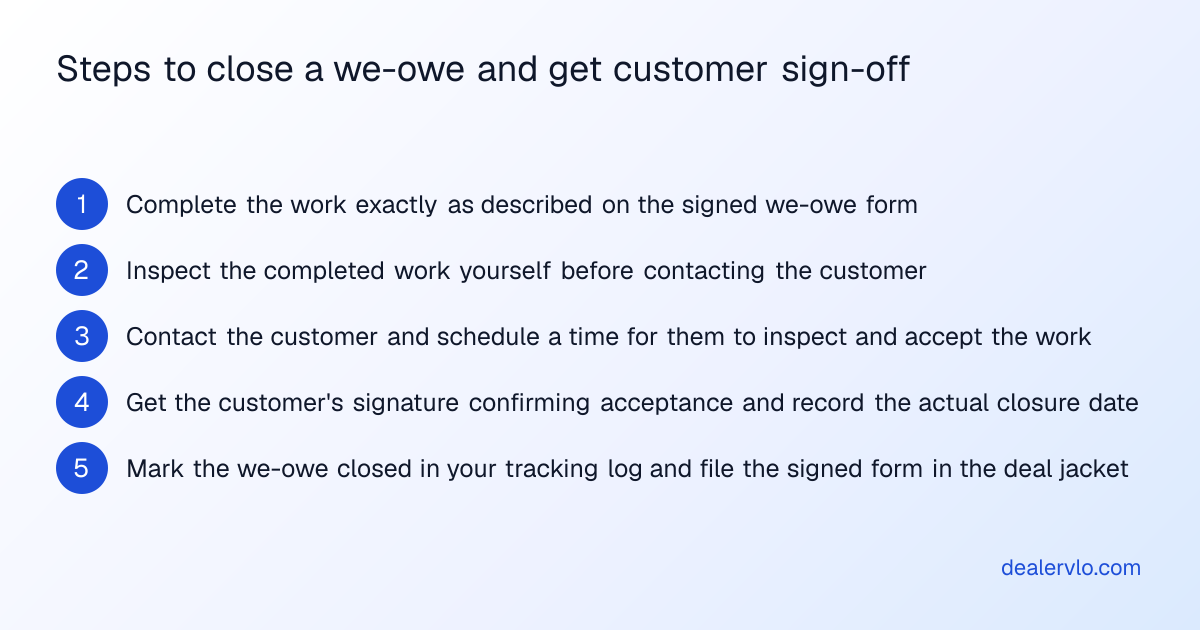
You need a tracking log. It can be a spreadsheet, a whiteboard in the office, or a module in your DMS if you have one. The log should list every open we-owe by stock number, customer name, item owed, target completion date, and status. Review it weekly. When the work is complete and the customer has accepted it, mark the actual closure date and file the signed we-owe in the deal jacket.
The field most often left blank is the closure date. Without it, you can't distinguish between truly outstanding items and those that were completed but never marked closed. A drawer full of we-owe slips, half of them done and none of them marked, tells you nothing about which customers are still waiting.
DealerVLO does not ship a built-in we-owe tracking module or send automated reminders. You'll need to build your own workflow to track completion. The we-owe can be signed and stored in the digital deal jacket alongside the buyer's order and the rest of the deal documents, so the promise is in the same system as the financials, but tracking completion is still a manual process you have to manage. If you're using a separate tool for task management, that's where open we-owes should live until they're closed.
The important part is that one person owns each we-owe. Assign it. If the customer calls, that person knows the status. If the target date passes, that person escalates it. If the work is done, that person gets the customer's signature confirming completion and marks it closed.
The consequences of an unfulfilled we-owe
The customer has a signed document listing what you promised, and if you don't complete it, that document goes with them to small claims court or a complaint to your state's dealer regulator. What happens next depends on your state and your paperwork; ask your attorney if you're unsure where you stand. The practical rule is simpler: don't sign a promise you don't intend to keep.
The reputational cost is worse. A broken we-owe is the kind of detail that shows up in a one-star Google review, complete with the customer posting a photo of the signed form. "They promised to fix the dent and never called me back." That review sits at the top of your profile for months, and every buyer who searches your lot sees it. The Consumer Federation of America and state attorney general offices explicitly warn car buyers to get repair promises in writing because verbal promises are difficult to enforce — which means when a buyer does get it in writing and you don't deliver, the regulator's guidance already told them you're in the wrong.
The bottom line: a we-owe is not a courtesy or a "we'll try." It's a signed commitment. If you write it and sign it, finish it. That's why the specificity matters, why costing it into the deal matters, and why tracking it to closure matters. The we-owe is part of the sale, and if you treat it like an afterthought, it will come back as a problem.
This is part of the broader deal workflow that independent lots run every day. The in-person used-car sale article walks through the full sequence from test drive to close; the we-owe gets written at the end of it, before the buyer leaves.
How DealerVLO handles we-owe workflows
DealerVLO doesn't ship a pre-built we-owe form, but it gives you the tools to make your own form part of the deal paperwork and to track the cost impact on each car's margin. Here's how the workflow fits together:
Upload your own fillable we-owe PDF. Whether you buy a standard dealer due bill form from a supply house or build your own template, upload the PDF to DealerVLO. The system maps the form fields and auto-fills them from the deal: customer name, vehicle year, make, model, VIN, date, salesperson. You fill in the specific description of the work, the target date, and any exclusions or notes.
E-signatures on deal documents. The we-owe can be signed electronically alongside the buyer's order, as-is disclosure, and the rest of the deal paperwork. All signed documents are stored in the digital deal jacket, so the we-owe is in the same place as the contract, the title application, and the cost breakdown. If a question comes up three weeks later, you have the signed we-owe in the file, and you know exactly what was promised.
Per-car cost tracking. Every vehicle in DealerVLO has cost lines where you log vendor work, parts, and labor. Each line includes the vendor name, a description, and the cost. When you write a we-owe, estimate the cost of the work and enter it as a cost line before the deal is finalized — for example, "We-owe detail, $150, Joe's Detail Shop." That cost flows into the vehicle's all-in cost, and the deal jacket's live front-end gross calculation updates to reflect the true margin. When the work is done and the vendor invoice comes in, you can update the cost line if the actual amount differed from the estimate. The dealer paperwork software page has more on how the deal jacket and cost tracking work together.
What DealerVLO does not do: It doesn't send automatic reminders to close open we-owes, and it doesn't provide a dashboard or report of outstanding we-owe items. You'll need to build your own tracking workflow — a manual log, a spreadsheet, or integration with a separate task-management tool — to ensure every we-owe is followed through to closure.
The guide to creating documents in DealerVLO walks through the process of uploading a custom form, mapping the fields, and generating signed documents from a deal. Once your we-owe form is uploaded and mapped, it fills from any deal like the rest of your documents.
Frequently asked questions
What is a we-owe form, and when do car dealers use it?
A we-owe form — also called a due bill — is a written record documenting anything a dealership has promised to deliver or complete after the customer takes delivery of the car. Common items include a second key that's being cut, a dent or scratch repair agreed to during negotiation, floor mats or accessories not yet in stock, or a car wash. The we-owe is signed by both the dealer and the customer, with one copy for the customer and one for the deal file, and it becomes part of the deal paperwork.
How do I write a dealer we-owe form that won't lead to disputes?
Every we-owe should describe exactly what will be done, what is excluded, who pays, a target completion date, and be signed by both parties. Avoid vague language like "fix brakes" — instead write "front brake pads only" or "inspect and repair the most probable cause of the check-engine light based on current diagnostic findings; additional repairs not included." The more specific the description, the less room for argument later. Standard dealer we-owe forms are sold as carbonless multi-part sets, or you can upload a fillable PDF to your dealer management system and auto-populate the vehicle and customer details from the deal.
Should I cost the we-owe into the deal before the customer signs?
Yes. If you promise a $400 repair to close a deal but never enter that cost into the vehicle's reconditioning line, your reported gross will overstate your actual margin by $400. Estimate the cost of the we-owe work — parts plus labor or the vendor's quote — at the time the deal is being structured, and add it to the car's all-in cost before you calculate gross. That way the margin shown on the deal sheet is the margin you'll actually keep after the we-owe is closed. DealerVLO's per-car cost lines let you log the we-owe repair as a vendor cost against the vehicle's stock number, so the live front-end gross in the deal jacket reflects the true all-in cost.
What should not go on a we-owe slip for a used car?
A we-owe should be used only for minor work that's part of the sales transaction — things like a dent repair, detailing, installing floor mats, replacing a wiper blade, or delivering a second key. Do not use a we-owe to document major mechanical repairs like transmission rebuilds, engine work, or complex diagnostics. These introduce scope creep, extended timelines, and customer expectations that you'll cover every related issue, not just the originally identified symptom. If a vehicle needs major work, complete it before delivery or sell the car as-is with full disclosure; don't use a we-owe to close a deal on a car that isn't sale-ready.
How do I track open we-owes until they're completed?
Maintain a simple tracking log — a spreadsheet, a whiteboard in the office, or a module in your DMS — listing every open we-owe by stock number, customer name, item owed, target completion date, and status. Assign one person responsible for closing each we-owe, and review the log weekly. When the work is complete and the customer has accepted it, mark the actual closure date and file the signed we-owe in the deal jacket. The field most often left blank is the closure date, and without it you can't distinguish between truly outstanding items and those that were completed but never marked closed.
What happens if a dealer doesn't complete a signed we-owe?
The customer is holding a signed document that lists what you promised, and that's the first thing they'll show a small claims judge, your state's dealer regulator, or a review site. What it means legally depends on your state and your paperwork, so ask your attorney, but don't plan on arguing your way out of a promise you signed. A broken we-owe also tends to become a one-star review, sometimes with a photo of the form. Treat it as a commitment: if you write it and sign it, finish it.
Bottom line
A we-owe is a written promise with your signature on it. The difference between a clean we-owe and a problem is specificity: describe exactly what you're committing to do, what it excludes, who pays, and when it will be done. Cost the work into the deal before the buyer signs so your reported gross reflects the true margin. Track every open we-owe until it's closed and the customer has signed off. And never promise major work on a we-owe — if the car needs it, do it before delivery or sell it as-is. The we-owe is not where you hide unfinished reconditioning; it's where you document the minor items that will be completed in a defined time frame, in writing, with accountability on both sides.
14-day free trial, then $29/mo · Cancel anytime
Paste a VIN, the buyer, and the price — see the title & registration form filled in for 50 states, free, no signup.
Open the State Form Auto-Fill