Form 8300 for Car Dealers: When Cash Triggers the $10,000 Report
For dealers: when a car buyer's cash tops $10,000 you file Form 8300 within 15 days. What counts as cash, related payments, e-filing and the January 31 letter.
Part of the Compliance, taxes & deal paperwork guide: What goes in a used-car deal jacket: the complete checklist
Switching from another DMS? Compare DealerVLO to DealerCenter, Frazer, or Lot Wizard.
When a buyer pays you more than $10,000 in cash for a car, you file Form 8300 within 15 days, send the buyer a written statement by January 31 of the next year, and keep a copy for five years. "Cash" here is wider than bills: on a car sale over $10,000, cashier's checks, money orders, bank drafts and traveler's checks of $10,000 or less count too, and a deposit and the balance on the same deal are added together.
This is written for the dealer taking the money. If you're a buyer wondering why the dealer asked for your Social Security number on a cash deal, this is why. Everything below comes from the IRS's own Form 8300 reference guide and Publication 1544. It's a working summary, not tax or legal advice; your CPA should look at anything unusual.
14-day free trial, then $29/mo · Cancel anytime
What Form 8300 is
Form 8300 is the "Report of Cash Payments Over $10,000 Received in a Trade or Business." Any business that receives more than $10,000 in cash in a single transaction or in related transactions files it, and a used-car lot is a business like any other. It's an information report, not a tax return, and it's a separate report from the Currency Transaction Report a bank files when cash is deposited.
The rule doesn't stop you from taking cash. It requires you to report it, on time, with the buyer's details.
What counts as cash on a car sale
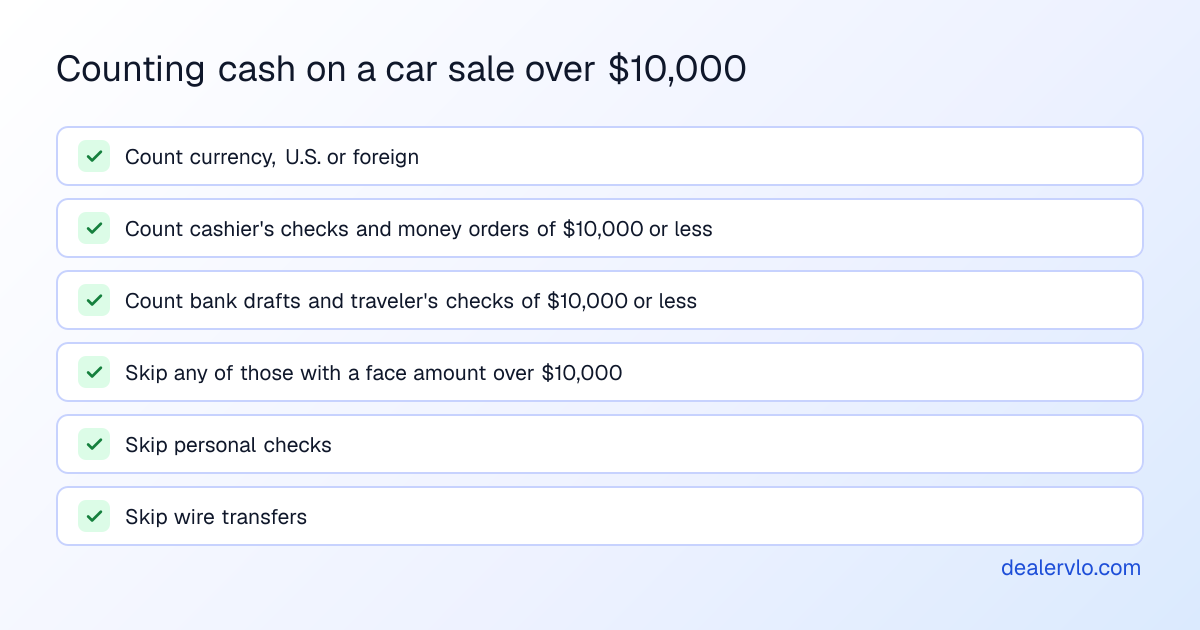
Currency always counts: U.S. or foreign coins and bills.
Cashier's checks, bank drafts, traveler's checks and money orders count only in two situations. One is when you get them in a designated reporting transaction, and the retail sale of a "consumer durable" is one: property other than land or buildings that's suitable for personal use, can be expected to last at least a year, has a sales price over $10,000, and can be seen or touched. A car you retail for more than $10,000 fits. The other is any transaction where you know the customer is trying to avoid the report.
Even then, only instruments with a face amount of $10,000 or less count. The IRS's own car example: a buyer pays for a car with a single $12,000 cashier's check, and "the cashier's check is not treated as cash because its face value is more than $10,000," so there's nothing to file. Split that same payment into a $6,000 cashier's check plus $6,000 in currency, as in another IRS example, and both pieces count.
What doesn't count:
- A personal check drawn on the buyer's own account.
- A wire transfer. The IRS says it "does not constitute cash for Form 8300 reporting purposes."
- A cashier's check that is the proceeds of a bank loan. In Publication 1544's dealer example, a buyer pays $2,000 in currency plus a $9,500 cashier's check from her bank loan for an $11,500 car, and the dealer doesn't have to file. If you're relying on this, keep the proof that the check came from a loan with the deal.
Deposits, installments and related payments
You don't look at one payment in isolation. Two or more payments from the same buyer within 24 hours are treated as one transaction, and payments further apart are still related when you know, or have reason to know, they're part of a series of connected transactions. A deposit and the balance on the same car are the obvious case.
Here's an example with example numbers. A buyer puts $3,000 in currency down on a $13,000 car on Monday, then comes back Friday with an $8,500 cashier's check. That's $11,500 in cash on one sale, and the clock starts Friday, when the total went over $10,000.
Installments follow a one-year rule. If the first cash payment is $10,000 or less, you add it to later cash payments made within one year of the first one, and you file within 15 days once the total passes $10,000. After you've filed, you start a new count, and if you receive more than $10,000 in additional cash from that buyer within 12 months, you file again. If you carry the note on a buy-here-pay-here deal and customers pay in currency, ask your CPA how these rules apply to your payment history.
Not every later payment is related. The IRS gives the example of a car buyer who, within 12 months, pays the dealership another $1,500 in cash for extras that are "not part of the original sales contract," with no legal obligation to buy them. Those don't get added to the car.
When you take deposits and down payments, write down how each piece was paid. That's the record you'll count from.
Build the whole deal — price, tax on the right base, doc, title, minus trade and down — into the out-the-door number and the monthly payment.
Open the Out-the-Door Price CalculatorRunning the deal's numbers before the buyer pays tells you the total that's about to change hands. If that total is going to arrive as currency or small cashier's checks, you know before anyone signs that this deal needs a Form 8300.
The 15-day deadline
File within 15 days after the date you receive the cash. If the cash arrives in pieces, it's 15 days from the payment that pushes the total over $10,000. If the 15th day lands on a Saturday, Sunday or holiday, the IRS says to file on the next business day.
The clock runs from the money, not the paperwork. A deal signed on the 1st and paid on the 5th is due 15 days after the 5th.

E-filing: who has to
Since January 1, 2024, you must e-file Form 8300 if you're required to file at least 10 information returns of other types during the calendar year. W-2s and 1099s count toward the 10; Forms 8300 don't. A lot that files payroll W-2s and contractor 1099s can cross that line without noticing.
If you're under the threshold, you can still file on paper, and anyone can choose to e-file. E-filing goes through FinCEN's BSA E-Filing System, and it's free.
Two details from the IRS reference guide trip people up:
- Waivers. If the IRS grants you a waiver from e-filing your other information returns, it automatically covers your Forms 8300 for the rest of that calendar year, and you write "WAIVER" at the top center of page 1 of each paper Form 8300. You can't ask for a waiver from e-filing Form 8300 alone.
- Keep the form, not the email. Print or save a copy of the form before you submit it. In the IRS's words, "Email confirmation the form was filed is not a substitute of the form itself."
14-day free trial, then $29/mo · Cancel anytime
The January 31 statement to the buyer
You don't give the buyer a copy of Form 8300. You send each person named on it a written statement by January 31 of the year after the payment. The statement has to include:
- your business's name and address,
- a contact person and telephone number,
- the total amount of reportable cash you received from them, and
- a note that you furnished the information to the IRS.
A short letter on your letterhead covers it. Keep a copy with the deal in your deal jacket.
There's one exception. You can file Form 8300 voluntarily for a payment of $10,000 or less that looks suspicious. Because that filing wasn't required, there's no requirement to send the buyer a statement, and the IRS says a statement should never be a copy of a form marked suspicious.
Keep a copy for five years
Keep a copy of every Form 8300 you file for five years from the date you filed it. File it with the deal, along with the written statement you sent and any proof you relied on, such as the loan paperwork behind a cashier's check you didn't count.
Structuring: the request you say no to
Structuring is breaking up a large cash payment into smaller ones to disguise the real amount. It looks like a buyer offering two $6,000 cashier's checks "so you don't have to do the paperwork," asking you to write the deposit off the books, or splitting one car across two deals.
The answer is no. Once you know a customer is trying to avoid the report, cashier's checks, bank drafts, traveler's checks and money orders of $10,000 or less count as cash in any transaction, so the split doesn't get the buyer out of anything. The IRS says the penalties for failing to file can also apply to anyone who tries to structure a payment. Publication 1544 lists both civil and criminal penalties for not filing; read it there rather than relying on a number repeated secondhand.
If a payment of $10,000 or less feels wrong (the buyer is evasive about the money, or asks you to keep it quiet), you can file a voluntary Form 8300 and check the suspicious-transaction box. For more ways buyers try to get cars or money past a small lot, see test-drive theft and payment fraud.
What the form asks for
Form 8300 asks for identifying details about the person you received the cash from, including their taxpayer identification number, a description of the transaction and how the cash was paid, and your business's information. Publication 1544 is direct about the TIN: "If you do not know a person's TIN, you have to ask for it," and you can be penalized for a missing or incorrect one. On a cash deal with no financing, that may be the first time you ask the buyer for a Social Security number, so tell them up front that it's for a required federal report. In the publication's own example, the business asks the customer for identification to get the information the form needs.
That's sensitive data. Store it the way you'd store anything else covered by the FTC Safeguards Rule, and don't leave the form on the desk.
The current form and its instructions are on irs.gov, and the BSA E-Filing System walks you through the fields if you file online.
A counter routine that catches it
You'll go months without a reportable deal, which is exactly why it gets missed. Make it part of how every deal is written:
- Ask how the buyer is paying before you write the paperwork: currency, cashier's check, money order, financing, or a mix.
- Count every cash piece on the deal, deposit included. Currency always; cashier's checks, money orders, drafts and traveler's checks only at $10,000 or less face amount.
- Write it on the jacket: total reportable cash, the date it crossed $10,000, the filing due date, and who is filing (you, your office manager or your CPA).
- File, then send the January statement, and keep the copy with the deal.
If your CPA or bookkeeper files for you, the dealership is still the business that received the cash. Get them the buyer's details and the payment dates the same week, not at month-end, because 15 days goes fast.
Where DealerVLO fits
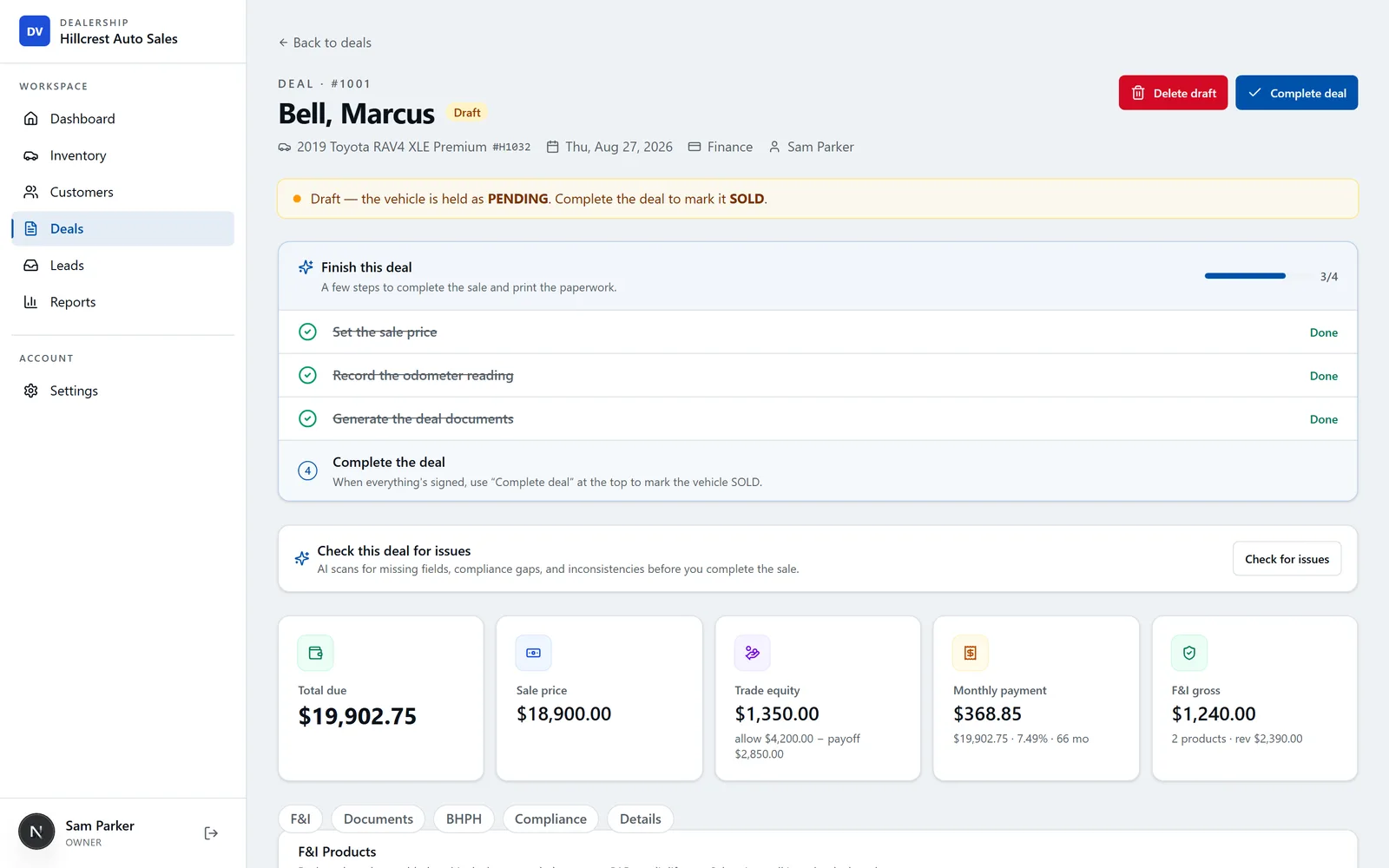
DealerVLO doesn't file Form 8300, and it won't tell you a deal is reportable. A deal's "Cash down" field is one number for the down payment however it was paid, so it can't tell currency from a cashier's check or a wire. There's no flag for cash over $10,000, no 15-day reminder, and no Form 8300 in the documents. Counting and filing are on you.
What it does is keep the deal in one place. The buyer and the car are on the deal, the deal math (totals, trade, down payment and payment) is computed on the deal jacket, and the deal's generated paperwork is stored with it. When you sit down to fill out the form, the buyer's name and address, the car's VIN and the deal numbers are a click away, and you add the payment details and the TIN you collected for the form. For how that fits the rest of your paperwork, see dealer compliance software.
Frequently asked questions
What is considered cash for Form 8300 on a car sale?
Currency (U.S. or foreign) always counts. On a retail sale of a car priced over $10,000, a cashier's check, bank draft, traveler's check or money order with a face amount of $10,000 or less also counts. A personal check doesn't, a wire transfer doesn't, and an instrument with a face amount over $10,000 doesn't. The IRS also gives a dealer example where a cashier's check that is the proceeds of a bank loan isn't treated as cash.
When do I have to file Form 8300?
Within 15 days after you receive more than $10,000 in cash in one transaction or in related transactions. If the 15th day falls on a Saturday, Sunday or holiday, the IRS says to file on the next business day. When the cash comes in pieces, the clock runs from the payment that takes the total over $10,000.
Do I have to e-file Form 8300?
Since January 1, 2024, you must e-file Form 8300 if you're required to file at least 10 information returns of other types (such as W-2s and 1099s) during the calendar year. Forms 8300 don't count toward the 10. Below that, you can still file on paper, and anyone can choose to e-file through FinCEN's BSA E-Filing System, which is free.
Do I give the buyer a copy of Form 8300?
No. You send each person named on the form a written statement by January 31 of the next year. It has to include your business's name, address, contact person and phone number, the total reportable cash, and a note that the information was furnished to the IRS.
What if a buyer asks me to split the payment to stay under $10,000?
That's structuring: breaking up a large cash payment to disguise the real amount. Don't do it and don't suggest it. Once you know a customer is trying to avoid the report, cashier's checks and money orders of $10,000 or less count as cash in any transaction, and the IRS says the failure-to-file penalties can also apply to someone who tries to structure a payment.
Does DealerVLO file Form 8300 or flag cash deals over $10,000?
No. A DealerVLO deal has a "Cash down" field, but it's one number for the down payment however it was paid, so it isn't your Form 8300 count. DealerVLO doesn't record the form of payment, flag reportable cash, track the 15-day deadline, or prepare or file Form 8300. It does keep the buyer, the car, the deal math and the deal's paperwork together, which is where most of the form's details come from.
Bottom line
Form 8300 comes down to counting correctly and filing on time. On a car over $10,000, count currency plus any cashier's check, money order, bank draft or traveler's check of $10,000 or less; add the deposit to the balance; file within 15 days of crossing $10,000 (electronically if you file 10 or more other information returns); send the buyer a statement by January 31; and keep a copy for five years. Ask how every buyer is paying before you write the deal, and the reportable ones won't slip by.
DealerVLO won't file it for you, but it keeps every deal's buyer, car, numbers and paperwork in one record for $29 a month flat with unlimited users. See what's included.
14-day free trial, then $29/mo · Cancel anytime