How to fill out the VTR-61 in Texas
A field-by-field walkthrough of the Texas VTR-61 (Rebuilt Vehicle Statement) for licensed used car dealers — what goes in every section, who signs what, and the documents you attach. Verified against the official form as of October 2026.
Filing these every week? Upload the VTR-61 to DealerVLO once and it fills from every deal you enter, $29/month flat. See pricing
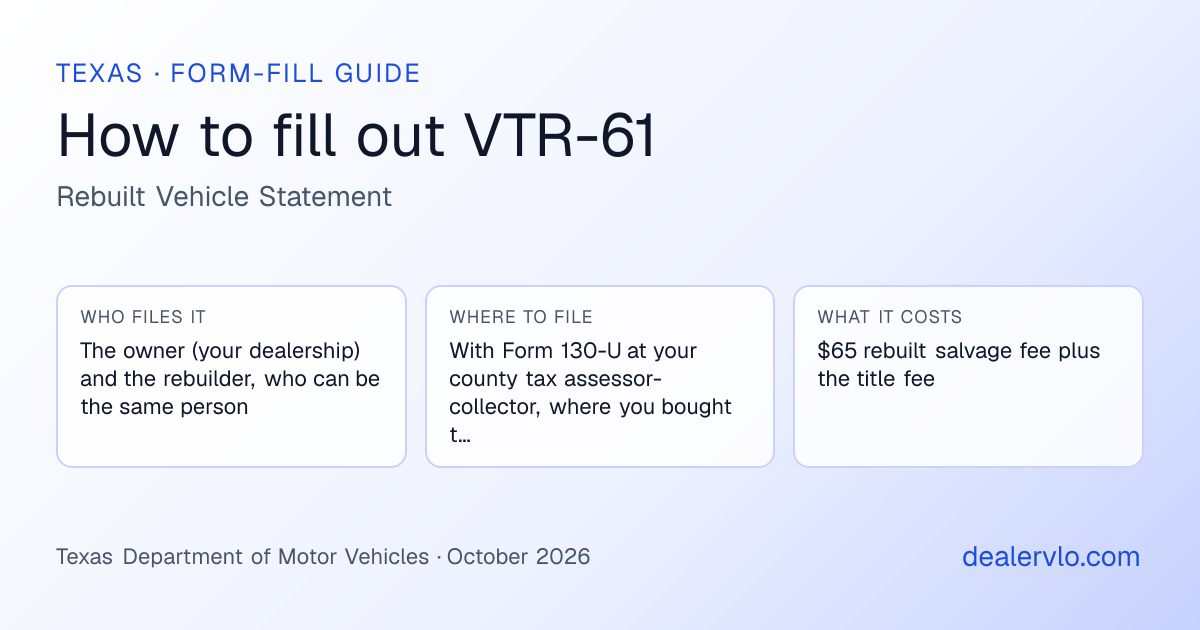
Filling out the TX VTR-61 after a sale:
- What it is
- TxDMV's statement of the repairs and parts used to rebuild a salvage vehicle, filed to get a Rebuilt Salvage title
- Who completes it
- The owner (your dealership) and the rebuilder, who can be the same person
- Where to file it
- With Form 130-U at your county tax assessor-collector, where you bought the car, or any willing county
- Processing time
- Processed with the title application at the county office
- Cost
- $65 rebuilt salvage fee plus the title fee
This guide is informational and does not replace the official Texas instructions. Always confirm the current form and procedure with the Texas Department of Motor Vehicles before you file.
The VTR-61 is one car's paperwork. A 20-second read on your lot, and the tax-and-fee math for the whole deal — built for dealers, no signup. Free calculators dealers actually use — no signup, no email.
Upload the fillable Texas VTR-61 to DealerVLO once. It maps the fields, then fills the form from every deal — buyer, co-buyer, the vehicle you sold, and your dealership already in place. $29/month, free to try — cancel any time.
What the VTR-61 is and why it matters
Form VTR-61, the Rebuilt Vehicle Statement, is how a salvage vehicle becomes a titled road car again in Texas. The owner and the rebuilder describe the repairs and list where the major component parts came from, and the county issues a title branded "Rebuilt Salvage." A dealer can't retail a rebuilt car on the salvage title: TxDMV's Salvage/Nonrepairable Motor Vehicle Manual (January 2026) says an independent dealer must get the Rebuilt Salvage title in the dealer's name first.
The form is two pages. Page 1 is the vehicle, the owner, the rebuilder, and the work done. Page 2 is a parts table, and the engine, frame, and body rows are where applications stall: if you can't show the part number or VIN of the vehicle a replaced engine, frame, or body came from, the county can't title it on a VTR-61. This guide walks both pages.
VTR-61 (Rev 01/25) is the form TxDMV requires to title a rebuilt salvage vehicle; it's filed with Form 130-U at a county tax assessor-collector's office. The PDF is fillable, so you can upload it to DealerVLO once under Settings → Forms: the VIN, year, make, model, body style, and your dealership's name and address fill from the deal. When you confirm the field mapping, set the owner and rebuilder lines to your dealership (the automatic suggestion points them at the buyer) and clear any suggestions on the page 2 parts rows. The repair details and the parts list are specific to each rebuild, so fill those by hand from your receipts. Signatures go on in ink.
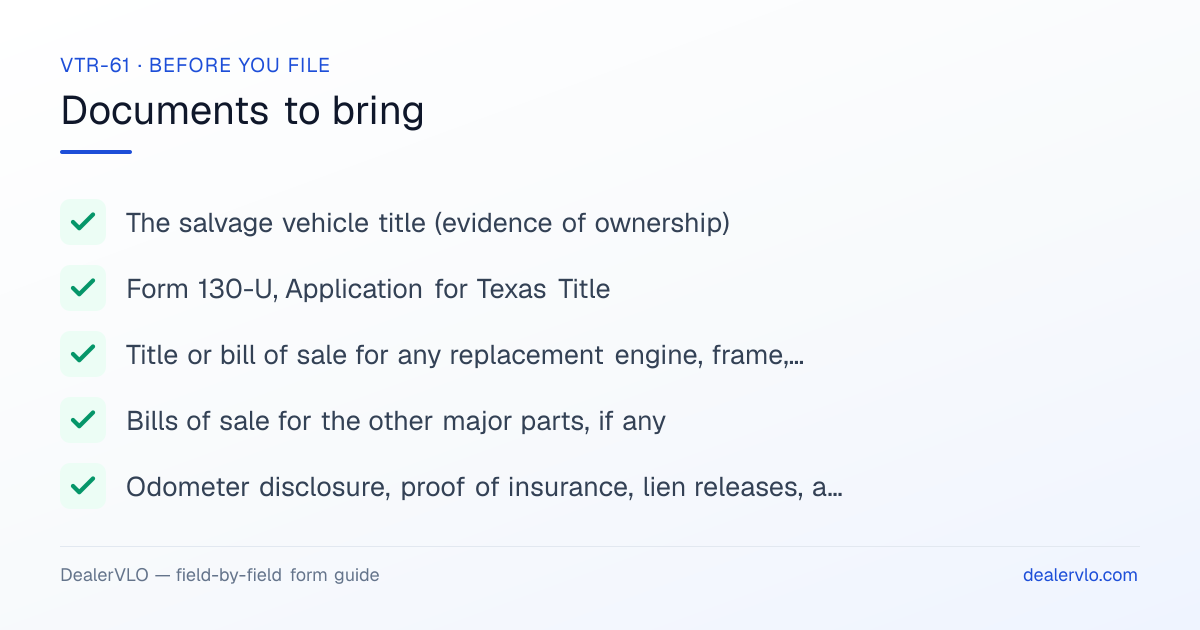
Documents to have before you start
Gather these before you complete the VTR-61. A missing attachment is the number-one reason the the Texas Department of Motor Vehicles bounces a title application back.
- The salvage vehicle title (evidence of ownership) — A Texas salvage title, or a comparable out-of-state salvage title. Nonrepairable titles issued on or after September 1, 2003 can never be rebuilt or retitled.
- Form 130-U, Application for Texas Title — The current revision has a $65 Rebuilt Salvage Fee box. See the 130-U guide.
- Title or bill of sale for any replacement engine, frame, or body — Page 2 of the VTR-61 requires it. Use Form VTR-63 (Component Part(s) Bill of Sale), one per donor vehicle, for parts that don't carry their own title.
- Bills of sale for the other major parts, if any — Transmission, fenders, hood, doors, bumpers, quarter panels, and the rest of the page 2 list.
- Odometer disclosure, proof of insurance, lien releases, and VIN certification if last titled out of state — VIN certification comes through an emissions or commercial inspection, or self-certification on the 130-U.
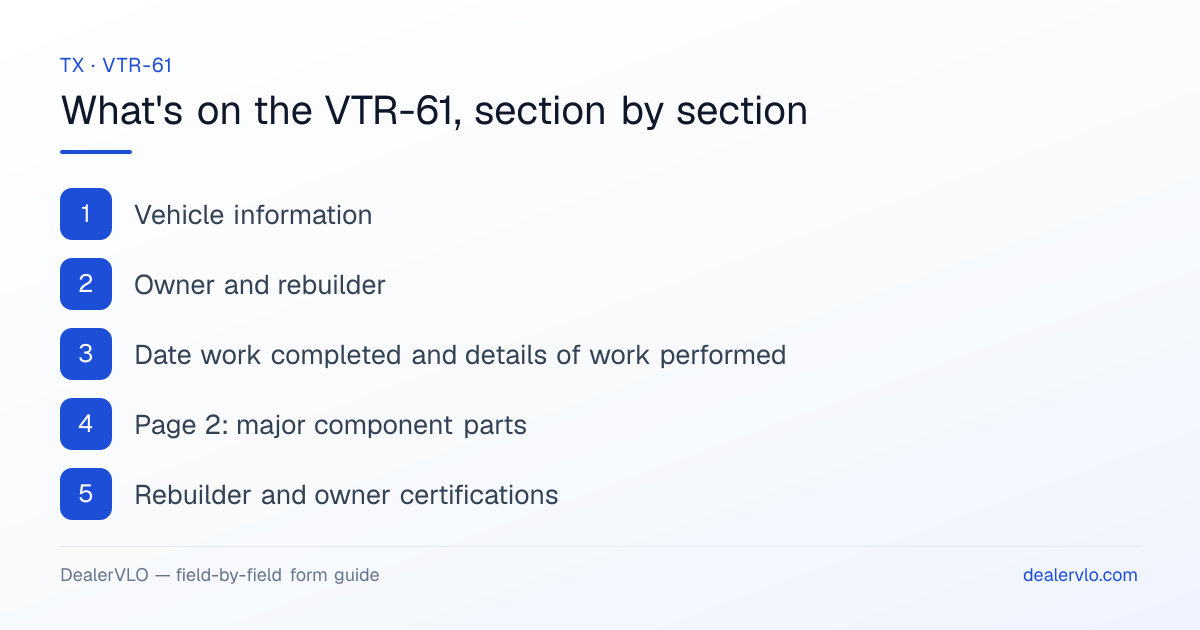
VTR-61, section by section
Vehicle information
Page 1 starts with the vehicle: VIN, year, make, body style, and model. Copy them from the salvage title so they match the 130-U exactly. The VIN is the car's own VIN, not a donor's.
| Field | Who fills it |
|---|---|
Vehicle identification number | You (dealer) |
Year, make, body style, model | You (dealer) |
Owner and rebuilder
The owner line is one field for the full name or entity name. On a dealer rebuild that's your dealership, because the title has to be issued in the dealer's name before you retail the car. The rebuilder line takes the name and address of whoever did the work, your own shop or an outside body shop. TxDMV's manual notes that an independent motor vehicle dealer with a general distinguishing number (GDN) doesn't need a separate salvage vehicle dealer license to rebuild. Other dealer types and individuals do once they rebuild more than five salvage vehicles in a calendar year.
| Field | Who fills it |
|---|---|
Owner name (or entity name) Your dealership, so the title issues in its name. | You (dealer) |
Rebuilder name, address, city, state, ZIP Whoever did the repairs. | You (dealer) |
Date work completed and details of work performed
Enter the date the rebuild was finished, then describe the work on the four lines: what was damaged and what was repaired or replaced. Keep it specific and consistent with your receipts. TxDMV's manual allows one shortcut: an owner who bought the car already repaired and doesn't know what was done may write "Repairs unknown" here and skip page 2.
| Field | Who fills it |
|---|---|
Date work completed | You (dealer) |
Details of work performed (4 lines) Or "Repairs unknown" if you bought it already repaired. | You (dealer) |
Page 2: major component parts
Page 2 lists 13 major parts: engine, frame, body, transmission, fenders, hood, doors, bumpers, quarter panels, tailgate/deck lid/hatchback, pickup cargo box, cab of a truck, and roof or floor pan. Fill in only the rows for parts you replaced. For each, give who you bought it from (name and complete address) and the component part number. The part number is required for the engine, frame, and body, and "if available" for the rest. TxDMV's manual says the part number or the VIN of the vehicle the part came from must be disclosed for those basic parts. If you can't, the county can't issue the title on a VTR-61, and your options become a bonded title or a tax assessor-collector hearing. Attach the title or bill of sale for an engine, frame, or body, and bills of sale for the others if you have them.
| Field | Who fills it |
|---|---|
Engine, frame, body: origin and part number Part number or donor VIN required, with a title or bill of sale. | You (dealer) |
Other major parts: origin and part number Part number if available; attach bills of sale if any. | You (dealer) |
Rebuilder and owner certifications
Two certifications close the form: the rebuilder's and the owner's, each with a printed name, signature, and date. If your dealership did the work, the same person can sign both. Sign in ink. Giving false information on the VTR-61 is a third-degree felony under the Texas Transportation Code, so the parts list has to match what's on the car and what's in your receipts.
| Field | Who fills it |
|---|---|
Rebuilder: printed name, signature, date | You (dealer) |
Owner: printed name, signature, date | You (dealer) |
Filing it, fees, and the brand you get
File the VTR-61 with Form 130-U, the salvage title, the parts documents, an odometer disclosure, proof of insurance, any lien releases, and VIN certification for a car last titled out of state. You can file in the county where you reside, where the car was bought or encumbered, or any willing county. The fee is $65 under Transportation Code § 501.100 plus the title fee. TxDMV's January 2026 manual describes no separate state rebuilt-vehicle inspection beyond VIN certification. The title comes back branded "REBUILT SALVAGE – DAMAGED" for a Texas salvage title issued on or after September 1, 2003, or "REBUILT SALVAGE – ISSUED BY (STATE)" for an out-of-state one, and a flood remark carries forward.
| Field | Who fills it |
|---|---|
Form 130-U with the $65 Rebuilt Salvage Fee box checked | You (dealer) |
County tax assessor-collector Issues the Rebuilt Salvage title in the dealership's name. | At the counter |
Then, before you retail it: the disclosure
Once it's titled, Texas has a separate rule for selling it. Under 43 Tex. Admin. Code § 215.160, a dealer displaying a rebuilt salvage car for retail sale must post a written disclosure visible from outside the car stating that it "has been repaired, rebuilt or, reconstructed after formerly being titled as a salvage motor vehicle." At the sale, the buyer signs an acknowledgment in 14-point or larger type. It can be part of the buyer's order but needs its own signature.
| Field | Who fills it |
|---|---|
Disclosure visible from outside the vehicle | You (dealer) |
Buyer's signed acknowledgment (14-point type, separate signature) | Buyer |
Common VTR-61 mistakes that cause rejections
The county can't title it on a VTR-61 without one. Get the part number or donor VIN, plus a title or VTR-63 bill of sale, when you buy the part, not after the rebuild.
An independent dealer has to title it Rebuilt Salvage in the dealership's name first, then sell it with the retail disclosure.
A Texas nonrepairable title issued on or after September 1, 2003 can never be retitled, and neither can export-only titles or out-of-state junk or parts-only titles. Check the title before you buy.
VTR-63 covers component parts. A part that carries the vehicle's identity, like a passenger car's body, needs a negotiable title instead.
Page 2 is required whenever you replaced any of the 13 listed parts. Only an owner who bought it already repaired and writes "Repairs unknown" skips it.
Common questions
What is Texas Form VTR-61?+
VTR-61 is TxDMV's Rebuilt Vehicle Statement. The owner and rebuilder of a salvage vehicle use it to describe the repairs and list where the major component parts came from, so the county tax office can issue a title branded Rebuilt Salvage. It's filed with Form 130-U. The current revision is VTR-61 (Rev 01/25).
How do you get a rebuilt title in Texas?+
Repair the salvage vehicle, then file Form 130-U, Form VTR-61, the salvage title, titles or bills of sale for any replacement engine, frame, or body, an odometer disclosure, proof of insurance, and VIN certification if it was last titled out of state, with a county tax assessor-collector. Pay the $65 rebuilt salvage fee plus the title fee. The new title is branded Rebuilt Salvage.
Does Texas require an inspection for a rebuilt salvage title?+
TxDMV's Salvage/Nonrepairable Motor Vehicle Manual (January 2026) describes no separate rebuilt-vehicle inspection. A vehicle last titled out of state needs VIN certification, through an emissions or commercial inspection or self-certification on Form 130-U. Texas ended safety inspections for non-commercial vehicles on January 1, 2025.
Can a Texas dealer sell a car on a salvage title?+
Not at retail. TxDMV's manual says an independent dealer must obtain a title branded Rebuilt Salvage in the dealer's name before retailing a rebuilt salvage vehicle. A car that's still on a salvage title can't be driven on public roads until it's rebuilt, retitled, and registered.
What if I don't know the part numbers for a rebuilt car I bought?+
If you bought it already repaired and don't know what was done, TxDMV's manual lets the owner write "Repairs unknown" and skip page 2. But if replaced basic parts (engine, frame, body) can't be identified by part number or donor VIN, the county can't title it on a VTR-61, and the options are a bonded title or a tax assessor-collector hearing.
Do Texas independent dealers need a salvage dealer license to rebuild cars?+
TxDMV's manual says an independent motor vehicle dealer with a general distinguishing number doesn't need a salvage vehicle dealer license. Other persons, including other dealer types, need one if they repair, rebuild, or reconstruct more than five salvage vehicles in the same calendar year.
Is there software that fills out the VTR-61 automatically?+
Yes. The Texas VTR-61 is a fillable PDF, so dealer management software like DealerVLO can fill it for you: upload the blank form once, DealerVLO detects its fields and suggests a mapping you confirm, and from then on it fills from every deal you enter — the buyer, co-buyer, the vehicle you sold, and your dealership's details already in place. It's $29/month flat with a 14-day free trial, and the same deal also generates your federal documents (Bill of Sale, FTC Buyers Guide, odometer disclosure) and your state title paperwork.
- How to fill out Texas Form 130-U
- Can you make money selling salvage title cars?
- Salvage and branded title disclosure by state
- Selling salvage and rebuilt title cars as a dealer
- How to get a used car dealer license in Texas
- Texas dealer plates
- E-signatures and e-titling for Texas dealers
- How Texas car sales tax works on a dealer sale
- Title application forms in every state
- How much is a dealer's license? Cost in every state
Stop filling out the VTR-61 by hand.
Upload the fillable TX VTR-61 once. DealerVLO detects its fields, you confirm the mapping, and every deal after that prints it with the buyer, co-buyer, vehicle, and your dealership already in place. $29/month. 14-day free trial, cancel any time.
Curious how it works? See how DealerVLO auto-fills every dealer document — bill of sale, FTC Buyers Guide, odometer disclosure, and state title & registration forms for all 50 states, from one deal.
Bond amounts, fees, and form rules change. Get a short email when your state does. No spam, unsubscribe anytime.