The Texas VTR-40 is retired: what dealers use now
The Texas VTR-40 (Odometer Disclosure Statement (discontinued January 1, 2011)) is no longer a TxDMV form (it was discontinued January 1, 2011, and the disclosure now goes in the odometer section of the title assignment). This guide covers what replaced it for licensed used car dealers: where the disclosure goes, who signs what, and the records you keep. Verified against the TxDMV Motor Vehicle Title Manual (August 2026) and 49 CFR Part 580 as of October 2026.
Stop retyping every Texas deal.
DealerVLO fills the official Texas 130-U title application, the Bill of Sale, the FTC Buyers Guide, and a federal odometer disclosure statement from each deal.
Filing these every week? DealerVLO fills the official Texas 130-U title application and the rest of the deal paperwork from the deal you already entered, $29/month flat. See pricing
Switching from another DMS? Compare DealerVLO to DealerCenter, Frazer, or Lot Wizard.
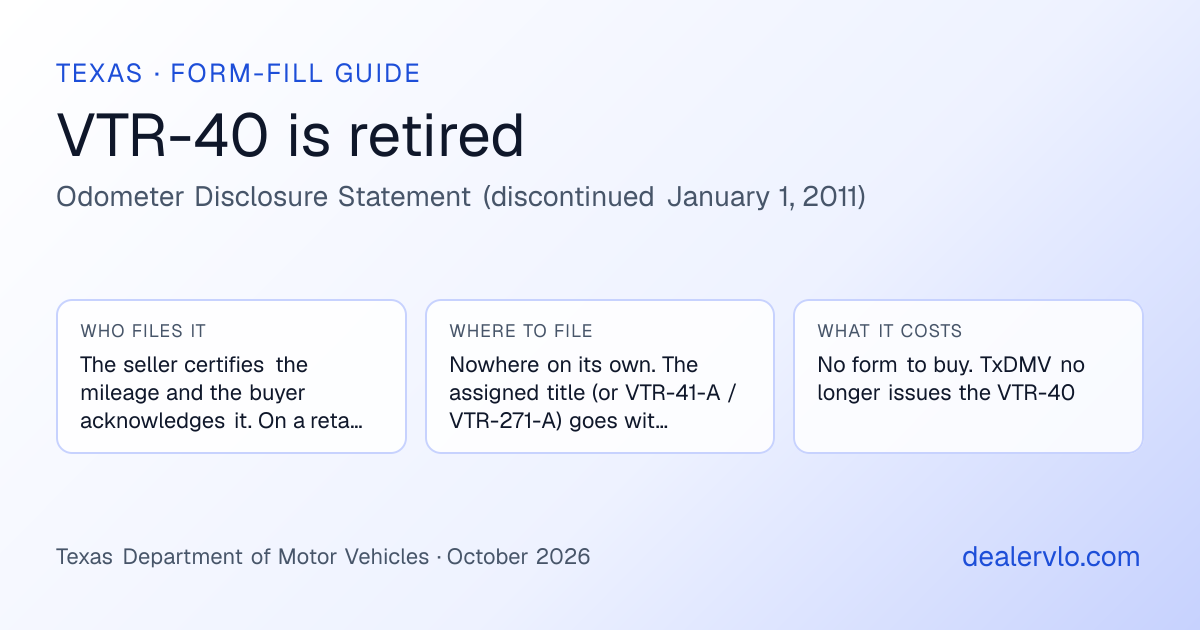
Filling out the TX VTR-40 after a sale:
- What it is
- A retired TxDMV form. The VTR-40 was discontinued effective January 1, 2011; the disclosure now goes on the title assignment
- Who completes it
- The seller certifies the mileage and the buyer acknowledges it. On a retail sale, the seller is your dealership
- Where to file it
- Nowhere on its own. The assigned title (or VTR-41-A / VTR-271-A) goes with the 130-U to the county tax assessor-collector
- Processing time
- None of its own. The disclosure is processed with the title application
- Cost
- No form to buy. TxDMV no longer issues the VTR-40
This guide is informational and does not replace the official Texas instructions. Always confirm the current form and procedure with the Texas Department of Motor Vehicles before you file.
The VTR-40 is one car's paperwork. A 20-second read on your lot, and the tax-and-fee math for the whole deal — built for dealers, no signup. Free calculators dealers actually use — no signup, no email.
DealerVLO fills the official Texas 130-U title application, the Bill of Sale, and the FTC Buyers Guide straight from your deal — VIN-decoded vehicle, buyer, co-buyer, and sale price already in place. $29/month, free to try — cancel any time.
What the VTR-40 is and why it matters
If you're looking for the Texas VTR-40, here's the short version: TxDMV stopped using it on January 1, 2011. Texas Transportation Code 501.072 still requires the seller to give the buyer an odometer disclosure at transfer, in compliance with federal law, and the disclosure has to go with the title application. It just isn't made on a separate state form anymore.
The Title Manual says it plainly. If there's an actual buyer and seller, or the vehicle is exempt, complete the odometer statement on the vehicle assignment. If there's no actual buyer and seller, record the odometer information on Form 130-U. This guide covers where the disclosure goes on each kind of deal, the two secure dealer forms that carry it when the title can't, the exemptions, and the mistakes that get a transaction rejected.
TxDMV discontinued the Odometer Disclosure Statement (Form VTR-40) effective January 1, 2011, according to the Motor Vehicle Title Manual. It is not on TxDMV's forms page. The "VTR-40 PDF" copies on form-library sites are the old VTR-40 (Rev. 11/09), and that form itself said it could not be used with title documents that already carry a conforming disclosure, such as Texas titles issued on or after April 29, 1990. Today the disclosure goes on the title assignment, a Dealer's Reassignment of Title (VTR-41-A), or a secure Power of Attorney (VTR-271-A), and the reading is repeated on Form 130-U.
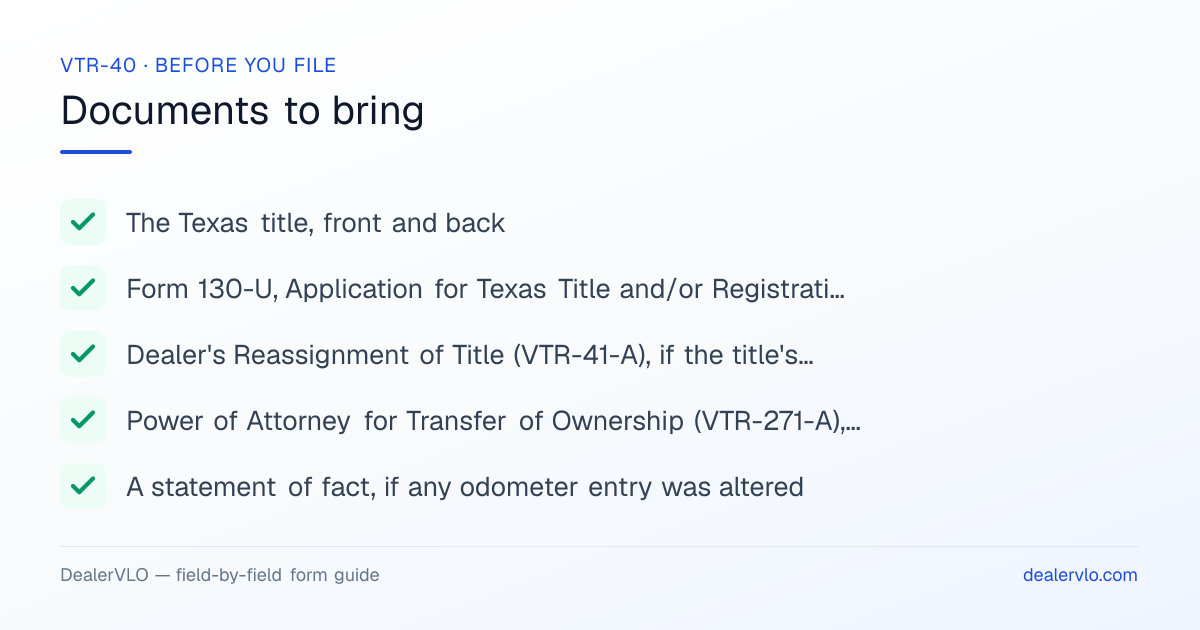
Documents to have before you start
There's no VTR-40 to file anymore. These are the documents that carry a Texas odometer disclosure now, and the county tax assessor-collector checks them against the title application.
- The Texas title, front and back — Texas titles issued on and after April 29, 1990 have the odometer disclosure built into the assignments.
- Form 130-U, Application for Texas Title and/or Registration — The odometer reading on the 130-U must match the disclosure on the ownership evidence. See the 130-U guide.
- Dealer's Reassignment of Title (VTR-41-A), if the title's assignments are full — A secure form for licensed Texas dealers only.
- Power of Attorney for Transfer of Ownership (VTR-271-A), if the title is lost, held by a lienholder, or an eTitle you can't access — A secure form you get from a TxDMV Regional Service Center.
- A statement of fact, if any odometer entry was altered — From the seller explaining the alteration, acknowledged by the buyer.
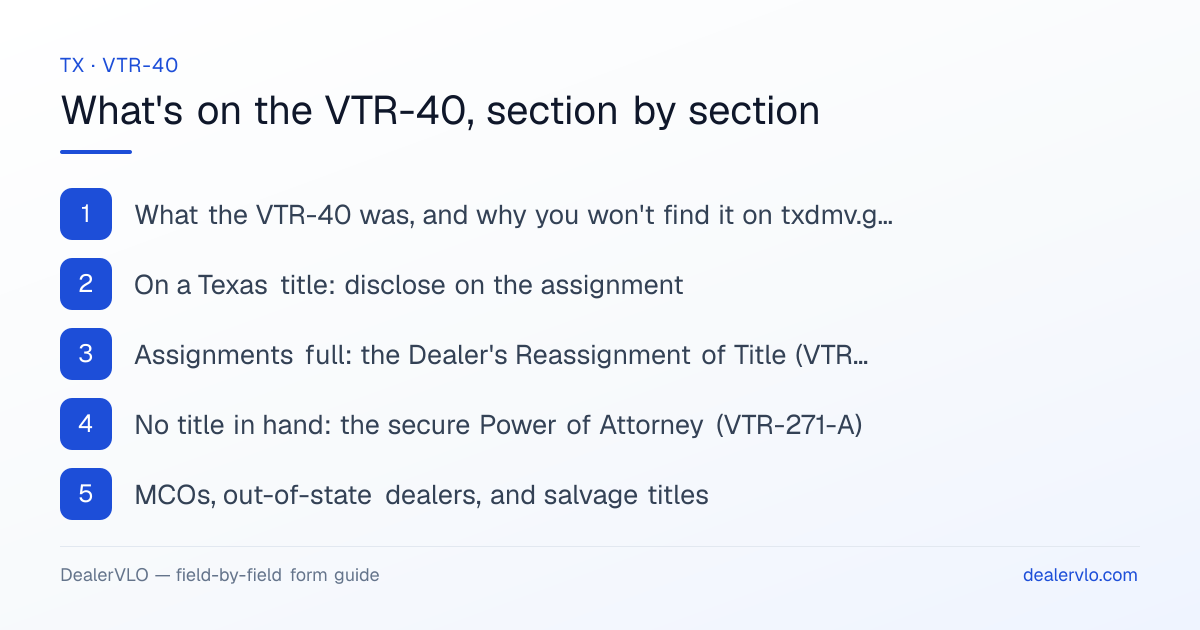
VTR-40, section by section
What the VTR-40 was, and why you won't find it on txdmv.gov
The VTR-40 (Rev. 11/09) was a one-page Odometer Disclosure Statement: vehicle year, make, body style, model and VIN; the reading with no tenths; a seller certification with two exceptions to check (exceeds mechanical limits, or not the actual mileage); the seller's signature, printed name and address; and the buyer's acknowledgment. Its own header said it could not be used with title documents that already met the federal and state disclosure rules, such as Texas titles issued on or after April 29, 1990. TxDMV discontinued it effective January 1, 2011. The same items are now captured on the title assignment.
| Field | Who fills it |
|---|---|
Old VTR-40 Discontinued Jan. 1, 2011. Don't use a copy from a form-library site. | You (dealer) |
Actual buyer and seller, or exempt vehicle Disclose on the vehicle assignment. | You (dealer) |
No actual buyer and seller (court order, hearing) Record the reading in Box 9 and the brand in Box 10 of Form 130-U. | You (dealer) |
On a Texas title: disclose on the assignment
The assignments on the back of a Texas title include the seller's odometer statement. The Title Manual lists what a conforming disclosure contains: the reading with no tenths, the date, the seller's signature, printed name and current address, the buyer's signature, printed name and current address, the vehicle description, and the seller's certification that the reading is the actual mileage, not the actual mileage, or in excess of the odometer's mechanical limits. The same person, or the same agent for an entity, can't sign as both buyer and seller unless the disclosure is signed under a properly completed VTR-271-A. Out-of-state titles work the same way: the owner completes the disclosure on the reassignment unless the vehicle is exempt.
| Field | Who fills it |
|---|---|
Odometer reading (no tenths) Numbers only. A letter in the reading isn't accepted without a statement of fact. | You (dealer) |
Actual / not actual / exceeds mechanical limits | You (dealer) |
Date of the statement | You (dealer) |
Seller's signature, printed name, address Your dealership on a retail sale. The name must agree with your dealer license. | You (dealer) |
Buyer's signature, printed name, address | Buyer |
Assignments full: the Dealer's Reassignment of Title (VTR-41-A)
When every assignment on a Texas title is used, the Title Manual says dealers must use a VTR-41-A, and it can show exempt in the odometer field. It's a secure form for licensed Texas dealers only, and you must show your current dealer license number. Reassignments must run in consecutive order. If you use a VTR-41-A while open reassignments remain on the title, write "REASSIGNMENT ON" and the VTR-41-A's control number in the next open reassignment on the title. All reassignments need original signatures, and any alteration or erasure needs a statement of fact. The county records the odometer reading and brand from the title assignment or the VTR-41-A when it issues the new title.
| Field | Who fills it |
|---|---|
Dealer license number Current Texas license required. | You (dealer) |
Odometer reading and certification Or "exempt" for an exempt vehicle. | You (dealer) |
"REASSIGNMENT ON" + control number on the title Only when open reassignments remain on the title. | You (dealer) |
Seller and buyer signatures Original signatures. | Buyer |
No title in hand: the secure Power of Attorney (VTR-271-A)
Federal law allows a power of attorney for odometer disclosure only when the title is lost, held by a lienholder (paper or electronic), or an electronic title that can't be accessed. In Texas the only acceptable one is the VTR-271-A, available to licensed dealers, salvage dealers and insurance companies from a TxDMV Regional Service Center. Part A is completed by the seller and the dealer when you take the vehicle in; once the title arrives, you complete the assignment and disclosure on it. Part B is used if the title still isn't available when you sell, and Part C is your certification after you complete the title. If the vehicle is exempt, the VTR-271-A can't be used; the non-secure VTR-271 is the option. A dealer can't be appointed in a limited power of attorney to complete an odometer disclosure.
| Field | Who fills it |
|---|---|
Part A: seller to dealer Seller and dealer both sign, original signatures. | You (dealer) |
Part B: dealer to retail buyer Only if Part A is done and the title is still unavailable. | Buyer |
Part C: dealer certification After you complete the assignment and reassignment on the title. | You (dealer) |
MCOs, out-of-state dealers, and salvage titles
On a new vehicle's first retail sale, the disclosure can go on a conforming statement on the MCO or on a separate odometer disclosure statement, whether or not the MCO has one, and the buyer acknowledges it. When an out-of-state title's assignments are all used and that state has no supplemental dealer reassignment form, a bill of sale can be used, and for a retail purchaser it must include the odometer disclosure statement unless the vehicle is exempt. On a salvage title transfer, the seller completes the disclosure on the salvage title, the buyer acknowledges it, and the same reading goes on the 130-U.
| Field | Who fills it |
|---|---|
New vehicle: disclosure on MCO or separate statement | You (dealer) |
Out-of-state bill of sale with odometer statement Only in the case the Title Manual describes. | You (dealer) |
Salvage title: disclosure on the salvage title | You (dealer) |
Form 130-U Boxes 9 and 10, and exempt vehicles
Box 9 of the 130-U is the odometer reading and Box 10 is the brand. Exempt vehicles get "Exempt" in Box 9 and/or Box 10, and the buyer doesn't have to sign the back of the title on reassignment. Exempt means: over 16,000 lbs GVWR, not self-propelled, model year 2010 or older, model year 2011 or newer once it's 20 years old, sold by the manufacturer to a U.S. agency, or new before the first retail sale. A vehicle already branded NOT ACTUAL MILEAGE or MILEAGE EXCEEDS MECHANICAL LIMITS keeps the brand after it becomes exempt. No odometer: "N/A" in Box 9 and "Not Actual" in Box 10. Broken or reading "ERROR": the disclosure can't be actual mileage. Kilometers: strike "mileage" and write "kilometers."
| Field | Who fills it |
|---|---|
Box 9: odometer reading Must match the disclosure on the title, VTR-41-A, or VTR-271-A. | You (dealer) |
Box 10: actual / not actual / exceeds / exempt | You (dealer) |
Out-of-state title showing exempt on a 2011+ vehicle Reading captured at application and branded NOT ACTUAL MILEAGE. | At the counter |
Corrections, e-signatures, and the 5-year record
If a disclosure on a Texas or out-of-state title looks altered, the transaction is rejected for a statement of fact from the seller and buyer. Correct obvious errors by drawing a line through the error and completing a statement of fact from the seller, which the buyer acknowledges. An altered VTR-41-A or VTR-271-A is fixed by completing a new one. Electronic signatures work on secure documents (titles, VTR-41-A, VTR-271-A) only when the transaction goes through webDEALER; paper submissions need wet ink. Under 49 CFR 580.8, keep a copy of every odometer statement you issue or receive, and every power of attorney you're granted, for five years at your primary place of business.
| Field | Who fills it |
|---|---|
Statement of fact for any alteration Buyer acknowledges it. | You (dealer) |
Signatures on secure documents E-signatures only through webDEALER; otherwise ink. | You (dealer) |
Dealer copies, kept 5 years | You (dealer) |
Common VTR-40 mistakes that cause rejections
TxDMV discontinued it on January 1, 2011. Make the disclosure on the title assignment, a VTR-41-A, or a VTR-271-A.
The Title Manual says the transaction must be rejected unless the vehicle is exempt or there's no change in ownership.
The reading in Box 9 must be the same as the disclosure on the ownership evidence. Copy it from the signed assignment.
The secure POA can't be used when the vehicle is exempt. Use the non-secure VTR-271 if you need a power of attorney.
The same person or agent can't sign both sides of the disclosure unless it's signed under a properly completed VTR-271-A.
Line through the error and complete a seller's statement of fact the buyer acknowledges. On a VTR-41-A or VTR-271-A, complete a new form.
Common questions
Is the VTR-40 still used in Texas?+
No. TxDMV's Motor Vehicle Title Manual says the department discontinued the Odometer Disclosure Statement (Form VTR-40) effective January 1, 2011. With an actual buyer and seller, or an exempt vehicle, the odometer statement is completed on the vehicle assignment. With no actual buyer and seller, the odometer information goes directly on Form 130-U.
Where can I get a Texas odometer disclosure statement PDF?+
TxDMV doesn't publish one. The VTR-40 PDFs on form-library sites are the old Rev. 11/09 version of a discontinued form. On a Texas title, the disclosure is part of the assignment on the back. If the assignments are full, dealers use the secure VTR-41-A; if the title is lost, held by a lienholder, or an inaccessible eTitle, dealers use the secure VTR-271-A from a TxDMV Regional Service Center.
Which vehicles are exempt from odometer disclosure in Texas?+
Vehicles over 16,000 lbs GVWR, vehicles that aren't self-propelled, model year 2010 and older, model year 2011 and newer once they're 20 years old, vehicles sold by the manufacturer directly to a U.S. agency, and new vehicles before their first retail sale. Mark "Exempt" in Box 9 and/or Box 10 of the 130-U. These match the federal exemptions in 49 CFR 580.17.
What if the title is with the bank when I buy or sell the car?+
Use the secure Power of Attorney for Transfer of Ownership to a Motor Vehicle (VTR-271-A). It's the only power of attorney Texas accepts for odometer disclosure, it's limited to a lost title, a title held by a lienholder, or an eTitle that can't be accessed, and only licensed dealers, salvage dealers and insurance companies may use it.
Can a Texas odometer disclosure be signed electronically?+
On a secure document (a title, VTR-41-A, VTR-271-A, or VTR-71-1), only if the transaction is submitted through webDEALER. A secure document submitted on paper needs wet-ink signatures. Electronic signatures are acceptable on any non-secure document, and must match the signer's printed name.
How long do Texas dealers keep odometer disclosures?+
Five years under federal rule 49 CFR 580.8: a copy of every odometer statement you issue and receive, and every power of attorney you're granted, kept at your primary place of business in an order that permits systematic retrieval. Electronic copies count if they can't be altered.
Is there software that fills out the VTR-40 automatically?+
There's nothing to fill: the Texas VTR-40 is no longer a TxDMV form (it was discontinued January 1, 2011, and the disclosure now goes in the odometer section of the title assignment). Dealer management software like DealerVLO handles the paperwork around the disclosure from the deal you already entered: the official Texas 130-U title application, the Bill of Sale, the FTC Buyers Guide, and a federal odometer disclosure statement for your records. It's $29/month flat with a 14-day free trial.
- How to fill out Texas Form 130-U
- Odometer disclosure statements by state
- Texas dealer plates
- How to get a used car dealer license in Texas
- E-signatures and e-titling for Texas dealers
- How Texas car sales tax works on a dealer sale
- Texas rebuilt vehicle statement (VTR-61)
- Title application forms in every state
- How much is a dealer's license? Cost in every state
Stop re-typing the rest of the deal.
The VTR-40 is retired. The rest of the deal paperwork isn't: DealerVLO fills the official Texas 130-U title application, the Bill of Sale, the FTC Buyers Guide, and a federal odometer disclosure statement from your deal jacket. $29/month. 14-day free trial, cancel any time.
Curious how it works? See how DealerVLO auto-fills every dealer document — bill of sale, FTC Buyers Guide, odometer disclosure, and state title & registration forms for all 50 states, from one deal.
Bond amounts, fees, and form rules change. Get a short email when your state does. No spam, unsubscribe anytime.