How to fill out the VTR-264 in Texas
A field-by-field walkthrough of the Texas VTR-264 (Repossessed Motor Vehicle Affidavit) for licensed used car dealers — what goes in every section, who signs what, and the documents you attach. Verified against the official form as of October 2026.
Don't waste another second filling out the Texas VTR-264.
Let DealerVLO fill out every form for you instantly.
Filing these every week? DealerVLO fills the VTR-264 from the deal you already entered, $29/month flat. See pricing
Switching from another DMS? Compare DealerVLO to DealerCenter, Frazer, or Lot Wizard.
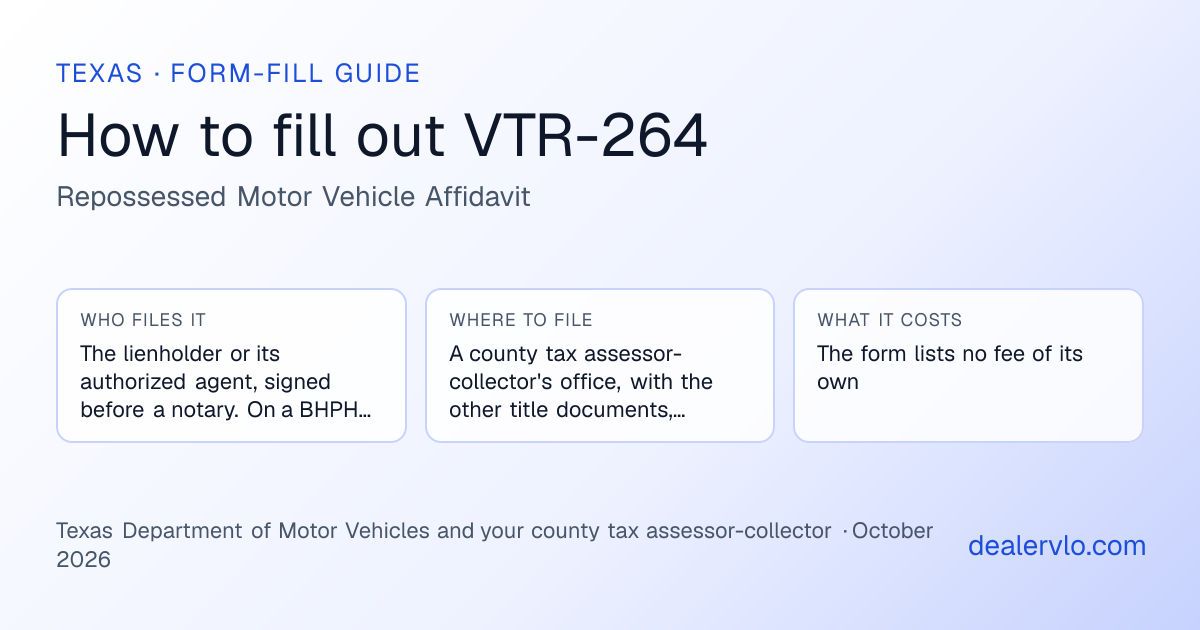
Filling out the TX VTR-264 after a sale:
- What it is
- TxDMV's Repossessed Motor Vehicle Affidavit: the lienholder's sworn statement that the vehicle was repossessed, filed to support the title transfer
- Who completes it
- The lienholder or its authorized agent, signed before a notary. On a BHPH note, that's your dealership
- Where to file it
- A county tax assessor-collector's office, with the other title documents, at the time of title transfer
- Processing time
- None of its own. It travels with the title transfer
- Cost
- The form lists no fee of its own
This guide is informational and does not replace the official Texas instructions. Always confirm the current form and procedure with the Texas Department of Motor Vehicles and your county tax assessor-collector before you file.
The VTR-264 is one car's paperwork. A 20-second read on your lot, and the tax-and-fee math for the whole deal — built for dealers, no signup. Free calculators dealers actually use — no signup, no email.
DealerVLO fills the official Texas VTR-264 straight from your deal: the VIN, year, make, body style and model; your dealership as lienholder with its phone, email and address; and the Terms of Security (Lien) Agreement box. It prints from the servicing section of a BHPH deal where your dealership carries the note, for when you've taken a car back, not on every deal. The date of repossession, the authorized agent's name, the printed name and date, and the notary block stay blank. $29/month, free to try — cancel any time.
What the VTR-264 is and why it matters
VTR-264 is the Texas Repossessed Motor Vehicle Affidavit. The TxDMV Title Manual says any sign of "repossession" in a title transaction means the application has to be backed by a repossession affidavit. The lienholder, or its authorized agent, completes it. If you sold the car on a buy-here-pay-here note and took it back, that's your dealership.
This guide covers the paperwork after the car is back on your lot: what each box asks for, which method box a BHPH dealer checks, the notary block, and the title evidence the county expects. It doesn't cover when or how you may repossess. The Title Manual itself says the department "should never advise anyone that a repossession can or cannot be made."
The current revision is VTR-264 (Rev 08/16). When people search for a "Texas repossession affidavit," this is the form. It's one page: vehicle information, lienholder information, the method of repossession (three boxes), the authorized agent's certification, and a notary block. The Title Manual also accepts "a notarized document with the same information" as the VTR-264.
Documents to have before you start
Gather these before you complete the VTR-264. A missing attachment is the number-one reason the the Texas Department of Motor Vehicles and your county tax assessor-collector bounces a title application back.
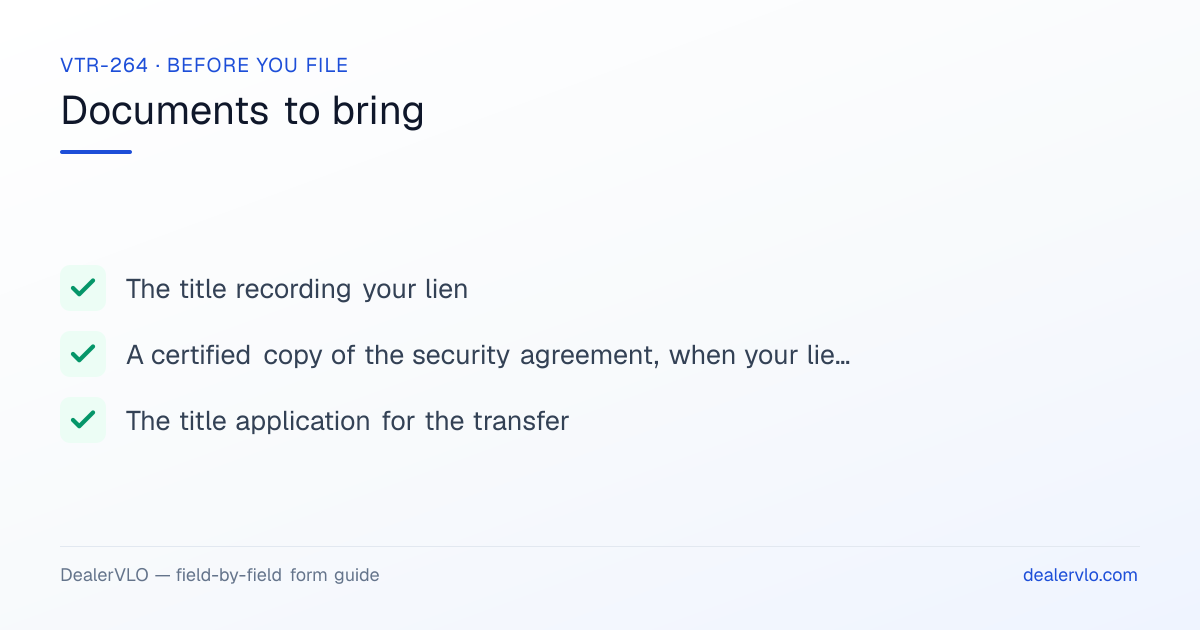
- The title recording your lien — In the name of the person you repossessed from. The Title Manual says you assign it to the next buyer, or skip the assignment if the title issues in your name.
- A certified copy of the security agreement, when your lien isn't on the Texas title — If the lienholder isn't recorded on the Texas title, the form says the lienholder (dealer included) applies for a Texas title in its own name with this copy before transferring the vehicle.
- The title application for the transfer — Form 130-U. See the 130-U guide for how the rest of the title packet goes together.
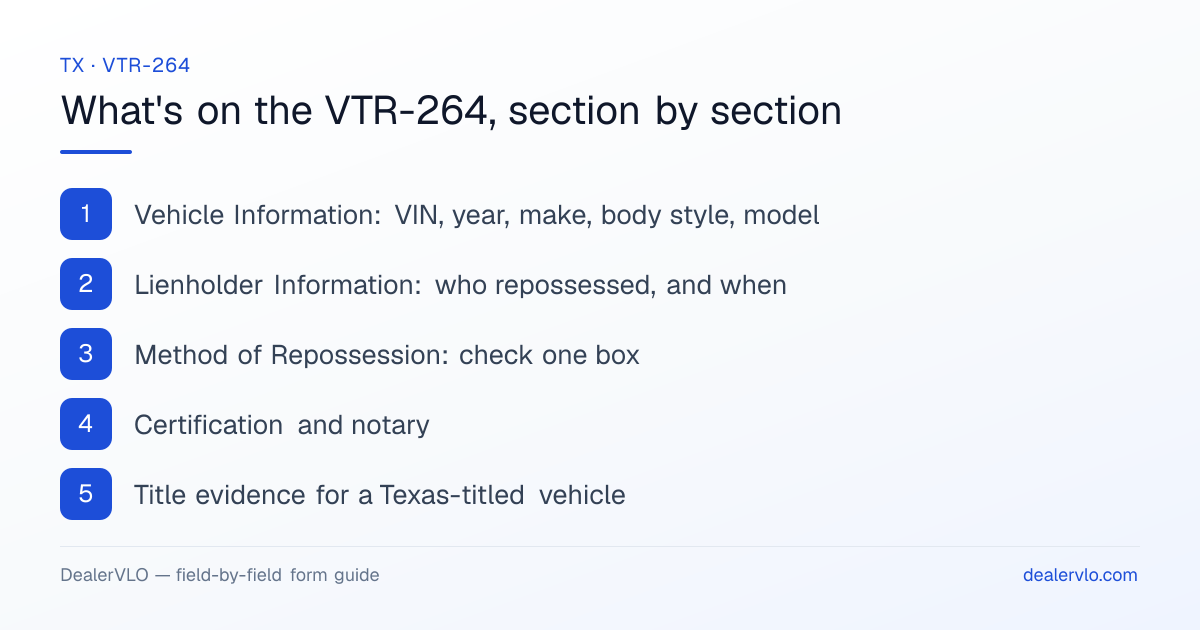
VTR-264, section by section
Vehicle Information: VIN, year, make, body style, model
Five boxes identify the vehicle. Copy them from the title so they match the 130-U for the same transfer. The form's instructions say "All fields are required to be completed," so don't leave any of these blank.
| Field | Who fills it |
|---|---|
Vehicle Identification Number All 17 characters, from the title. | You (dealer) |
Year, Make, Body Style, Model | You (dealer) |
Lienholder Information: who repossessed, and when
The lienholder block takes the lienholder's name, phone number, email, and address, plus the date of repossession and the authorized agent's name. On a BHPH note the lienholder is your dealership: use the legal name that's recorded as lienholder on the title. The date of repossession is the day the vehicle came back into your possession. The authorized agent is the person who'll sign the certification at the bottom.
| Field | Who fills it |
|---|---|
Name of Lienholder Your dealership's legal name, as recorded on the title. | You (dealer) |
Phone Number, Email | You (dealer) |
Address, City, State, Zip | You (dealer) |
Date of Repossession | You (dealer) |
Authorized Agent Name The person who signs below. | You (dealer) |
Method of Repossession: check one box
Check the box that applies and attach whatever it calls for. A BHPH dealer repossessing under its own installment contract checks "Terms of Security (Lien) Agreement." The form's note under that box says that if the repossessing lienholder is recorded on the Texas title, it may reassign the title to a later buyer. If it isn't recorded, the lienholder (dealer included) must apply for a Texas title in its own name with a certified copy of the security agreement first. "Sequestration" is for a court writ: the original or a certified copy of the Sheriff's Bill of Sale goes with the title application. "Floor Plan Lien" is for a floor-plan lender taking back a dealer's inventory, and asks for that dealership's name and GDN.
| Field | Who fills it |
|---|---|
Terms of Security (Lien) Agreement The BHPH box. | You (dealer) |
Sequestration Court writ; attach the Sheriff's Bill of Sale. | You (dealer) |
Floor Plan Lien, Dealership Name, Dealer's GDN Floor-plan lenders only. | You (dealer) |
Certification and notary
The authorized agent signs a certification that "the statements herein are true and correct and the vehicle described above was repossessed." The heading warns that state law makes falsifying information a third degree felony. Print the name exactly as signed (the form says "Same as Signature") and date it. The signature is sworn: the notary block reads "Before me, a notary public, on this day personally appeared," then the signer's name, the county, the notary's signature, date, and stamp. Sign in front of the notary, not before. The Title Manual adds two signer rules. If an agent signs for an individual or a deceased person, attach evidence of that authority, such as a power of attorney or letters testamentary. When an individual lienholder repossesses, the individual signs unless a current dealer number appears next to the name; otherwise a power of attorney must be attached for an agent to sign.
| Field | Who fills it |
|---|---|
Signature of Authorized Agent In front of the notary. | You (dealer) |
Printed Name (Same as Signature), Date | You (dealer) |
Notary block: name of person appearing, county, signature, date, stamp You bring it to a notary; the notary completes this block. | You (dealer) |
Title evidence for a Texas-titled vehicle
The Title Manual lists what supports the application. The original (or certified copy) title recording the lien, in the name of the person you repossessed from, is assigned by the lienholder to the next buyer. No assignment is needed if the title issues in the lienholder's name. If the latest title isn't in the name of the person you repossessed from, it must be assigned to that person, with either an application in their name recording the lien or a certified copy of the security agreement, and the lienholder (dealers included) must title in its own name before transferring. If the lien isn't recorded on the latest Texas title, attach a certified copy of the security agreement. In that case the Manual says lienholders, dealers included, must secure title in their own name.
| Field | Who fills it |
|---|---|
Title recording the lien, assigned by the lienholder | You (dealer) |
Certified copy of the security agreement (lien not on the title) | You (dealer) |
Title issued in the lienholder's name first (when required) | At the counter |
Vehicles last titled out of state
The Title Manual allows a Texas title after a repossession only if the out-of-state title is in the name of, or assigned to, the person you repossessed from. A Texas lienholder recorded on the out-of-state title can assign it; otherwise the Texas lienholder must title in its own name first. The affidavit can be the VTR-264, a notarized document with the same information, or the repossession affidavit prescribed by the state where the vehicle was last registered. The Manual also lists a Vehicle Inspection Report if applicable, a weight certificate for a commercial vehicle, and proof of financial responsibility in the applicant's name.
| Field | Who fills it |
|---|---|
Out-of-state title in, or assigned to, the debtor's name | You (dealer) |
VTR-264 or the other state's repossession affidavit | You (dealer) |
Vehicle Inspection Report (if applicable), proof of financial responsibility | You (dealer) |
Common VTR-264 mistakes that cause rejections
Floor Plan Lien is for a lender taking back a dealer's inventory. A dealer repossessing from a retail buyer under its own contract checks Terms of Security (Lien) Agreement.
The form says an unrecorded lienholder, dealer included, applies for a Texas title in its own name with a certified copy of the security agreement before transferring the vehicle.
The instructions say all fields are required. Fill every lienholder box before you take it to the notary.
The notary certifies that the signer personally appeared and was sworn. Sign in front of the notary.
The form asks for the printed name "Same as Signature." The person who signs prints their own name.
Common questions
What is the Texas repossession affidavit?+
It's TxDMV Form VTR-264, the Repossessed Motor Vehicle Affidavit. The lienholder or its authorized agent completes it, signs it before a notary, and submits it to a county tax assessor-collector's office with the other documents when title is transferred after a repossession. The current revision is Rev 08/16.
Does the VTR-264 have to be notarized?+
Yes. The form has a notary block in which the notary certifies the signer personally appeared and was sworn. The Title Manual accepts the VTR-264 or "a notarized document with the same information" as the VTR-264.
Where do I file the VTR-264?+
The form says it must be submitted to a county tax assessor-collector's office, along with all other required documents, at the time of title transfer.
Do I have to title the car in my name before I sell it?+
It depends on the title. Per the form and the Title Manual, if your lien is recorded on the Texas title in the debtor's name, you can assign that title to the next buyer. If your lien isn't recorded on the Texas title, you title it in your own name first, with a certified copy of the security agreement. Dealers aren't exempt from that.
Can I use another state's repossession affidavit in Texas?+
For a vehicle last titled out of state, yes. The Title Manual accepts the VTR-264, a notarized document with the same information, or the repossession affidavit prescribed by the state where the vehicle was last registered.
Who can sign the VTR-264 for the lienholder?+
The lienholder or its authorized agent. The Title Manual says that when an individual lienholder repossesses, the individual signs unless a current dealer number appears next to the name; otherwise a power of attorney must be attached for an agent to sign. An agent signing for an individual or a deceased person attaches evidence of authority.
Is there software that fills out the VTR-264 automatically?+
Yes. Dealer management software like DealerVLO fills the official Texas VTR-264 from the deal you already entered: the VIN, year, make, body style and model; your dealership as lienholder with its phone, email and address; and the Terms of Security (Lien) Agreement box. It prints from the servicing section of a BHPH deal where your dealership carries the note, for when you've taken a car back, not on every deal. The date of repossession, the authorized agent's name, the printed name and date, and the notary block stay blank. Signatures stay blank for ink. It's $29/month flat with a 14-day free trial, and the same deal also generates your federal documents (Bill of Sale, FTC Buyers Guide) and your state title paperwork.
- Affidavit of repossession forms by state
- Vehicle lien release form by state
- How to fill out Texas Form 130-U
- Texas used car dealer license
- Texas dealer plates
- E-signatures and e-titling for Texas dealers
- How Texas car sales tax works on a dealer sale
- Texas release of lien (VTR-266)
- Texas limited power of attorney (VTR-271)
- Texas odometer disclosure (VTR-40 retired)
- Texas rebuilt vehicle statement (VTR-61)
- Title application forms in every state
- How much is a dealer's license? Cost in every state
Stop filling out the VTR-264 by hand.
DealerVLO fills the official TX VTR-264 straight from your deal jacket: the VIN, year, make, body style and model; your dealership as lienholder with its phone, email and address; and the Terms of Security (Lien) Agreement box. It prints from the servicing section of a BHPH deal where your dealership carries the note, for when you've taken a car back, not on every deal. The date of repossession, the authorized agent's name, the printed name and date, and the notary block stay blank. $29/month. 14-day free trial, cancel any time.
Curious how it works? See how DealerVLO auto-fills every dealer document — bill of sale, FTC Buyers Guide, odometer disclosure, and state title & registration forms for all 50 states, from one deal.
Bond amounts, fees, and form rules change. Get a short email when your state does. No spam, unsubscribe anytime.