How to fill out the VTR-271 in Texas
A field-by-field walkthrough of the Texas VTR-271 (Limited Power of Attorney for Eligible Motor Vehicle Transactions) for licensed used car dealers — what goes in every section, who signs what, and the documents you attach. Verified against the official form as of October 2026.
Don't waste another second filling out the Texas VTR-271.
Let DealerVLO fill out every form for you instantly.
Filing these every week? DealerVLO fills the VTR-271 from the deal you already entered, $29/month flat. See pricing
Switching from another DMS? Compare DealerVLO to DealerCenter, Frazer, or Lot Wizard.
Filling out the TX VTR-271 after a sale:
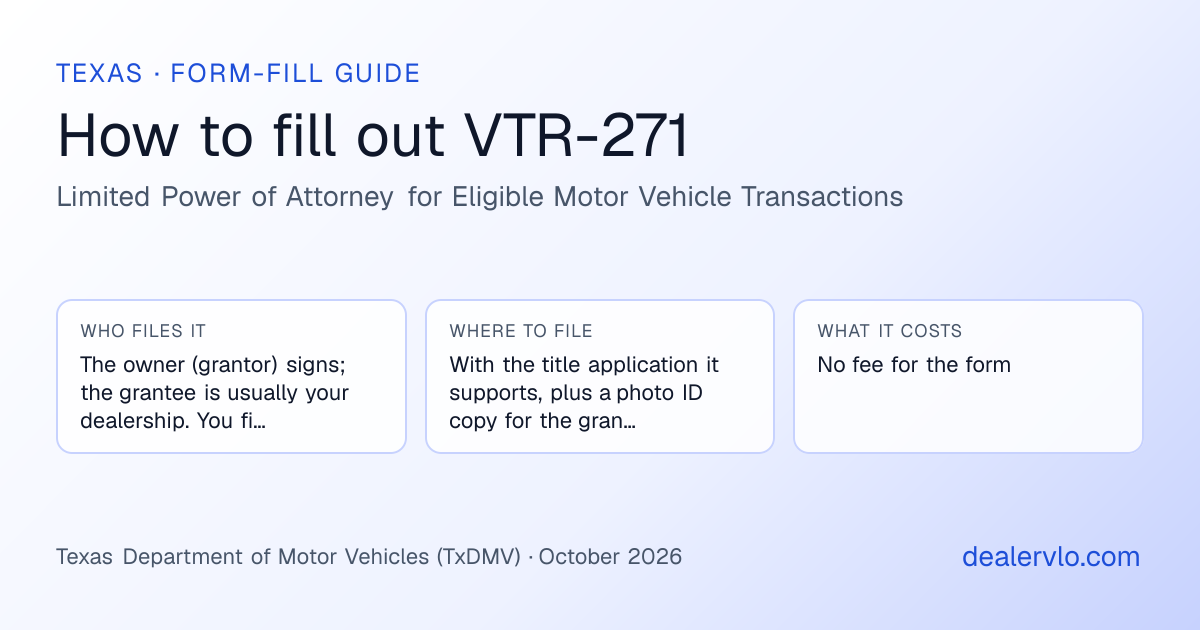
- What it is
- TxDMV's general limited power of attorney: the owner appoints someone to title a vehicle for them
- Who completes it
- The owner (grantor) signs; the grantee is usually your dealership. You fill the vehicle and grantee lines
- Where to file it
- With the title application it supports, plus a photo ID copy for the grantor and for the grantee
- Processing time
- None of its own. It rides with the title application
- Cost
- No fee for the form
This guide is informational and does not replace the official Texas instructions. Always confirm the current form and procedure with the Texas Department of Motor Vehicles (TxDMV) before you file.
The VTR-271 is one car's paperwork. A 20-second read on your lot, and the tax-and-fee math for the whole deal — built for dealers, no signup. Free calculators dealers actually use — no signup, no email.
DealerVLO fills the official Texas VTR-271 straight from your deal: the vehicle and VIN, the plate and title number when the deal has them, the buyer as grantor with their address, your dealership as grantee, and the buyer's printed name in the certification. Your dealership's county line, the date, and the grantor's signature stay blank, and the buyer's county is filled only when the deal records it. $29/month, free to try — cancel any time.
What the VTR-271 is and why it matters
The VTR-271 is the Texas vehicle power of attorney form. The owner (the grantor) appoints someone (the grantee) to title the vehicle in the owner's name. On a retail deal the usual setup is your buyer as grantor and your dealership as grantee, so your title clerk can sign the title application for them. The form also gives the grantee "full power of substitution," meaning the grantee can hand that authority to someone else with a substitute power of attorney.
It's one page: vehicle, grantor, grantee, and a certification the grantor signs. The traps are the ones TxDMV prints at the top. Every section has to be complete, signatures must be original, ink is black or blue only, and no alterations are allowed. When it's used to apply for title, both the grantor and the grantee attach a photocopy of their photo ID. And it is not the form for an odometer-disclosure title assignment. That's the VTR-271-A.
Texas has two vehicle powers of attorney and the numbers are one letter apart. The VTR-271 (Rev 11/20) is the general one, a free PDF on TxDMV's forms page. The VTR-271-A, Power of Attorney for Transfer of Ownership to a Motor Vehicle, is the secure one for odometer disclosure. The VTR-271 says in its own text that it can't be used in a dealer transaction to complete a title assignment on a vehicle subject to federal odometer disclosure. The VTR-271-A isn't among the downloadable forms on TxDMV's forms page.
Documents to have before you start
Gather these before you complete the VTR-271. A missing attachment is the number-one reason the the Texas Department of Motor Vehicles (TxDMV) bounces a title application back.
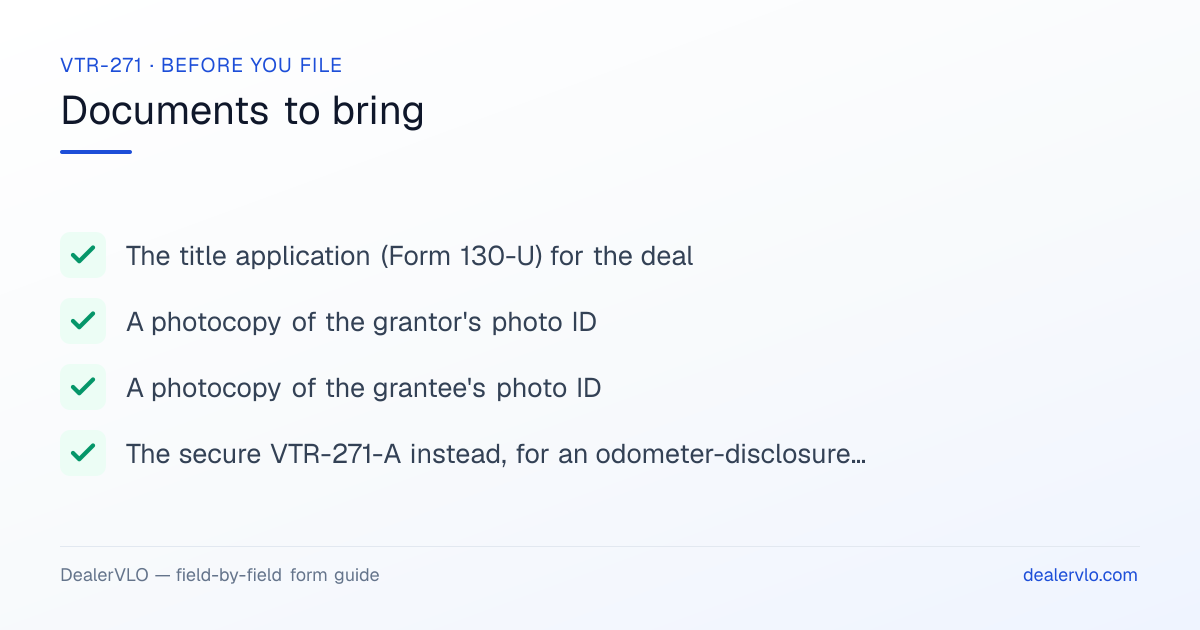
- The title application (Form 130-U) for the deal — The VTR-271 lets the grantee sign it for the owner. See the 130-U guide for the application itself.
- A photocopy of the grantor's photo ID — Required by the form when a power of attorney is used to apply for title, initial registration, or a certified copy of title.
- A photocopy of the grantee's photo ID — The form calls the grantee "the person signing the application." When your dealership is grantee, that's the employee who signs.
- The secure VTR-271-A instead, for an odometer-disclosure title assignment — The VTR-271 can't be used for that in a dealer transaction. The form says the VTR-271-A must be used when a power of attorney is permitted for a vehicle subject to federal odometer disclosure.
VTR-271, section by section
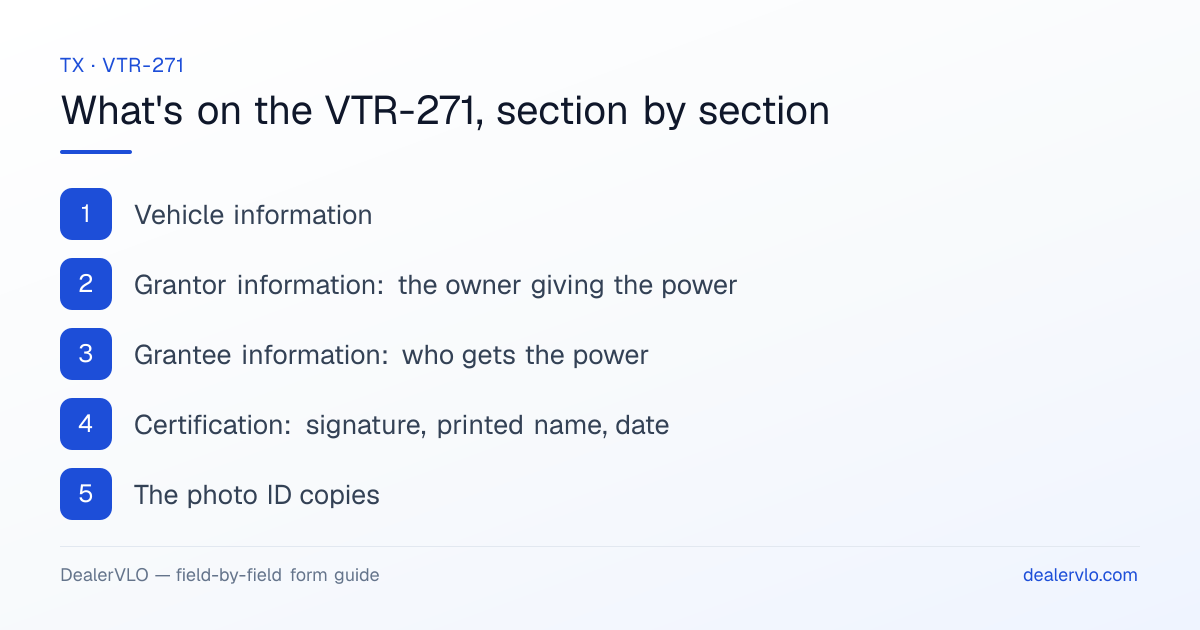
Vehicle information
Year, make, body style, model, and the VIN, then the license plate state and number if the vehicle has one, and the title or document number. The form says to leave the title/document number blank if you don't know it. Copy the rest from the title or MSO so the VIN matches the 130-U exactly. A power of attorney for the wrong VIN doesn't authorize anything.
| Field | Who fills it |
|---|---|
Year, make, body style, model | You (dealer) |
Vehicle identification number All 17 characters, matching the title application. | You (dealer) |
License plate state and number (if any) | You (dealer) |
Title/document number If unknown, the form says leave it blank. | You (dealer) |
Grantor information: the owner giving the power
The grantor is the owner of the vehicle, the person who signs at the bottom. On a sale where you'll title the car for the buyer, that's your buyer. The name runs across four columns: first name (or entity name), middle name, last name, and suffix. Then the street address, city, county, state, and ZIP. Use the name as it will appear on the title application. The form has one grantor block, so a co-buyer signs their own VTR-271.
| Field | Who fills it |
|---|---|
First name (or entity name), middle, last, suffix The buyer's legal name. | You (dealer) |
Address | You (dealer) |
City, county, state, ZIP County too. The certification refers to "the county and state as listed above." | You (dealer) |
Grantee information: who gets the power
The grantee is who the owner appoints. When it's your dealership, put the dealership's legal name on the name line, since the first column reads "First Name (or Entity Name)." Then the dealership's address, city, county, state, and ZIP. The grantee gets full power of substitution, so your store can pass the authority to another person by a substitute power of attorney if it needs to.
| Field | Who fills it |
|---|---|
Grantee name (entity name) Your dealership's legal name. | You (dealer) |
Address | You (dealer) |
City, county, state, ZIP Don't skip the county. Every section must be complete. | You (dealer) |
Certification: signature, printed name, date
The grantor certifies they're the owner and appoints the grantee as their lawful attorney "to title," with authority to substitute. The grantor signs, prints their name the same as the signature, and dates it. Original signature, black or blue ink. The certification header warns that state law makes falsifying information a third-degree felony. The form has no notary block.
| Field | Who fills it |
|---|---|
Signature of grantor Original, in black or blue ink. | Buyer |
Printed name (same as signature) The buyer's name, matching how they sign. | You (dealer) |
Date | Buyer |
The photo ID copies
When a power of attorney is used to apply for title, initial registration, or a certified copy of title, the form requires a photocopy of photo identification for the grantor (who signed the form) and the grantee (who signs the application). On a dealer deal that's a copy of the buyer's ID and a copy of the ID of the employee signing for the dealership. Copy the buyer's ID at the desk when they sign, not after they've driven off.
| Field | Who fills it |
|---|---|
Grantor's photo ID copy | Buyer |
Grantee's photo ID copy The person who signs the title application. | You (dealer) |
When you need the VTR-271-A instead
The VTR-271 says it cannot be used in a dealer transaction to complete a title assignment on a vehicle subject to federal odometer disclosure. For that, it names the secure VTR-271-A, used when a power of attorney is permitted under the federal rules. Under 49 CFR 580.13, a power of attorney for the mileage disclosure is allowed only when the title is held by a lienholder or lost (or an electronic title is held by a lienholder or can't be accessed), and 49 CFR 580.4 requires those forms to be issued by the state on a secure printing process. The typical case is a trade-in with a loan payoff. Federal odometer disclosure covers model year 2011 and newer vehicles until they're 20 years old (49 CFR 580.17). TxDMV's title manual updated its secure power of attorney section in October 2023 to say a dealer's reassignment (VTR-41-A) can't be used in place of Part B of the VTR-271-A when Part B still applies.
| Field | Who fills it |
|---|---|
Buyer appoints you to title the car VTR-271. | You (dealer) |
Trade-in title with the lender, odometer disclosure required VTR-271-A, not the VTR-271. | You (dealer) |
Keep a copy of each mileage power of attorney you receive for 5 years 49 CFR 580.8. | You (dealer) |
Common VTR-271 mistakes that cause rejections
The form says it can't be used for that in a dealer transaction. Use the secure VTR-271-A.
The form says all sections must be properly completed to be accepted. Fill the grantor's and the grantee's county.
No alterations are allowed. If the VIN or a name is wrong, start a clean VTR-271.
When the power of attorney is used to apply for title, both the grantor's and the grantee's photo ID copies go with it.
Original signatures only, in black or blue ink.
Common questions
What is the Texas VTR-271 form?+
The VTR-271 is TxDMV's Limited Power of Attorney for Eligible Motor Vehicle Transactions. The vehicle owner (grantor) appoints someone (grantee) to title the vehicle for them, with full power of substitution. The current revision is Rev 11/20, and it's a free PDF on TxDMV's forms page.
What's the difference between the VTR-271 and the VTR-271-A?+
The VTR-271 is the general power of attorney to title a vehicle. The VTR-271-A, Power of Attorney for Transfer of Ownership to a Motor Vehicle, is the secure form for odometer disclosure. The VTR-271 says it can't be used in a dealer transaction to complete a title assignment on a vehicle subject to federal odometer disclosure, and that the VTR-271-A must be used when a power of attorney is permitted in that case.
Does the Texas VTR-271 need to be notarized?+
The form has no notary block. Its stated requirements are that every section is complete, signatures are original, ink is black or blue, and nothing is altered. When it's used to apply for title, the grantor and the grantee each attach a photocopy of their photo ID.
Who is the grantor and who is the grantee on a VTR-271?+
The grantor is the vehicle owner who signs the form and gives the power. The grantee is the person or business receiving it, the one who will sign the title application. On a dealer sale where you title the car for the buyer, the buyer is the grantor and your dealership is the grantee.
Can one VTR-271 cover a buyer and a co-buyer?+
The form has one grantor block and one grantor signature line, so each owner who isn't signing the application themselves signs their own VTR-271.
Which vehicles need an odometer disclosure in Texas?+
Under the federal rule (49 CFR 580.17), model year 2011 and newer vehicles need an odometer disclosure until they're 20 years old. Model year 2010 and older are exempt. Vehicles over 16,000 lbs GVWR are exempt too. For a vehicle that needs one, a dealer title assignment can't be done on the VTR-271.
Is there software that fills out the VTR-271 automatically?+
Yes. Dealer management software like DealerVLO fills the official Texas VTR-271 from the deal you already entered: the vehicle and VIN, the plate and title number when the deal has them, the buyer as grantor with their address, your dealership as grantee, and the buyer's printed name in the certification. Your dealership's county line, the date, and the grantor's signature stay blank, and the buyer's county is filled only when the deal records it. Signatures stay blank for ink. It's $29/month flat with a 14-day free trial, and the same deal also generates your federal documents (Bill of Sale, FTC Buyers Guide) and your state title paperwork.
- Vehicle power of attorney forms by state
- How to fill out the Texas Form 130-U title application
- Odometer disclosure statements and secure powers of attorney
- Dealer reassignment forms by state
- Texas dealer plates
- How to get a Texas used car dealer license
- E-signatures and e-titling for Texas dealers
- How Texas car sales tax works on a dealer sale
- Texas repossessed vehicle affidavit (VTR-264)
- Texas release of lien (VTR-266)
- Texas odometer disclosure (VTR-40 retired)
- Texas rebuilt vehicle statement (VTR-61)
- Title application forms in every state
- How much is a dealer's license? Cost in every state
Stop filling out the VTR-271 by hand.
DealerVLO fills the official TX VTR-271 straight from your deal jacket: the vehicle and VIN, the plate and title number when the deal has them, the buyer as grantor with their address, your dealership as grantee, and the buyer's printed name in the certification. Your dealership's county line, the date, and the grantor's signature stay blank, and the buyer's county is filled only when the deal records it. $29/month. 14-day free trial, cancel any time.
Curious how it works? See how DealerVLO auto-fills every dealer document — bill of sale, FTC Buyers Guide, odometer disclosure, and state title & registration forms for all 50 states, from one deal.
Bond amounts, fees, and form rules change. Get a short email when your state does. No spam, unsubscribe anytime.