Dealer bill of sale: what it has to say, and where states add their own rules
A dealer's bill of sale isn't the one-paragraph form two neighbors sign. On a used car sold to a consumer it's your contract of sale, so federal rules reach into it, and some states print their own form or add required lines. This guide covers what goes on it, how it differs from a buyer's order and a finance contract, and the states with their own rules.
- What it is
- The dealer's itemized record of a retail sale: the car, the parties, the price and every fee, the trade, the warranty, and signatures
- Federal line
- On a used car sold to a consumer, the FTC Buyers Guide statement goes on the contract of sale (16 CFR 455.3(b))
- Odometer
- A mileage line is fine, but the federal disclosure goes on the title or a full odometer statement
- State rules
- Some states have their own form (AR 10-313, VT-005, CA REG 262) or required wording (FL doc-fee statement, AL penalty warning)
- Notarized?
- Not by default. Louisiana dropped it for dealer sales in 2023. Check your state
Bill of sale, buyer's order, finance contract: which is which
A private-party bill of sale proves a car changed hands for a price. A dealer's bill of sale does that and more. Under the FTC Used Car Rule, anyone who sold or offered five or more used cars in the past twelve months is a dealer, and the Buyers Guide on the window becomes part of the contract of sale for every used car you sell to a consumer. On a retail sale, the bill of sale is usually that contract.
“Bill of sale” and “buyer's order” mostly name the same thing. South Carolina asks for a signed bill of sale or buyer's order with every title transaction. Virginia and Texas statutes use “buyer's order” for the document that has to show the doc fee. Call yours whatever your state's forms call it. The content is what gets checked.
The retail installment contract is a different document. On a financed deal it's the credit agreement, and it carries the Truth in Lending disclosures: amount financed, finance charge, annual percentage rate, payment schedule, total of payments, and on a credit sale the total sale price (12 CFR 1026.18). A financed deal has both papers.
| Document | Between | What it does |
|---|---|---|
| Dealer bill of sale | Dealer to retail buyer | Itemized record of the sale: car, parties, price, fees, tax, trade, warranty, signatures |
| Buyer's order / purchase agreement | Dealer to retail buyer | Usually the same itemized document under another name; many states accept either |
| Retail installment contract | Dealer (or lender) to a financed buyer | The credit agreement, with the Truth in Lending disclosures (12 CFR 1026.18) |
| Private-party bill of sale | One owner to another | Proof of the transfer and price; the FTC Used Car Rule doesn't apply to a non-dealer |
| Wholesale bill of sale | Dealer to dealer | Record of a sale for resale; the buyer isn't a consumer under the Used Car Rule |
What goes on a dealer bill of sale
These are the parts a working retail bill of sale carries. The ones tied to a federal or state rule are marked; the rest are what the title clerk, the tax office and a buyer with a complaint will look for.
- The parties. Your dealership's legal name (and d/b/a), address and phone. The buyer and any co-buyer, with address. Alabama also wants the dealer license number on it.
- The vehicle. Year, make, model, VIN, and your stock number. Title number and state help when the title application is filed.
- Sale date and price. The sale price, then every fee and tax on its own line, the total, down payment, and the balance. State title applications compute tax from these numbers, so they have to match the application. Massachusetts, for one, figures its sales tax from the bill of sale.
- The doc fee, labeled the state's way. Several states set the wording. See the state lines below.
- Trade-in. Year, make, model, VIN, mileage, allowance and payoff. If the payoff is more than the allowance, show the negative equity as its own line. Missouri, for example, wants proof of the trade before it gives the buyer the trade-in tax credit.
- Odometer reading. A mileage line is useful, but it isn't the federal disclosure. That goes on the title or a full odometer disclosure statement.
- Warranty terms (federal). As is, implied warranties only, or the dealer warranty with its terms. If you negotiate the warranty, 16 CFR 455.4 says the final terms are identified in the contract of sale and summarized on the buyer's copy of the Buyers Guide. The two can't disagree.
- The Buyers Guide statement (federal). 16 CFR 455.3(b) makes the final Buyers Guide part of the contract and requires this language, conspicuously, in each consumer contract of sale:
The information you see on the window form for this vehicle is part of this contract. Information on the window form overrides any contrary provisions in the contract of sale.
If you sell in Spanish, the rule requires that language in Spanish too (455.5). - Signatures and dates. The buyer, any co-buyer, and someone signing for the dealership with a printed name.
Lines some states require
These are the state-specific lines we've checked against the statute or rule. Other states have their own, so read your dealer statutes before you print a stack.
- Florida. Fla. Stat. 501.976(18) bars charging for predelivery service (the dealer fee) unless every document with that line item prints: “This charge represents costs and profit to the dealer for items such as inspecting, cleaning, and adjusting vehicles, and preparing documents related to the sale.”
- Texas. Fin. Code 348.006 requires the documentary fee notice, bold and capitalized, in reasonable proximity to the fee on the buyer's order and the contract.
- Maryland. TR 15-311.1(d): the fee is shown as “Dealer processing charge (not required by law)” in 12-point type or larger.
- Virginia. 46.2-1530 has the buyer's order show the item as a “processing fee.”
- Arkansas. The “service and handling fee” is its own itemized charge, with the statutory notice printed bold and capitalized near it on the buyer's order and the installment contract (Ark. Code 23-112-617).
- Alabama. Ala. Admin. Code r. 810-5-1-.246(3)(g) puts this on a licensed retail dealer's bill of sale, bold and conspicuous: “Penalty of fifteen dollars ($15) due if vehicle is not registered in the name of the new owner within 20 calendar days.”
- California. Since October 1, 2026 the CARS Act puts a fixed notice on the first page of every purchase or lease contract (Civil Code 1784.43(e)). Details in our CARS Act guide.
For fee caps and what each state calls the fee, see dealer doc fees by state.
DealerVLO builds the bill of sale from the deal, with the Buyers Guide statement and your state's doc-fee wording printed where they belong. $29/month, free to try — cancel any time.
States with their own bill of sale form or rule
Each row repeats what the linked guide sourced from the state agency. A state that isn't listed may still have a rule; we just haven't verified it.
| State | Form or rule | Our guide |
|---|---|---|
| Alabama | A licensed retail dealer's bill of sale must print, bold and conspicuous, the warning of a $15 penalty if the car isn't registered in the new owner's name within 20 calendar days. | MVT 5-1E guide |
| Arizona | Retail sales off an electronic Dealer Reassignment Transfer record use the 38-1305 dealer bill of sale. | Reassignment forms |
| Arkansas | Form 10-313 is the state's combined Vehicle Bill of Sale / Odometer Disclosure Statement: price, trade-in and net taxable amount on one page. | 10-313 guide |
| California | The REG 262 is DMV security paper that carries the odometer disclosure, the bill of sale and a power of attorney. It isn't downloadable; you order it from the DMV. | REG 343 guide |
| Connecticut | The DMV lists a bill of sale with the registration documents. Its own form is the H-31, and the price must match the H-13B. | H-13B guide |
| Maryland | The VR-182, Dealer Bill of Sale and/or Reassignment, is bought from MADA or MIADA, not the MVA. | Reassignment forms |
| Massachusetts | The bill of sale must go with the RMV-1 when the car is titled and registered. It documents the price the sales tax is figured on. | MA checklist |
| New Mexico | MVD's own bill of sale is the MVD-10009. The odometer statement can be made on it instead of a separate form. | MVD-10187 guide |
| Oklahoma | A dealer sale of an electronically titled car goes on Form 718, the Bill of Sale of an Electronic Title, with a separate Form 729 odometer statement. | Form 729 guide |
| South Carolina | A signed bill of sale or buyer's order showing the total sale price is required for every title transaction. | Form 400 guide |
| Vermont | The VT-005 is a combined Bill of Sale and Odometer Disclosure Statement: bill of sale on the front, odometer statement on the back. | VT-005 guide |
Two record rules worth knowing: Illinois law lists a bill of sale among the papers a used dealer gives every buyer (Illinois license guide), and Indiana requires a separate file for every sale that holds the bill of sale with the rest of the deal (IC 9-32-11-21, Indiana license guide). For the title side in every state, see title application forms by state.
Building your own dealer bill of sale template
A generic “vehicle bill of sale” PDF off the internet is written for private sellers. Before you use any template on a retail deal, check it against this list:
- It has the Buyers Guide statement from 455.3(b), word for word, and conspicuous.
- Its warranty boxes match the three Buyers Guide choices, with room for dealer warranty terms.
- Every fee is its own line, and the doc fee uses your state's label and notice.
- It has trade-in lines for allowance, payoff and negative equity, not one “trade” box.
- It has room for a co-buyer, and a printed name and title for whoever signs for the dealership.
- The price and tax lines will match your state's title application to the penny.
- It doesn't pretend to be the odometer disclosure unless it has every element 49 CFR 580.5 requires.
If your state publishes its own form (the table above), use that one. And since the bill of sale is your contract, have your attorney look at the terms once. This guide isn't legal advice.
Selling to another dealer
A wholesale sale is a different document. The Used Car Rule defines a consumer as anyone who isn't a used vehicle dealer, so the Buyers Guide language that anchors a retail bill of sale isn't what this one is about. A dealer-to-dealer bill of sale records both dealerships and their license numbers, the car, the price and how it was paid, and that the car was bought for resale. The mileage still gets disclosed on the title or the state's reassignment form.
How DealerVLO handles the bill of sale
- Every deal generates a Bill of Sale filled from the deal: your dealership, the buyer and co-buyer, the car with its VIN, stock number and title details, the trade with allowance, payoff and lienholder, and the odometer reading with its status.
- Pricing prints line by line: sale price, each fee and add-on, sales tax, total cash price, cash down, and trade equity or negative equity as its own line, down to the total due. On a financed deal it adds the lender, amount financed, APR, term and payment.
- The warranty box is checked from the deal (as is, implied warranties only, or dealer warranty with its terms), and the 455.3(b) Buyers Guide statement prints in bold on the same page as the signatures.
- State lines print by your dealership's state: the doc-fee label (Maryland, Virginia, California, Arkansas) and required notice (Florida, Texas, Arkansas), Alabama's $15 penalty statement and license number, and the CARS Act notice on page one in California.
- The same deal generates the FTC Buyers Guide, the odometer disclosure statement, and your state's title paperwork, so the price and VIN match across all of them. It can be e-signed or printed for ink.
- For a sale to another dealer, a wholesale (dealer-to-dealer) bill of sale prints from the car's inventory page, no deal needed. Your dealership and the car fill in; the buying dealer, price and terms are blanks you complete together.
- If your state publishes its own fillable bill of sale PDF, upload it once under Settings → Forms and DealerVLO maps its fields and fills it from every deal.
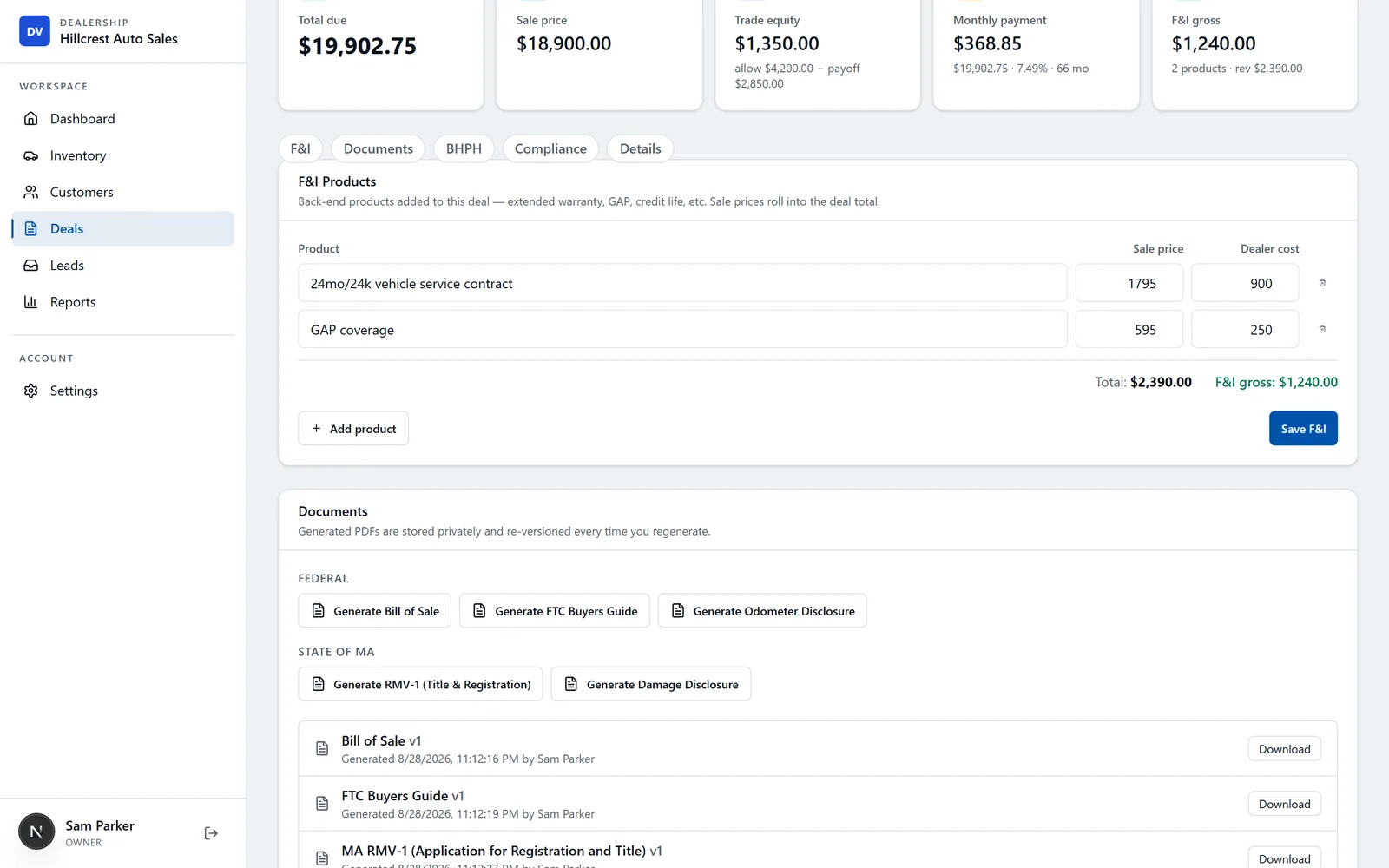
It doesn't choose your warranty or write contract terms for you, and it isn't a substitute for your attorney's review. See how to create documents for the steps.
One deal record fills the bill of sale, the Buyers Guide, the odometer statement, and your state's title application. $29/month, free to try — cancel any time.
Dealer bill of sale FAQ
Is a bill of sale required when you buy a car from a dealer?
It depends on the state, but you should always get one. Massachusetts requires the bill of sale with the title and registration application, South Carolina requires a signed bill of sale or buyer's order for every title transaction, and Illinois law lists a bill of sale among the papers a used dealer gives every buyer. Federally, the FTC Used Car Rule requires every consumer contract of sale for a used car to carry the Buyers Guide statement.
What should a dealer bill of sale include?
The dealership and the buyer (and any co-buyer), the vehicle's year, make, model and VIN, the sale date, the price and every fee and tax as its own line, any trade-in with its allowance and payoff, the odometer reading, the warranty terms (as is, implied warranties only, or the dealer warranty), the FTC Buyers Guide statement, and signatures. Some states add their own lines, like Florida's doc-fee statement or Alabama's registration-penalty warning.
Does a dealer bill of sale need to be notarized?
Check your state's title rules. Louisiana's OMV says that since January 1, 2023, a sale from a Louisiana-licensed dealer to a purchaser doesn't need the title, MSO or bill of sale notarized, though private-party sales still do. Hawaii's title paperwork calls for a notarized bill of sale in one case: a title that wasn't released by the recorded owner. We haven't verified a rule for every state, so don't assume either way.
What's the difference between a bill of sale and a buyer's order?
In practice they're the same document under two names: the dealer's itemized record of what was sold, to whom, and for how much. State paperwork often accepts either. South Carolina asks for a signed bill of sale or buyer's order, and Virginia and Texas statutes use "buyer's order" for the document that has to show the doc fee. What matters is the content, not the title at the top.
Is a bill of sale the same as a retail installment contract?
No. On a financed deal the retail installment contract is the credit agreement. It carries the Truth in Lending disclosures (amount financed, finance charge, annual percentage rate, payment schedule, total of payments, and on a credit sale the total sale price) under 12 CFR 1026.18. The bill of sale records the sale itself. A financed deal usually has both.
Can a bill of sale be used as the odometer disclosure?
Only if it carries every element of the federal disclosure in 49 CFR 580.5, including the seller's certification, the federal-law warning and both signatures. Arkansas's 10-313 and Vermont's VT-005 are state forms built to do both jobs. A mileage line on an ordinary bill of sale isn't a disclosure statement.
What if the dealer didn't give me a bill of sale?
Ask the dealer for a copy. In states like Massachusetts and South Carolina the title paperwork can't go through without one, and the FTC Used Car Rule also requires the dealer to give you the Buyers Guide that reflects the warranty you agreed to. If a dealer won't produce it, that's a question for your state's dealer licensing agency.
Is there a different bill of sale for selling to another dealer?
Yes, it's usually a wholesale or dealer-to-dealer bill of sale. The FTC Used Car Rule's protections apply to consumers, and it defines a consumer as anyone who isn't a used vehicle dealer, so the Buyers Guide statement isn't the point of that document. The odometer disclosure still goes on the title or the state's reassignment form.
The out-the-door math for a whole deal, and a 20-second read on your lot's health. Built for dealers, no signup. Free calculators dealers actually use — no signup, no email.
Bond amounts, fees, and form rules change. Get a short email when your state does. No spam, unsubscribe anytime.