How to fill out the Form 10-313 in Arkansas
A field-by-field walkthrough of the Arkansas Form 10-313 (Vehicle Bill of Sale / Odometer Disclosure Statement) for licensed used car dealers — what goes in every section, who signs what, and the documents you attach. Verified against the official form as of October 2026.
Don't waste another second filling out the Arkansas Form 10-313.
Let DealerVLO fill out every form for you instantly.
Filing these every week? DealerVLO fills the Form 10-313 from the deal you already entered, $29/month flat. See pricing
Switching from another DMS? Compare DealerVLO to DealerCenter, Frazer, or Lot Wizard.
Filling out the AR Form 10-313 after a sale:
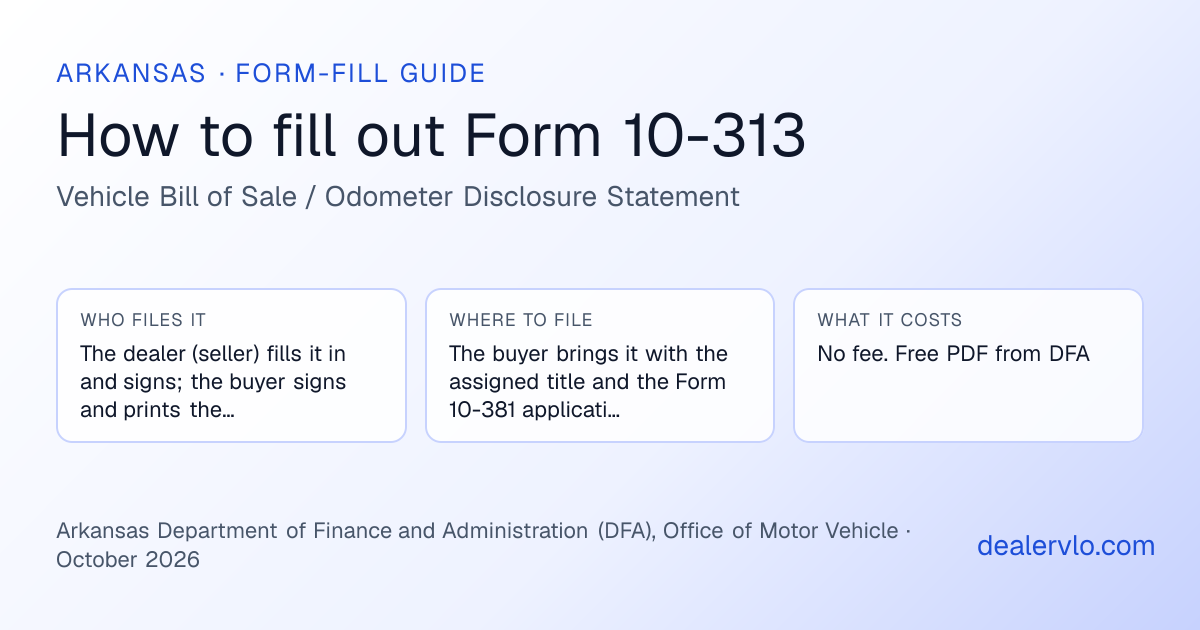
- What it is
- Arkansas's combined vehicle bill of sale and odometer disclosure statement, published by DFA
- Who completes it
- The dealer (seller) fills it in and signs; the buyer signs and prints their name
- Where to file it
- The buyer brings it with the assigned title and the Form 10-381 application to a State Revenue Office. You keep a copy for 5 years
- Processing time
- None of its own. The buyer has 60 days from the purchase date to register
- Cost
- No fee. Free PDF from DFA
This guide is informational and does not replace the official Arkansas instructions. Always confirm the current form and procedure with the Arkansas Department of Finance and Administration (DFA), Office of Motor Vehicle before you file.
The Form 10-313 is one car's paperwork. A 20-second read on your lot, and the tax-and-fee math for the whole deal — built for dealers, no signup. Free calculators dealers actually use — no signup, no email.
DealerVLO fills the official Arkansas Form 10-313 straight from your deal: the VIN, the buyer in Section 2 (with the multiple-owners box when there's a co-buyer), your dealership in Section 4, the purchase date, the vehicle and any trade-in, the odometer reading and its status box, the full price, trade-in and net taxable amount, and both printed names. The company section and secondary color stay blank. $29/month, free to try — cancel any time.
What the Form 10-313 is and why it matters
Form 10-313 is Arkansas's combined vehicle bill of sale and odometer disclosure statement. It does two jobs on a dealer sale. The bottom half is the bill of sale the revenue office reads when your buyer registers: full price, trade-in, and the net taxable amount. Section 7 is a federal-format odometer statement, so it also covers the mileage disclosure when the title can't.
In Arkansas the buyer, not the dealer, pays sales tax at registration. That makes this form the paper the tax is figured from. This guide walks it section by section, covers which model years still need a disclosure (DFA's own odometer regulation hasn't caught up with the federal change), and the five-year record rule.
The form prints only "10-313" in its footer, with no revision date. DFA's Motor Vehicle Forms page lists it as "Vehicle Bill of Sale / Odometer Disclosure Statement," posted 07/19/2012, and that is still the current file. It's one page in nine sections: VIN, buyer, company buyer, dealer/seller, purchase date, the vehicle and any trade-in, the odometer disclosure, the price and signatures, and a tax warning. The form says it may be reproduced as long as the format and language aren't changed.
Documents to have before you start
Gather these before you complete the Form 10-313. A missing attachment is the number-one reason the the Arkansas Department of Finance and Administration (DFA), Office of Motor Vehicle bounces a title application back.
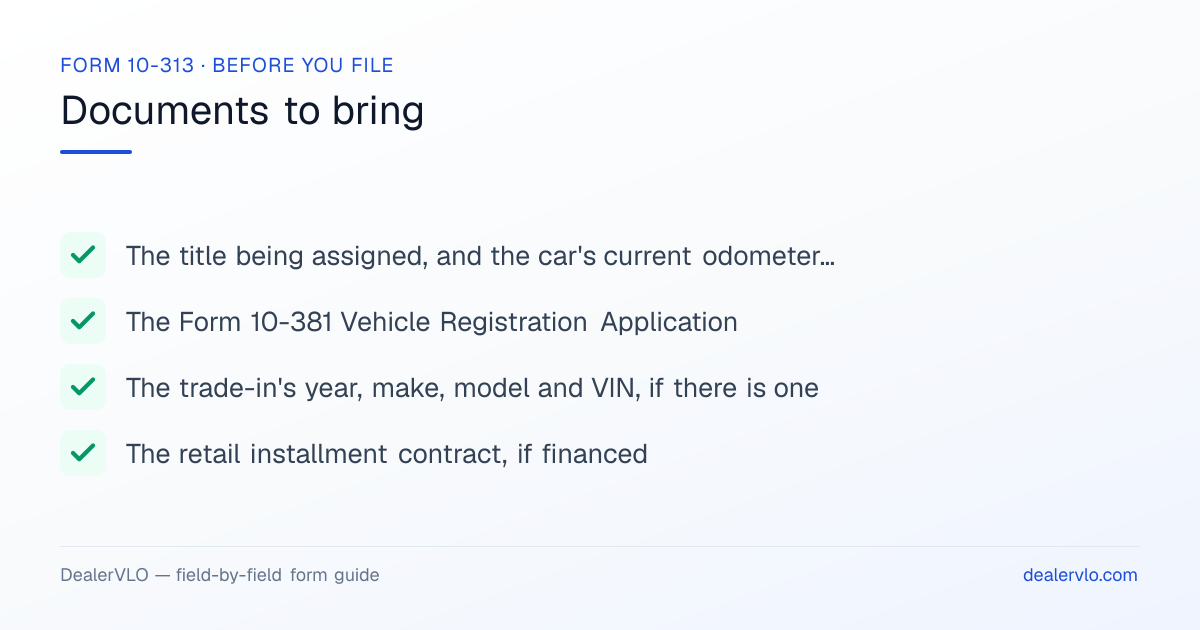
- The title being assigned, and the car's current odometer reading — Read the odometer on the day of sale. Compare it to the title and any reassignments before you certify anything.
- The Form 10-381 Vehicle Registration Application — Its OD reading box should match Section 7 of the 10-313. See the 10-381 guide.
- The trade-in's year, make, model and VIN, if there is one — Section 6 has a trade-in row, and Section 8 subtracts the allowance. The trade credit only works if it's documented.
- The retail installment contract, if financed — Not part of the 10-313, but the revenue office needs it for the lien on the 10-381.
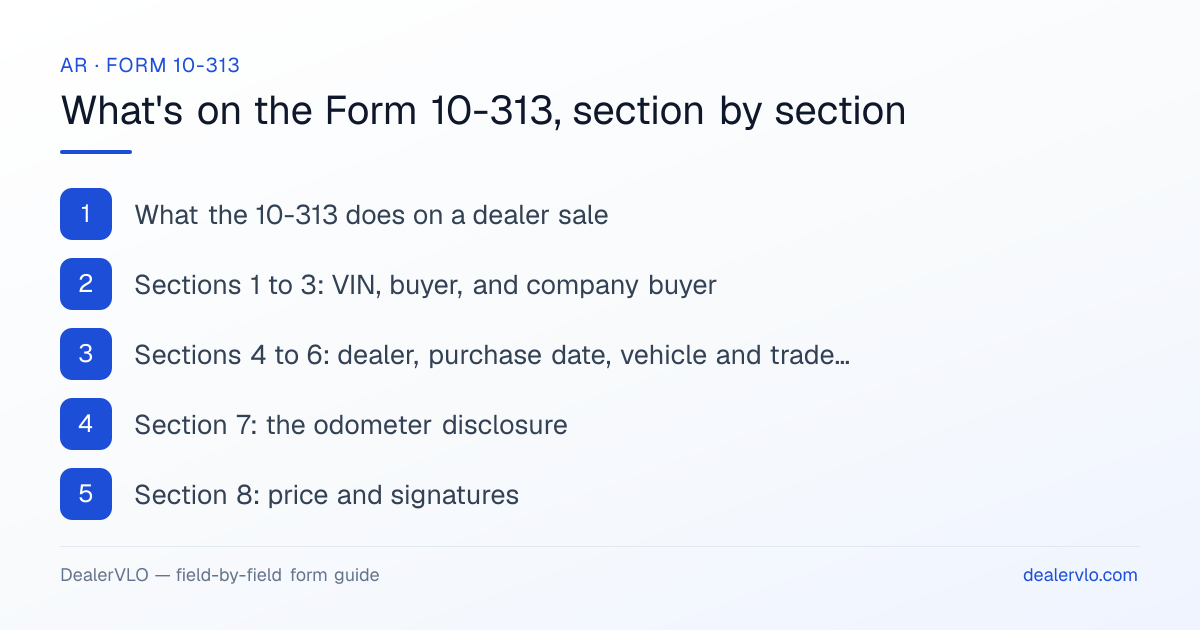
Form 10-313, section by section
What the 10-313 does on a dealer sale
Federal rules put the mileage disclosure on the title (49 CFR 580.5(c)). Arkansas's odometer regulation, Motor Vehicle Regulation 1995-1 on DFA's site, says the same, and adds that when a vehicle hasn't been titled or the title has no space for the disclosure, it goes on a separate document (Section 4(g)). Section 7 of the 10-313 is that separate document. The bill of sale half matters on every deal: the 10-381 guide covers how the revenue office uses the full price and trade-in to figure the buyer's tax. DealerVLO generates a 10-313 on every Arkansas deal for that reason.
| Field | Who fills it |
|---|---|
Title with an odometer assignment section Disclose on the title. Section 7 repeats it on the bill of sale. | You (dealer) |
Title with no space for the disclosure, or no title yet Section 7 of the 10-313 is the separate statement. | You (dealer) |
Bill of sale for the revenue office Price, trade-in and net taxable amount in Section 8. | You (dealer) |
Sections 1 to 3: VIN, buyer, and company buyer
Section 1 is the 17-character VIN. Section 2 is an individual buyer: first name, middle initial, last name, street address, and city, state and ZIP. Check the box under Section 2 when there are multiple owners. The form says that if the buyer is a company rather than individuals, skip Section 2 and go to Section 3: company name, address, and city, state and ZIP.
| Field | Who fills it |
|---|---|
Section 1: Vehicle identification number All 17 characters, matching the title. | You (dealer) |
Section 2: First name, middle initial, last name | You (dealer) |
Section 2: Address; city, state, ZIP Use the buyer's residence. Local tax is charged by where they live. | You (dealer) |
Multiple owners box Check it when there's a co-buyer. | You (dealer) |
Section 3: Company name, address, city, state, ZIP Only when the buyer is a company. DealerVLO fills Section 2 and leaves this blank. | You (dealer) |
Sections 4 to 6: dealer, purchase date, vehicle and trade-in
Section 4 is your dealership: name, street address, and city, state and ZIP. Section 5 is the purchase date. It starts the buyer's 60-day registration clock, so it should match your deal paperwork. Section 6 has two rows. The Vehicle Purchased row takes make, model, year, primary color, and a secondary color if there is one. The Vehicle Trade-In row takes the trade's make, model, year and VIN. Leave it blank on a deal with no trade.
| Field | Who fills it |
|---|---|
Section 4: Dealer/seller name Your dealership's legal name. | You (dealer) |
Section 4: Address; city, state, ZIP | You (dealer) |
Section 5: Purchase date The sale date. | You (dealer) |
Section 6: Vehicle purchased (make, model, year, primary color) | You (dealer) |
Section 6: Secondary color (if applicable) DealerVLO leaves it blank. | You (dealer) |
Section 6: Vehicle trade-in (make, model, year, VIN) Only with a trade. | You (dealer) |
Section 7: the odometer disclosure
The statement reads "I, (sellers printed name) hereby state that the Odometer now reads (no tenths) miles," and that it reflects the actual miles unless a box is checked. On a dealer sale the seller is your dealership. Write the reading in whole miles. There's no box for actual mileage: leave both boxes blank when the reading is actual. Box 1, Exceeds Mechanical Limits, is for an odometer that has rolled over. Box 2, Warning – Odometer Discrepancy, certifies the reading is not the actual mileage. Under 49 CFR 580.5(e) you check it when you know the reading differs from the real mileage by more than calibration error, or doesn't show a valid reading.
| Field | Who fills it |
|---|---|
Seller's printed name (in the statement) Your dealership's legal name. | You (dealer) |
Odometer reading (no tenths) Whole miles, read on the day of sale. | You (dealer) |
1. Exceeds mechanical limits Odometer rolled over. | You (dealer) |
2. Warning – odometer discrepancy Known discrepancy or no valid reading. | You (dealer) |
Section 8: price and signatures
The left side is the money: Full Sales Price of Vehicle, Less Trade-In, and the net taxable amount (the form prints the label as "Net Taxable Income"). The revenue office figures the buyer's sales tax from these lines, so they should match the deal. The right side is the printed name and signature of the seller, then the printed name and signature of the buyer. Sign in ink after you've read the odometer yourself. Section 9 warns that it's a felony to willfully attempt to evade Arkansas tax, or to help a taxpayer do it. Don't let the price on this form drift from the real price.
| Field | Who fills it |
|---|---|
Full sales price of vehicle | You (dealer) |
Less trade-in The trade allowance, when there's a trade. | You (dealer) |
Net taxable amount (printed "Net Taxable Income") | You (dealer) |
Printed name of seller | You (dealer) |
Signature of seller Ink. | You (dealer) |
Printed name of buyer Both names with a co-buyer. | You (dealer) |
Signature of buyer Ink. | Buyer |
Which cars are exempt (and why DFA's regulation reads differently)
The federal rule, 49 CFR 580.17, exempts a vehicle from model year 2010 or older, and a model year 2011 or newer vehicle once it's transferred at least 20 years after January 1 of its model year. In 2026 that means every model year 2011 and newer car still needs a disclosure, and 2011 models age out on January 1, 2031. Vehicles over 16,000 lbs GVWR, vehicles that aren't self-propelled, and new vehicles before their first retail transfer are exempt too. DFA's Regulation 1995-1 still prints the older exemption for "a vehicle that is ten years old or older." The federal rule changed in 2021 and applies to the transfer either way, so go by it: a 2014 car sold in 2026 still needs a disclosure.
| Field | Who fills it |
|---|---|
Model year 2010 or older Exempt. | You (dealer) |
Model year 2011 or newer, under 20 years Disclosure required. | You (dealer) |
Trade-ins, powers of attorney, and the 5-year copy rule
Regulation 1995-1 (Section 7) and 49 CFR 580.8 both require dealers to keep a copy of every odometer statement they issue or receive for five years, at their primary place of business, filed so it can be pulled on request. That includes the statement your customer gives you on a trade-in, where they're the seller. When a seller's title is held by a lienholder or lost, the federal rule (49 CFR 580.13) allows a power of attorney for mileage disclosure. DFA's forms page lists TIMA Form #2, a power of attorney for odometer mileage disclosure, for that. Keep any power of attorney you receive for five years too.
| Field | Who fills it |
|---|---|
Copy of every 10-313 you issue, kept 5 years | You (dealer) |
Copy of every statement you receive on a trade, kept 5 years | You (dealer) |
Power of attorney for mileage disclosure, kept 5 years Only when the title is with a lienholder or lost. | You (dealer) |
Common Form 10-313 mistakes that cause rejections
Section 7 says "no tenths," and so does 49 CFR 580.5(c). Write whole miles only.
The old 10-year exemption now covers only model year 2010 and older. Model year 2011 and newer need a disclosure until they're 20 years old, even though DFA's regulation still reads the old way.
There isn't one. Leave both boxes blank when the reading is actual. Check Box 2 if you know the miles are off.
The revenue office taxes from Section 8. A wrong price or an undocumented trade means wrong tax for your buyer, and the form warns that willful tax evasion is a felony.
The form says a company buyer goes in Section 3 instead. Use Section 2 only for individuals.
Common questions
What is Arkansas Form 10-313?+
It's the State of Arkansas Vehicle Bill of Sale/Odometer Disclosure Statement, published by the Department of Finance and Administration. One page covers the buyer, the seller, the vehicle and trade-in, the odometer reading with its two status boxes, and the full price, trade-in and net taxable amount, with signatures from both sides.
Is the 10-313 the federal odometer statement for Arkansas?+
Section 7 is written in the federal format: the seller's printed name, the reading with no tenths, and the two certifications (exceeds mechanical limits, or not the actual mileage). DFA's odometer regulation says the disclosure goes on the title, or on a separate document when the title has no space for it. The 10-313 serves as that separate document.
Which vehicles need an odometer disclosure in Arkansas in 2026?+
Every model year 2011 and newer vehicle, under the federal rule in 49 CFR 580.17. Model year 2010 and older are exempt, as are vehicles over 16,000 lbs GVWR, vehicles that aren't self-propelled, and new vehicles before their first retail transfer. A 2011 model ages out on January 1, 2031.
Does the 10-313 need to be notarized?+
The form has no notary block. It has signature and printed-name lines for the seller and the buyer only.
How long do Arkansas dealers keep odometer statements?+
Five years. DFA's Regulation 1995-1 and 49 CFR 580.8 both require dealers to keep a copy of every odometer statement they issue or receive, at their primary place of business, filed so it can be retrieved. Powers of attorney for mileage disclosure are kept five years too.
Where do I download Form 10-313?+
DFA publishes it as a free fillable PDF on its Motor Vehicle Forms page, listed as "Vehicle Bill of Sale / Odometer Disclosure Statement." The download button at the top of this guide links straight to it.
Is there software that fills out the Form 10-313 automatically?+
Yes. Dealer management software like DealerVLO fills the official Arkansas Form 10-313 from the deal you already entered: the VIN, the buyer in Section 2 (with the multiple-owners box when there's a co-buyer), your dealership in Section 4, the purchase date, the vehicle and any trade-in, the odometer reading and its status box, the full price, trade-in and net taxable amount, and both printed names. The company section and secondary color stay blank. Signatures stay blank for ink. It's $29/month flat with a 14-day free trial, and the same deal also generates your federal documents (Bill of Sale, FTC Buyers Guide) and your state title paperwork.
Stop filling out the Form 10-313 by hand.
DealerVLO fills the official AR Form 10-313 straight from your deal jacket: the VIN, the buyer in Section 2 (with the multiple-owners box when there's a co-buyer), your dealership in Section 4, the purchase date, the vehicle and any trade-in, the odometer reading and its status box, the full price, trade-in and net taxable amount, and both printed names. The company section and secondary color stay blank. $29/month. 14-day free trial, cancel any time.
Curious how it works? See how DealerVLO auto-fills every dealer document — bill of sale, FTC Buyers Guide, odometer disclosure, and state title & registration forms for all 50 states, from one deal.
Bond amounts, fees, and form rules change. Get a short email when your state does. No spam, unsubscribe anytime.