How to get a used car dealer license in Arkansas
A practical walkthrough of the Used Motor Vehicle Dealer License application — fees, bond, timeline, and what to expect at each step. Verified against the official agency as of October 2026.
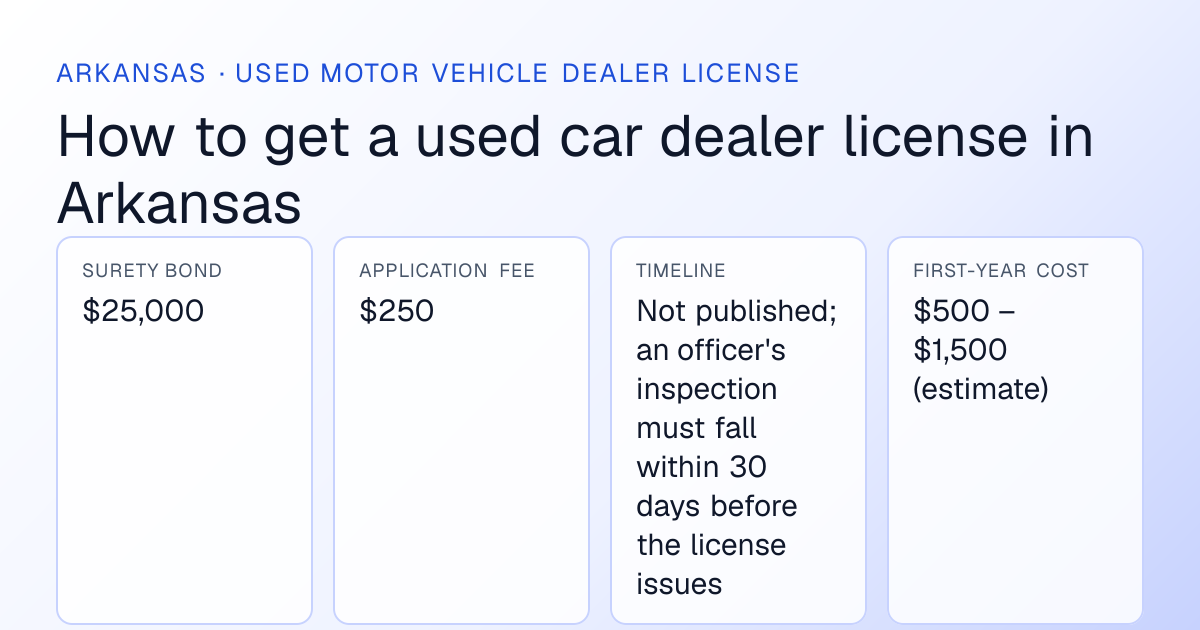
Getting a Used Motor Vehicle Dealer License used-car dealer license in Arkansas:
- Surety bond required
- $25,000
- Application fee
- $250
- License term
- 1 year (January 1 – December 31)
- Typical timeline
- Not published; an officer's inspection must fall within 30 days before the license issues
- Typical first-year cost
- $500 – $1,500 (estimate)
This guide is informational and does not replace official Arkansas requirements. Always verify with Arkansas State Police — Used Motor Vehicle Dealer Section before applying.
Two numbers worth knowing before you commit. Free calculators dealers actually use — no signup, no email.
Inventory with VIN auto-decode, the deal jacket, and every AR + federal form your sales need. $29/month, free to try — cancel any time.
Who can apply for a Used Motor Vehicle Dealer License license
Arkansas licenses used car dealers through the Arkansas State Police (ASP), not the DMV or the Motor Vehicle Commission. The Used Motor Vehicle Dealer license covers retail lots, wholesalers, and auto auctions. Selling five or more used vehicles in a calendar year is presumed to be the business of selling used vehicles (Ark. Code Ann. 23-112-602), and selling without a license is a crime.
In Arkansas this is also commonly called an auto dealer license, car dealer license, or motor vehicle dealer license — all the same Used Motor Vehicle Dealer License authority to sell used vehicles.
- A bona fide established place of business used primarily for selling used vehicles
- A sign identifying the business as a used motor vehicle dealership, legible from the street, road, or highway, plus a photo of it
- A photograph of the business location
- A telephone number listed in the business name
- A filing cabinet or other repository that locks, for your business records
- A $25,000 corporate surety bond on a state-approved form
- Proof of liability insurance on all vehicles offered for sale, at least the Motor Vehicle Safety Responsibility Act minimums
- A list of every owner and every salesperson
- A named agent to receive legal process
- An inspection by an ASP officer or designee within 30 days before the license issues
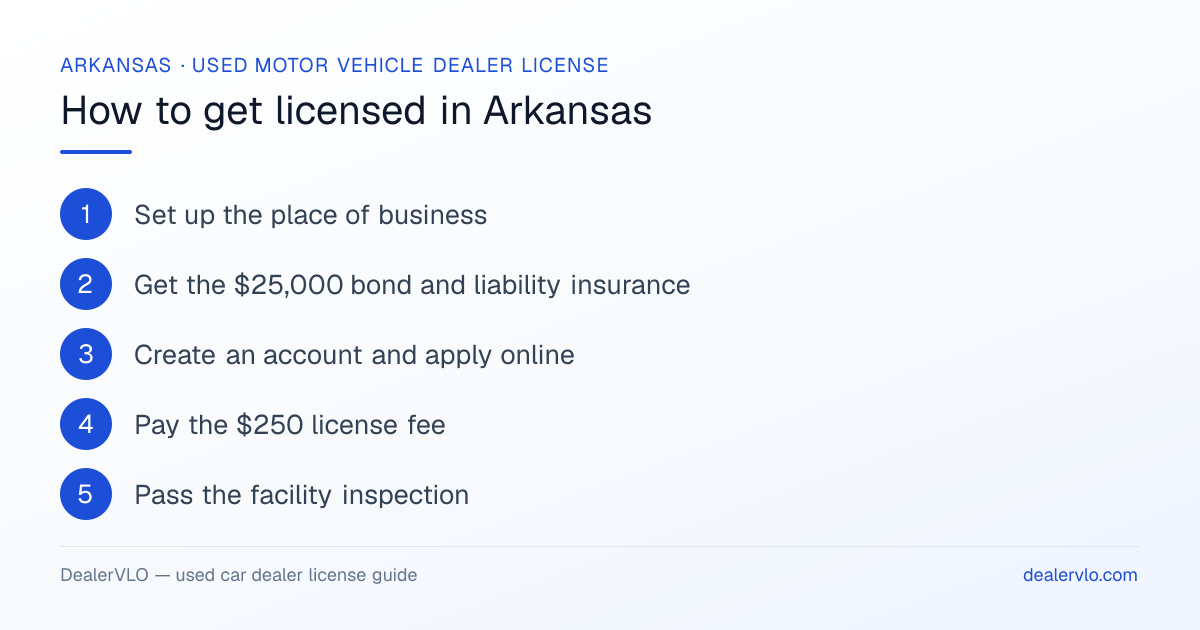
Step-by-step process
- 1
Set up the place of business
Arkansas requires a bona fide established place of business used primarily for selling used vehicles. Put up a sign that identifies it as a used motor vehicle dealership and can be read from the street. Get a phone number listed in the business name and a locking filing cabinet for your records. Take photos of the location and the sign — the application asks for both.
- 2
Get the $25,000 bond and liability insurance
Buy a $25,000 corporate surety bond on a bond form approved by the state. It runs in the name of the State of Arkansas or any aggrieved party and covers retail buyers' losses and reasonable attorney's fees from a dealer's violations. If you'll license several locations, one $100,000 bond can cover all of them instead of separate bonds. You also need proof of liability insurance on every vehicle you offer for sale, at least at the state's Motor Vehicle Safety Responsibility Act minimums.
- 3
Create an account and apply online
ASP takes applications through its online licensing portal. First-time applicants create a business account from the Primary Dealer License Application link on ASP's page, using an email address and a phone that can receive text messages for sign-in codes. Then complete the application: ownership, salespeople, bond, insurance, photos, and your agent for legal process. The application is made under oath, and a material misstatement is grounds to deny it.
- 4
Pay the $250 license fee
The license certificate is $250 a year for each dealer, and $125 for each additional location. ASP waives the initial application fee if you receive Medicaid, SNAP, WIC, TANF, or Lifeline assistance, were approved for unemployment in the last 12 months, or earn no more than 200% of the federal poverty guidelines. Military members, veterans, and qualifying spouses can ask for expedited licensing.
- 5
Pass the facility inspection
Before ASP issues or renews a license, an ASP officer or designee must inspect the facility within the prior 30 days and sign an affidavit that it complies. Once the license issues, display the certificate where customers can see it, and put your licensed name on all your signs.
- 6
Order dealer plates from DFA
Dealer plates come from the Department of Finance and Administration, not ASP, and only licensed dealers qualify. DFA's dealer plate rule (Rule 2005-7, as amended) sets a $100 master plate and $25 for each extra plate, with extra plates tied to named managers and salespeople. Confirm current plate fees with your DFA revenue office.
Arkansas dealer licenses: one license, three kinds of dealer
Arkansas splits dealer licensing by agency, not by class. The Arkansas State Police licenses used-vehicle dealers. New-vehicle franchise dealers go through the Arkansas Motor Vehicle Commission, and a franchise dealer selling used cars as part of its new-car business doesn't need the ASP license.
The ASP license is broader than its name suggests. The statute's definition of a used motor vehicle dealer includes wholesalers and auto auctions, along with anyone who sells, brokers, exchanges, or rents-to-own used vehicles for profit. ASP issues two kinds of license: Primary and Satellite.
- Primary license — $250 a year; your main licensed location
- Satellite license — additional locations at $125 each
- Wholesaler — someone who primarily sells used vehicles to dealers; covered by the same dealer license
- Auto auction — a place for wholesale exchanges between dealers or for auction-format and consignment sales; also covered by the dealer definition
- Salesperson — anyone who sells, brokers, or negotiates for a licensed dealer, or uses its line of credit or floor plan; listed on the dealer's application
Can you get an Arkansas dealer license without a lot?
Arkansas doesn't have a lot-free license type. The statute requires a bona fide established place of business used primarily for selling used vehicles, with a street-legible sign, a listed phone, and a locking file cabinet, and an officer has to inspect it. Since wholesalers are dealers under the same definition, there's no separate wholesale-only path with lighter rules.
The sections we read don't set a minimum lot size or square footage. They do say you can't sell, offer, or advertise vehicles from anywhere other than your licensed location, with three exceptions: a state trade association promotion or exhibit, a special sale permit, or an auto auction. If you move, you have 15 days to tell ASP in writing. A move ASP finds out about on its own draws a fine equal to the license fee.
The five-vehicle sales requirement
One line in the statute ASP publishes catches people off guard. Ark. Code Ann. 23-112-607(b) says an applicant for a used dealer license, or a licensee renewing one, "shall establish that he or she has sold at least five (5) used motor vehicles during the previous calendar year."
The statute doesn't say how that applies to someone who has never held a license, and ASP's rules don't add detail. Ask the Used Motor Vehicle Dealer Section at 501-618-8000 how it handles first-time applicants before you sign a lease. For renewals, plan on a working dealership, not a license held only for auction access.
Buy-here-pay-here and in-house financing in Arkansas
The ASP statute we read doesn't create a separate financing license for dealers, and ASP's pages don't mention one. That doesn't make every contract term fair game. Arkansas sets its interest-rate ceiling in the state constitution (Article 19, Section 13, as amended by Amendment 89), and state law caps the interest parties can agree to at that limit (Ark. Code Ann. 4-57-104, as amended by Act 1124 of 2013). Have an Arkansas attorney review your contract and rate before you write the first note.
The dealer statute does regulate spot delivery. If you hand over a car before the financing is final, you must give the buyer a signed "delivery prior to sale" agreement in at least 12-point type. Until financing is approved and the contract is signed, you can't cash the down payment or sell the trade-in. If the deal falls through, you return both, and the buyer has 48 hours to bring the car back (Ark. Code Ann. 23-112-613).
If you carry notes, DealerVLO tracks buy-here-pay-here accounts with a payment schedule and a collections panel. It doesn't lend money, pull credit, or handle any ASP or DFA filing. The contract terms and the legal review are on you.
Buying at dealer-only auctions with an Arkansas license
Dealer-only auctions are built around licensed dealers, but each auction sets its own registration paperwork, so ask the auction what it needs.
Arkansas law treats auctions as part of the dealer world. Auto auctions fall under the same used dealer definition, and selling at an auto auction is one of the three exceptions to the rule that you only sell from your licensed location. Buyers of salvage or parts-only titled vehicles at an auto auction pay a $5 fee per item (Ark. Code Ann. 23-112-614).
Also keep the five-vehicle requirement in mind. A license held only for occasional auction buying may not survive renewal.
Why Arkansas dealer applications stall
ASP doesn't publish a processing time. The statute and rules point to the usual trouble spots:
- No inspection affidavit dated within 30 days before the license would issue
- A bond that isn't a $25,000 corporate surety bond on a state-approved form
- No proof of liability insurance on the vehicles you'll offer for sale
- Missing photos of the location or the sign, or a sign that can't be read from the street
- No phone listed in the business name, or no locking records cabinet
- An incomplete owner or salesperson list, or no agent for legal process
- A material misstatement on the sworn application, which is grounds for denial
- Missed emails from the licensing portal — ASP tells applicants to check their spam folders
Once you're licensed: the paperwork on every deal
Keep records of every vehicle transaction for three years — bills of sale, titles, odometer statements, invoices, and reassignments — open to ASP inspection during business hours. Print ads must show your dealer name or "AR DLR" with your ASP license number. If you charge a service and handling fee, it can't exceed $129, must be charged to every retail customer, and must be itemized with the state's required notice printed next to it.
The buyer's title and registration application is Form 10-381. Our Arkansas 10-381 guide walks through it field by field. DealerVLO fills the official 10-381 from the deal — buyer, vehicle, and sale details — and leaves the fee and county-code boxes for the revenue office.
Unless the vehicle is exempt, the seller discloses mileage at transfer. See our odometer disclosure guide for when a written mileage statement is required.
Arkansas dealer license cost — fees breakdown
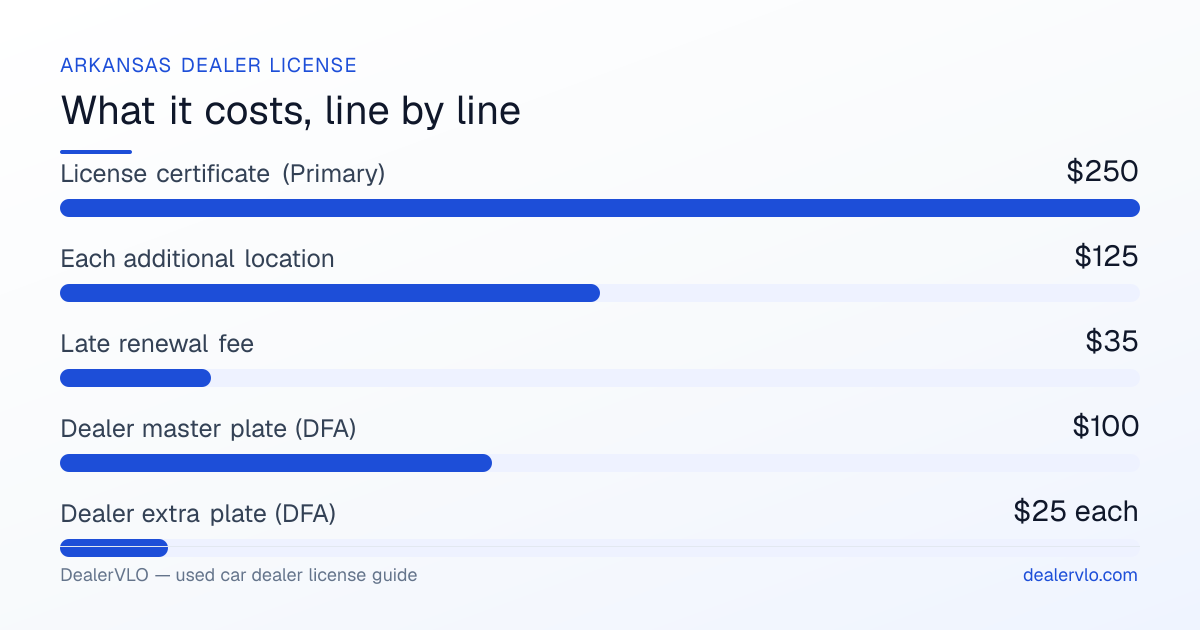
| Item | Amount |
|---|---|
License certificate (Primary) Per year; waived for qualifying low-income applicants | $250 |
Each additional location Satellite license | $125 |
Late renewal fee If expired at least 31 days but less than 6 months; after 6 months, the license is permanently expired | $35 |
Dealer master plate (DFA) Per DFA Rule 2005-7 as amended; confirm with DFA | $100 |
Dealer extra plate (DFA) Per DFA Rule 2005-7 as amended; tied to named managers and salespeople | $25 each |
Surety bond premium (estimate) Market estimate of 1–5% on the $25,000 bond; set by your credit | $250 – $1,250/yr |
The Arkansas auto dealer bond: $25,000
Arkansas requires every used-vehicle dealer to post a $25,000 surety bond. The bond protects buyers from misconduct (odometer fraud, undisclosed liens, deceptive trade practices) and the state from unpaid taxes.
You don't pay the full bond amount up front — you pay an annual premium to a surety company, typically 1–5% (estimate) of the bond's face value. Your actual premium depends on personal credit and business history.
Each applicant needs a $25,000 corporate surety bond on a state-approved form (Ark. Code Ann. 23-112-607). A dealer with several locations can file a single $100,000 bond covering all of them instead. The bond indemnifies retail buyers for losses and reasonable attorney's fees caused by the dealer's violations, and pays out after an Arkansas court judgment. The surety's liability tops out at $25,000. The bond and insurance must stay in force the whole time you're licensed, or ASP summarily suspends the license. The premium range is a market estimate, not a state figure.
Renewal
Arkansas used dealer licenses run January 1 to December 31 and renew in January through ASP's online portal. Dealers moved over from the old system activate their migrated account before renewing. A license expired at least 31 days but less than six months owes a $35 late fee; after six months it's permanently expired and you reapply from scratch. Renewal also needs a fresh inspection within 30 days (every other year once you've been licensed at the same facility for 10 years or more) and, under the statute, proof of at least five used-vehicle sales in the previous calendar year.
Common questions
Who issues the used car dealer license in Arkansas?+
The Arkansas State Police, through its Used Motor Vehicle Dealer Section. New-vehicle franchise dealers are licensed by the Arkansas Motor Vehicle Commission, and dealer plates come from the Department of Finance and Administration.
How many cars can I sell in Arkansas without a dealer license?+
Selling five or more used vehicles in one calendar year is prima facie evidence that you're in the business of selling used vehicles (Ark. Code Ann. 23-112-602). A person selling their own personal-use vehicle isn't a dealer under the statute.
Can you get a dealer license in Arkansas without a lot?+
There's no lot-free license. You need a bona fide established place of business used primarily for selling used vehicles, with a readable sign, a listed phone, and a locking file cabinet, and it must pass an inspection. Wholesalers are licensed as dealers under the same rules.
Is there a wholesale dealer license in Arkansas?+
Not a separate one. Arkansas's definition of a used motor vehicle dealer includes wholesalers — people who primarily sell used vehicles to other dealers — so they get the same ASP license, bond, and place-of-business requirements.
Can I buy at dealer-only auctions with an Arkansas dealer license?+
Dealer-only auctions are built around licensed dealers, but each auction sets its own registration rules, so ask the auction. Arkansas law lets licensed dealers sell at an auto auction even though it isn't their licensed location.
Does Arkansas require dealer training?+
ASP's current Used Motor Vehicle Dealer Licensing Rules, effective December 15, 2023, contain no pre-licensing seminar requirement. Older versions of the rules did, so ask ASP if you see a guide that says otherwise.
How long does it take to get an Arkansas dealer license?+
ASP doesn't publish a processing time. The license issues once your application, fee, and bond are verified and an officer or designee has inspected your facility within the 30 days before issuance.
How much does a Arkansas dealer license cost?+
Plan for about $500 – $1,500 (estimate) in the first year. That covers the $250 application fee and the $25,000 surety bond — you pay an annual premium of roughly 1–5% (estimate) of the bond, not the full amount — plus business-formation, facility, and dealer-plate costs. See the full fees breakdown above.
How do I get dealer plates in Arkansas?+
Dealer plates are separate from the license itself. Once your Used Motor Vehicle Dealer License license is approved, you apply for dealer plates and pay a per-plate fee (listed in the fees breakdown above). You can't obtain dealer plates before the license is issued.
- Arkansas State Police — Used Motor Vehicle Dealer License
- Ark. Code Ann. 23-112-601 et seq. — Used Motor Vehicle Buyers Protection (as published by ASP)
- Arkansas State Police — Used Motor Vehicle Dealer Licensing Rules (effective Dec. 15, 2023)
- Arkansas State Police — Service and Handling Fees Rules
- Arkansas State Police — Account creation tutorial for new dealers
- Arkansas DFA — Rule 2005-7: Dealer Plates and Tags
- Act 1124 of 2013 — Ark. Code Ann. 4-57-104 interest limit tied to Ark. Const. art. 19, § 13 (Amendment 89)
- How to fill out Form 10-381 (Arkansas)
- Arkansas bill of sale / odometer disclosure (10-313)
- Dealer license without a lot: state-by-state rules
- Dealer license for car auctions
- Odometer disclosure rules and forms by state
- Dealer license cost in all 50 states
- License cost calculator (fees + bond by state)
Got your AR dealer license? Run your lot in DealerVLO.
Inventory with VIN auto-decode, the deal jacket, your Arkansas title paperwork and the federal forms filled from each deal, and your own dealer website at your custom domain. $29/month. 14-day free trial, cancel any time.
Bond amounts, fees, and form rules change. Get a short email when your state does. No spam, unsubscribe anytime.