How to fill out the Form 10-381 in Arkansas
A field-by-field walkthrough of the Arkansas Form 10-381 (Vehicle Registration Application) for licensed used car dealers — what goes in every section, who signs what, and the documents you attach. Verified against the official form as of September 2026.
Filing these every week? DealerVLO fills the Form 10-381 from the deal you already entered, $29/month flat. See pricing
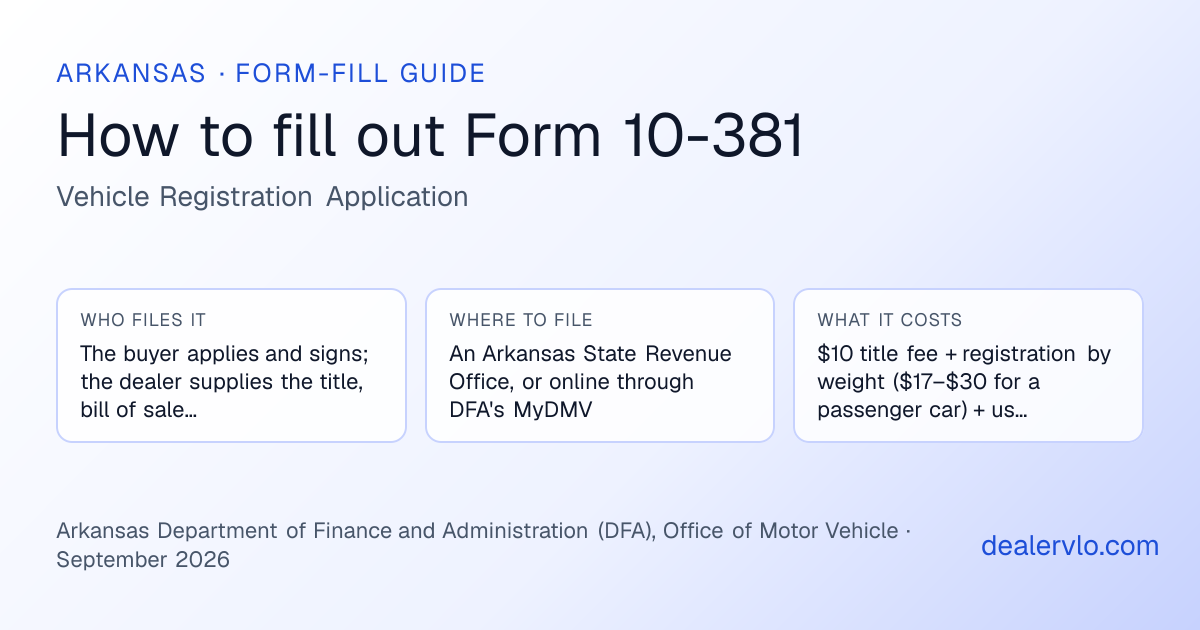
Filling out the AR Form 10-381 after a sale:
- What it is
- Arkansas's combined title + registration application (Vehicle Registration Application)
- Who completes it
- The buyer applies and signs; the dealer supplies the title, bill of sale and vehicle/lien details, and the revenue office completes the coded and fee boxes
- Where to file it
- An Arkansas State Revenue Office, or online through DFA's MyDMV
- Processing time
- Register within 60 days of purchase, or pay a 10% sales-tax penalty plus $3 for each 10 days late
- Cost
- $10 title fee + registration by weight ($17–$30 for a passenger car) + used-car state sales tax (0% under $4,000, 3.5% for $4,000–$9,999, 6.5% at $10,000+) + local tax on the first $2,500
This guide is informational and does not replace the official Arkansas instructions. Always confirm the current form and procedure with Arkansas Department of Finance and Administration (DFA), Office of Motor Vehicle before you file.
See the AR Form 10-381 filled — from just a VIN
Enter a VIN, the buyer's name, and the price. We decode the vehicle and drop it onto the actual Arkansas Form 10-381 — the same fill DealerVLO produces from a deal. Watermarked preview; nothing is saved.
What the Form 10-381 is and why it matters
Form 10-381 is Arkansas's Vehicle Registration Application, the DFA form that titles and registers a vehicle in the buyer's name. Arkansas works differently from most states: the buyer, not the dealer, pays the sales tax at the time of registration, either at a State Revenue Office or online through DFA's MyDMV. The buyer has 60 days from the purchase date to do it. The dealer's job is to hand over a clean package: the assigned title, a bill of sale showing the price and trade-in, the odometer disclosure, and the lien contract if financed.
The quirk that matters most is the used-vehicle tax bracket. Under Act 1013 of 2021, a used vehicle priced under $4,000 owes no sales tax, one priced $4,000 through $9,999 is taxed at a reduced 3.5% state rate, and $10,000 or more pays the full 6.5%. The bracket is set by the price before the trade-in is subtracted. City and county tax is added on top, based on where the buyer lives, and only on the first $2,500 of the price. This guide walks the current (12-30-2019) form box by box.
The PDF is titled "Vehicle Registration Application" and numbered 10-381. DFA's forms page lists it as the Application for Title or Replacement Title. It's one combined title and registration application. On a dealer sale in Arkansas, the buyer registers the vehicle and pays the sales tax at the time of registration (at a State Revenue Office or online through MyDMV), within 60 days of purchase. Many of the coded boxes and the whole fee column are filled in by the revenue office.
Documents to have before you start
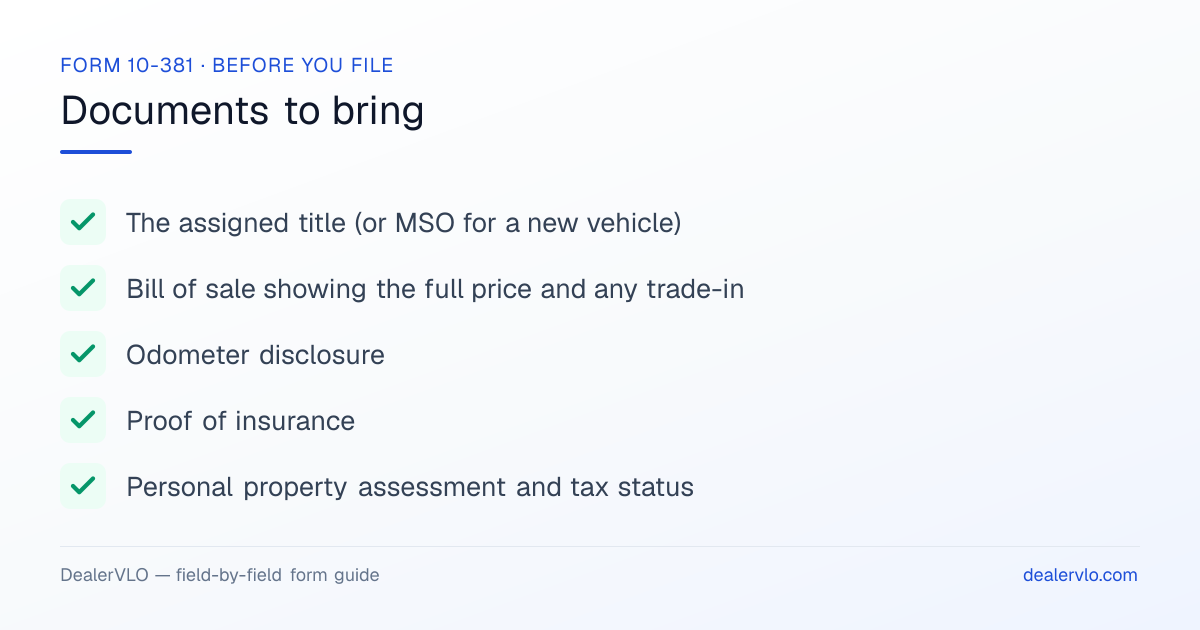
Gather these before you complete the Form 10-381. A missing attachment is the number-one reason the Arkansas Department of Finance and Administration (DFA), Office of Motor Vehicle bounces a title application back.
- The assigned title (or MSO for a new vehicle) — Signed by the seller and buyer. The prior title number goes in the Previous Title No. box.
- Bill of sale showing the full price and any trade-in — DFA asks for the VIN, date of sale, purchase amount and both signatures. Arkansas Form 10-313 (Vehicle Bill of Sale/Odometer Disclosure Statement) covers the price, trade-in and odometer in one document.
- Odometer disclosure — On the title assignment, or on Form 10-313 when the title doesn't carry it.
- Proof of insurance — Current insurance on the VIN that meets Arkansas liability requirements.
- Personal property assessment and tax status — DFA's checklist asks for a current-year personal property assessment with the vehicle listed, and personal property tax paid up to date. The buyer handles this with their county assessor and collector.
- Lien contract, if financed — The retail installment contract, so the first lienholder and contract date go on the application.
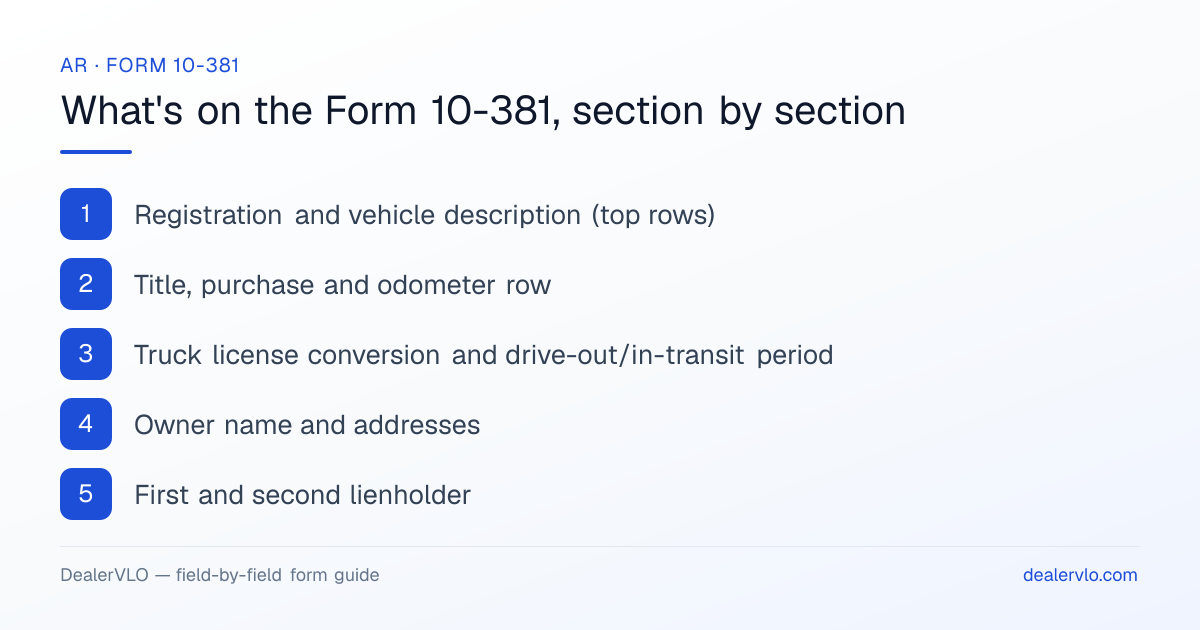
Form 10-381, section by section
Registration and vehicle description (top rows)
The first two rows identify the plate and the vehicle. License No., Inv. Type, Use Code, Decal No. and Expiration Date are registration details the revenue office assigns or confirms. The vehicle row is what you supply from the title and the unit: VIN, year, make, model, body, cylinders, color, fuel, and weights. Unladen weight matters because Arkansas sets passenger-car registration fees by weight class. Previous Title No. links this application to the title being surrendered.
| Field | Who fills it |
|---|---|
License no., inv. type, use code, decal no., expiration date | At the counter |
Vehicle identification number Must match the title and the VIN plate. | You (dealer) |
Year, make, model, body, cyl, color, fuel | You (dealer) |
Unladen wt, gross wt, DSP, axles Passenger-car registration is priced by weight class. | You (dealer) |
Previous title no. The title being surrendered. | You (dealer) |
Title, purchase and odometer row
This row records the purchase: the purchase date (which starts the buyer's 60-day clock), the selling dealer, and the odometer reading. Title Code, Pur. Type and OD Code are DFA codes the revenue office enters. The Check If Applicable boxes flag damage or prior damage, a lease, proration, a late-registration penalty, and whether the title and registration should be mailed.
| Field | Who fills it |
|---|---|
Title code, pur. type, OD code DFA codes. | At the counter |
Pur. date Starts the 60-day registration deadline. | You (dealer) |
Dealer The selling dealer. Confirm the expected format with the revenue office. | You (dealer) |
OD reading Must match the odometer disclosure. | You (dealer) |
Check if applicable: damage, prev. damage, lease, prorate, penalty, mail | At the counter |
Truck license conversion and drive-out/in-transit period
Two blocks most car deals skip. The first is only for converting a Class 2 through Class 8 truck license (old license number, old weight, old fee, and any overload weight and summons number). The second records the beginning and ending date and time of a drive-out or in-transit validation period. Leave both blank on an ordinary retail sale unless they apply.
| Field | Who fills it |
|---|---|
Old lic. no., old wt., old fee Class 2–8 truck conversions only. | At the counter |
Overload weight, summons number Only if the conversion was involuntary. | At the counter |
Drive-out / in-transit beginning and ending date and time | At the counter |
Owner name and addresses
The buyer's legal name goes on the owner lines (last, first), with a second owner line and a company line for a business buyer. Then come three addresses. The Arkansas address is where the buyer lives, and it matters because city and county sales tax is charged by the buyer's residence. The title mailing address and renewal mailing address are separate lines in case they differ. Each has a CTY code box for the revenue office.
| Field | Who fills it |
|---|---|
Owner name (last, first) + second owner | Buyer |
Company Business buyers. | Buyer |
Arkansas address (name, address, city, AR ZIP) Sets the local tax. | Buyer |
Title mailing address | Buyer |
Renewal mailing address | Buyer |
CTY code boxes | At the counter |
First and second lienholder
If the buyer financed, the first lienholder's name, address and contract date go here so the lien is recorded on the new Arkansas title. A second lien has its own block. Take the details straight from the retail installment contract so the name and contract date match what the lender will look for.
| Field | Who fills it |
|---|---|
First lienholder name, address, city/state/ZIP | You (dealer) |
Contract date The date of the lien contract. | You (dealer) |
Second lienholder + contract date (if any) | You (dealer) |
Fee column and sales tax receipt
The whole right-hand fee column (registration, replacement, credit, transfer, additional, title, prorated, lien, special fees, penalty, postage, and total) is filled in by the revenue office, along with the sales tax receipt number. There's no sales-tax math printed on the 10-381. The tax is figured from your bill of sale, so the bill of sale has to be right. Used-vehicle state tax is 0% if the price is under $4,000, 3.5% from $4,000 through $9,999, and 6.5% at $10,000 or more. The bracket is set by the sales price before the trade-in is subtracted. The tax itself is then charged on the price minus the trade-in allowance (a trade-in must be a motor vehicle, trailer or semitrailer). City and county taxes for the buyer's residence are added, applied only to the first $2,500 of the price. Standard fees from DFA's schedule: $10 title fee, and $17, $25 or $30 passenger-car registration depending on weight.
| Field | Who fills it |
|---|---|
Registration, title, lien, transfer, and other fees $10 title fee; passenger registration $17/$25/$30 by weight. | At the counter |
Credit | At the counter |
Penalty After 60 days: 10% of the sales tax due plus $3 for each 10 days unregistered. | At the counter |
Total reg. fees | At the counter |
Sales tax receipt number Tax is paid by the buyer at registration. | At the counter |
Revenue office, agent and signatures
The bottom block records where the application was processed: revenue office city, office number, county, the Arkansas revenue agent, the date, and a CTY code. The lienholder signs if applicable, and the owner(s) sign last.
| Field | Who fills it |
|---|---|
Revenue office city, office number, county | At the counter |
Arkansas revenue agent, date, CTY code | At the counter |
Signature of lienholder (if applicable) Signed by the lender, only when required. | You (dealer) |
Signature of owner(s) | Buyer |
The Form 10-381 is one car's paperwork. A 20-second read on your lot, and the tax-and-fee math for the whole deal — built for dealers, no signup. Free calculators dealers actually use — no signup, no email.
DealerVLO fills the official Arkansas Form 10-381 straight from your deal — VIN-decoded vehicle, buyer, co-buyer, and sale price already in place. $29/month, free to try — cancel any time.
Common Form 10-381 mistakes that cause rejections
Arkansas sets the used-vehicle bracket (under $4,000 / $4,000–$9,999 / $10,000+) by the sales price, and Act 1013 says the trade-in does not reduce the price for that test. A $12,000 car with a $4,000 trade is still in the 6.5% bracket; the 6.5% is then charged on the $8,000 difference. Quoting the buyer 3.5% on that deal understates what they'll owe at the revenue office.
The current rule is 60 days from purchase, per DFA. After that, the buyer pays a 10% penalty on the sales tax due plus $3 for each 10 days the vehicle isn't registered. Put the purchase date on the paperwork clearly, because it starts the clock.
The revenue office figures the tax from your paperwork. DFA wants the VIN, sale date, purchase amount and both signatures, and the trade-in credit only works if the trade is documented. Form 10-313 has lines for the full sales price, less trade-in, and the net taxable amount, plus the trade's VIN.
DFA says no sales tax is due on a used vehicle under $4,000. But the test is the whole sales price, not the price after the trade. Confirm with the revenue office how add-ons on the bill of sale count toward that total before promising a buyer $0 tax.
City and county sales tax on a vehicle is charged by the buyer's residence, not your lot's location, and on only the first $2,500 of the price. A wrong Arkansas address on the 10-381 means the wrong local tax. Take it from the buyer's license and confirm it.
Common questions
What form do I use to title and register a vehicle in Arkansas?+
Arkansas Form 10-381, the Vehicle Registration Application, from the Department of Finance and Administration (DFA), Office of Motor Vehicle. It's one combined title and registration application. The buyer applies at a State Revenue Office or online through MyDMV, and the revenue office completes the coded and fee boxes.
How much is sales tax on a used car in Arkansas?+
The state rate for a used vehicle depends on the price. Under $4,000, no sales tax is due. From $4,000 through $9,999, the reduced state rate is 3.5%. At $10,000 or more, it's the full 6.5%. City and county sales tax for the buyer's residence is added and applies only to the first $2,500 of the price. These brackets have applied to purchases since January 1, 2022 (Act 1013 of 2021).
Does a trade-in lower Arkansas car sales tax?+
Yes. Tax is charged on the price minus the trade-in allowance, and the trade must be a motor vehicle, trailer or semitrailer. But the trade doesn't change which bracket the sale falls into: under Act 1013, the sales price isn't reduced by the trade-in when deciding whether the reduced 3.5% rate applies.
How long do I have to register a car in Arkansas after buying it?+
60 days from the date of purchase. After that, DFA charges a penalty of 10% of the sales tax due, plus a late-registration penalty of $3 for each 10 days the vehicle isn't registered.
Does the dealer collect sales tax on a car sale in Arkansas?+
Normally no. Under DFA's rules, sales tax on a vehicle that must be registered for road use is paid by the buyer at registration and title application. It's paid at a State Revenue Office or online through MyDMV, not collected at the dealership. The dealer's bill of sale is what the tax is figured from.
How much is the title fee in Arkansas?+
DFA's fee schedule lists a $10 title fee. Registration for a passenger car is $17, $25 or $30 depending on weight (3,000 lbs or less, 3,001–4,500 lbs, or 4,501 lbs and over). Sales tax and any lien filing fee are on top of that.
Can a buyer get a sales tax credit for selling their old car privately in Arkansas?+
Yes. DFA offers a sales and use tax credit when the buyer sells a used vehicle privately within 60 days before or after buying the new one. It works like a trade-in credit: tax is due on the difference. The buyer brings the bill of sale for the vehicle sold when registering, or applies for a refund afterward. Check DFA's rules for the timing if the sale happens after registration.
Is there software that fills out the Form 10-381 automatically?+
Yes. Dealer management software like DealerVLO fills the Arkansas Form 10-381 from the deal you already entered — the VIN-decoded vehicle, buyer, co-buyer, lienholder, and sale price are placed for you instead of hand-writing them. For most states that's the official DMV form itself; where a state issues its form only through its own dealer portal, you get a print-ready worksheet with every value already in place. It's $29/month flat with a 14-day free trial, and the same deal also generates your federal documents (Bill of Sale, FTC Buyers Guide, odometer disclosure) and any other state's title forms.
Stop filling out the Form 10-381 by hand.
DealerVLO fills the official AR Form 10-381 straight from your deal jacket — VIN-decoded vehicle, buyer, co-buyer, lienholder, and sale price already in place. Print, sign, and file in about 90 seconds. $29/month. 14-day free trial, cancel any time.
Curious how it works? See how DealerVLO auto-fills every dealer document — bill of sale, FTC Buyers Guide, odometer disclosure, and state title & registration forms for all 50 states, from one deal.
Bond amounts, fees, and form rules change. Get a short email when your state does. No spam, unsubscribe anytime.