How to fill out the H-13B in Connecticut
A field-by-field walkthrough of the Connecticut H-13B (Connecticut Registration and Title Application) for licensed used car dealers — what goes in every section, who signs what, and the documents you attach. Verified against the official form as of September 2026.
Filing these every week? DealerVLO fills the H-13B from the deal you already entered, $29/month flat. See pricing
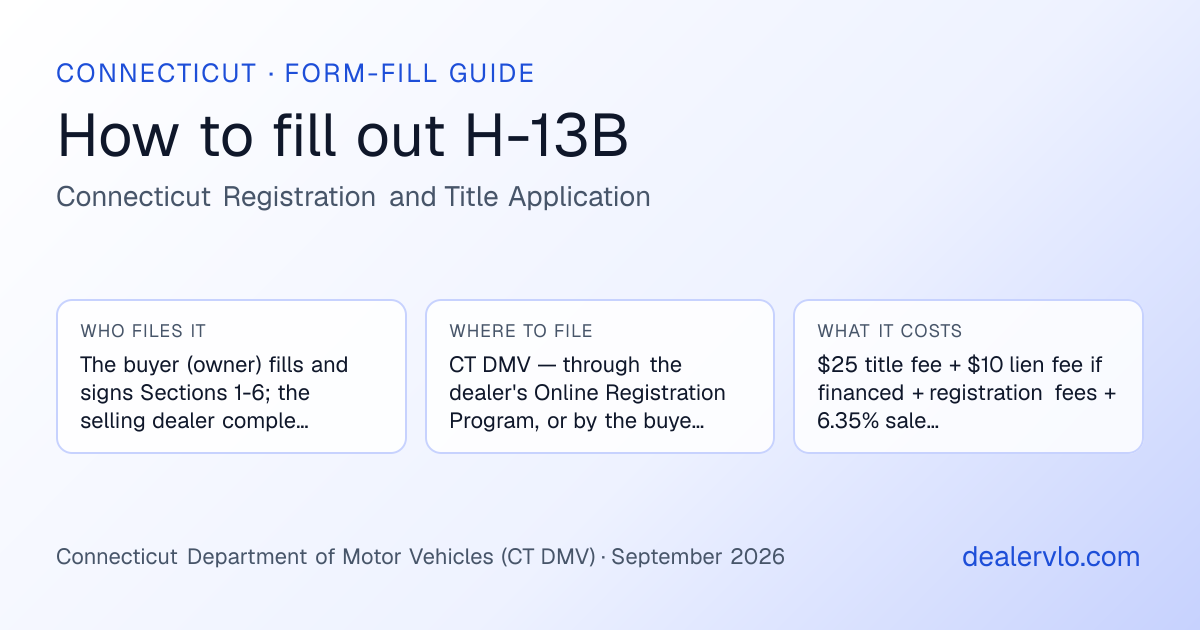
Filling out the CT H-13B after a sale:
- What it is
- Connecticut's combined registration and title application — Section 9 carries the dealer's sales tax figures
- Who completes it
- The buyer (owner) fills and signs Sections 1-6; the selling dealer completes and signs Section 9
- Where to file it
- CT DMV — through the dealer's Online Registration Program, or by the buyer at a DMV office
- Processing time
- ORP dealers issue the registration at the dealership and must submit the paperwork within 10 DMV business days
- Cost
- $25 title fee + $10 lien fee if financed + registration fees + 6.35% sales tax (7.75% over $50,000)
This guide is informational and does not replace the official Connecticut instructions. Always confirm the current form and procedure with Connecticut Department of Motor Vehicles (CT DMV) before you file.
See the CT H-13B filled — from just a VIN
Enter a VIN, the buyer's name, and the price. We decode the vehicle and drop it onto the actual Connecticut H-13B — the same fill DealerVLO produces from a deal. Watermarked preview; nothing is saved.
What the H-13B is and why it matters
Form H-13B is Connecticut's Registration and Title Application — the one form that registers the vehicle and applies for the title in the buyer's name. The front has six numbered sections (owner, vehicle, seller, lien, tax exemption, signatures), an addendum for leased and commercial vehicles, and Section 9, the Dealer Transaction block where a licensed dealer reports the sale and the sales tax it collected.
The number that trips people up is the sales tax rate. Connecticut charges 6.35% on most vehicles, but a vehicle with a sales price over $50,000 is taxed at 7.75% on the whole taxable amount, not just the part over $50,000 — and DRS measures that $50,000 before the trade-in is subtracted. So a $52,000 car with a $10,000 trade still pays 7.75%, just on the $42,000 net. This guide walks the current (REV. 3-2021) form section by section.
H-13B is one combined form for registration and title — Connecticut doesn't use a separate title application. On a dealer sale, a dealer approved for the DMV's Online Registration Program (ORP) processes the registration and title at the dealership and must get the signed H-13B and supporting paperwork to the DMV's online processing unit within 10 DMV business days. Otherwise the buyer takes the completed H-13B and the dealer's paperwork to the DMV. Section 9 (Dealer Transaction) is where the dealer reports the price, trade-in, and sales tax collected.
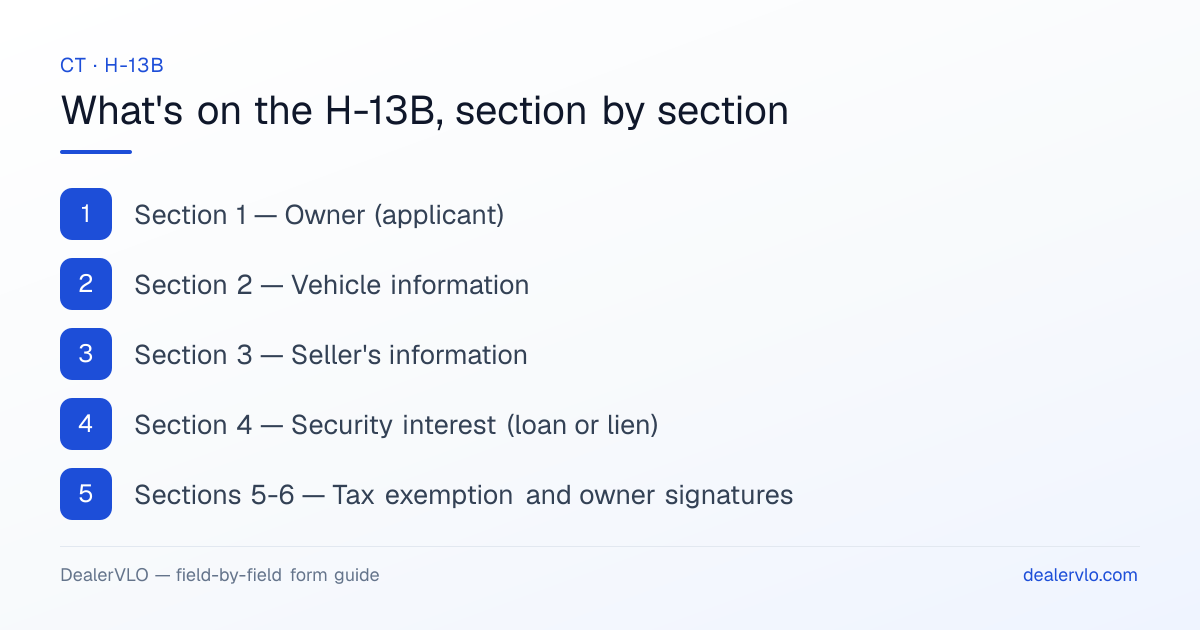
Documents to have before you start
Gather these before you complete the H-13B. A missing attachment is the number-one reason the Connecticut Department of Motor Vehicles (CT DMV) bounces a title application back.
- The properly assigned title (or certificate of origin for a new vehicle) — Connecticut doesn't title vehicles more than 20 model years old — for those, ownership moves on the prior registration plus a Supplemental Assignment of Ownership (Q-1) and/or bill of sale.
- Bill of sale / buyer's order — The DMV lists a bill of sale (its own form is H-31) with the registration documents; the price must match Section 3 and Section 9.
- Federal odometer disclosure — On the title assignment. The reading also goes in Section 2 of the H-13B.
- Connecticut insurance identification card — Required to register. In Section 6 the owner certifies the required insurance is in effect.
- Buyer's acceptable identification — The owner's license or ID number and issuing state go in Section 1.
- Lien information, if financed — Lienholder name, address, and date of lien for Section 4.
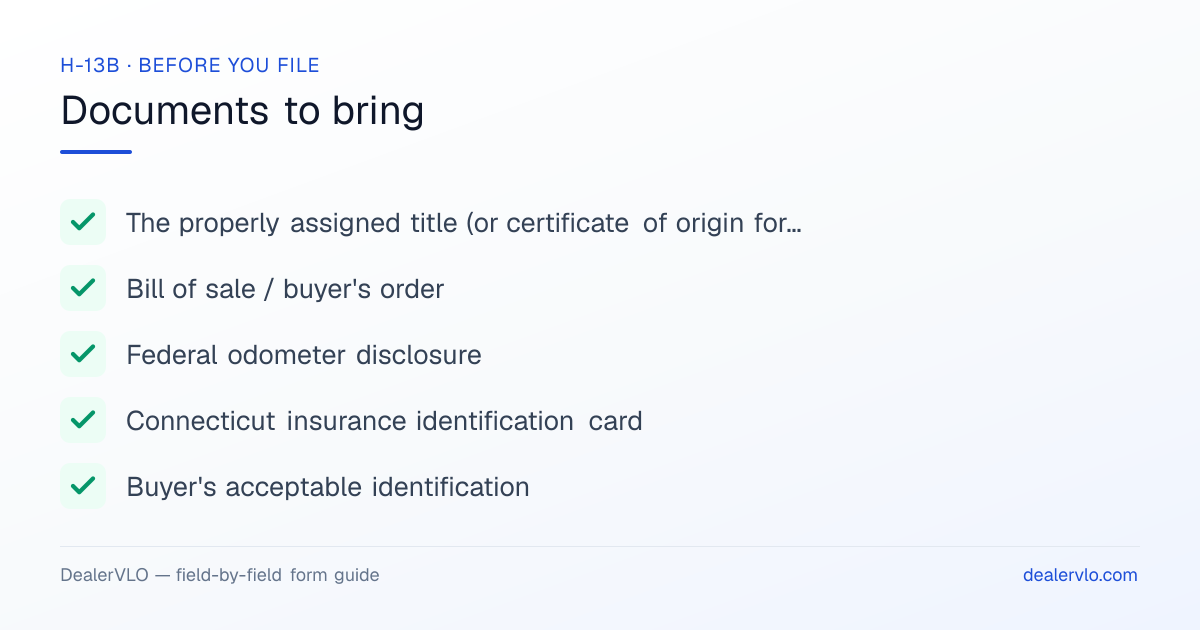
H-13B, section by section
Section 1 — Owner (applicant)
The buyer the vehicle is registered and titled to. Enter the owner's name (last, first, middle initial), birthdate, and license or ID number with issuing state; a business adds its Secretary of State business ID. If there's a co-owner, check one box: JOINT/OR needs only one signature to transfer the vehicle later, COMMON/AND needs all signatures. Then the mailing address, whether the owner is a Connecticut resident, and the residence address if different (no P.O. box). The last line is the address where the vehicle is usually kept — it's there for local property tax, so fill it in if it differs from the residence.
| Field | Who fills it |
|---|---|
Owner's name + birthdate | Buyer |
License or ID number + issuing state | Buyer |
Sec. of State / business ID no. (if applicable) For a business owner. | Buyer |
Co-ownership: JOINT/OR or COMMON/AND OR = one signature to transfer; AND = all signatures. | Buyer |
Co-owner name, birthdate, license/ID | Buyer |
Mailing address | Buyer |
CT resident? + resident address No P.O. box for the resident address. | Buyer |
Address where the vehicle is kept (property tax) Only if different from the resident address. | Buyer |
Section 2 — Vehicle information
Describes the vehicle. The VIN must match the title and the vehicle; the odometer reading must match the disclosure on the title assignment. Mark new or used. If it's a commercial, combination, or pickup-truck registration, the form sends you to Section 8 as well.
| Field | Who fills it |
|---|---|
Vehicle I.D. number (VIN) Must match the title and the VIN plate. | You (dealer) |
Year, make, model name or no., body style | You (dealer) |
Fuel type, cylinders or CCs, no. of wheels | You (dealer) |
Color(s) — maximum of two | You (dealer) |
Odometer reading Must match the title's odometer disclosure. | You (dealer) |
New or used | You (dealer) |
Section 3 — Seller's information
Who sold the vehicle. On a dealer sale that's the dealership: its name, address, the date sold, and the selling price. The selling price here should be the same figure as the total sales price in Section 9 and on the buyer's order.
| Field | Who fills it |
|---|---|
Name of seller(s) The dealership's name on a dealer sale. | You (dealer) |
Date vehicle sold (purchased) | You (dealer) |
Selling price Match the buyer's order and Section 9. | You (dealer) |
Seller's address | You (dealer) |
Section 4 — Security interest (loan or lien)
If the buyer financed, enter the lienholder's name and address and the date of the lien so it's recorded on the Connecticut title; a second lien has its own line. The DMV charges a $10 lien fee when there's a lien. Leave it blank if there's no loan — in Section 6 the owner certifies there are no liens except those listed here.
| Field | Who fills it |
|---|---|
Name of lien-holder + date of lien | You (dealer) |
Address of lien-holder | You (dealer) |
Second lien-holder name, address, date (if any) | You (dealer) |
Sections 5-6 — Tax exemption and owner signatures
Section 5 is only for a claimed exemption from Connecticut sales/use tax — on an ordinary dealer sale to a Connecticut buyer it stays blank. The code comes from the back of the form: 1 immediate-family transfer, 2 exempt organization or government, 3 tax paid to another jurisdiction (list the amount), 4 vehicle bought while living out of state, 5 other (gift, lessor purchase, and so on). Section 6 is the owner's certification — no liens other than those listed, the required insurance is in effect, and all Connecticut property taxes on vehicles previously registered in the owner's name are paid — signed under penalty of false statement.
| Field | Who fills it |
|---|---|
Exemption code no. (from back of form) Only if an exemption is claimed. | Buyer |
Exemption information E.g. relationship, exempt number, or lessor's tax number. | Buyer |
If code #3: total sales tax paid to other jurisdiction Needs an official receipt or dealer invoice. | Buyer |
Owner's signature + date | Buyer |
Co-owner's signature + date | Buyer |
Sections 7-8 — Addendum (leased and commercial vehicles)
Only if it applies. Section 7 records the lessee (and any co-lessee) and their operator license numbers when the vehicle is leased. Section 8 is for anything other than a passenger-style vehicle — buses, trucks, commercial and combination registrations — and asks for light weight, declared gross weight, manufacturer's GVWR, axles, seating, US DOT number, and the interstate / hazardous-material questions. A typical used passenger car sale skips both.
| Field | Who fills it |
|---|---|
Lessee / co-lessee name, address, license no. and state Leased vehicles only. | You (dealer) |
Light weight, gross weight declared, manufacturer GVWR Commercial, combination, and pickup registrations. | You (dealer) |
No. axles, seat capacity, standees, US DOT no. | You (dealer) |
Interstate commerce / hazardous material / school children | Buyer |
Section 9 — Dealer transaction (price and sales tax)
The dealer's block, and the one the DMV checks against the tax collected. List the traded-in vehicle's VIN, year, make, and model; the dealer's Connecticut sales tax permit number; then the total sales price, the trade-in allowance, the net sales price, and the state tax collected. On a dealer sale Connecticut gives full trade-in credit, so the tax is figured on the net. The rate is 6.35% — or 7.75% on the entire net price when the sales price before the trade-in is over $50,000 (vehicles over 12,500 lbs GVWR and commercially registered vehicles used for business are excluded from the higher rate). A dealer conveyance or processing fee is subject to sales tax, so it belongs in the taxable amount. The dealer signs with its Connecticut dealer license number under penalty of false statement.
| Field | Who fills it |
|---|---|
VIN, year, make, model of traded-in vehicle | You (dealer) |
Connecticut sales tax permit no. | You (dealer) |
Total sales price Match Section 3 and the buyer's order. | You (dealer) |
Trade-in allowance Full credit on a dealer sale. | You (dealer) |
Net sales price Total sales price − trade-in allowance. | You (dealer) |
State tax collected 6.35%, or 7.75% if the price before trade-in exceeds $50,000. | You (dealer) |
Connecticut dealer license number | You (dealer) |
Dealer signature (authorized representative) + date | You (dealer) |
CT Sales tax & title fee calculator
Free · no signup · updates as you type
Connecticut sales tax is 6.35% of the price after a full trade-in credit, plus the taxable dealer conveyance fee. If the sales price before the trade-in is over $50,000, the whole amount is taxed at 7.75% instead — enter 1.4 in the over-$50k add-on field to bring the rate from 6.35% to 7.75% (not for vehicles over 12,500 lbs GVWR or commercially registered business vehicles). Title fee $25; add the $10 lien fee if financed. Registration and plate fees vary by vehicle and term — enter them as the plate fee. Connecticut doesn't cap the conveyance fee. Confirm current figures with the CT DMV and DRS.
Stop re-keying this onto the H-13B.
DealerVLO runs this math on every deal and drops it — with the VIN, buyer, and sale price — straight onto the official CT H-13B, the bill of sale, and the FTC forms. One screen, no re-keying.
14-day free trial — a card starts it, no charge until day 14, then $29/month. Cancel any time.
The H-13B is one car's paperwork. A 20-second read on your lot, and the tax-and-fee math for the whole deal — built for dealers, no signup. Free calculators dealers actually use — no signup, no email.
DealerVLO fills the official Connecticut H-13B straight from your deal — VIN-decoded vehicle, buyer, co-buyer, and sale price already in place. $29/month, free to try — cancel any time.
Common H-13B mistakes that cause rejections
DRS measures the $50,000 threshold on the sales price before the trade-in is applied. A $55,000 vehicle with a $15,000 trade is still a 7.75% sale — the rate just applies to the $40,000 net. Deciding the rate from the net price undercollects the tax.
Connecticut's dealer conveyance (processing) fee is subject to sales tax. Include it in the amount the tax is figured on. The fee also has to be disclosed and stated separately from the vehicle price.
The selling price in Section 3, the total sales price in Section 9, and the bill of sale all have to match. Generate all three from the same deal record so a changed number doesn't leave one form behind.
An Online Registration Program dealer must get the signed H-13B and supporting documents to the DMV's online processing unit within 10 DMV business days. Late submissions are a violation of the ORP procedures — batch and ship each day's work together.
Connecticut doesn't title vehicles more than 20 model years old. For those, ownership transfers on the previous registration with a Supplemental Assignment of Ownership (Q-1) and/or a bill of sale — don't wait on a title that won't come.
Common questions
What form do I use to title and register a car in Connecticut?+
Form H-13B, the Connecticut Registration and Title Application, issued by the CT DMV. It's one form for both registration and title. On a dealer sale the dealer completes Section 9 with the price, trade-in, and sales tax collected.
Where do I get Connecticut Form H-13B?+
The CT DMV publishes H-13B free as a PDF on its forms page. The current version is REV. 3-2021. The download button at the top of this guide links straight to the official file.
What is the sales tax on a car in Connecticut?+
6.35% for most vehicles. A motor vehicle with a sales price over $50,000 (measured before any trade-in) is taxed at 7.75% on the whole taxable amount, not just the part over $50,000. Vehicles over 12,500 lbs GVWR and commercially registered vehicles used for business are excluded from the 7.75% rate.
Does a trade-in lower Connecticut sales tax?+
Yes. On a purchase from a licensed dealer, Connecticut gives full trade-in credit — tax is due only on the difference between the sale price and the trade-in allowance. But the trade doesn't change which rate applies: if the price before the trade is over $50,000, the 7.75% rate applies to the net.
Is the dealer conveyance fee taxable in Connecticut?+
Yes. The dealer conveyance (processing) fee is subject to Connecticut sales and use tax. Connecticut doesn't cap the fee, but the dealer must disclose that it's negotiable and state it separately from the vehicle price.
How much is a Connecticut title?+
The title fee is $25, plus a $10 lien fee if the vehicle is financed. Registration, plate, and other fees are charged on top and depend on the vehicle and the registration term.
How long does a Connecticut dealer have to submit H-13B paperwork?+
A dealer approved for the DMV's Online Registration Program must submit the signed H-13B and supporting documents to the DMV's online processing unit within 10 DMV business days, per C.G.S. 14-15(d).
Is there software that fills out the H-13B automatically?+
Yes. Dealer management software like DealerVLO fills the Connecticut H-13B from the deal you already entered — the VIN-decoded vehicle, buyer, co-buyer, lienholder, and sale price are placed for you instead of hand-writing them. For most states that's the official DMV form itself; where a state issues its form only through its own dealer portal, you get a print-ready worksheet with every value already in place. It's $29/month flat with a 14-day free trial, and the same deal also generates your federal documents (Bill of Sale, FTC Buyers Guide, odometer disclosure) and any other state's title forms.
Stop filling out the H-13B by hand.
DealerVLO fills the official CT H-13B straight from your deal jacket — VIN-decoded vehicle, buyer, co-buyer, lienholder, and sale price already in place. Print, sign, and file in about 90 seconds. $29/month. 14-day free trial, cancel any time.
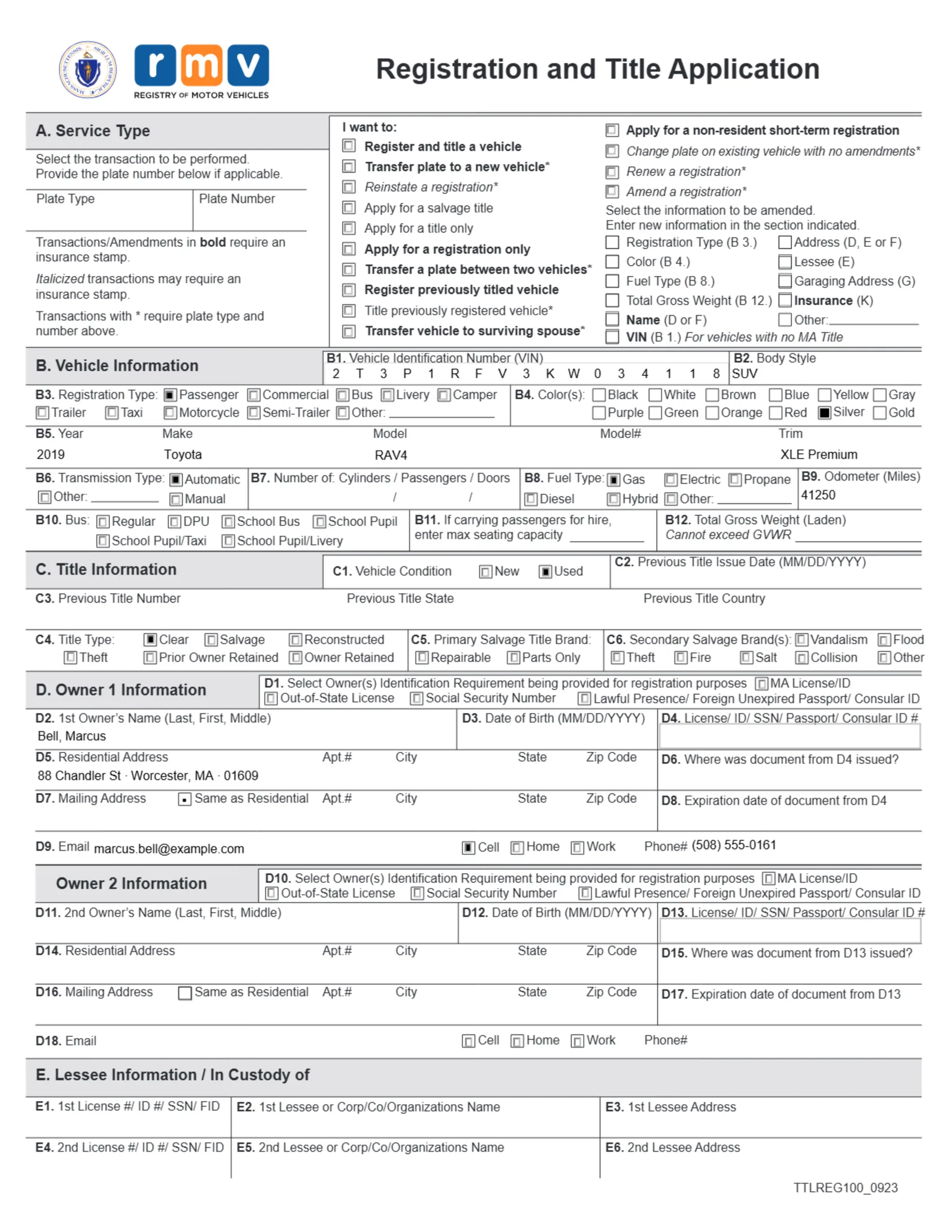
Curious how it works? See how DealerVLO auto-fills every dealer document — bill of sale, FTC Buyers Guide, odometer disclosure, and state title & registration forms for all 50 states, from one deal.
Bond amounts, fees, and form rules change. Get a short email when your state does. No spam, unsubscribe anytime.