How to get dealer plates in Connecticut
What Connecticut dealer plates cost, the types you can get, how to apply, and the rules on using them. Verified as of October 2026.
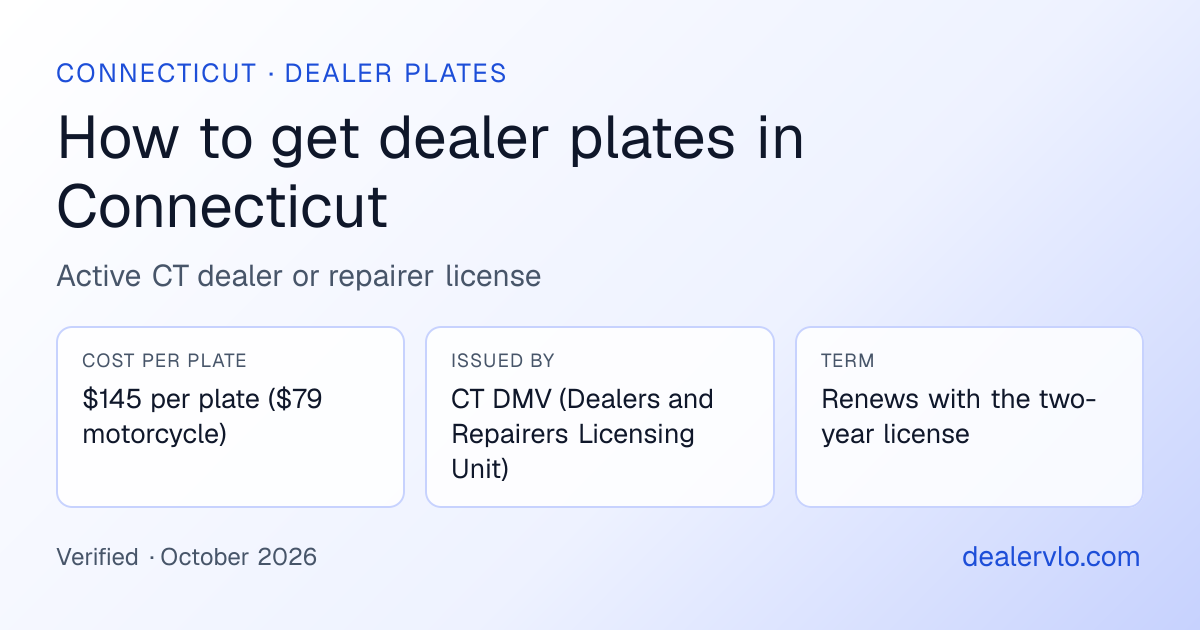
CT dealer plates at a glance:
- Issued by
- CT DMV (Dealers and Repairers Licensing Unit)
- Cost per plate
- $145 per plate ($79 motorcycle)
- Requirement
- Active CT dealer or repairer license
- Use them for
- Inventory, demos, employee use, loans
- Term
- Renews with the two-year license
Informational only — confirm current fees and rules with the CT DMV Dealers and Repairers Licensing Unit before you apply.
Plates are the easy part. These take 20 seconds and tell you what your inventory is costing you while it sits. Free calculators dealers actually use — no signup, no email.
DealerVLO tracks your inventory, deals, and paperwork so the plates are the only thing left on your list. $29/month, free to try — cancel any time.
What Connecticut dealer plates are
In Connecticut, a licensed dealer doesn't register each car on the lot. The law has you apply for a "general distinguishing number and mark" instead, and every vehicle you own or hold is treated as registered under it until it's sold (CGS 14-58). The plates that carry that number are what everyone calls dealer plates.
The DMV decides how many you get. There's no sales-volume table. You justify each extra plate in writing, your insurer certifies coverage for the total count, and the DMV can pull plates back if it decides you don't need them. The use rules in CGS 14-60 are tight, and they're worth knowing before you hand a plate to anyone.
Types of CT dealer plates
The standard plate for passenger vehicles you own or hold. The DMV's plate page lists $145 per regular plate and $79 per motorcycle plate. Plates issued since July 1, 2023 have no expiration date printed on them.
Special dealer plates for trucks and other commercial-registration vehicles you own or hold (CGS 14-59). The statute sets the fee at half the fee for the vehicle's maximum gross weight, so the DMV prices SX plates by GVWR. You can loan an SX-plated truck, or the plate itself, for up to 15 days a year when a customer's own truck is down or their registration is pending.
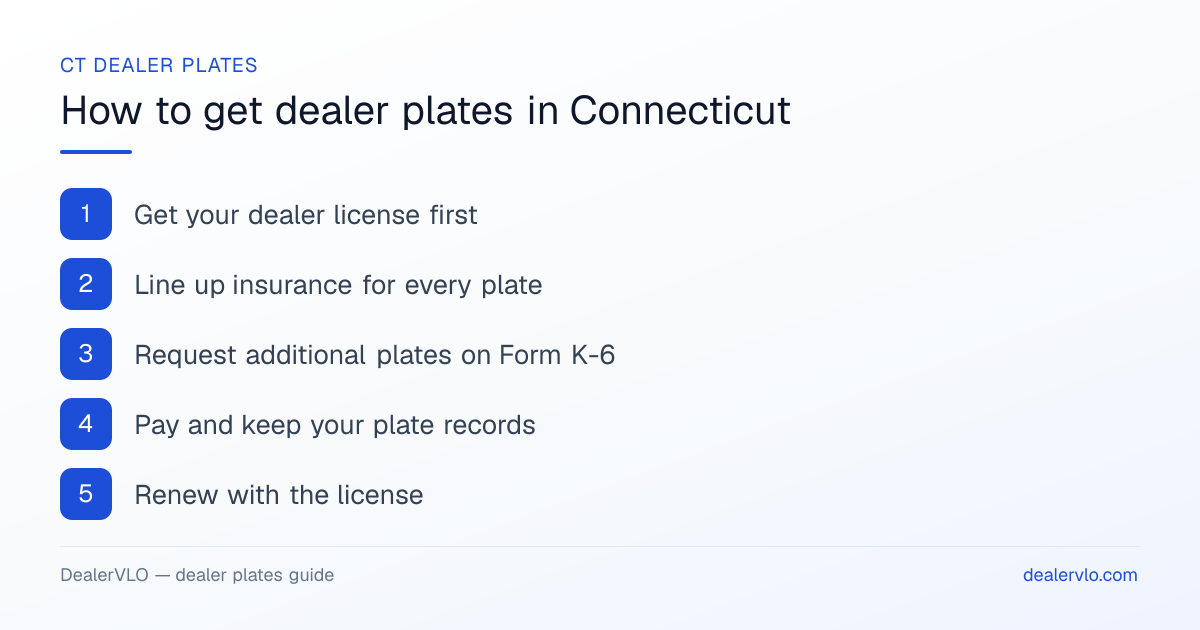
How to get dealer plates in Connecticut
- 1
Get your dealer license first
Plates come with a Connecticut new car dealer, used car dealer, or repairer license. The license, the surety bond and the approved location all come before any plate request.
- 2
Line up insurance for every plate
You must furnish financial responsibility to the DMV (CGS 14-58). For plates, that means a Form R1325e special financial responsibility certificate from your insurer, listing coverage for the total number of plates you'll have assigned.
- 3
Request additional plates on Form K-6
Send the DMV a completed Form K-6 (request for marker plates), the R1325e, and a written statement justifying the extra plates. The statement should include how many employees you have and your average number of service customers.
- 4
Pay and keep your plate records
Pay the plate fee the DMV quotes ($145 per regular plate on its plate page). Then keep a log of every plate: which employee it's assigned to, the date, and where each unassigned plate is (CGS 14-60(b)).
- 5
Renew with the license
Dealer licenses renew every two years. Most dealers can renew online through the DMV's business license auto-renew system. Print and keep the renewed license, the plate list and the receipt. If the license ends, the plates are void and must go back to the DMV right away.
Rules on using CT dealer plates
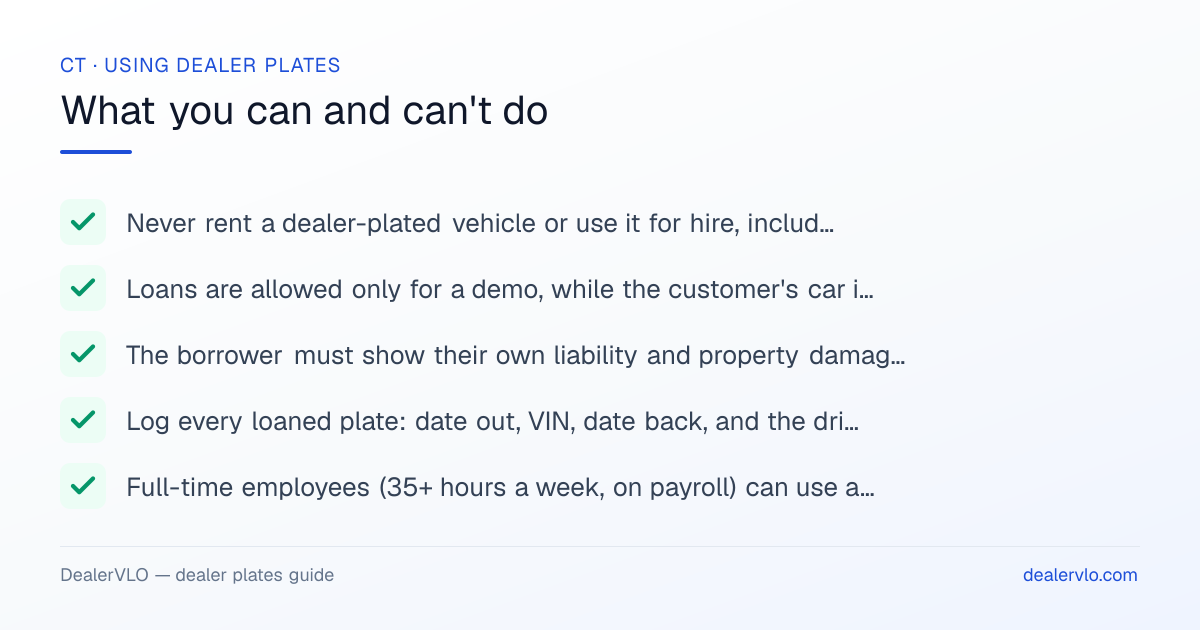
- Never rent a dealer-plated vehicle or use it for hire, including hauling passengers or freight for pay
- Loans are allowed only for a demo, while the customer's car is in your shop, or after a sale while registration is pending, and for no more than 30 days a year
- The borrower must show their own liability and property damage insurance; it's primary. No insurance means you and the borrower are jointly liable
- Log every loaned plate: date out, VIN, date back, and the driver's name, address and license number. Give the driver a copy to carry, and keep the record 6 months
- Full-time employees (35+ hours a week, on payroll) can use a dealer car for business, parts runs and personal use; part-time employees for business only
- Give every driver a document showing they're entrusted with the vehicle (in the form the DMV sets), kept in the car
- If the license lapses or is revoked, the plates are void and must be returned immediately
Common questions
How much are dealer plates in Connecticut?+
The CT DMV's dealer and repairer plate page lists $145 per regular plate and $79 per motorcycle plate. SX plates for commercial vehicles are priced by gross vehicle weight rating. Confirm the current amount with the Dealers and Repairers Licensing Unit before you send payment.
How many dealer plates can I get in CT?+
There's no fixed number in the statute. You request extra plates on Form K-6 with a written justification (employee count and average service customers), and your R1325e insurance certificate has to cover the total. The DMV can limit or withdraw plates if it decides you don't need them or you've violated CGS 14-64.
Can an employee take a dealer car home in Connecticut?+
Yes, if they're a bona fide full-time employee: at least 35 hours a week and on your payroll with taxes withheld. CGS 14-60(b) allows business use, parts pickup and the employee's personal use. Part-time employees can use the car only for dealership business. Keep a record of who has each plate.
Can a customer drive on my CT dealer plate?+
Only in three cases: a demo, a loaner while their car is in your shop, or after they've bought a car and the registration is pending. The total can't exceed 30 days in a year, they must show their own liability and property damage insurance, and you log the loan and give them a copy to carry. Customers who already hold a CT registration can also get a 60-day temporary transfer from a qualified dealer (CGS 14-61).
What insurance do I need for CT dealer plates?+
Your insurer files Form R1325e, a special financial responsibility certificate, listing coverage for the total number of plates assigned to you. If you add plates, the certificate has to cover the new total. The DMV charges a $200 administrative fee if you don't show proof of renewal before your existing policy or bond expires.
Do Connecticut dealer plates expire?+
Plates issued since July 1, 2023 don't have an expiration date on them. They stay valid while your license is valid, and the license renews every two years. If you don't renew, or the license is surrendered or revoked, the plates are void as of that date and must be returned.
Plates on the car? Run the rest of the deal in DealerVLO.
Inventory, the deal jacket, and every CT + federal form your sales need — filled automatically from one deal. $29/month. 14-day free trial, cancel any time.
Bond amounts, fees, and form rules change. Get a short email when your state does. No spam, unsubscribe anytime.