How to fill out the HSMV 84490 in Florida
A field-by-field walkthrough of the Florida HSMV 84490 (Statement of Builder) for licensed used car dealers — what goes in every section, who signs what, and the documents you attach. Verified against the official form as of October 2026.
Filing these every week? Upload the HSMV 84490 to DealerVLO once and it fills from every deal you enter, $29/month flat. See pricing
Filling out the FL HSMV 84490 after a sale:
- What it is
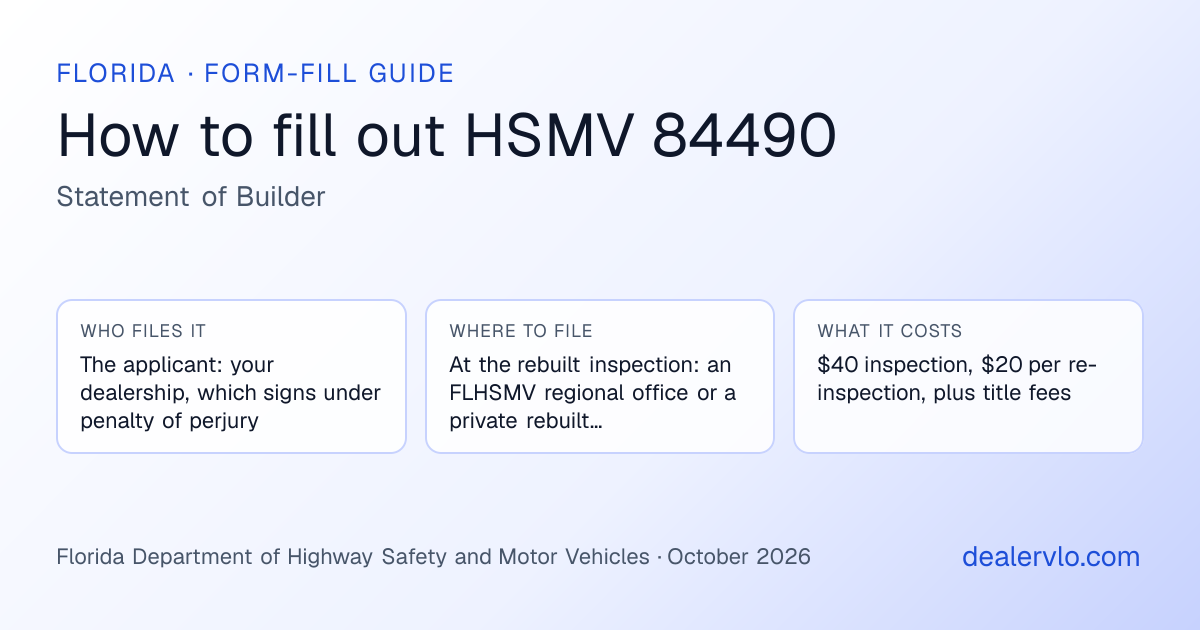
- Florida's builder statement listing the repairs and major component parts used to rebuild a salvage vehicle
- Who completes it
- The applicant: your dealership, which signs under penalty of perjury
- Where to file it
- At the rebuilt inspection: an FLHSMV regional office or a private rebuilt vehicle inspection (PRVIP) facility
- Processing time
- Inspected at the appointment; a failed vehicle has 60 days to correct the problems
- Cost
- $40 inspection, $20 per re-inspection, plus title fees
This guide is informational and does not replace the official Florida instructions. Always confirm the current form and procedure with the Florida Department of Highway Safety and Motor Vehicles before you file.
The HSMV 84490 is one car's paperwork. A 20-second read on your lot, and the tax-and-fee math for the whole deal — built for dealers, no signup. Free calculators dealers actually use — no signup, no email.
Upload the fillable Florida HSMV 84490 to DealerVLO once. It maps the fields, then fills the form from every deal — buyer, co-buyer, the vehicle you sold, and your dealership already in place. $29/month, free to try — cancel any time.
What the HSMV 84490 is and why it matters
HSMV 84490, the Statement of Builder, is the form a Florida dealer files to turn a car on a salvage rebuildable title into a car on a rebuilt title. You list every major component part you repaired or replaced and where it came from, describe the repairs, and certify under penalty of perjury that the vehicle meets Florida and federal safety standards. FLHSMV's procedure TL-37 is blunt about the timing for dealers: "If a dealer rebuilds a vehicle which has a salvage rebuildable title, they must apply for a rebuilt title in their name prior to selling it."
The form goes with an inspection at an FLHSMV regional office or a private rebuilt vehicle inspection facility. That inspection checks the VIN and matches your parts to your receipts to make sure nothing is stolen; it isn't a safety inspection. This guide walks the sections that apply to a rebuilt salvage car and the paperwork that has to come with it.
HSMV 84490 (Revised 05-2024) is printed as "Statement of Builder"; FLHSMV's procedure TL-37 also calls it the affidavit for rebuilt or assembled vehicles. It covers rebuilt, assembled-from-parts, kit car, and custom vehicles, so on a rebuilt salvage car you only use parts of it. Overflow parts go on HSMV 84491. The PDF is fillable, so you can upload it to DealerVLO once under Settings → Forms: the year, make, VIN, color, body, and your dealership's name, address, and phone fill from the deal. When you confirm the field mapping, point the Section IV applicant fields at your dealership (the automatic suggestion uses the buyer) and clear the suggestions on the parts grid's Source/VIN boxes and on the office-only Section V. Those Source/VIN boxes are for the donor vehicles, not this car. The parts grid and repair description are different on every rebuild, so fill those by hand. Note that the first repair-description line in the state's PDF is a signature field, not a text box.
Documents to have before you start
Gather these before you complete the HSMV 84490. A missing attachment is the number-one reason the the Florida Department of Highway Safety and Motor Vehicles bounces a title application back.
- The salvage rebuildable title — A vehicle issued a certificate of destruction can never be rebuilt. Out-of-state salvage titles go through the same rebuilt process.
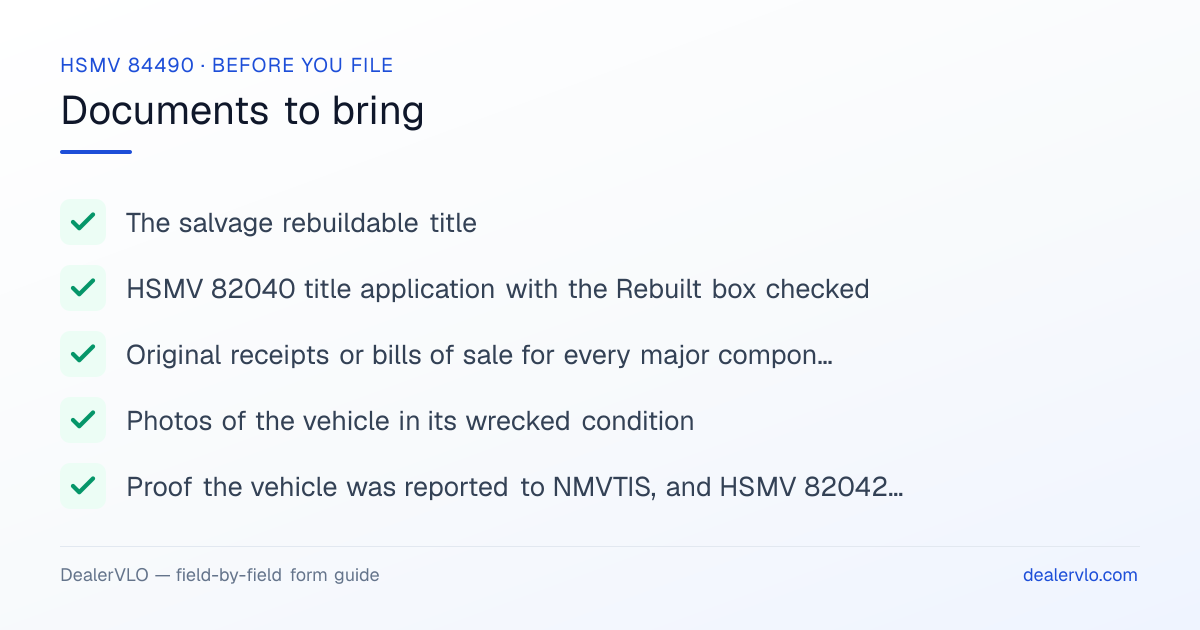
- HSMV 82040 title application with the Rebuilt box checked — In the dealership's name, since you must title it before you sell it. See the HSMV 82040 guide.
- Original receipts or bills of sale for every major component part — In the rebuilder's name, with each part's ID or serial number and proof of payment. Private-seller bills of sale need the seller's name, address, and signature; TL-37 says a business receipt doesn't need a signature.
- Photos of the vehicle in its wrecked condition — From at least two angles, in focus, showing all the damage. Take them before you start the repair.
- Proof the vehicle was reported to NMVTIS, and HSMV 82042 if last titled out of state — Bring the originals plus one set of copies.
HSMV 84490, section by section
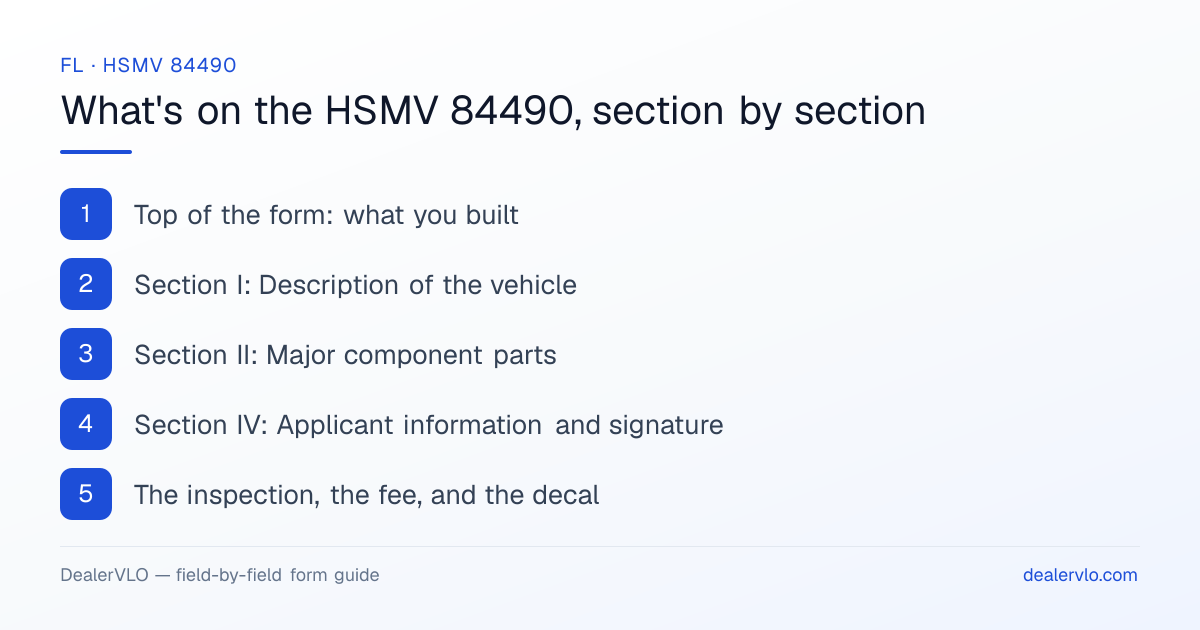
Top of the form: what you built
The form opens with four boxes: REBUILT, ASPT, KIT CAR, and OTHER. For a salvage car you repaired, check REBUILT. The other boxes are for vehicles assembled from parts, kit cars, and other builds.
| Field | Who fills it |
|---|---|
REBUILT Check it for a repaired salvage vehicle. | You (dealer) |
Section I: Description of the vehicle
Check Motor Vehicle (or Motorcycle). Line 1 is the year, make, identification number (VIN), color, and body; the length box is for mobile homes. Line 2 is the title number and title state from the salvage title, and line 3 is for an additional title if there is one. Line 4 is the one people skip: initial it to state that the vehicle "is complete and in road operable condition." The rebuilt application is for a finished car, so don't file until it is.
| Field | Who fills it |
|---|---|
Year, make, identification number, color, body | You (dealer) |
Title number and title state From the salvage rebuildable title. | You (dealer) |
Complete and in road operable condition (initials) | You (dealer) |
Section II: Major component parts
The form defines major component parts as any fender, hood, bumper, cowl assembly, rear quarter panel, trunk lid, door, deck lid, floor pan, engine, frame, transmission, catalytic converter, or airbag, plus the high-voltage parts on electric and hybrid vehicles. Skip item 1; it's only for a vehicle you bought already rebuilt. In item 2, list each major part you repaired or replaced, one per row, check whether it was New, Used, Repaired, Aftermarket, or Homemade, and give the source and the VIN of the vehicle it came from. Use HSMV 84491 if you have more than five. In item 3, describe the repairs in detail. In item 4, enter the number of receipts you're attaching. The inspector matches the parts on the car to this list and to your receipts, so all three have to agree.
| Field | Who fills it |
|---|---|
Item 1: purchased already rebuilt Leave blank on a car you rebuilt. | You (dealer) |
Item 2: part, New / Used / Repaired / Aftermarket / Homemade, source and VIN One row per major part; HSMV 84491 for overflow. | You (dealer) |
Item 3: description of repairs Specific, and consistent with the receipts. | You (dealer) |
Item 4: number of receipts | You (dealer) |
Section IV: Applicant information and signature
Section III is for custom vehicles and street rods, so skip it. In Section IV, date the form and fill in the applicant: your dealership's printed name, street address, city, state, ZIP, and phone, then sign. The certification reads that the vehicle conforms to Florida and Federal Motor Vehicle Safety Standards, and "Under penalties of perjury, I declare that I have read the foregoing document and that the facts provided herein are true." There's no notary block. Section V is for the FLHSMV examiner or PRVIP inspector only.
| Field | Who fills it |
|---|---|
Date | You (dealer) |
Printed name of applicant/business, address, phone | You (dealer) |
Signature of applicant/business Under penalty of perjury. | You (dealer) |
Section V Office and inspector use only. | At the counter |
The inspection, the fee, and the decal
Take the car, the HSMV 84490, the HSMV 82040, the salvage title, the receipts, and the photos to an FLHSMV Bureau of Dealer Services regional office or a Private Rebuilt Vehicle Inspection Program (PRVIP) facility. PRVIP facilities operate in 12 counties (Bay, Broward, Duval, Escambia, Hillsborough, Leon, Manatee, Marion, Miami-Dade, Orange, Palm Beach, and Volusia) and can inspect for customers from any county; FLHSMV lists them on its PRVIP page. The inspection fee is $40, and $20 for each re-inspection; PRVIP facilities can charge their own itemized service fees on top. The examiner verifies the VIN and checks the major components against your receipts. A failed vehicle has 60 days to fix the problems, and the re-inspection has to be done by the same facility or by FLHSMV. A passed car gets a Rebuilt decal, and removing it to hide the rebuilt status is a third-degree felony.
| Field | Who fills it |
|---|---|
Inspection at a regional office or PRVIP facility $40; $20 per re-inspection. | At the counter |
Rebuilt decal Removing it to conceal the status is a felony. | At the counter |
The rebuilt title, and selling the car
The new title is stamped that the vehicle is "rebuilt and may have previously been declared a total loss vehicle due to damage" (§ 319.23), and that brand stays for the life of the vehicle. Then the sale rules apply: § 319.14(2) requires you to disclose in writing, before the sale is completed, that the vehicle is rebuilt, and § 319.14(3) requires every ad for it to clearly and precisely state that it's rebuilt.
| Field | Who fills it |
|---|---|
Title stamped rebuilt, permanently | At the counter |
Written rebuilt disclosure before the sale | You (dealer) |
"Rebuilt" in every ad | You (dealer) |
Common HSMV 84490 mistakes that cause rejections
TL-37 requires photos of the vehicle in its wrecked condition from at least two angles, showing all the damage. Shoot them when the car arrives; you can't recreate them after.
Receipts must be in the rebuilder's name, show each major part's ID or serial number, and show payment. Private-party bills of sale need the seller's name, address, and signature.
The inspector checks the parts on the car against Section II and the receipts. List every major part you replaced, and only those.
A dealer must apply for the rebuilt title in the dealership's name before selling the car.
Under § 319.30, a vehicle issued a certificate of destruction can't be rebuilt or retitled. Check the title type before you buy it.
Common questions
What is Florida form HSMV 84490?+
HSMV 84490 is FLHSMV's Statement of Builder. For a rebuilt salvage vehicle, it lists the major component parts repaired or replaced (new, used, repaired, aftermarket, or homemade, with source and VIN), describes the repairs, and carries the applicant's certification under penalty of perjury that the vehicle meets Florida and federal safety standards. The current revision is 05-2024.
How do you get a rebuilt title in Florida?+
Repair the vehicle on its salvage rebuildable title, then take it to an FLHSMV regional office or a private rebuilt vehicle inspection facility with HSMV 84490, HSMV 82040 marked Rebuilt, the salvage title, original receipts for every major component part, photos of the wrecked vehicle from at least two angles, and proof of NMVTIS reporting. The inspection is $40. The title issued is permanently stamped rebuilt.
Is the Florida rebuilt inspection a safety inspection?+
No. The examiner verifies the VIN and checks the major component parts against your receipts to make sure they weren't stolen. FLHSMV's own guidance describes it as inspecting the major components to ensure the parts haven't been stolen. The applicant certifies on HSMV 84490 that the vehicle meets safety standards.
Can a Florida dealer sell a car on a salvage title?+
Not as a rebuilt car. FLHSMV's procedure TL-37 says a dealer that rebuilds a vehicle on a salvage rebuildable title must apply for a rebuilt title in its own name before selling it. After that, Florida law requires written disclosure of the rebuilt status before the sale, and every ad must state it.
Does HSMV 84490 need to be notarized?+
No. The form has no notary block. The applicant signs a declaration under penalty of perjury.
Which salvage cars can't be rebuilt in Florida?+
Any vehicle issued a certificate of destruction. Under § 319.30, that includes late-model vehicles worth at least $7,500 before the loss when repairs reach 90% or more of their value, vehicles worth only parts or scrap, and vehicles brought in on out-of-state junk, parts-only, or not-repairable documents.
Is there software that fills out the HSMV 84490 automatically?+
Yes. The Florida HSMV 84490 is a fillable PDF, so dealer management software like DealerVLO can fill it for you: upload the blank form once, DealerVLO detects its fields and suggests a mapping you confirm, and from then on it fills from every deal you enter — the buyer, co-buyer, the vehicle you sold, and your dealership's details already in place. It's $29/month flat with a 14-day free trial, and the same deal also generates your federal documents (Bill of Sale, FTC Buyers Guide, odometer disclosure) and your state title paperwork.
- How to fill out Florida Form HSMV 82040
- Can you make money selling salvage title cars?
- Salvage and branded title disclosure by state
- Selling salvage and rebuilt title cars as a dealer
- How to get a used car dealer license in Florida
- Florida dealer plates
- E-signatures and e-titling for Florida dealers
- How Florida car sales tax works on a dealer sale
- Title application forms in every state
- How much is a dealer's license? Cost in every state
Stop filling out the HSMV 84490 by hand.
Upload the fillable FL HSMV 84490 once. DealerVLO detects its fields, you confirm the mapping, and every deal after that prints it with the buyer, co-buyer, vehicle, and your dealership already in place. $29/month. 14-day free trial, cancel any time.
Curious how it works? See how DealerVLO auto-fills every dealer document — bill of sale, FTC Buyers Guide, odometer disclosure, and state title & registration forms for all 50 states, from one deal.
Bond amounts, fees, and form rules change. Get a short email when your state does. No spam, unsubscribe anytime.