How to Write Used Car Listings That Sell
Learn how to write used car listings that convert browsers into buyers. Covers descriptions, feature bullets, marketplace keywords, condition honesty, and disclosure requirements for independent dealers.
Inventory, the deal jacket, and every federal + state form filled from one deal — plus your own dealer website. $29/month, free to try — cancel any time.
Why listing copy still matters in 2026
We all know photos sell cars — if you haven't nailed that yet, start with how to photograph used cars before you come back here. But once a buyer clicks into your vehicle detail page, the next thing they do is read. They read to confirm what they saw in the thumbnail, to find the details the photos didn't show, and to decide whether you're honest enough to call.
Good listing copy doesn't replace good photos. It complements them. A clean description speeds up the buyer's decision, answers the questions they'd ask on the phone, and gives marketplace algorithms the structured keywords they need to surface your inventory when someone searches "used Silverado under 15k near me."
Bad copy — vague, full of hype, or missing the details that matter — sends buyers to the next listing. Worse, copy that omits required disclosures or misstates condition can land you in front of a regulator or a judge. Courts hold dealers to a higher standard than private sellers when it comes to disclosing vehicle history, and state consumer protection laws treat material facts about condition as mandatory to disclose.
This guide covers what to write, how to structure it, which keywords matter for marketplace search, and how to stay compliant while still writing copy that converts.
Compliance note: This article touches on federal advertising rules and disclosure practices. It is not legal advice. Confirm your state's current requirements with your attorney or state motor vehicle authority before you publish listings or advertise prices.
What has to be in every listing (compliance first)
Before you write a single emotional hook or feature bullet, get the mandatory disclosures right. The FTC's Used Car Rule applies in every state except Maine and Wisconsin, and it requires you to post a Buyers Guide sticker before you display a vehicle for sale or let a customer inspect it. That sticker discloses warranty terms — as-is or dealer warranty — and you must honor what it says.
The Buyers Guide is a physical sticker, but the substance of what it requires carries into your online listings. If you're advertising a car as-is, say so clearly. If you're offering a dealer warranty, state the duration and what percentage of repair costs you'll cover. Buyers who see one thing online and another thing on the lot assume you're hiding something, and they leave.
Vehicle history is a material fact under state unfair and deceptive practices laws. If you know or reasonably should have known that a car was a rental, a prior salvage, a flood vehicle, or had frame damage, you must disclose it. Dealers get sued over this constantly, and the standard is high: courts assume you know more about the car than the buyer does, so "I didn't check" isn't a defense.
Pull a history report on every unit — Carfax, AutoCheck, or the National Motor Vehicle Title Information System — and disclose what it shows. If the report is clean, say so and link to it in the listing. If there's an accident or a prior rental flag, disclose it up front and price accordingly. Honesty about condition builds trust, and trust converts better than hype.
As of March 2026, the FTC sent warning letters to 97 dealer groups clarifying that the advertised price must include all mandatory dealer-imposed charges. The only items you can exclude from the headline price are government taxes and government registration fees. Your doc fee, dealer prep, and any other mandatory add-ons have to be in the number you advertise. If your listing system or third-party feed isn't set up to do this automatically, fix it before you publish another unit.
How to structure a description that converts
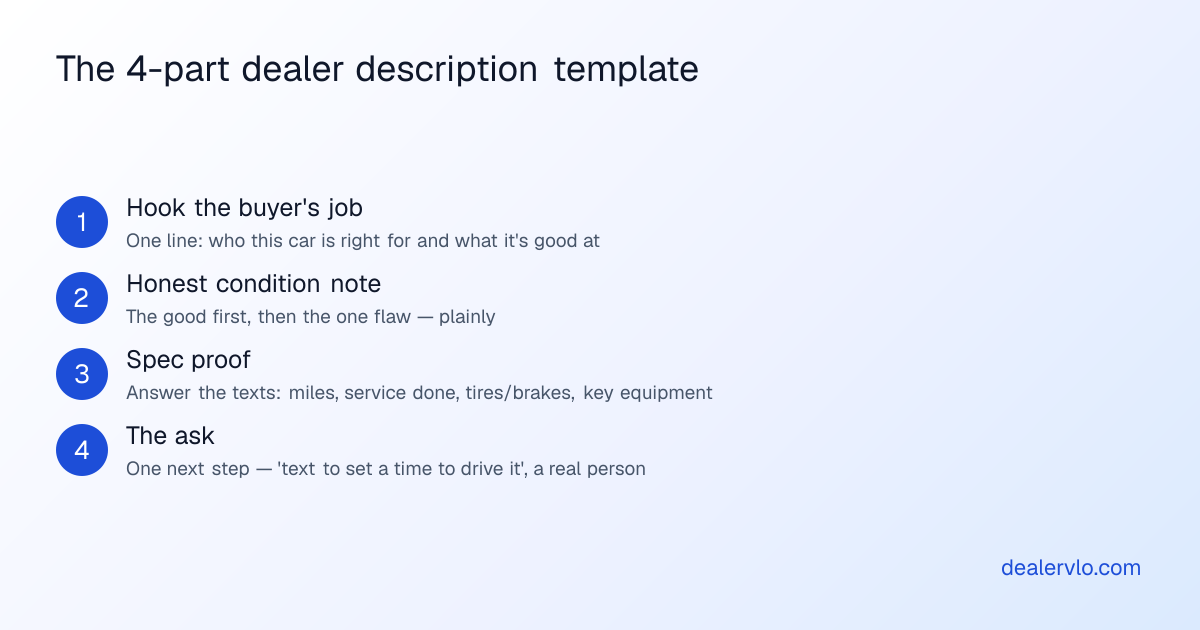
Start with the most important information first: year, make, model, trim, mileage, and condition summary. Buyers skim, and they decide in the first two sentences whether to keep reading. A strong opening looks like this:
2022 Honda CR-V EX with 38,000 miles. One-owner, clean Carfax, serviced at the dealership through 36k. Non-smoker, no accidents, new tires at 35k.
That opener answers the six questions every buyer asks before they call: how old, how many miles, how many owners, any accidents, any smoking, and recent maintenance. You've eliminated half their objections in three sentences.
Next, work through features in logical groups. Don't list every line item from the window sticker — that's what the spec sheet is for. Focus on the features that move the needle for this body style and price point. For a family SUV, buyers care about third-row seating, backup camera, blind-spot monitoring, and whether the second row has captain's chairs or a bench. For a crew-cab truck, they care about bed length, tow package, four-wheel drive, and whether it has the bigger engine.
Group related features into short paragraphs or bullets:
- Safety & driver assist: Lane-keeping assist, adaptive cruise, blind-spot monitoring, rear cross-traffic alert.
- Comfort & convenience: Heated leather seats, dual-zone climate, power liftgate, remote start.
- Technology: Apple CarPlay, Android Auto, navigation, premium audio.
Bullets scan faster than paragraphs, and marketplace algorithms parse them better. If your listing platform supports structured bullets, use them. If not, format them clearly with line breaks or dashes.
After features, address condition honestly. This is where most dealers either oversell or undersell. Don't write "mint" or "showroom" unless the car genuinely looks like it just rolled off the lot — and even then, it's safer to be specific. Instead of "excellent condition," write "clean interior, no rips or stains, minor door ding on driver's rear quarter, otherwise no body damage." Buyers trust specifics more than adjectives, and calling out a small flaw up front proves you're not hiding the big ones.
If the car has high mileage but strong service records, lean into that: 118,000 miles, but timing belt and water pump replaced at 105k, transmission serviced at 110k, and it drives tight. Priced to reflect mileage. You're not apologizing — you're positioning it as a value buy for someone who wants a well-maintained truck and doesn't need low miles.
End with a call to action that reflects how you actually want buyers to reach you. If you prefer text, say "Text [your number] to schedule a test drive." If you want them to come by, say "Stop by [lot address] — we're open [hours], no appointment needed." Don't end with generic fluff like "won't last long" unless you genuinely expect it to sell in 48 hours.
Keyword optimization for marketplace search
Marketplaces like Autotrader and Cars.com rank listings based on structured data and search relevance, and Google increasingly surfaces inventory pages when someone searches transactional keywords like "used Ford F-150 for sale [city]" or "SUV under 20k near me." If your descriptions don't contain the terms buyers actually search, the algorithm won't surface your car.
The highest-value keywords for used-car listings are transactional and hyper-specific: year, make, model, trim, price range, body style, and location. Buyers searching for used inventory are further down the funnel than someone researching new models, so they search differently — they often include price caps, mileage limits, or feature requirements.
For example, someone shopping for a family hauler might search "used Honda Pilot under 25k" or "7-passenger SUV near [city]." If your listing title and description include those exact phrases — naturally, not stuffed — you're more likely to rank. Prioritize long-tail keywords that match real buyer intent over generic short-tail terms. "Used car" is useless; "used Toyota Camry low miles [your city]" converts.
Marketplace algorithms also reward listings that include trim-level detail, because buyers filter by it. Don't write "2021 Chevy Equinox" if it's actually an Equinox Premier with the Convenience & Driver Confidence package. Write the trim name and the package if it's a known one, because someone searching "Equinox Premier" expects to see it in the results.
Local SEO matters more for used-car dealers than almost any other retail category. A fully optimized Google Business Profile and city-specific landing pages help, but your individual listings also carry local weight if you include geographic keywords naturally. Mention your city or region once in the description — "serviced locally at [City] Honda" or "available for viewing at our [City] location" — and make sure your contact info matches your GBP exactly.
In 2026, search increasingly means AI-assisted tools like ChatGPT, Perplexity, and Google's AI Overviews pulling answers instead of returning a list of links. If someone asks an AI assistant "best used SUV under 20k near me," the answer it gives is being pulled from a dealership's structured content somewhere. Listings that state facts declaratively and answer common questions directly are more likely to get cited. This doesn't mean you write for robots — it means clear, well-organized descriptions perform better everywhere, including in AI-generated results.
Conversational queries tend to be longer and more question-shaped than classic keyword searches. Instead of "used truck," buyers ask "where can I find a used Silverado with low miles near [city]?" If your description answers that implicit question — mileage, location, availability — you're more likely to show up.
For guidance on which inventory to prioritize in your listings and merchandising, see best used cars to stock in 2026 and how to buy cars that sell fast.
What details actually matter to buyers
Buyers want proof the car was maintained, evidence it wasn't abused, and confidence they're not inheriting someone else's problem. The details that move the needle are service history, ownership count, accident history, and recent repairs or replacements.
If you have service records — either from the prior owner or from pulling the vehicle's maintenance history through the dealership network — mention the highlights. "Oil changes every 5k miles, brake pads replaced at 42k, battery new in 2025" tells the buyer this car was cared for. If you don't have full records but the CarFax shows regular service intervals, say "CarFax shows consistent maintenance at [Brand] dealerships."
One-owner and two-owner cars sell faster than three-plus-owner units, especially at higher price points. If it's a single-owner trade-in and you can say so, lead with it. If it's a lease return, that's worth mentioning too — lease returns are typically well-maintained and low-mileage, and buyers know it.
For trucks and SUVs, towing capacity and four-wheel-drive status are make-or-break details. Don't assume the buyer knows which trims came standard with 4WD or which engine has the tow package. Spell it out: "factory tow package, 9,200-lb capacity" or "4WD with low-range transfer case." If the bed is a short bed versus a long bed, say so — contractors and weekend haulers care.
Used EVs are a growing category, and they require more transparency than gas vehicles. Buyers evaluating a used electric car want to know battery state of health, remaining manufacturer warranty coverage, realistic range estimates, and charging speed. If you have a battery health report, include the percentage. If the factory battery warranty is still active (many are 8 years / 100k miles), highlight it. If you don't have diagnostic data, say "no battery diagnostics available" rather than skipping it, because silence reads like you're hiding degradation.
Condition honesty is not a liability — it's a filter. If you disclose a cosmetic flaw or a minor mechanical note, the only people you lose are the ones who would have walked anyway after they saw it in person. The people who stay are pre-qualified, and they're more likely to close because you've already set accurate expectations. Frame the disclosure in context: "small paint chip on hood from road debris, otherwise clean paint" or "A/C blows cold but could use a recharge by next summer." You're not apologizing; you're showing you checked.
If you've done recent recon work — new tires, brakes, alignment, detail — say so. Buyers assign real value to "just serviced" or "new inspection sticker," and it justifies your price versus a private-party listing that's selling as-is.
For additional tips on getting units retail-ready, see how to detail and recondition cars for resale.
Writing tone and style for independent dealers
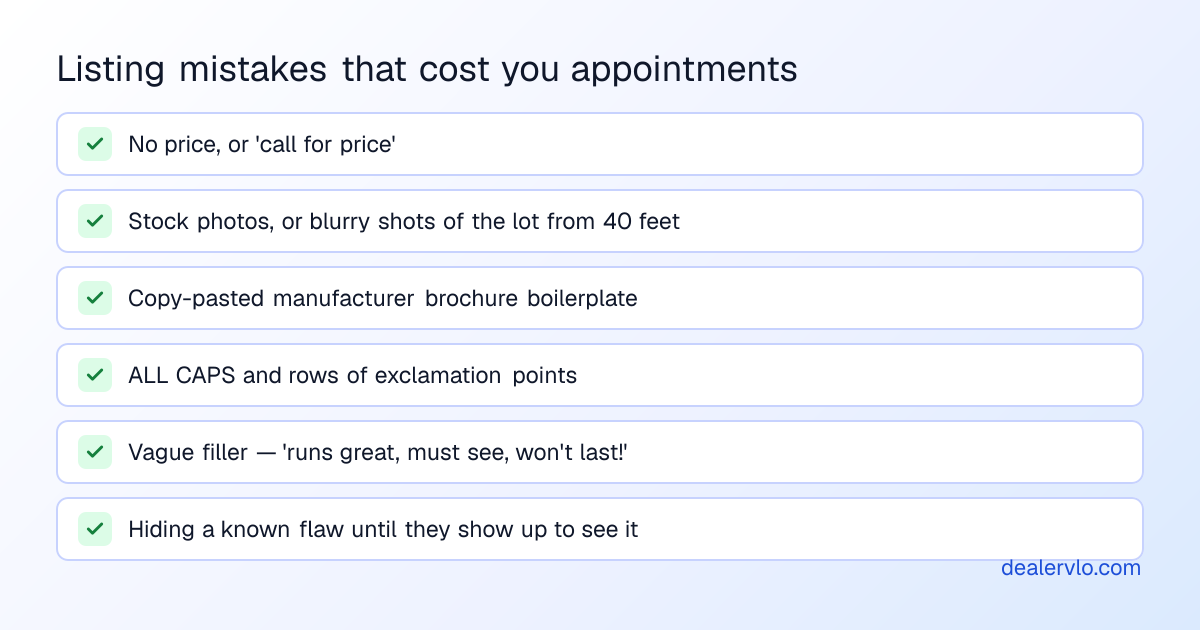
You're not a megadealer franchise with a corporate voice guide and a compliance team reading every word. You're an independent lot, and your listings should sound like a real person who knows cars and doesn't waste the buyer's time. That means no boilerplate, no ALL CAPS, no exclamation points after every sentence, and no phrases like "AMAZING DEAL!!!!" that make you sound like you're yelling at a live auction.
Write the way you'd talk to a buyer standing on your lot. Be direct, specific, and helpful. If the truck has a leveling kit and bigger tires, say "leveling kit installed, rides level, 33-inch all-terrains with 80% tread." That's clear and useful. "SICK CUSTOM LIFT!!!" is not.
Avoid jargon unless your buyer base expects it. If you're selling work trucks to contractors, terms like "gooseneck hitch" and "PTO-ready" are fine — they know what they mean. If you're selling a family sedan to a first-time buyer, "lane-keeping assist" is clearer than "LKA."
Emotion works when it's earned. If the car genuinely has a story — one-owner garage-kept trade-in, adult-driven lease return, local car with full service history — lean into it. "Traded in by the original owner who bought it new here in 2020 and serviced it here every 5,000 miles" is an emotional hook backed by fact. "You'll love this car!" is empty.
If you're listing on Facebook Marketplace or other platforms where your personal tone matters more than on aggregator sites, feel free to add a little personality. "I've had this truck for three weeks and I'm honestly surprised it hasn't sold yet — clean interior, no rust, drives great" works in a peer-to-peer environment. That same line would feel out of place on Autotrader.
Length matters less than clarity. Some guides recommend a specific word count, but there's no magic number. If you can cover the key details in 150 words, stop there. If it's a higher-dollar or unusual unit and you need 300 words to tell the story and disclose everything, use them. The test is simple: if a buyer reads your description, do they have enough information to decide whether to call, or do they still have to ask basic questions?
Don't repeat information that's already in the structured fields. If the listing platform displays mileage, trim, and exterior color at the top of the page, you don't need to restate them in the first sentence of your description. Use that space for details the algorithm can't surface — service history, condition notes, recent upgrades.
Managing listings at scale without losing quality
If you're turning 8-12 units a month, you can write every listing by hand. If you're pushing 30-plus, you need a system or you'll default to copy-paste templates that all sound identical.
AI-assisted merchandising tools can generate trim-specific descriptions and feature lists faster than you can type them, and they're increasingly good at pulling the right details for the year and model. But they're not good at the parts that actually convert: the condition-specific notes, the service history summary, the local keyword mentions, and the honest disclosure of flaws. Use AI to draft the feature bullets and spec overview, then edit in the details that matter.
If you're using a DMS that auto-generates listings from your inventory feed, make sure it's pulling accurate data and that you have a way to add custom notes for each unit. A description that's 90% auto-generated and 10% hand-written detail will outperform a 100% auto-generated wall of specs. For more on choosing systems that support this workflow, see best DMS for independent used car dealers and cloud-based DMS options.
Standardize your disclosure language so you're not rewriting compliance boilerplate every time. Create a short template for as-is sales, another for cars with a dealer warranty, and another for certified units. Paste the appropriate one into each listing and customize the rest.
Track which listings convert and which sit. If a car has 40 page views and no calls, the photos or the price are wrong — or the description isn't answering the buyer's objections. If a car has strong page views and lots of calls but no test drives, your description might be overselling the condition. Use your DMS or marketplace analytics to spot patterns, then adjust your copy accordingly. For pricing strategy context, see how to price used cars and set dealer markup.
Marketplace-specific optimization
Each major listing platform has its own ranking algorithm and its own buyer behavior. Autotrader and Cars.com both reward detailed, accurate listings with more prominent placement, but the weight they assign to photos versus keywords versus recency varies and isn't public.
What we do know: both platforms parse structured data better than unstructured prose. If your feed or manual entry includes trim-level detail, option packages, and feature flags, use them. A listing tagged with "heated seats," "navigation," and "sunroof" will surface in filtered searches that a listing with those terms buried in a paragraph won't.
Cars.com emphasizes dealer reviews and transparency features. If you're active on that platform, make sure your profile is complete, your reviews are recent, and your listings link to vehicle history reports. Autotrader's editorial content and comparison tools mean buyers often arrive after researching the model elsewhere — your listing needs to confirm what they learned and add the unit-specific details they can't get from a review site.
Local classifieds and Facebook Marketplace skew toward lower-price inventory and private-party-style listings. Buyers on those platforms expect a more casual tone and often want to text or message before they call. If you're cross-posting to Facebook, tailor your description to sound less corporate: drop the feature bullets, write in first person, mention where the car is located, and make it easy to message you directly.
Google's local inventory ads and organic search results increasingly pull from structured data markup on your website. If your site supports schema markup for vehicles (year, make, model, mileage, price, condition, VIN), implement it — it helps your listings show up in rich results and in AI-generated answers.
For broader guidance on digital marketing budget and channel mix, see used car dealer marketing budget.
Data security and compliance when managing listing content
Your listing system — whether it's a third-party marketplace feed, a DMS with integrated VDPs, or a website inventory plugin — handles customer information and vehicle data. That makes it subject to the FTC's Safeguards Rule, which requires financial institutions (including auto dealers) to protect customer information with administrative, technical, and physical safeguards.
Enforcement of the Safeguards Rule has intensified in 2026, with the FTC pursuing more actions against auto dealers specifically. The rule requires multi-factor authentication for any system that accesses customer information. If your DMS, CRM, or listing management platform still uses username-and-password-only login, you're out of compliance.
Make sure any third-party vendor that touches your inventory data or customer inquiries is contractual bound to meet the same standards. If a lead-aggregation service stores buyer contact info and gets breached, you're still liable. Ask your vendors about their security practices, whether they encrypt data in transit and at rest, and whether they'll sign a business associate agreement if required.
If you collect buyer inquiries through forms on your VDPs — which most marketplace and website listings do — treat that contact information as customer data from the moment it hits your inbox. Store it securely, don't share it with third parties without consent, and delete it when you no longer need it.
For independent dealers, the practical compliance steps are: enable MFA on every system, use a DMS or CRM that encrypts stored data, train anyone who has access not to forward customer info through unsecured channels, and document your policies in writing. The FTC expects you to have a written information security plan, even if you're a one-person shop. For more on software that meets these requirements, see used car dealer software and dealer paperwork software.
Bottom line
Good listing copy doesn't replace good photos, competitive pricing, or a well-maintained lot — but it's the bridge between the first click and the phone call. Write clearly, disclose honestly, include the details that answer buyer questions before they ask, and optimize for the keywords and structure that marketplace algorithms reward. If you do that consistently, your listings will surface higher, convert better, and generate fewer surprises when the buyer shows up.
Most dealers under-invest in listing copy because they assume photos do all the work. The dealers who write tight, specific, keyword-rich descriptions get more organic traffic, better-qualified leads, and faster turns. It's not hard — it just has to be done every time, for every unit.
Frequently asked questions
What makes a used car listing description effective?
An effective description answers the six questions every buyer asks up front: year, make, model, mileage, ownership history, and condition. Start with the most important facts, group features logically, disclose condition honestly with specific details rather than generic adjectives, and end with a clear call to action. Include service history highlights and recent maintenance, and avoid hype or ALL CAPS. The goal is to give buyers enough information to decide whether to call without making them hunt for basic details.
Which keywords should I include in a used car listing?
Focus on transactional long-tail keywords that match real buyer search behavior: year, make, model, trim, body style, price range, and your city or region. Buyers searching for used inventory often include terms like "under 20k," "low miles," "crew cab," or "7-passenger." Include the exact trim name and option packages because buyers filter by them on marketplaces. Mention your location naturally once in the description, and make sure your listing title contains the year, make, model, and trim. Avoid keyword stuffing — write for humans first and let the structure carry the SEO weight.
Do I have to disclose prior accidents or rental history in my listings?
Yes. Vehicle history is a material fact under state unfair and deceptive practices laws, and courts hold dealers to a higher standard than private sellers. If you know or reasonably should have known about prior accidents, rental use, salvage title, flood damage, or frame damage, you must disclose it. Pull a vehicle history report on every unit and state what it shows. If the report is clean, say so and link to it. If there's an accident or other flag, disclose it up front and price accordingly. Honesty builds trust and protects you legally — silence or misrepresentation can result in lawsuits and regulatory penalties.
How long should a used car listing description be?
There's no magic word count. The right length is however many words it takes to cover the key details clearly without repeating information already in the structured fields. For most used cars, that's 150-250 words. Higher-dollar or unusual units may need more space to tell the story and disclose condition details. Lower-price or high-volume inventory can be shorter if the photos and specs speak for themselves. The test is whether a buyer can read your description and decide whether to call without having to ask basic questions. Stop writing when you've answered those questions.
Can I use AI tools to write my vehicle descriptions?
Yes, and many high-volume dealers do. AI-assisted tools can generate trim-specific feature lists and spec overviews faster than manual typing, and they're good at pulling accurate details for a given year and model. But AI-generated copy is weak on the parts that actually convert: service history, condition-specific notes, recent upgrades, honest flaw disclosure, and local keyword mentions. Use AI to draft the feature bullets and boilerplate, then edit in the unit-specific details that matter. A listing that's 90% auto-generated and 10% hand-written will outperform a 100% template every time.
What's the FTC's current rule on advertised pricing for used cars?
As of March 2026, the FTC clarified that the price you advertise must include all mandatory dealer-imposed charges. The only items you can exclude from the headline price are government taxes and government registration fees. That means your doc fee, dealer prep, and any other non-negotiable add-on must be included in the advertised price. If your listing feed or website isn't set up to do this automatically, update it before you publish another unit. Violations of federal advertising rules can result in significant penalties per violation, and enforcement is active in 2026.
Before you authorize the work: see whether a repair earns back its cost plus the holding days it adds.
Open the Recon ROI Calculator