List It Before It Lands: Pre-Arrival Merchandising From Auction Photos and Condition Reports
How to legally list a car before it arrives at your lot, using auction condition-report photos and an estimated price.
Part of the Buying & sourcing inventory guide: How to buy at dealer auctions without getting buried
Switching from another DMS? Compare DealerVLO to DealerCenter, Frazer, or Lot Wizard, or see what DealerVLO's car dealer management software includes.
Most independent lots wait until a car is washed, photographed, and sitting on the line before it goes on the website. That's days of lead time you're leaving on the table. If you bought the car at auction, you already have real photos of the actual VIN and a condition report that tells you roughly what recon it needs — which is enough, done carefully, to list it before the hauler even picks it up.
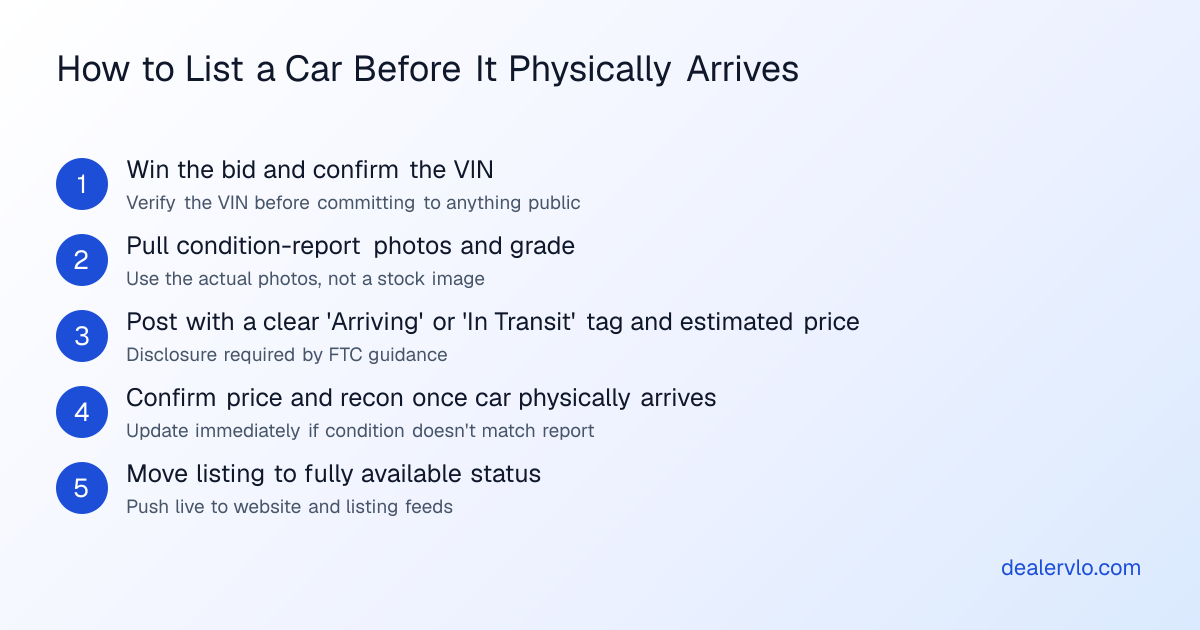
This isn't a gray-area hack. The FTC has been explicit that dealers can advertise a vehicle that isn't physically on the lot yet, as long as the ad makes that clear and the car is genuinely available — not already spoken for. Get the disclosure right, price it as an estimate, and you can start generating leads before the car ever crosses your curb.
14-day free trial, then $29/mo · Cancel anytime
This isn't legal advice — advertising rules get enforced by the FTC and interpreted by the courts, and policies on third-party marketplaces change. Confirm anything you're unsure about with the FTC's own guidance or your own counsel before you build a process around it.
What the FTC actually allows (and what it doesn't)
The relevant guidance here is the FTC staff's price-transparency FAQ published in September 2026, which followed warning letters sent to a wave of dealership groups over advertising practices. It doesn't create a new rule out of nowhere — truthful, non-deceptive advertising has been required under Section 5 of the FTC Act for decades — but it spells out, in more detail than before, how that applies to inventory that isn't physically present.
Here's the shape of it:
- You can advertise a car that's in transit, stored offsite, or available through a dealer trade/inventory-sharing arrangement, but the ad has to plainly disclose that the vehicle is not physically on the lot.
- The car has to be genuinely available. The FTC specifically calls out the practice of advertising a car "in transit" as a hook to get a shopper in the door, when the unit is actually already allocated to someone else's order. If you bought it at auction and it's yours, that's fine. If a unit is already committed to a specific buyer or deal, it can't be advertised as available.
- For used vehicles, the photo has to be the actual car, not a stock or representative image. This is the part that makes pre-arrival listing workable in the first place. Auction condition-report photos are real photos of the real VIN — they satisfy this requirement in a way a generic stock photo of "a 2021 Camry" never would.
- Sold or unavailable cars need to come down promptly. The FTC's own language doesn't specify an hour count, but industry commentary following the guidance has pointed dealers toward pulling sold listings quickly as a sound practice — treat that as a best practice to build into your process, not a hard legal deadline.
Practically, this means your pre-arrival listing needs a clear tag — something like "In Transit — Arriving [date]" or "Pending Arrival" — sitting right on the listing, not buried in the description. Don't rely on a marketplace's native "pending" status for this; on platforms like Facebook Marketplace, "pending" means a sale is in progress, which is a different thing entirely from a car that physically hasn't arrived yet. Conflating the two is exactly the kind of ambiguity the FTC guidance is aimed at.
Where the photos and pricing actually come from
You don't need to invent anything here — the auction already generated what you need, you're just using it earlier than most lots bother to.
Photos: Every condition report from a major auction comes with photos of the actual vehicle, taken by the inspector at intake. Those are the photos you use. Don't touch them up to look better than reality — a car with a grade indicating meaningful curb rash shouldn't show up on your site looking showroom-fresh. Leave merchandising polish for later: once the car is physically on your lot and you've taken your own photos, that's the point where a tool like DealerVLO's photo enhance (which places the car on a clean white, dark, or showroom backdrop without altering the car itself) makes sense — it's for your own retail photography, not a step you need while you're still working from borrowed auction images.
Condition and recon estimate: The grade on the condition report (and the composite condition-score some auctions attach alongside it) is based on an inspector cataloging visible cosmetic damage against a standardized scale — it's not a guess, but Manheim's own buyer guidance is blunt that you should never make a final decision on the grade alone. Use it to build a range, not a number you print on the window sticker. If the report flags curb rash on two wheels and a cracked windshield, you can reasonably estimate a recon cost bracket before the car lands — then confirm it once the car is physically in front of you.
This is also why the estimated price on a pre-arrival listing should say "estimated" and move once the car is actually inspected. If the condition report undersold the damage, your reconditioning cost just went up and your price needs to reflect that before you let a shopper make an offer on stale numbers. Once the car is in front of you and you're deciding whether a specific repair is worth doing, the Recon ROI Calculator takes the recon cost, the shop days, and the retail value the work adds, and shows you the net gain and return per dollar — useful for checking a repair against your plan before you spend the money, not just your gut feel.
Before you authorize the work: see whether a repair earns back its cost plus the holding days it adds.
Open the Recon ROI CalculatorWhy the lead time is worth the extra discipline
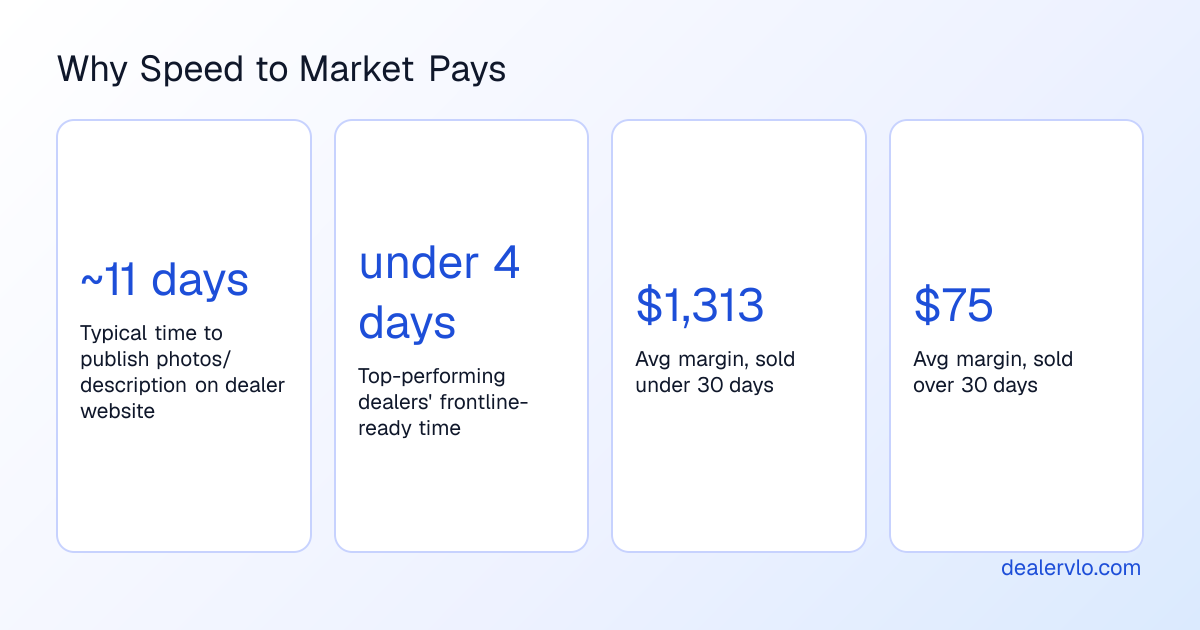
Cox Automotive's own speed-to-market research has long pointed at a gap between when a car lands and when it's actually live on a dealer's website — in-house reconditioning and listing workflows at a typical dealer have historically taken well over a week, while faster operators get the same car frontline-ready in a few days. The same research ties that gap directly to money: vehicles that sell inside 30 days carry meaningfully more gross than ones that sit past that window. Every day a car sits unlisted after you've already paid for it is a day of that window burned for nothing.
Pre-arrival listing doesn't eliminate recon time — the car still needs its actual work done once it lands. What it does is move the lead-generation clock back to the day you won the bid instead of the day the detail guy finishes. A shopper who inquires on a car that's "arriving next week" is still a real lead you can start working: you can answer questions, quote financing, and even get a soft commitment lined up before the car is detailed and plated. A lead that comes in from your dealer website this way lands in DealerVLO's lead inbox like any other, with the car attached and a source recorded, so you can set a follow-up date and work it the same way you'd work a lead on a car already sitting on the lot.
14-day free trial, then $29/mo · Cancel anytime
Building the listing without misrepresenting the car
A few operational rules keep this clean:
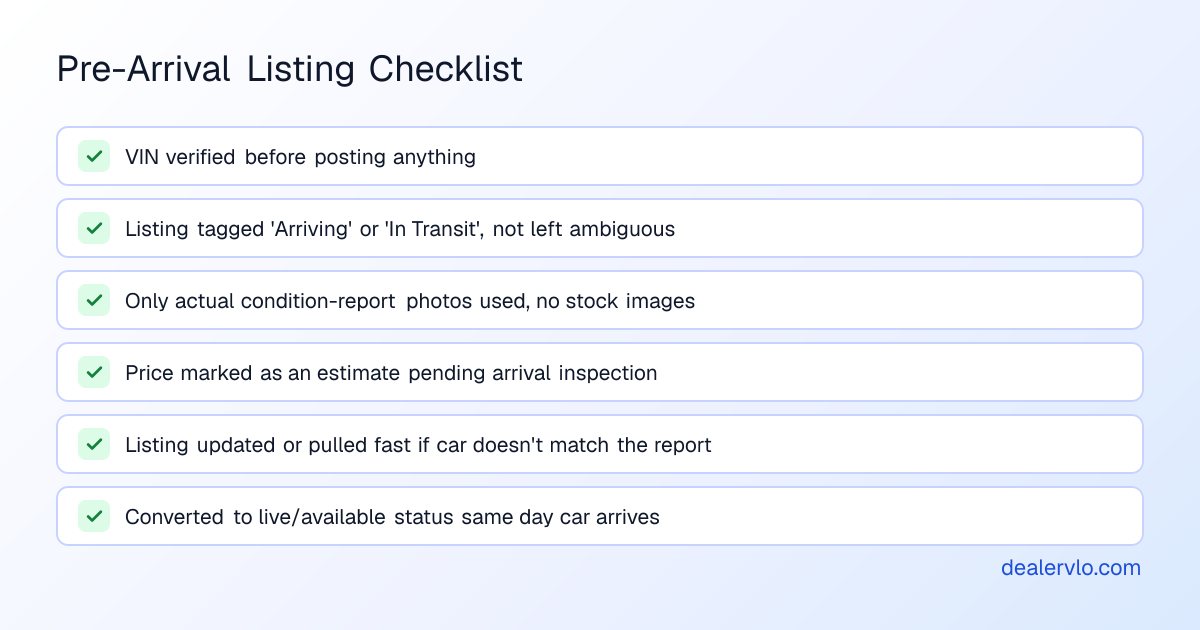
- Tag it unmistakably. "Arriving [date]," "In Transit," or "Pending Arrival" — pick language and use it consistently so shoppers never think the car is sitting on your lot right now.
- Use the real condition-report photos, not a stock image of the trim level. If the auction photos are thin (a few angles, no interior shots), say so in the listing rather than filling the gap with a generic stock shot — a used-vehicle listing with the wrong photo is exactly the practice the FTC flagged. If you want a refresher on how many photos a listing actually needs to do its job once the car does land, see how many photos a used car listing needs and why listing photos are doing most of the selling.
- Price it as an estimate and say so. "Estimated price, subject to confirmation on arrival" is honest and protects you if the condition report undersold the car's actual wear.
- Pull the listing — or update it fast — if the deal falls through, you decide not to buy, or the physical car doesn't match the report. Arbitration windows exist precisely because condition reports sometimes miss something; don't let a mismatch sit live on your website once you know about it.
- Confirm the VIN before you ever post anything. This matters double for pre-arrival listing, since you're committing to a car before you've laid hands on it. If you haven't built a habit of checking a VIN before you bid, verifying a VIN before you bid is worth reading before you start pre-listing on auction photos.
Once the car physically lands, get it converted from "pending arrival" to a fully live listing as fast as you can — confirm the price, swap in your own photos once you've taken them, and finish the record rather than letting it sit half-done. In DealerVLO, a car's inventory record holds its VIN, stock number, and photos, and once it's added with a price it's part of what posts to your dealer website and goes out through the listing feeds to CarGurus, Cars.com, Autotrader, and the Carfax.com feed. Those feeds run once a day, so building the habit of finishing a car's record the day it arrives — rather than a few days later — is what keeps it from sitting an extra cycle before it reaches those sites.
Title status and the "pending" problem
A car bought at auction frequently comes with a title that's still in transit itself — "title pending" at auction just means the paperwork hasn't caught up with the sale yet, not that there's anything wrong with the car. That's worth noting on the back end even though it shouldn't appear in your consumer-facing ad copy (a shopper doesn't need to see your internal title status, just whether the car is physically available).
DealerVLO gives each car a title status field — In Hand, Pending, or Lienholder — set on the vehicle record, which prints on the bill of sale later. It's a field you update yourself as the paperwork catches up; DealerVLO doesn't track title delivery timing from the auction or flag a late title automatically, so if a title is taking longer than it should, that's still a call you have to follow up on with the auction directly. If you've had a title drag on you before, what to do when the auction hasn't sent the title walks through the options.
14-day free trial, then $29/mo · Cancel anytime
Where this fits with your broader buying process
Pre-arrival listing only works if the buying decision underneath it is sound — a condition report you misread turns into a listing you have to pull or reprice, and a shopper who's already emailed you about it. If auction buying and condition reports aren't yet a tight part of your process, the dealer auction buying guide covers the fundamentals, and reading condition reports for red flags is specifically about spotting the kind of understatement that turns a confident pre-arrival price into an embarrassing correction.
| Step | Timing (typical lot) | Timing (pre-arrival listing) |
|---|---|---|
| Win the bid | Day 0 | Day 0 |
| Transport arrives | several days to a week+, depending on the lane | same |
| Recon + detail | after arrival | same |
| Photos taken, listed live | after recon — often well over a week out | Day 0-1, tagged "arriving" |
| First shopper inquiry | after full listing | days or a week+ earlier |
The gap in that last row is the entire point of this tactic — it doesn't shrink your recon time, it just stops your lead generation from waiting on it.
Frequently asked questions
Can I legally list a car on my website before it physically arrives at my lot?
Yes. FTC guidance confirms dealers can advertise a vehicle that's in transit, stored offsite, or otherwise not yet physically on the lot, as long as the ad clearly discloses that the car isn't there yet and the vehicle is genuinely available rather than already committed to another sale.
What photos can I use for a pre-arrival listing if I haven't taken my own yet?
Use the actual condition-report photos from the auction — they're real photos of the real VIN, which satisfies the FTC's requirement that used-vehicle ads show the actual car being sold, not a stock or representative image. Don't substitute a generic stock photo of the same year/make/model; that's exactly the practice the FTC's guidance calls out.
How accurate is an auction condition report for estimating recon cost before the car arrives?
It's a reasonable starting range, not a final number. The grade reflects a trained inspector's cataloging of visible cosmetic damage against a standardized scale, but even Manheim's own buyer guidance says not to make a final decision on the grade alone — treat your pre-arrival price as an estimate and confirm it once the car is physically inspected.
Do I need to call it "pending" or "in transit" specifically?
Use clear, plain language that a shopper can't misread — "Arriving [date]" or "In Transit" work. Don't rely on a marketplace's built-in "Pending" status for this, since on platforms like Facebook Marketplace that label means a sale is already in progress, which is a different thing from a car that simply hasn't arrived yet.
How much lead time does listing before arrival actually buy me?
There's no universal published figure for exactly how many extra leads it generates, but the time saved tracks directly to how long your current intake-to-listing process takes. Industry research has found that getting photos and a description onto a dealer website can take well over a week at a typical lot, versus a few days at faster operators — pre-arrival listing collapses that entire gap down to the day you win the bid.
What happens if the car doesn't match the condition report once it arrives?
Fix the listing immediately — adjust the price, swap in your own photos, or pull it if the mismatch is serious, since an inaccurate price or photo left live is the advertising problem the FTC is focused on. You also have a window to file at the auction if the physical car doesn't match what the condition report represented; see how auction arbitration works if you need to use it.
Bottom line
Pre-arrival listing is a real, FTC-compliant way to start generating leads the moment you win a bid instead of waiting on recon and photography — as long as you disclose that the car isn't physically present yet, use the actual condition-report photos, price it as an estimate, and update fast once the car lands. It's not a shortcut around good auction buying; it's a way to stop wasting the lead time you've already paid for. Build the habit of finishing each car's DealerVLO record the day it arrives — VIN, photos, price — instead of letting it sit half-done for days while the detail work gets done.
14-day free trial, then $29/mo · Cancel anytime