Can You Floor Plan a Trade-In or Private-Party Buy? Flooring Non-Auction Inventory, Explained
Yes, with most dealer floor plan lenders, but it's a separate setup. How non-auction flooring works, who pays the trade's lien, and what to ask your lender.
Part of the Floor plan financing guide: How dealer floor plans actually work — and where they quietly eat your gross
Switching from another DMS? Compare DealerVLO to DealerCenter, Frazer, or Lot Wizard, or see what DealerVLO's car dealer management software includes.
You take in a clean trade on a Saturday. It's a car you'd happily have bought at the sale, it has a $9,000 loan on it, and now you owe the customer's bank that payoff out of your own account. Two more like it that month and the cash you were saving for the auction is sitting in trades. The question every small lot with a floor plan line eventually asks: can I put this car on the line too?
Usually, yes. Most dealer floor plan lenders will floor trade-ins and cars you buy off the street, and some will pay the trade's lien for you. But it's not the same as flooring an auction car, the setup is often separate, and the details live in your own agreement. Here's how lenders treat non-auction units, how the trade payoff gets handled, what paperwork to have ready, and what to ask your lender before you count on it.
14-day free trial, then $29/mo · Cancel anytime
The short answer: yes, but it's a separate setup
If floor plans in general are new to you (the credit line, the daily interest, the curtailments), start with how dealer floor plans work. This post only covers the non-auction question.
At the auction, flooring is simple: you buy the car, the lender pays the auction, and the title travels from the auction to the lender. A trade-in or a street buy has none of that. There's no auction standing behind the title, nobody independent set the price, and often the car already belongs to you by the time you want the money. So lenders treat these as their own category, usually called non-auction purchases.
Here's what the lenders say on their own sites:
- NextGear Capital says it "lets you floor almost any car, no matter how or where you acquire it," including trade-ins, dealer-to-dealer buys and off-street cars (NextGear). The catch is in the footnote of its program page: "To finance trade-ins, you must be set up for non-purchase money financing" (NextGear finance programs).
- AFC defines a non-auction purchase as a vehicle bought "from any source other than a traditional physical auto auction or a digital auction/online marketplace," and lists customer trade-ins and street buys from private individuals among them (AFC). It handles them through its Non-Auction Purchase flooring program (AFC).
- Kinetic Advantage has separate pages for flooring trade-ins, off-street purchases and dealer-owned inventory, and says it offers terms "up to 180 days."
So the first thing to find out isn't whether trade flooring exists. It's whether your line is set up for it. A lot of dealers get approved for an auction line and assume it covers everything, then find out the day they need it.
How lenders treat a non-auction unit
Two things change when the car didn't come through an auction.
The money usually comes after you buy. At the sale, the lender pays for the car. With a trade or a street buy, you've typically already paid (or already taken the car on a deal), and you're asking the lender to advance against a car you own. That's what "non-purchase money" means: the loan isn't paying for the purchase as it happens. Plan on fronting the money until the advance funds. Kinetic says that in many cases its fast-fund program can fund the same day; still, budget as if it won't.
The lender leans on you for the title and the value. There's no auction title office or sale price backing the deal, so the lender wants the title in its hands and some way to check what the car's worth. How the advance amount is set on a trade isn't published by the big lenders, so ask. The one published number we found is on equity: NextGear says it "may finance equity up to the trade allowance or book value, whichever is less" (NextGear). Translation: don't expect them to fund a generous trade allowance you gave to close a deal.
The terms can differ too. AFC runs non-auction units through its own Non-Auction Purchase flooring program, and says the terms of its floorplan financing are "subject to a final written agreement" (AFC). Don't assume the rate, fees or curtailment schedule on a trade match your auction units. Get the non-auction terms in writing, and read the curtailment post before your trades start aging.
Trade-ins with a lien: who pays off the customer's loan
This is the part that ties up your cash, and it's where floor plan lenders have built specific programs.
NextGear's Lienholder Loan Payoff Program "allows qualifying NextGear Capital clients to use their floor plan to pay off a consumer's existing loan when a vehicle is taken in on trade," and NextGear "manages the payoff process on the dealer's behalf" (NextGear). What its page spells out:
- You floor the trade through the NextGear account portal and submit the required documentation.
- Requests must be received within 30 days of purchase.
- If the trade has positive equity, you can request financing for the difference, subject to program guidelines. Equity requests must be at least $500, and approved equity is deposited into the dealer's unapplied funds account within 24 to 48 hours after the payoff check is sent.
- Eligibility is for qualifying clients, it's subject to your note and security agreement, and NextGear says it can modify or end the offer at any time.
AFC Lien Pay is AFC's version, available through its Non-Auction Purchase flooring program. AFC says that for eligible transactions it "can help verify the payoff amount, advance funds directly to the lienholder and assist with title follow-up," and that its online power of attorney process can cut down the paperwork for title releases (AFC). AFC doesn't publish who qualifies; it refers to "eligible dealers" and "qualifying lien payoffs."
Kinetic Advantage lists "Consumer Loan Payoffs" as a type of inventory it floors, but its site doesn't describe the process. Ask your rep how it works.
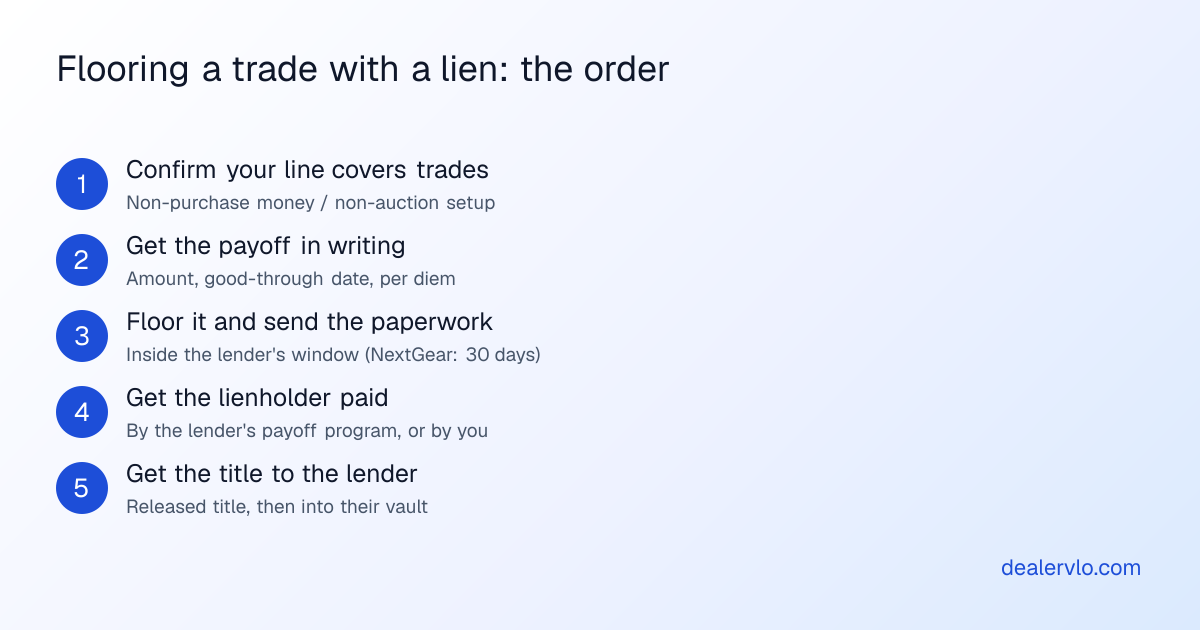
Whichever lender you use, the payoff has to be right. A payoff quote is good through a date, and interest keeps running after it. If the lender sends the check a week late on a stale quote, somebody is short, and the title doesn't release until the account is actually paid. Get the payoff in writing with its good-through date and per diem, every time. The negative-equity trade-in post walks through getting it right when the payoff is bigger than the trade is worth.
In DealerVLO, the trade-in on a deal records the allowance and the payoff owed, plus the payoff details you need to send the check: lienholder, loan account number (stored encrypted), the date the payoff is good through, and the per-diem interest after that date. The deal shows the equity, and when the payoff is more than the allowance it shows the negative equity and adds it to the amount due. To be clear, DealerVLO doesn't send the payoff or track the lien release; your lender's program or your own bank does that part.
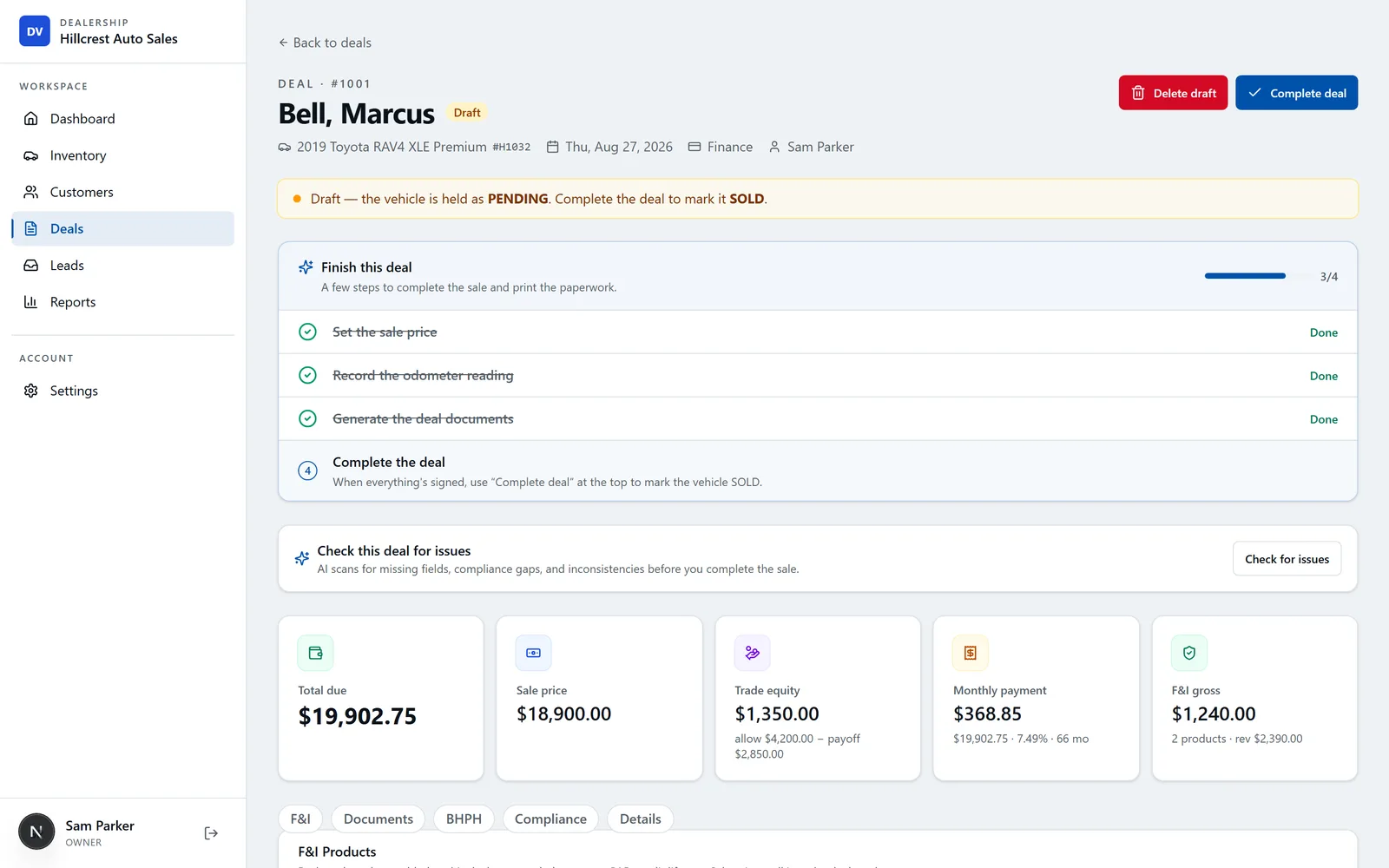
When the payoff is less than the allowance, that gap is your positive equity, and it's the part NextGear's program can fund too:
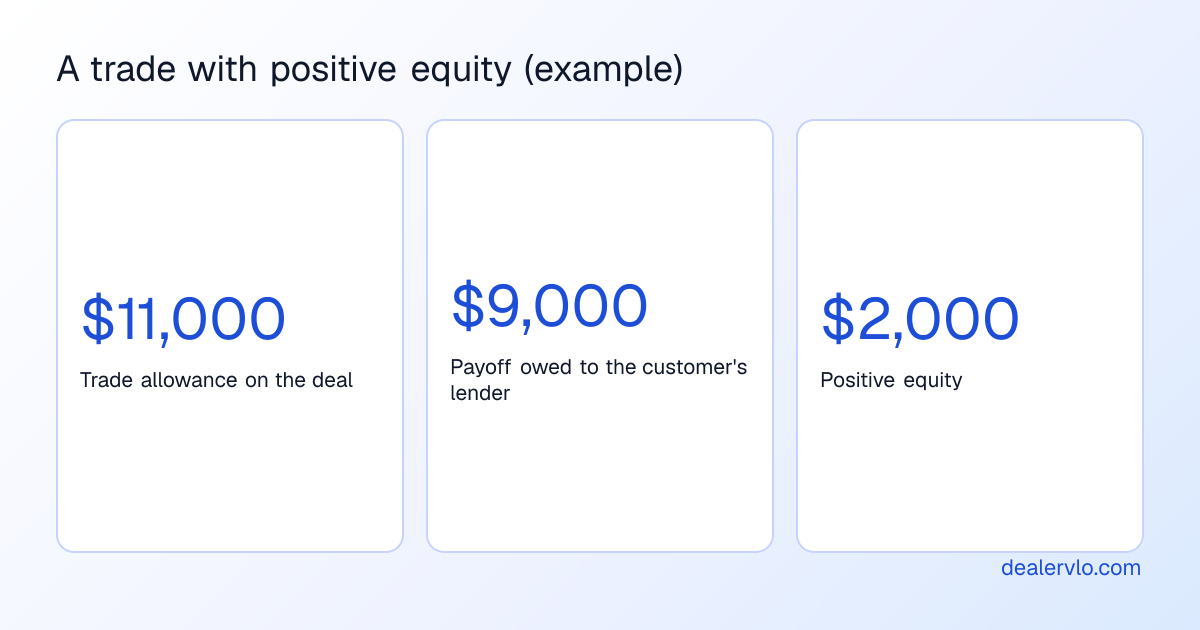
On that example, the customer's lender gets $9,000 and the remaining $2,000 is equity. Whether the floor plan funds the payoff, the equity, both or neither depends on your lender's program and what it thinks the car's worth.
Private-party buys off the street
A street buy works like a trade without the deal attached. You find the car (Marketplace, Craigslist, a customer who isn't buying), you agree on a price, you pay the seller, and then you floor it. NextGear's own sourcing page names Facebook Marketplace and Craigslist as places dealers find non-auction inventory, and says off-street cars "needing reconditioning" can be a good fit (NextGear). Kinetic's off-street page pitches it as a way to "avoid auction fees" and mentions overnight FedEx waybills for title returns.
Two things to watch on a street buy:
- The seller's lien. If the seller still owes on the car, the lien has to be paid before the title comes free, same as a trade. AFC's Lien Pay article names "trade-ins or street purchases" as the non-auction buys where the payoff adds extra steps. Ask your lender whether its payoff program covers a private seller's loan or only a customer trade.
- Your cash in between. You pay the seller today; the advance comes later. On a car with a lien you may be paying the seller's lender and the seller's equity before the floor plan funds anything.
For the buying side itself (first contact, title checks, closing a car with a lien), see the private-party acquisition guide.
What paperwork lenders typically ask for
None of the lenders we checked publish a full document list for non-auction units. NextGear says to "submit the required documentation" through its portal. Kinetic's dealer-owned inventory page says its fast-fund program gives "a 7-day grace period on their titles without a hold on the funds," which tells you the title is the piece they're waiting on. NextGear offers a free pre-paid FedEx waybill for title shipping.
From the dealer side, this is what to have in the folder before you request the advance:
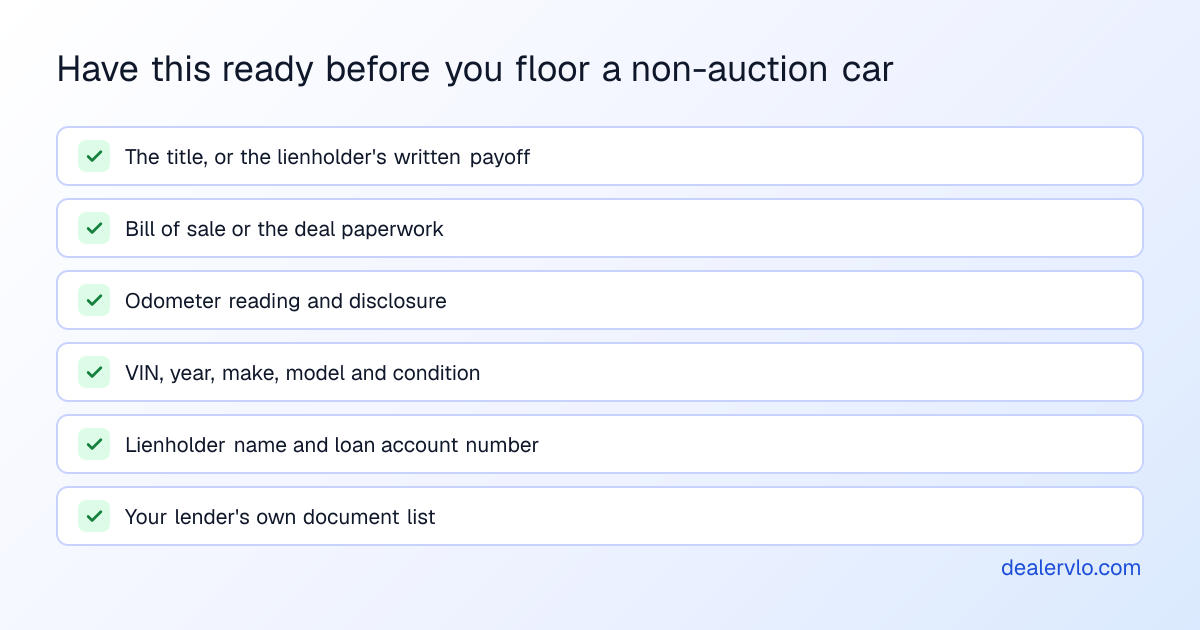
Get your lender's actual list before your first one, because a missing title or a payoff that doesn't match is what holds up the funding. And once the car is on the line, it counts in your audits like any other floored unit: if the title's still out, the auditor will ask. The floor plan audit post covers what they check.
DealerVLO keeps the car side of that folder straight. Every car has a title status field (In hand, Pending or Lienholder), a title number and a title state you set on the vehicle form, and when a deal with a trade is completed, a trade with a full 17-character VIN is added to inventory automatically with a "T-" stock number and the trade allowance as its acquisition cost. It's a field you set, not a tracker: DealerVLO doesn't follow the title through the payoff or warn you when it's late.
14-day free trial, then $29/mo · Cancel anytime
Should you floor the trade at all?
Being able to floor a trade doesn't mean you should floor every one. The math is the same as any floored car: interest and fees every day it sits, and a curtailment if it doesn't sell inside the term.
Take an $8,000 advance at an example 8% rate (yours will differ; lenders don't publish standard rates): $8,000 × 0.08 ÷ 365 ≈ $1.75 a day, before any per-unit fees your agreement charges. On a clean trade you'll retail in two weeks, that's cheap compared with tying up $8,000 of your own cash. On a rough trade that needs a month of recon, or one you're going to wholesale anyway, it may not be worth the fees and the paperwork. If the car is heading to the sale, sell it and skip the line.
A quick way to sort them:
- Floor it when it's front-line ready or close, you'd have bought it at the sale anyway, and the cash is better spent on your next auction buy.
- Pay cash when it's a quick wholesale, a car worth less than the fees and hassle, or your lender's non-auction terms are worse than your auction terms.
- Floor the payoff, not the car when your lender's payoff program covers the lien and the equity is small. That alone can keep a trade from draining your account.
The floor plan vs. cash framework runs the break-even in more detail, and the calculator below does the daily cost for your own numbers.
Estimate your daily floor-plan carrying cost per unit.
Open the Floor Plan CalculatorIn DealerVLO, each car shows its days in inventory and its all-in cost (what you paid plus every recon and cost line), so the pay-off-or-extend call on an aging trade is made on real numbers. Floor plan interest and fees go in as overhead under the floor plan category, and the P&L shows gross profit minus that overhead. DealerVLO doesn't compute a floor plan cost per car or know your curtailment dates; your lender's portal has those.
What to ask your own lender
Your agreement decides all of this, and most of it isn't published. Before your first trade, get these answered in writing:
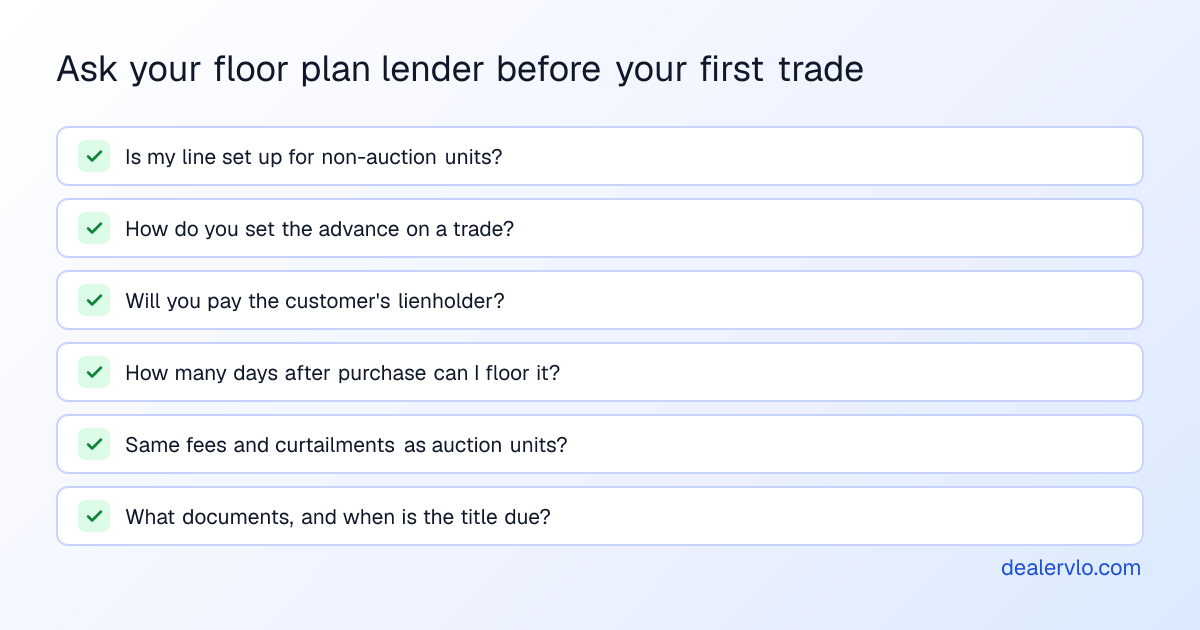
If you're still shopping for a line, add one more: does the non-auction setup come with the approval, or is it a separate request later? The floor plan financing requirements post covers how approval works, and if your current lender won't floor trades at all, how to switch floor plan lenders covers adding a second line for exactly that.
Where DealerVLO fits
Plainly: DealerVLO is not a lender. It doesn't provide floor plan financing, floor cars, send trade payoffs, track lien releases, or know which line a car is on. Your lender's portal and payoff program handle that.
What it does is keep the deal and the car accurate on your side:
- The trade on the deal records the allowance, payoff, lienholder, account number, good-through date and per diem, and the deal math shows the equity (or negative equity) live.
- A completed deal adds a trade with a full VIN to inventory automatically, at the trade allowance as its cost.
- Each car carries its title status, recon and cost lines, all-in cost and days in inventory, with a 60+ day aging flag.
- Floor plan expense goes on the P&L as overhead, so you can see what the line actually costs you each month.
That's the record you want in front of you when the lender asks for paperwork, or when you're deciding whether a 70-day trade gets paid off or extended.
Frequently asked questions
Can you put a trade-in on a floor plan? Usually, yes. NextGear, AFC and Kinetic Advantage all describe flooring trade-ins on their own sites. It's often a separate setup from auction flooring: NextGear says that to finance trade-ins you must be set up for non-purchase money financing, and AFC runs it through its Non-Auction Purchase flooring program. Ask your lender whether your line is set up for it.
Can a floor plan pay off the lien on a customer's trade? Some lenders offer it. NextGear's Lienholder Loan Payoff Program lets qualifying clients use their floor plan to pay off the customer's loan, with requests due within 30 days of purchase. AFC Lien Pay can verify the payoff, advance funds directly to the lienholder and help with title follow-up on eligible transactions. Eligibility is set by the lender.
Can you floor plan a car bought from a private seller? Many lenders floor off-street purchases. Kinetic Advantage has a page for flooring off-street purchases and NextGear names cars found on Facebook Marketplace and Craigslist as non-auction sources. You usually buy the car first, then floor it, so plan on fronting the money until the advance funds.
What paperwork does a floor plan lender want for a trade-in? None of the lenders we checked publish a full list. NextGear says to floor the trade in its portal and submit the required documentation. Expect the title or the payoff details, the bill of sale or deal paperwork, and the odometer reading, and get your lender's exact list before your first one.
Does flooring a trade-in cost the same as flooring an auction car? Not necessarily. Rates and fees are set in your own agreement, and the big lenders don't publish standard rates. AFC, for example, floors non-auction units through its Non-Auction Purchase flooring program. Ask for the non-auction terms in writing, including when the clock starts and when the first curtailment is due.
Does DealerVLO handle the floor plan or the trade payoff? No. DealerVLO is not a lender and doesn't send payoffs or track lien releases. It records the trade's allowance, payoff, lienholder, account number, good-through date and per diem on the deal, shows the equity, and adds a trade with a full VIN to inventory when the deal is completed.
Bottom line
You can usually floor a trade-in or a street buy, but not automatically. Confirm your line is set up for non-auction units, find out whether your lender will pay the customer's lien (NextGear's Lienholder Loan Payoff Program and AFC Lien Pay both do, for qualifying dealers), get every payoff in writing with its good-through date, and have the title and paperwork ready before you ask for the advance. Then floor the trades that will retail fast, and pay cash for the ones that won't.
I built DealerVLO for my own lot in Tewksbury, and trades are a big part of how we stock it. Try it free for 14 days and keep every trade's payoff, cost and days on lot in one place.
14-day free trial, then $29/mo · Cancel anytime