How to pass a floor plan audit (and never go out of trust)
What a floor plan auditor checks, the four ways honest lots come up short, and a 15-minute weekly self-audit that makes the real one boring.
Part of the Floor plan financing guide: How dealer floor plans actually work — and where they quietly eat your gross
The auditor doesn't care how good your month was. They have a list of every car your floor plan lender paid for, and they want to see each one: on the lot, or accounted for. A car at the body shop is fine if you can prove it's there. A car you sold ten days ago that the lender hasn't been paid for is a different conversation.
Most dealers who get in trouble on an audit aren't stealing from their lender. They're behind on paperwork, waiting on a buyer's bank, or they forgot that one car went to a recon vendor across town. This post covers what the auditor actually checks, the four ways honest lots come up short, and a 15-minute weekly self-audit that makes the real one boring. It builds on how dealer floor plans work, which covers the interest and curtailment side.
What a floor plan auditor actually checks
AFC defines a floorplan audit as the lender verifying the inventory and documentation the dealer provided, to make sure the dealer is following the financing agreement and has controls in place for the floored inventory. On the ground that means one thing: every VIN on the lender's list gets accounted for.

Every floored car ends up in one of four buckets:
- On the lot. The auditor finds the car and matches the VIN. Most of your list should be here.
- Off the lot, with a reason. At a body shop, a mechanic, on a transport truck, at an auction to be wholesaled out, or out on a test drive. That's normal. What matters is that you know where it is and can show it.
- Sold and unpaid. AFC's term for a car that's been sold where the lender hasn't been paid yet. The auditor checks that the payment is really in progress.
- Sold out of trust. The same car, but the payoff is late and there's no reasonable explanation. AFC calls it "a fairly serious issue," and that's an understatement. It's how dealers lose their line.
The goal isn't to have zero cars off the lot. The goal is that no car on the list surprises you.
Self-audits and on-site audits
Lenders handle audits differently, and the details are in your dealer agreement, not on a blog. Two published examples show the range.
NextGear Capital runs both kinds: on-site audits by its own auditors, and self-audits where you verify your floored inventory from its mobile app. Its audits page, as listed in October 2026, says self-audits must be completed within 48 hours of its notice. For a unit that can't be verified, it lets you send photos through the app afterwards. It also says additional fees may accrue if the unit isn't verified by day 7, and a maturity event is declared on that unit if it isn't verified before day 15.
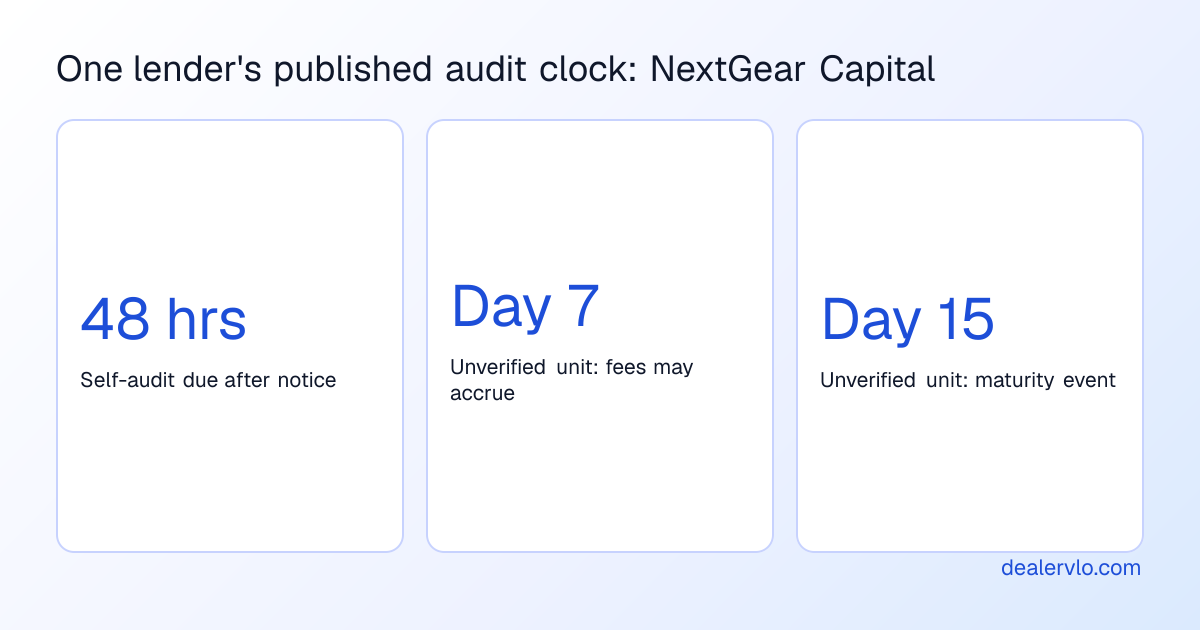
Those numbers are one lender's. Yours may audit monthly, quarterly, or whenever your payoff timing starts to look off, and may or may not call ahead. The safe assumption is that the next audit could be this week, and that after any discrepancy they'll come more often. Comparing lenders? We lay out what NextGear, AFC and Westlake each publish.
The four ways honest lots come up short
1. Sold, waiting on funding. You deliver the car Tuesday, the buyer's bank funds the following week, and the floor plan expects its money within the window in your agreement. Most of the time this is just "sold and unpaid" and the auditor moves on. It turns into a problem when the funding stalls (a stip the bank wants, a contract kicked back) and nobody tells the floor plan company.
2. The car is somewhere else and nobody wrote it down. The body shop, the transmission guy, the detailer who takes cars overnight. When the auditor asks where it is, "I think Mike has it" isn't an answer. A name, an address and a date it comes back is.
3. Wholesaled out, paperwork behind. You ran an aged unit back through the auction. The car is gone, the sale proceeds haven't posted, and the lender's list still shows it as yours. Same with a dealer-to-dealer sale: the car left, the payoff hasn't.
4. The lists don't match. A car you paid off still shows as floored, a VIN typo on the lender's side, a unit floored on the wrong line if you run two (the lender-switch post covers that trap). None of it is dishonest, and all of it eats the auditor's time and your credibility.
Every one of these is a records problem before it's a money problem. That's why a weekly check fixes most of them.
14-day free trial, then $29/mo · Cancel anytime
The 15-minute weekly self-audit
Pick a day, and the same one every week. Monday morning works because weekend deliveries are fresh.
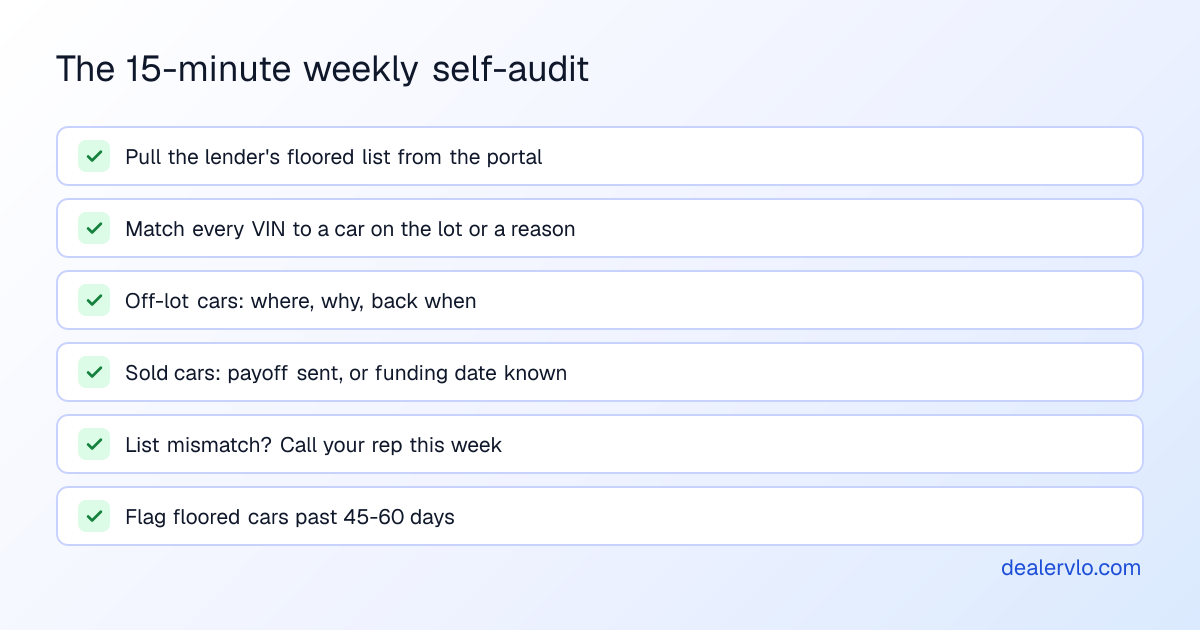
- Pull the lender's list from the portal. That's the auditor's list, so it's the one that counts.
- Match every VIN to a car you can see or a reason it's not there. Walk the lot with the list if you have more than a dozen units. It's faster than arguing with your memory.
- For every off-lot car, write down where it is, why, and when it's back. One line each.
- For every sold car, confirm the payoff went out, or write the date funding is expected.
- If the lists don't match, call your rep this week, not on audit day.
- Look at the age of every floored car. Anything past 45 to 60 days is heading for a curtailment or an extension fee. More on that below.
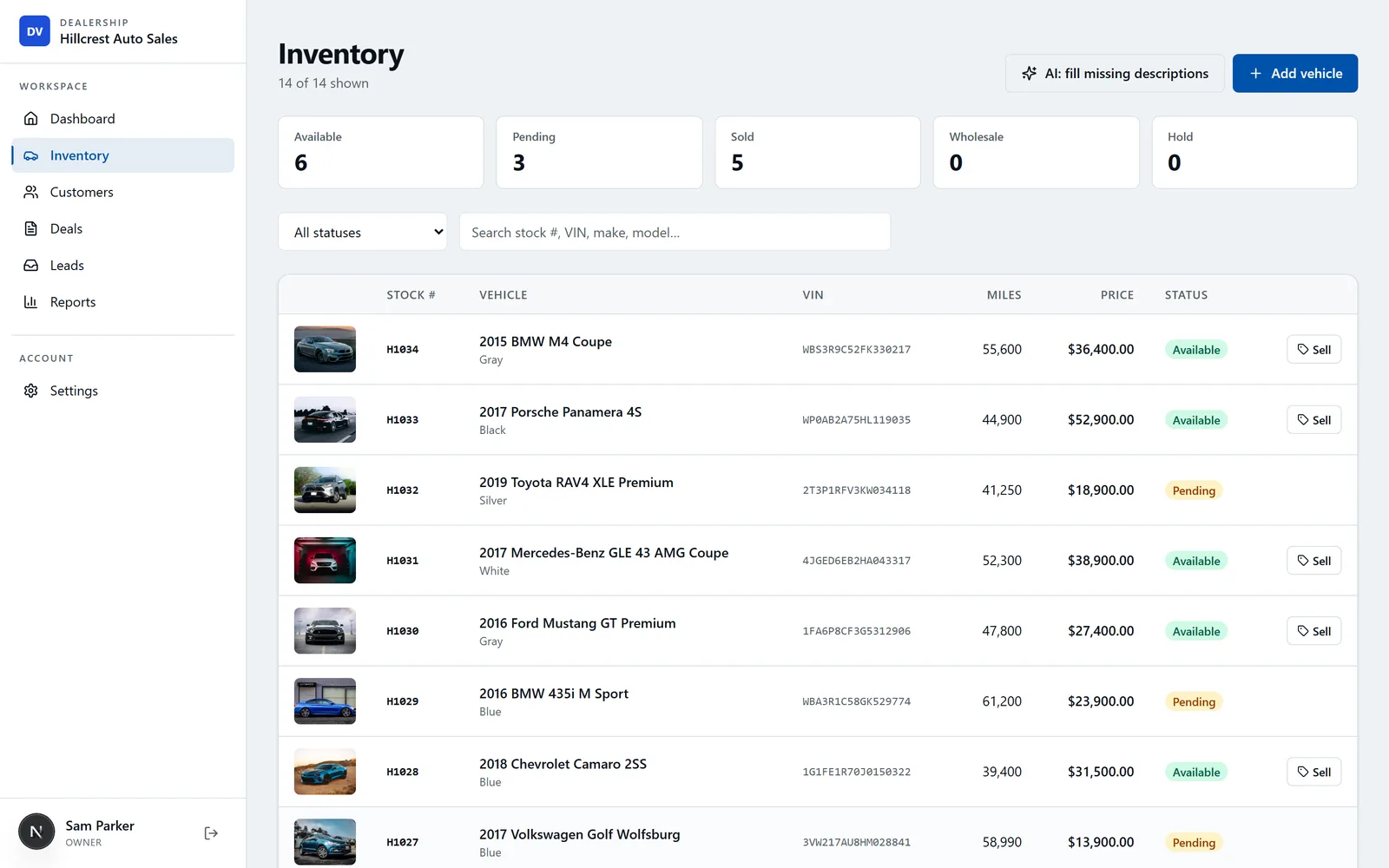
DealerVLO handles your side of the match. The inventory list shows every car with its status, searchable by stock number or VIN. Mark a car sold and it drops off your website and listing feeds, so "is this still for sale?" and "is this still on the lot?" stay in sync. What DealerVLO doesn't know is which cars are floored or what's been paid off: that's the lender's list, and the point of the weekly check is to line the two up.
Pay off when the deal funds, not when it's convenient
The cleanest habit in a floor-planned store is boring: the payoff goes out the day the money arrives. Cash deal, it goes out the same day. Financed deal, the moment the buyer's lender funds.

What goes wrong is batching. Holding three payoffs to send together at month-end feels efficient, and it's how a car sold on the 3rd is still unpaid on the 28th. If cash is tight enough that you're tempted to use a sold car's money for something else first, that's the real problem, and it's the definition of selling out of trust. The floor plan vs. cash framework is the place to rethink how much of the lot should be floored.
The payoff matters to the buyer too. The lender holds the title on a floored car, and it releases the title once it's paid. A late payoff is a late title to your customer.
DealerVLO's deal jacket keeps the deal side straight: the deal math is computed live, and the deal's documents and signatures sit in one place. Make "payoff sent" a step you check before you close the jacket out.
What to have ready when the auditor shows up
Whether the auditor calls ahead or just walks in, the visit goes faster with four things at hand:
- Keys organized by stock number, so a car can be started and moved if it's blocked in.
- The off-lot list from your weekly check: where each car is, a contact, and when it's back.
- The sold-and-unpaid list: deal date, how it's being paid, and when funding is expected.
- One person who knows the answers. If you're at the auction, whoever is minding the lot needs that list and permission to call you.
Be straight with the auditor. A car at the body shop with an address is a two-minute conversation. A car you can't explain becomes a follow-up, and in NextGear's case, a clock.
If a car really is out of trust
Sometimes it happens anyway: a deal funded and the payoff slipped, or a car got sold off the lot while you were away. Don't wait for the auditor to find it.
Call your floor plan rep first, tell them what happened, and pay it off as fast as you can. AFC says what happens after an audit depends on how serious the findings are and what your financing agreement says, and the auditor's report comes with recommendations. Lenders see paperwork lag all the time. What makes it worse is them finding it before you tell them. Expect closer audits for a while either way, and read your agreement so you know your lender's terms before you need them.
Aged cars are the audit's quiet second job
An auditor counts cars, but a lot full of old floored units tells the lender something too. Every floored car past its first term is heading for a curtailment payment or an extension fee, and interest accrues every day it sits. Run your own numbers in the floor plan calculator below.
Estimate your daily floor-plan carrying cost per unit.
Open the Floor Plan CalculatorThe weekly self-audit is also your aging review. Any floored car past 45 to 60 days needs a decision: reprice it, re-merchandise it, or wholesale it out before the next curtailment. Our day-by-day markdown playbook walks through it.
DealerVLO puts that decision on one screen. Every car shows its days in inventory and all-in cost, cars past 60 days get an "aging, consider repricing" flag, and the aging report buckets the lot into 0–30, 31–60, 61–90 and 90+ days. You can also log floor plan cost as a monthly expense category, so the P&L shows what the line really costs you against gross. It won't mark anything down for you or send alerts; it makes the list impossible to ignore.
14-day free trial, then $29/mo · Cancel anytime
Frequently asked questions
What is a floor plan audit? It's your floor plan lender checking that every car it financed is where it should be. AFC describes it as the lender verifying the inventory and documentation the dealer provided, to confirm the dealer is following the financing agreement. In practice an auditor, or you in a self-audit, goes VIN by VIN through the lender's list and accounts for every unit: on the lot, off the lot for a reason, or sold and paid off.
How often do floor plan lenders audit a dealer? It depends on the lender, the size of your line and your track record, and the major lenders don't publish a standard schedule. Your dealer agreement is the place to look. Plan as if one can show up any week, and expect more frequent checks after a discrepancy.
What does sold out of trust mean? A floored car was sold and the lender wasn't paid off on time, with no reasonable explanation. AFC separates that from "sold and unpaid," where the car is sold and the payment is still in progress. Sold and unpaid gets checked; sold out of trust is the serious one.
What happens if a car can't be found during an audit? It's marked unverified and you have to prove where it is. NextGear Capital, for example, lets dealers verify a unit afterwards with photos in its app, and says additional fees may accrue if it isn't verified by day 7 and a maturity event is declared on the unit if it isn't verified before day 15. Other lenders set their own terms in the dealer agreement.
Can I do a floor plan audit myself? Some lenders allow it. NextGear Capital offers self-audits in its mobile app and says they must be completed within 48 hours of its notice. Even when your lender always sends an auditor, a weekly self-check against the lender's list is the best way to make sure the real audit finds nothing.
Does DealerVLO track which cars are floored? No. DealerVLO isn't a lender and doesn't track floor plan lines, payoff dates or curtailments. Those live in your lender's portal. What DealerVLO gives the weekly check is the other half: a searchable inventory list with each car's status, days in inventory and all-in cost.
Bottom line
A floor plan audit is a records check. Lots that pass easily aren't more honest than the ones that don't; they just know where every car is, pay off the day the money lands, and line their list up with the lender's every week. Do that, and the auditor's visit is a walk around the lot.
Want every car's status, days on lot and all-in cost on one screen for that weekly check? Start your free 14-day DealerVLO trial.