Floor Plan Curtailment, Explained: What It Is, How the Schedule Works, and What It Really Costs
What a floor plan curtailment is, how curtailment schedules and extensions work, what's due at each one, and how to keep them from draining your cash.
Part of the Floor plan financing guide: How dealer floor plans actually work — and where they quietly eat your gross
Switching from another DMS? Compare DealerVLO to DealerCenter, Frazer, or Lot Wizard.
The first curtailment notice is where a lot of new floor plan dealers find out the line isn't free money. You floored eight cars in a good week, sold three, and now the lender wants a chunk of principal on the other five, plus every dollar of interest and fees since the day you bought them. Same day. Whether those cars are front-line ready or still at the body shop.
That's a curtailment. It's not a fee and it's not a penalty. It's the lender making you pay down a car that's taking longer to sell than the term you agreed to. Here's how curtailments work, what's actually due at each one, what the published lender terms say, and how to run them so they stop being a surprise.
What a curtailment is
A floor plan loans you the purchase price of each car for a set term. AFC, which runs one of the big independent floor plans, defines a curtailment as "a payment a dealer makes to the floorplan lender that reduces the outstanding balance on the loan" (AFC). In plain terms: the car hasn't sold by the end of its term, so you pay part of the principal down, settle the interest and fees, and the lender gives you another term on it.
Bank regulators describe the same thing from the lender's side. The OCC's handbook for examiners says a floor plan agreement normally includes "a curtailment provision that requires periodic principal reductions by the dealer for stale inventory," setting "the required timing and percentage reduction in principal for each loan when the financed inventory does not sell" (OCC Comptroller's Handbook, Floor Plan Lending). And it's blunt about why: curtailments are there to "push the dealer into moving slow inventory, by wholesale if necessary."
That's the right way to think about it. A curtailment is the lender's aging alarm, with a bill attached.
If the rest of the floor plan machine is new to you (the credit line, the daily interest, the audits), start with how dealer floor plans work. This post goes deep on the curtailment piece only.
How a curtailment schedule works
Every curtailment schedule comes down to three numbers: how long each term is, how much principal is due at the end of it, and how many times you can extend before the whole balance is due.
None of the big lenders publish those numbers as a rate card. They're set dealer by dealer:
- AFC says in its parent company's annual report that "typical loan terms are 30 to 90 days, each with a possible loan extension," and that an extension "generally requires the dealer to make payment towards the principal and payment of accrued fees and interest" (OPENLANE 10-K, filed February 2026). AFC's own explainer adds that when curtailments are required, and how much, "will vary from floorplan company to floorplan company" and gets set when you contract.
- NextGear's standard note, a signed copy of which a dealer group filed with the SEC in 2019, puts the term length and the principal reduction on each dealer's own "Advance Schedule." At each curtailment, the dealer pays the accrued interest, the accrued floorplan fee, other fees, "and a principal reduction" (NextGear note, SEC exhibit). Your current agreement may differ; read the one you signed.
- Kinetic Advantage's FAQ says it offers "flexible terms up to 180 days" (Kinetic Advantage).
So the honest answer to "what's the curtailment?" is: whatever's on your schedule. What the OCC handbook does give is an example structure for a used-car line: a 10 percent monthly curtailment starting in the fourth month, which pays the car all the way down by month 13. That's an illustration from a bank examiners' manual, not anyone's quote, but it shows the shape: the paydowns keep coming until the car is gone or paid off.
Here's what a simple schedule does to one car. Say you floor a $10,000 unit, and your agreement (example only) calls for 10% of the original principal every 60 days:
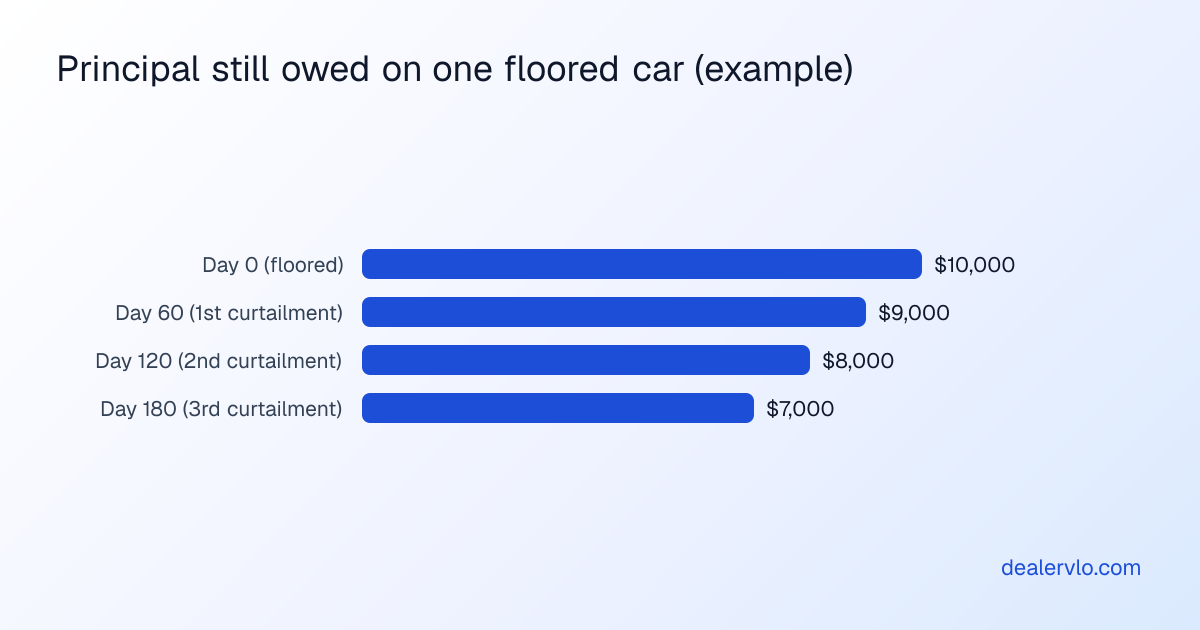
Six months in, you still owe $7,000 on a car you've already handed the lender $3,000 of principal on, plus interest every day and fees every period. One detail to pin down: whether your percentage is of the original balance or the remaining balance. On a 10% schedule that's the difference between $1,000 every time and a paydown that shrinks each period.
What's actually due at each curtailment
The principal is the part dealers remember, but it's never the whole check. At each extension you're also settling everything that built up during the term:
- Accrued interest for the period. On a $10,000 car at an example 9%, 60 days is $10,000 × 0.09 × 60 ÷ 365 ≈ $148.
- The floorplan fee for the period. NextGear's note charges it "for each Unit of Lender Financed Inventory for each Period, including any Extensions thereof," so a car that sits four periods pays it four times.
- A curtailment or extension fee, where your lender charges one. The OPENLANE 10-K lists a fee "to extend the terms of the receivable ('curtailment fee')" alongside the floorplan fee.
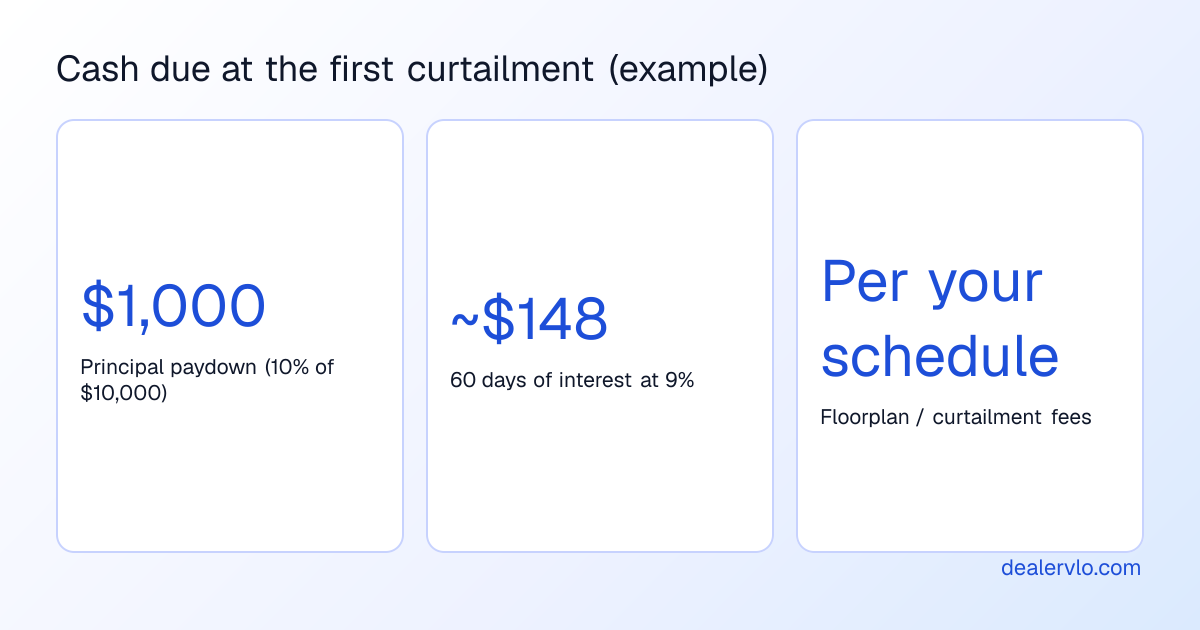
Call it roughly $1,150 plus fees on that one example car. Now multiply it by a buying week. Floor ten cars in the same week, sell four inside the first term, and the other six all come due on the same day: about $6,900 in principal and interest before a single fee, from cars that haven't brought in a dime yet. That's the curtailment cash crunch, and it's why the squeeze often follows a great buying week, not a bad one.
Two things make it worse over time. Extensions usually repeat the same terms as the last period, so the fees and paydowns keep landing until the car is gone. And the OCC tells banks that after the first renewal, "constant or increasing curtailments and interest should be due." The longer a car sits, the more each extension costs you, by design.
14-day free trial, then $29/mo · Cancel anytime
What happens if you miss one
A missed curtailment is a missed loan payment, and floor plan agreements treat it that way. Under NextGear's standard note, it's an event of default if the borrower or any guarantor fails to repay any amount when due. On default, the lender can demand immediate payment of everything owed, stop funding new advances, and take possession of the cars. Late fees and NSF fees are set on the dealer's fee schedule.
AFC's parent says in its annual report that restrictions are "automatically placed on customer accounts in the event of a delinquency, payments... with insufficient funds or poor audit results." Kinetic Advantage's FAQ puts it more gently: missing curtailment payments "can result in penalties or impact your relationship with your floorplan provider."
In practice, a restricted account means you can't floor the next car at the sale, which means you can't replace the inventory you're selling, which makes next month's cash flow worse. That's how one missed check turns into a slow month and then a bad quarter.
Don't confuse a curtailment problem with being out of trust, which is worse. The OCC defines selling out of trust as selling the car and not immediately sending the lender its money. It also notes the two travel together: its list of warning signs puts "unpaid curtailments" right next to "out-of-trust sales," because a dealer who can't make curtailments is short on cash, and a dealer short on cash is tempted to sit on a payoff. If you're behind on curtailments, the payoff on every car you sell goes out the day the deal funds, no exceptions. Our floor plan audit guide covers how out-of-trust happens to honest lots.
Deferments, $0-principal options, and other ways out
Some lenders sell a way around the paydown, for a fee:
- Kinetic Advantage: its Deferment Program "allows qualifying dealers to defer curtailment payments for $95 per deferment."
- AFC Principal Pass: "for a small one-time fee, pay $0 in principal at curtailment," on eligible units with an original principal of $40,000 or less, with a contract amendment and some states excluded (AFC Principal Pass).
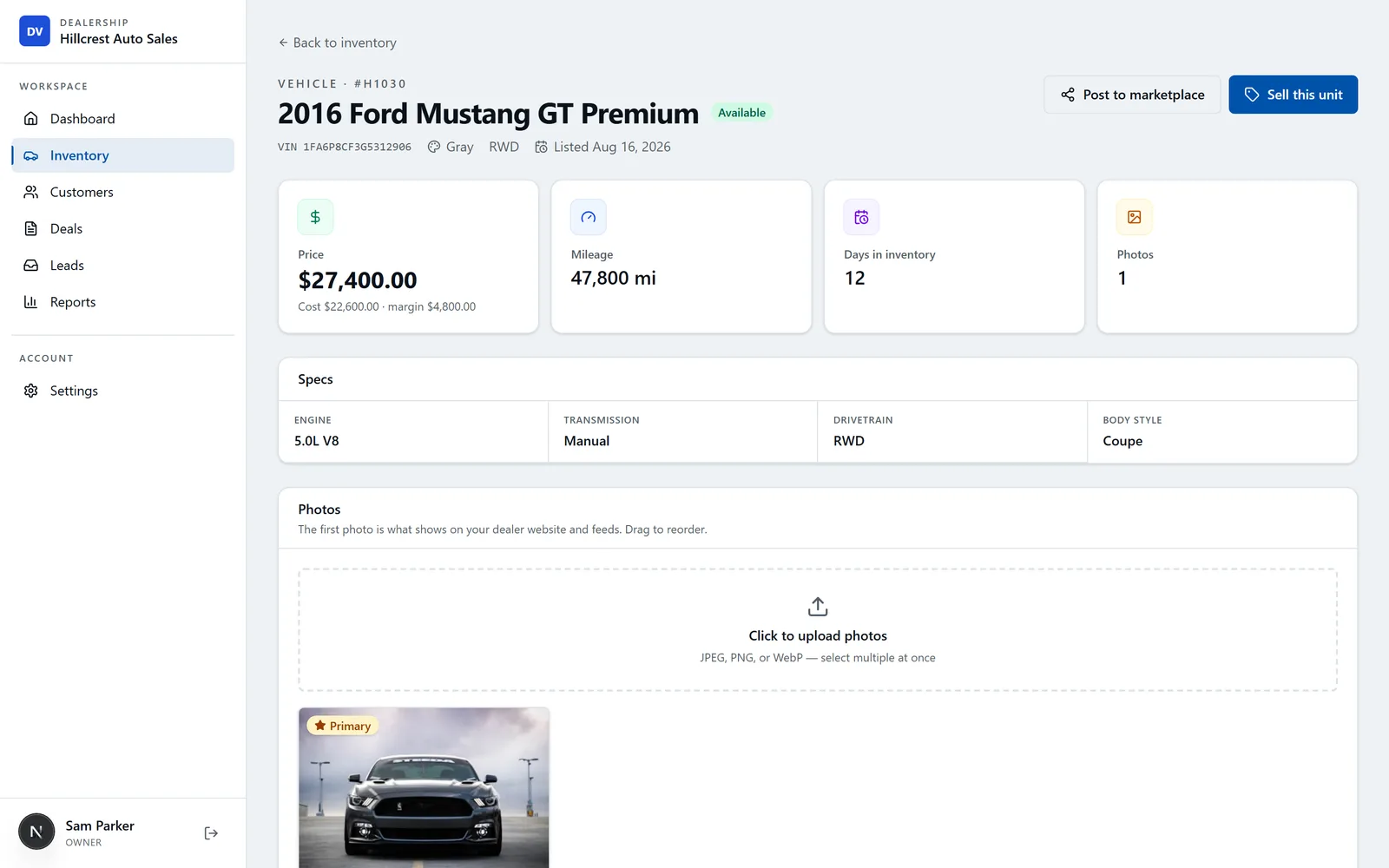
These are useful when you have a good car that's genuinely close to selling and cash is tight this week. They're dangerous as a habit. Deferring the principal doesn't stop the daily interest or the per-period fees, and the car is still aging on your lot. A deferment buys time. It doesn't fix a car you bought wrong. Before you pay to defer, look at the car's numbers: in DealerVLO, each car's page shows its price, cost and margin next to its days on lot, so you can see whether there's still enough gross left to be worth another term.
The personal guarantee behind your curtailments
Floor plan agreements often come with a personal guarantee. The NextGear agreement filed with the SEC includes an individual guaranty in which the guarantor "voluntarily, unconditionally, and absolutely guarantees" the full and prompt payment of all liabilities, plus the lender's attorneys' fees and collection costs. The OCC tells bank examiners to weigh "the value of personal guarantees, and the ability and willingness of the owners and guarantors to make up for any shortfalls."
Put simply: if you signed a personal guaranty, the curtailments, interest and fees on your line aren't only the LLC's problem. If the dealership can't pay, the lender can come after you. That's the real reason to manage curtailments tightly. It's not just the dealership's credit on the line.
This isn't legal advice. Read the guaranty you signed (or are about to), and have your own attorney walk you through what it covers before you sign a new one.
How to run curtailments so they stop being a surprise
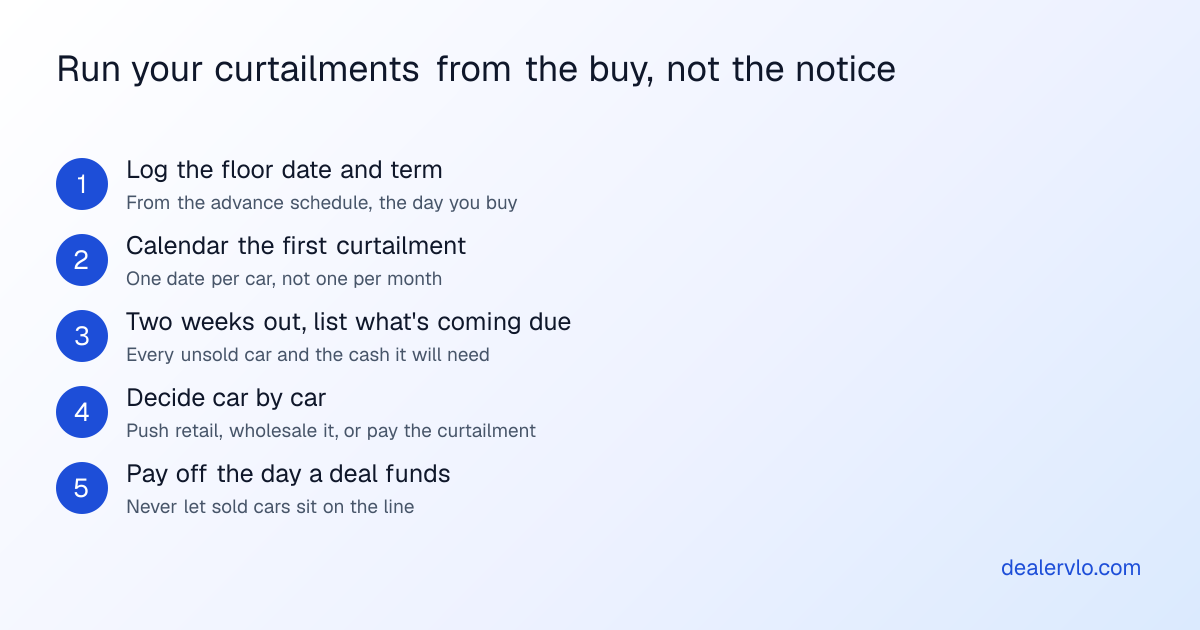
The fix is boring and it works: manage curtailments from the day you buy, not the day the notice shows up.
- Log each car's floor date and term when you buy it. It's on your advance schedule. Every car gets its own clock.
- Calendar the first curtailment date for each car. Not "the 1st of the month." Ten cars bought on ten different days come due on ten different days.
- Two weeks before, list every unsold car coming due and the cash each will need: principal, interest, fees.
- Decide car by car. Price it to retail before the date, send it to the auction, or pay the curtailment and keep it. A car you'd rather not pay $1,000 to keep is a car you should be wholesaling, which is the exact behavior the OCC says curtailments are designed to force.
- Pay off the day a deal funds. Sold cars sitting on your line are how a cash crunch turns into an out-of-trust problem.
Step 4 is where most of the money is. If you know a car is 50 days old and its first curtailment is at 60, you still have ten days to move it at a price you can live with. Find out at day 61 and you're paying the curtailment and still holding the car. Our inventory aging and markdown strategy covers how to price a car down on a schedule before it gets there, and the auction vs. retail break-even decision tree helps with the wholesale-or-keep call.
This is where the days-on-lot number does the work. In DealerVLO, every car shows its days in inventory on its own page, cars past 60 days get an "aging, consider repricing" flag, and the dashboard shows how many cars are on the lot 60+ days. The inventory aging report on the Reports page buckets the whole lot into 0-30, 31-60, 61-90 and 90+ days. DealerVLO isn't a lender and doesn't track your line or your curtailment dates, but if your terms are 60 days, the 31-60 bucket is your coming-due list.
Curtailments when you're choosing a lender
When you compare floor plans, the curtailment schedule matters as much as the rate. A slightly cheaper rate with a 30-day first term can cost you more in cash-flow pain than a higher rate with 90 days, if your cars typically take 45 days to sell. Get the checklist below answered in writing by every lender you're considering:
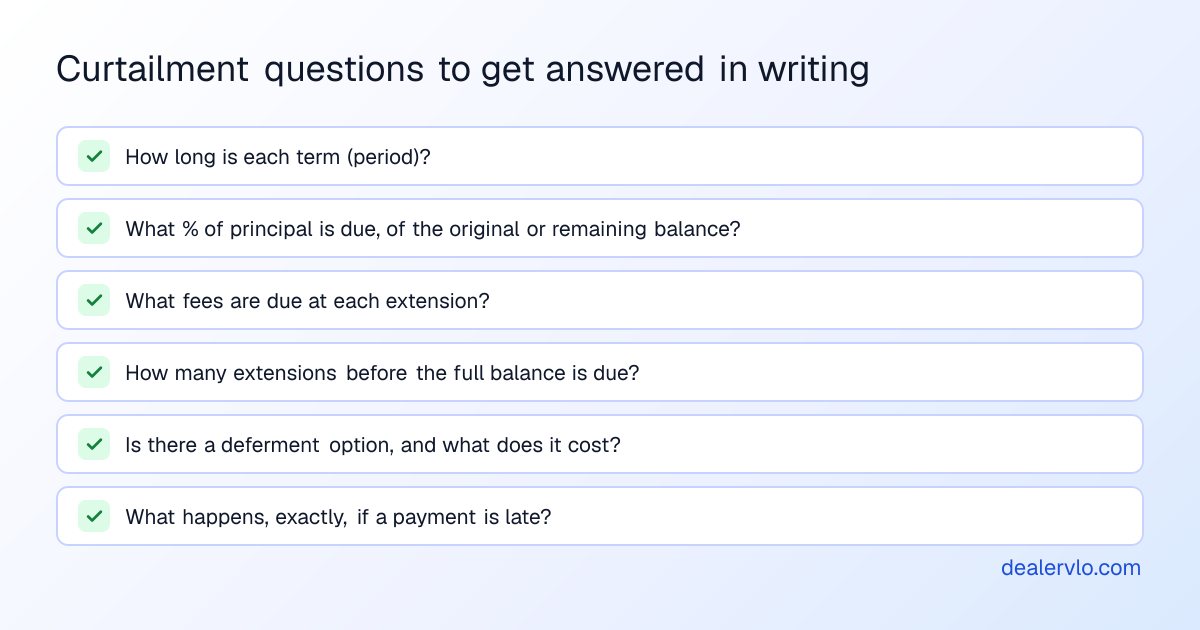
Then run the answers against your real days to sell. Our NextGear vs. AFC vs. Westlake comparison covers what each one publishes, floor plan financing requirements covers getting approved, and the floor plan vs. cash framework helps decide which cars should be floored at all.
Estimate your daily floor-plan carrying cost per unit.
Open the Floor Plan CalculatorIn DealerVLO, you can record floor plan interest and fees as overhead under the floor plan category, so the P&L shows what the line cost you each month next to your gross profit. If that number keeps climbing while your sales don't, your curtailments are telling you something about what you're buying.
14-day free trial, then $29/mo · Cancel anytime
Frequently asked questions
What is a curtailment on a floor plan?
A curtailment is a principal paydown on a floored car that hasn't sold by the end of its term. AFC defines it as a payment that reduces the outstanding balance on the loan. You usually pay part of the principal plus the interest and fees that have built up, and the lender extends the car for another term.
How much is a floor plan curtailment payment?
It's set in your own agreement, not published. AFC says the timing and amounts vary from floorplan company to floorplan company and are set when you contract. NextGear's note puts the term length and principal reduction on each dealer's advance schedule. Ask for the percentage, what it's a percentage of, and the fees due with it, in writing.
What happens if you miss a curtailment payment?
It's a missed payment on the loan. In NextGear's standard note, failing to repay any amount when due is an event of default, which lets the lender demand payment of everything you owe and take back the cars. AFC's annual report says it automatically restricts accounts on a delinquency. At minimum expect late fees; at worst, your line gets frozen.
Can you defer or skip a curtailment?
Some lenders sell a way out. Kinetic Advantage's FAQ says qualifying dealers can defer curtailment payments for $95 per deferment, and AFC's Principal Pass lets eligible units pay $0 principal at curtailment for a one-time fee. You still pay interest and fees, and the car still costs you every day it sits.
Is a curtailment the same as being out of trust?
No. A curtailment is a scheduled paydown on a car you still have. Selling out of trust is selling a floored car and not paying the lender back promptly. The OCC lists unpaid curtailments and out-of-trust sales together as warning signs, because a dealer short on cash for one is often heading toward the other.
Does a personal guarantee cover curtailments?
If you signed one, generally yes. The individual guaranty attached to the NextGear note filed with the SEC guarantees full and prompt payment of all liabilities, which includes curtailments, interest and fees. Read your own guaranty, and talk to your attorney before signing one.
Bottom line
A curtailment is your floor plan's way of telling you a car has overstayed its term, and charging you for it. You can't negotiate it away after you sign, so know your term, your percentage and your fees before you floor a single car, put every car's first curtailment date on the calendar the day you buy it, and make the keep-or-wholesale call before the date instead of after.
The dealers who never sweat a curtailment notice aren't the ones with the best rate. They're the ones who know every car's days on lot and act at day 45, not day 61. Start your free 14-day DealerVLO trial at /signup and see your whole lot's aging on one screen.