Floor Plan Financing Requirements: How a Small Used Car Lot Gets Approved, and How Big a Line to Expect
What floor plan lenders ask for, how approval works for a small lot, what AFC and NextGear publish about line sizes, and how to grow the line you get.
Part of the Floor plan financing guide: How dealer floor plans actually work — and where they quietly eat your gross
Switching from another DMS? Compare DealerVLO to DealerCenter, Frazer, or Lot Wizard.
The first time you apply for a floor plan, the hardest part is that nobody tells you what they're actually looking at. Lender websites say "apply in minutes" and "get approved fast," and dealer forums are full of guesses about credit scores and minimum years in business. Meanwhile you're trying to figure out whether you'll get a $50,000 line or a $250,000 one, because that decides how many cars you can buy at the next sale.
This post sticks to what floor plan lenders actually publish: what the application asks for, how approval works for a small lot, the real numbers on line sizes, and what grows a line once you have one. Where something isn't published, I'll say so instead of guessing. If you're new to how a floor plan works day to day, start with how dealer floor plans work.
What floor plan lenders ask for
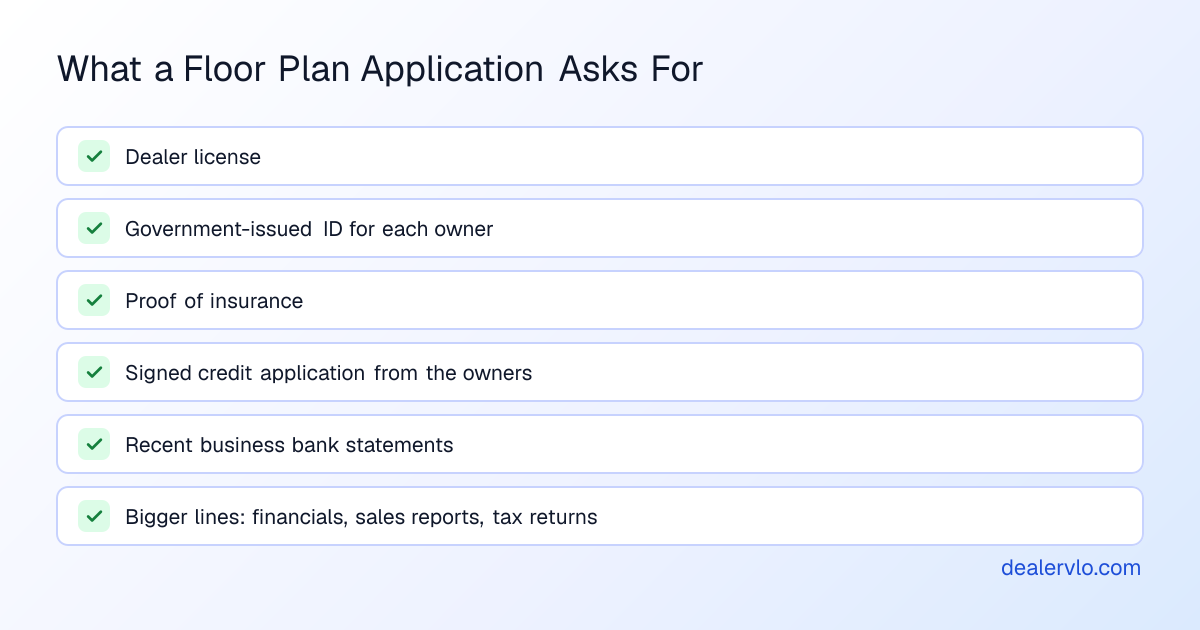
The basics are short. AFC, one of the biggest floor plan lenders for independents, lists three things to apply: a valid government-issued ID, your dealer license and proof of insurance, with every application "subject to approval by AFC." An earlier AFC guide spells out a fuller list: a signed credit application from the owners, the dealer license, driver's licenses, and "the last 90 days of business bank statements."
The paperwork grows with the line. AFC's guide puts it plainly: "Smaller lines of credit require less documentation, while larger lines require more." Its annual report gets specific. Lines up to $750,000 are extended "using a proprietary scoring model developed internally by AFC." Above that, underwriting "generally require[s] dealership and personal financial statements, monthly bank statements, sales reports and tax returns," with final approval by a credit committee.
So for most small lots, the application is a scoring decision on your license, your credit, your bank statements and your history, not a full financial review. That's good news for speed. It also means the few things you hand over carry a lot of weight.
Banks are a different animal. If you go to a local bank or credit union for a line, expect a fuller underwrite. Federal guidance for bank examiners, the OCC's handbook on floor plan lending, tells banks to review at least two years of year-end financial statements (noting smaller dealers may only have unaudited ones) and to analyze the finances of anyone guaranteeing the loan.
What underwriting actually weighs
Here's the honest version: no major lender we checked publishes a minimum credit score, a required number of years in business, or a minimum net worth. Anyone quoting you "you need a 600" is guessing, or quoting a different kind of loan.
What lenders do say they look at:
- Credit history and financial health. AFC's guide says the maximum line is "often based on… the dealership's financial health, inventory turn times, and credit history."
- How fast you turn cars. Bank examiners are told to review "historical sales, inventory days outstanding," and the same factor shows up in AFC's guidance. A lot that sells cars in 30 to 45 days is a better floor plan risk than one where cars sit for 90.
- Your history with other lenders. The OCC tells banks to look at prior audit reports and "evaluate the severity of historical out-of-trust incidents." A clean payoff history follows you.
On personal guarantees: the US lender pages we read don't publish a blanket rule. AFC's underwriting for big lines asks for personal financial statements, and the OCC tells banks to analyze each guarantor's finances when a loan is supported by guarantees. Read your agreement for a guaranty before you sign, and know what assets it reaches.
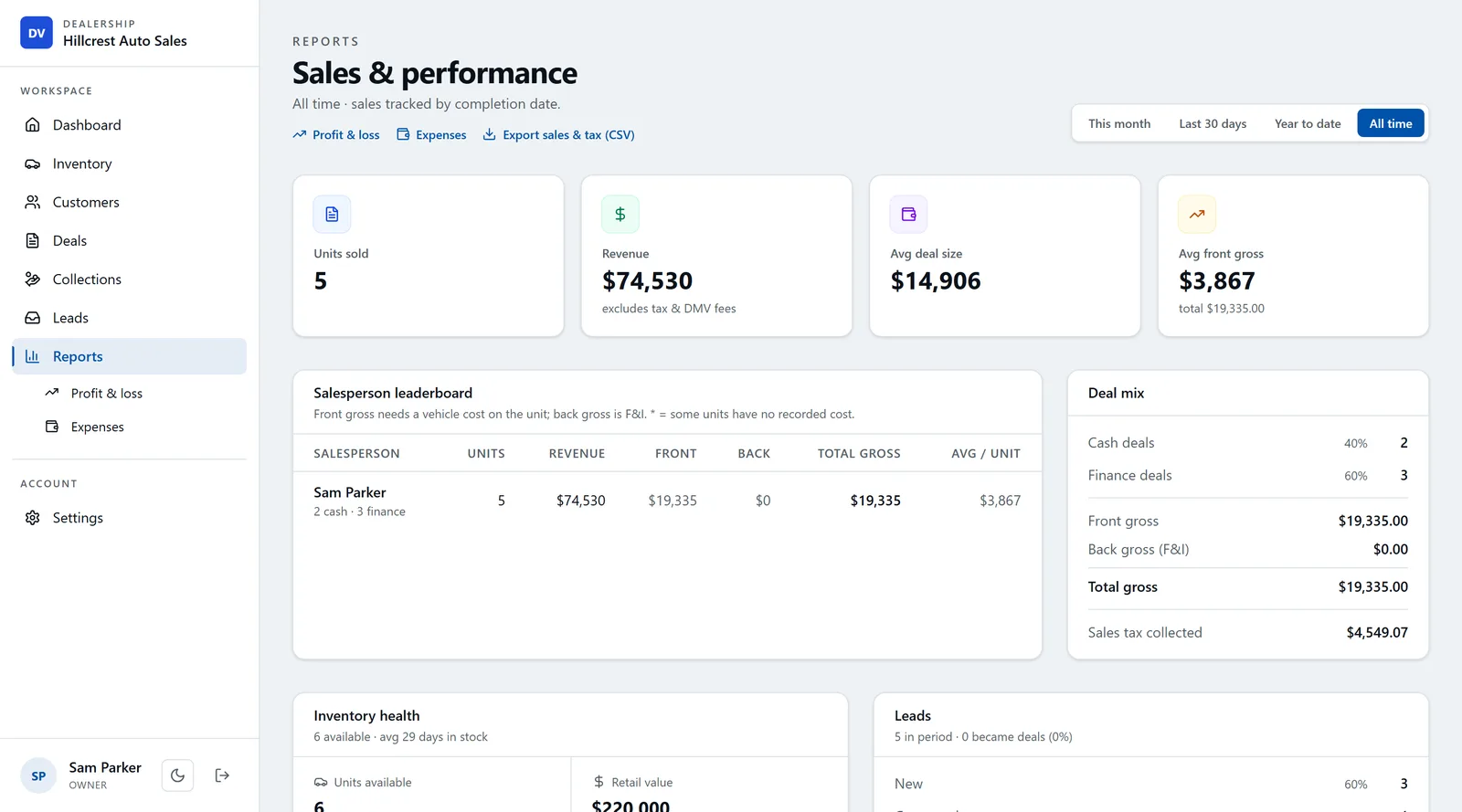
You can't fake turn or payoff history, but you can make it easy to see. In DealerVLO, every car shows its days in inventory, the Reports page breaks your lot into 0–30, 31–60, 61–90 and 90+ day buckets with the average days in stock, and the sales report lists every deal with its front- and back-end gross and exports to CSV. When a lender asks how fast you sell, or you're asking for an increase, that's the evidence in a few clicks instead of a weekend with a spreadsheet.
14-day free trial, then $29/mo · Cancel anytime
How big a line to expect
There's no published "typical" line for a 20-car lot. Here's what lenders actually put on the record:
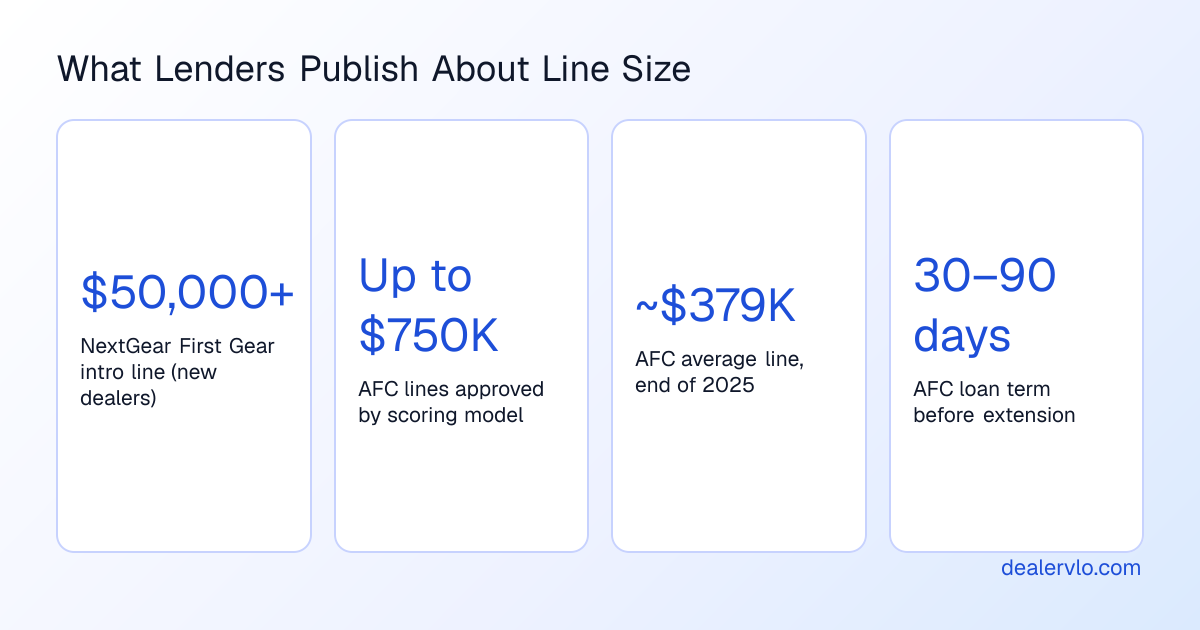
- New dealers: NextGear First Gear. NextGear's First Gear program is "built for independent dealers who've been in business for 12 months or less." It offers an introductory line of "the greater of $50,000 or the minimum allowed by law in dealer's state without submitting bank statements or records." It's at NextGear's discretion and, per that page, not available in New York, North Dakota, South Dakota or Rhode Island.
- The scoring-model ceiling: AFC. AFC approves lines up to $750,000 on its internal scoring model. Most small lots sit well inside that.
- The average across everyone: AFC. AFC reported about 11,600 active dealers with an average line of about $379,000 at the end of 2025. That's an average across stores of every size, so don't read it as what a small lot should expect on day one.
- Other lenders. Kinetic Advantage's FAQ says it advances "up to 100% of purchase price" with "flexible terms up to 180 days," but doesn't publish line sizes. Some bank floor plan programs are built for much bigger stores; one bank's program announcement put its starting point at $500,000.
The practical way to size what you need: count the cars you want floored at once and multiply by your average buy price. Twelve cars at around $9,000 each is roughly $108,000. If the first offer is smaller, that's normal. Treat it as the tier you start in and grow out of, the way our NextGear explainer describes it.
What the line costs once you have it
Approval is half the decision; the other half is what each floored car costs you. AFC's annual report says dealers pay a fee to floor a car, a fee to extend the term (the curtailment fee) and an origination fee, plus interest. Loans come due when the car sells or after a set period, "generally 30 to 90 days," and extending one "generally requires the dealer to make payment towards the principal and payment of accrued fees and interest." In testimony to the North Dakota legislature, AFC and NextGear described the interest rate as tied to the lender's published base or prime rate plus an agreed contract rate.
Every lender's fee schedule is different, so get yours in writing and run it against a real car before you sign. The free floor plan calculator does the daily-cost math for you:
Estimate your daily floor-plan carrying cost per unit.
Open the Floor Plan CalculatorFor a side-by-side of what the big three publish, see NextGear vs. AFC vs. Westlake, and before you floor everything, run the numbers in our floor plan vs. cash decision framework.
DealerVLO doesn't calculate floor plan cost per car, and it isn't a lender. What it does do: you record your floor plan charges as an overhead expense (one-time or recurring monthly), and the P&L subtracts them from gross so you see what the line really costs your lot each month.
Keeping the line, and growing it
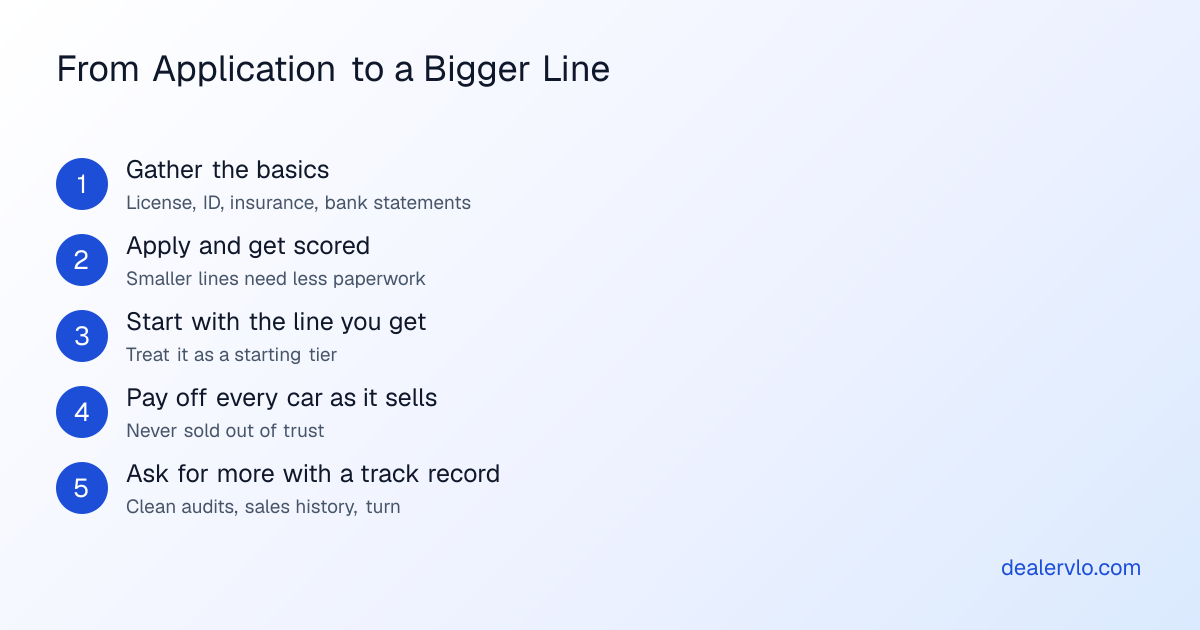
The line you're approved for isn't the line you keep. Three habits decide which way it goes:
1. Pay off every car the moment it sells. Selling a floored car without paying the lender is "sold out of trust." The OCC defines it as inventory sold with the funds "not immediately remitted," and AFC calls an unexplained sold-and-unpaid unit "a fairly serious issue." Nothing shrinks a line faster.
2. Pass every audit. AFC says it performs around 50,000 lot audits a year and holds titles on floored cars where permitted. NextGear's self-audits must be finished within 48 hours, or "additional steps will be required and fees may be incurred." Bank guidance calls for audits at least quarterly, announced and unannounced. Our guide to passing a floor plan audit covers the routine. The short version: every floored car is on the lot, or it's been paid off.
3. Turn cars. Aging units burn curtailments and tie up the line. Cars that sell in 30 to 45 days free it up for the next sale.
When an auditor reads off VINs, DealerVLO's inventory list searches by stock number, VIN, make or model, and every car's record holds its VIN, stock number and photos, so you can account for a car in seconds. When you ask for an increase, bring the sales report and your aging buckets. Showing you turn cars and pay them off is the strongest case you can make.
14-day free trial, then $29/mo · Cancel anytime
Frequently asked questions
What do you need to get floor plan financing as a used car dealer? At a minimum, expect a dealer license, a government-issued ID, proof of insurance and a signed credit application from the owners. AFC's application guidance also lists recent business bank statements. For larger lines, AFC's annual report says underwriting generally requires dealership and personal financial statements, monthly bank statements, sales reports and tax returns.
What credit score do you need for a dealer floor plan? None of the major floor plan lenders we checked publishes a minimum credit score. AFC says it extends lines up to $750,000 using its own internal scoring model, and its guidance says a line's size is often based on the dealership's financial health, inventory turn and credit history. Ask the lender directly what it looks at for your file.
Can a new used car dealer get a floor plan? Yes, there are programs aimed at new dealers. NextGear Capital's First Gear is built for independent dealers in business 12 months or less and offers an introductory line of the greater of $50,000 or the state minimum without submitting bank statements, at NextGear's discretion and not in every state. Expect a smaller first line that grows with a track record.
How big a floor plan line will a small lot get? There's no published standard. The numbers lenders do publish: NextGear's First Gear introductory line starts at the greater of $50,000 or the state minimum, and AFC reported an average line of about $379,000 across roughly 11,600 active dealers at the end of 2025, an average that includes much bigger stores. So don't plan your first buying trip around that average; plan on a smaller first line that grows with clean payoffs and steady turn.
Do floor plan lenders require a personal guarantee? The US lender pages we checked don't publish a blanket rule. AFC's underwriting for its largest lines asks for personal financial statements, and bank regulators tell banks to analyze each guarantor's finances when a floor plan loan is supported by guarantees. Read your agreement for a guaranty and ask before you sign.
How often do floor plan lenders audit your lot? It depends on the lender and your agreement. AFC says it performs around 50,000 lot audits a year, and NextGear uses self-audits that must be finished within 48 hours. For banks, federal regulator guidance says floor plan audits should happen at least quarterly, with both announced and unannounced visits. Assume an auditor can show up any day and every floored car must be on the lot or paid off.
Bottom line
Floor plan financing requirements for a small used car lot are simpler than the forums make them sound: a license, ID, insurance, a credit application and some bank statements get most small lines scored. What lenders don't publish (minimum credit scores, years in business, a standard line size) nobody can promise you. Expect a modest first line, pay off every car the day it sells, pass every audit, and turn your inventory. That's the file that gets a bigger line.
DealerVLO keeps the numbers a lender cares about in one place: days on lot for every car, aging buckets, a sales report by deal, and a P&L with your floor plan costs in it, for $29 a month. Start your 14-day free trial.