Can You Floor Plan Salvage or Rebuilt-Title Inventory? What Lenders Will and Won't Finance
Most floor plan lines exclude branded titles; here's which lenders finance salvage/rebuilt inventory and what to do instead.
Part of the Floor plan financing guide: How dealer floor plans actually work — and where they quietly eat your gross
Switching from another DMS? Compare DealerVLO to DealerCenter, Frazer, or Lot Wizard, or see what DealerVLO's car dealer management software includes.
If you've decided to run salvage or rebuilt-title inventory, the next question isn't legal — it's financial: who will actually extend you a line of credit to buy that stock? The honest answer is that most standard floor plan lines are built around clean-title collateral, and branded titles either get excluded outright or routed into a separate program you have to ask for by name.
This matters because floor plan financing and retail financing are two completely different products, and a lot of the search results on this topic blur them together. Floor plan is the wholesale line you use to buy inventory for your lot. Retail financing is the loan your customer gets when they buy the car from you — that's a separate topic, covered in our guide to selling salvage and rebuilt-title cars. This post is only about funding the purchase side.
14-day free trial, then $29/mo · Cancel anytime
Why most floor plan lenders don't want branded-title collateral
A floor plan line is secured by the car itself. The lender is betting that if you default, they can repossess and resell the unit for close to what they advanced. A salvage-titled car — one that hasn't been repaired and re-inspected yet — isn't road-legal in most states and has murky resale value from a lender's perspective, which makes it a much weaker piece of collateral than a clean-title used car sitting on your lot. That's the core reason a lot of conventional, generalist floor plan providers simply aren't built to finance it.
This isn't a documented industry-wide exclusion with a published percentage — no one tracks "what share of floor plan lenders take salvage" the way they track interest rates. But the pattern is visible in who's bothered to build a dedicated product for it: when a major provider wants to serve this niche, they create a separate, named program rather than just folding salvage into their standard used-vehicle line. That tells you something about how most of the market treats it by default.
The same logic shows up on the retail side, where it's easier to document. Big bank lenders frequently exclude branded titles from consumer auto loans entirely, while treating a title that's already been cleared of its brand (a "rebuilt" or "restored" title, once repaired and reinspected) as a different, more financeable risk. Floor plan lenders aren't consumer lenders, but the underlying collateral logic — unrepaired damage history equals weaker security — is the same one driving the exclusion.
For the mechanics of how a standard floor plan line works before you add the salvage wrinkle, our guide to how dealer floor plans actually work covers advances, curtailment, and audits in plain terms.
The lenders that do have a salvage program
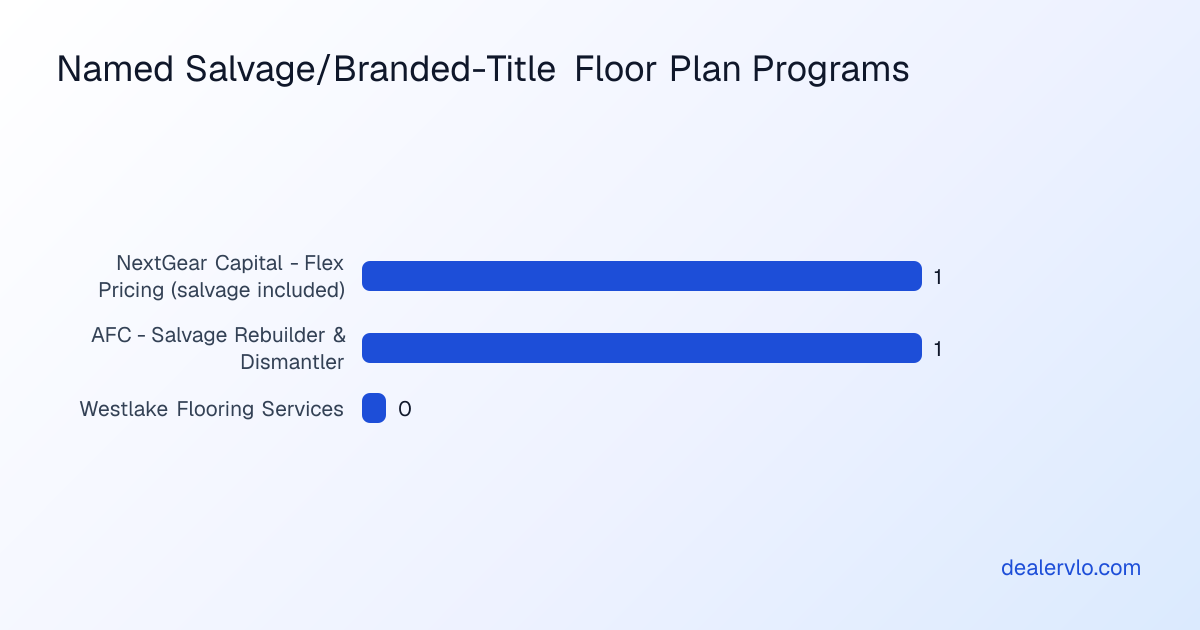
Two national floor plan providers have built out explicit, named products for branded-title inventory rather than treating it as an edge case.
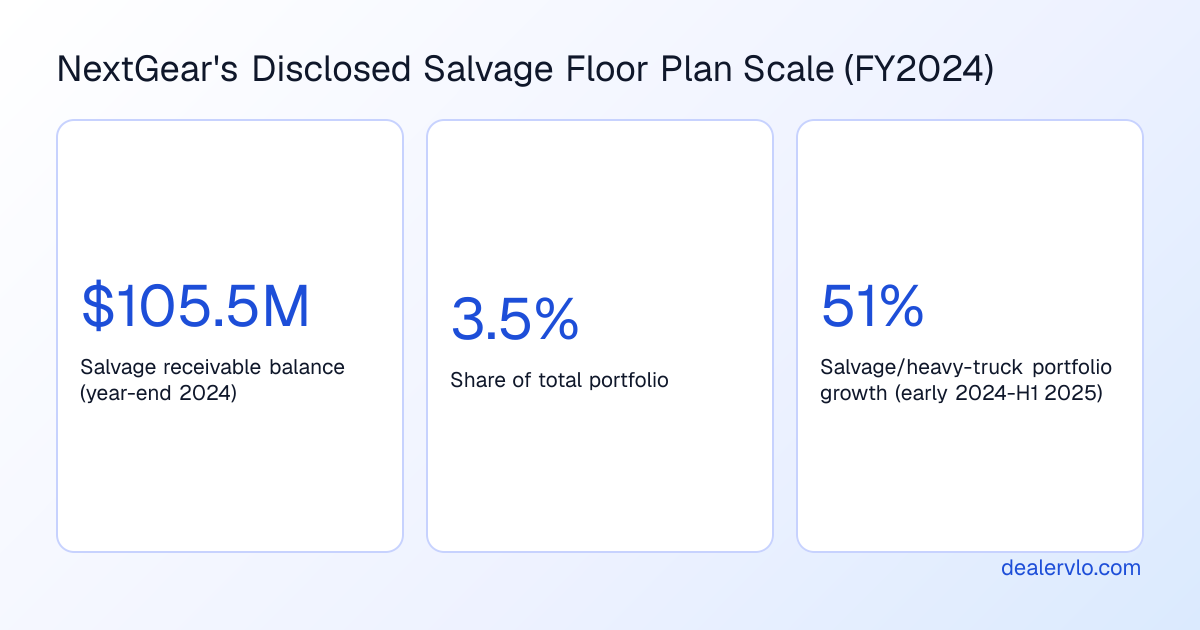
NextGear Capital (a Cox Automotive company) lists salvage as one of its named inventory types under its Flex Pricing program, which lets eligible dealers defer interest, fees, and principal paydowns until a vehicle is due for payoff — and NextGear has specifically expanded that deferral option to cover salvage and rebuilder inventory, alongside heavy trucks. Eligibility isn't automatic: Flex Pricing applies only to dealers who already hold the right line of credit (retail, wholesale, salvage, or heavy truck) and have signed the matching advance schedule, and approval is at the lender's discretion. NextGear also handles title work differently for branded units — for most states, if you need title, salvage, or lien work done, you contact their client services team directly rather than using the self-service release process used for clean titles, meaning a salvage floor plan unit moves through a more manual path on the back end.
AFC (Automotive Finance Corporation), part of KAR/OPENLANE, has arguably the most built-out product line here. AFC lists "Salvage" as its own inventory category alongside whole car and fleet lines, and offers two named sub-products: "Salvage Rebuilder" for dealers who repair salvage units to roadworthy condition, with extended terms built around the longer timeline a rebuild takes, and "Dismantler" for dealers who part out salvage cars rather than repair them. AFC is also integrated with salvage auction platforms like Copart and IAA, so a dealer floored with AFC can bid and finance in the same workflow. Like any floor plan marketer's copy, AFC's own materials carry a standard disclaimer that terms are subject to a final written agreement — the marketing page isn't the contract, so get the actual advance schedule before you count on anything.
Outside of these two, the research didn't turn up a floor plan provider's own page explicitly stating it won't finance salvage — generalist lenders mostly just don't mention salvage at all, which you should read as "doesn't appear to offer this," not confirmation that it's forbidden. Worth noting too: Westlake Financial's well-known branded-title program is a retail lending product for consumer contracts. Westlake Flooring Services, the same company's dealer floor plan arm, doesn't advertise salvage eligibility on its own marketing — if you're already floored with them, ask directly rather than assuming the retail program's rules carry over.
If your current floor plan doesn't cover it
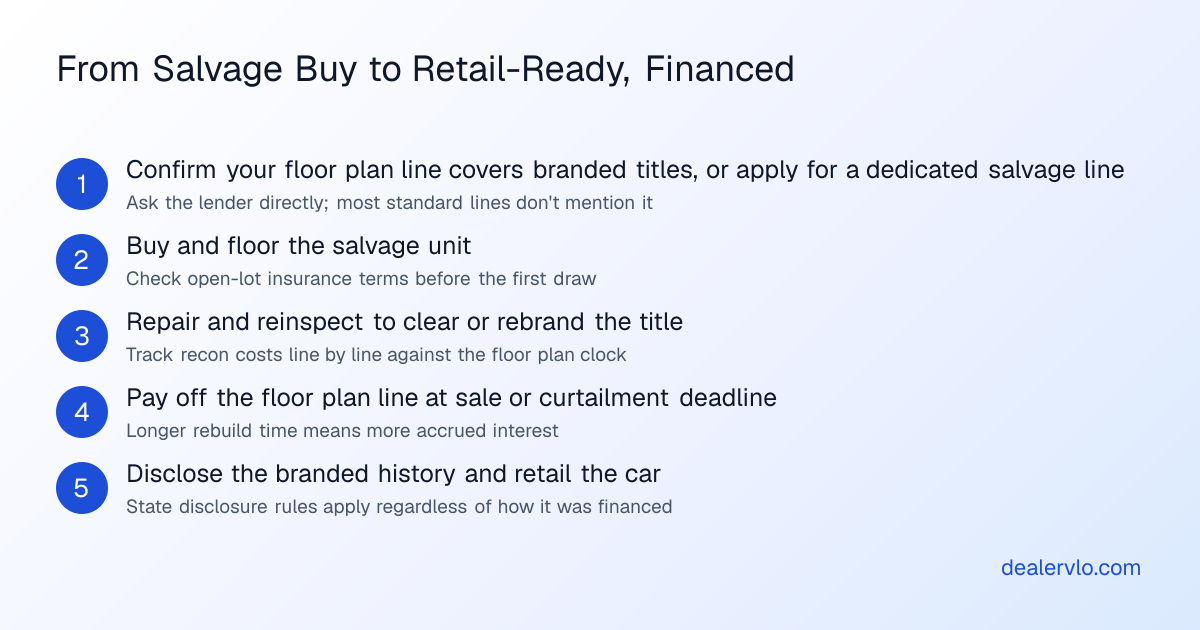
If you're already running a line with a provider that doesn't have a dedicated salvage product, you have a few realistic paths: ask your existing rep directly whether branded titles are covered under your current advance schedule (don't assume from the marketing site either way), apply for a second, salvage-specific line with a provider like NextGear or AFC while keeping your clean-title line where it is, or buy salvage inventory with cash or a separate business line and keep it out of the floor plan conversation entirely. Running two floor plan relationships is manageable but adds complexity — our guide on adding a second floor plan line without a cash crunch walks through the timing issues that come up when you split inventory across lenders.
Whichever route you take, know the real holding cost of the units you're funding before you bid. A salvage rebuild typically sits longer than a clean retail unit — parts delays, inspection scheduling, a second round of recon — so the interest and fees pile up longer too. Run the numbers before you commit a unit to a floored line:
Estimate your daily floor-plan carrying cost per unit.
Open the Floor Plan CalculatorAnd separately, check whether the repaired car's resale actually clears your buy price, repair cost, and financing cost combined:
Branded-title resale minus every rebuild cost: see the profit, your max bid, and the brand discount where it breaks even.
Open the Salvage Rebuild Profit Calculator14-day free trial, then $29/mo · Cancel anytime
Insurance is where branded titles get expensive, even when the lender says yes
Getting approved for a salvage floor plan line doesn't end the collateral conversation — your insurer is the next gate. Every floor plan agreement requires a dealer open lot (garagekeepers or inventory) policy with the lender listed as loss payee, and coverage has to match your floor plan line. A lapse in that coverage is treated as a default under most floor plan agreements: the lender can demand immediate repayment, cut off further draws, or force-place its own coverage and bill you for the premium. That's true for clean-title inventory already, and it doesn't get easier for branded titles.
On the retail side, branded-title vehicles routinely carry surcharges or outright exclusions on ancillary products — Westlake's own aftermarket acceptance list, for example, requires a mandatory surcharge on salvage/rebuilt units for at least one named service contract provider, and that provider won't cover vehicles branded for flood, fire, or saltwater damage at all. No source confirms that open-lot insurers apply a similar surcharge specifically to branded-title collateral on the floor plan side — so don't assume parity, but don't assume it's free of extra scrutiny either. Call your insurer and ask how they treat salvage units on your policy before you float a salvage line.
Keeping title paperwork straight once a car is on a salvage floor plan
Regardless of who's floored the car, you still carry the disclosure obligation. Federal reporting rules require junk and salvage yards, and insurance carriers, to report salvage and junk vehicles into the National Motor Vehicle Title Information System at least monthly — that's the backbone that's supposed to keep a brand permanent on a vehicle's record once it's applied. In practice, title brands can still get "washed" when a car moves across state lines with inconsistent reporting, which is part of why buyers (and lenders) treat branded titles cautiously even after a repair. Several states go further and require a posted disclosure or written notice to the buyer before a branded vehicle is sold — our salvage title disclosure guide by state breaks down what different states require, and it's worth checking regardless of how the car was financed on your end.
Once a salvage unit is repaired, retitled clean (or "rebuilt," depending on your state's terminology), and ready to sell, keeping its paper trail straight on your lot matters as much as it did at purchase. DealerVLO's vehicle record has a Title status field — In hand, Pending, or Lienholder — plus a title number and title state you set when you add or edit the car, and that status prints on the bill of sale. It's a field you maintain yourself; DealerVLO doesn't track title delivery timing from an auction or flag a late title, so you'll still want your own tickler for units coming out of a salvage sale with a slow title.
Tracking what the rebuild actually costs you
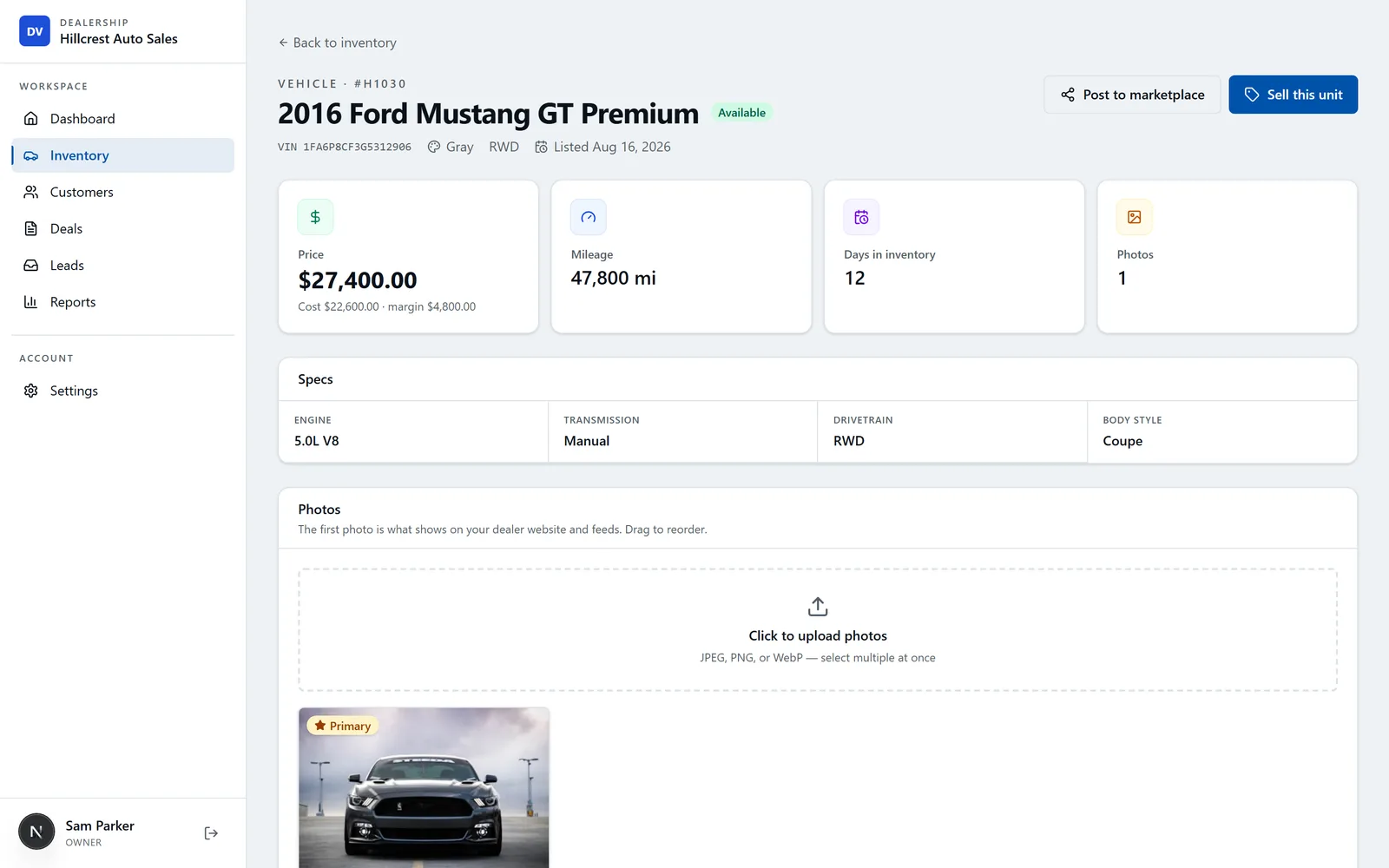
Whether you floor the purchase or pay cash, the number that decides whether a branded-title deal was worth doing is the all-in cost: what you paid at the salvage sale plus every dollar of recon and related costs it took to get the car road-ready. DealerVLO logs each car's acquisition cost when it's added, and reconditioning or per-car costs — a repair bill, transport, a history report bought for that car — can each be added as its own labeled line with a vendor and description. Those lines roll into that car's all-in cost, so when you price it for retail, the gross shown on your sales report reflects the repair work you actually put into it, not just the buy price at the salvage sale. Floor plan interest itself isn't part of that per-car math — it's overhead, and it shows up on your P&L as its own line, so you'll want to account for it separately when you judge whether a given branded-title car was worth financing.
That's also where a floor plan decision earns or costs you real money. A car that sits an extra three weeks waiting on parts is a car accruing interest the whole time — our floor plan curtailment guide explains how those scheduled paydowns work and what happens if you miss one, which is worth understanding before you put a slower-moving salvage unit on a floored line at all. For a side-by-side on whether financing the buy or paying cash makes more sense for a given car, the floor plan vs. cash decision framework lays out the tradeoff in plain terms.
14-day free trial, then $29/mo · Cancel anytime
What this means if you're just starting to sell branded titles
If selling salvage and rebuilt-title cars is new to your lot, don't assume your existing floor plan line covers it just because it's covered your clean-title inventory without issue. Ask your current provider directly, in writing if you can, whether branded titles fall under your existing advance schedule — and if the answer is no or unclear, look at NextGear's or AFC's named salvage programs before you commit cash flow to buying units you can't floor. The floor plan financing requirements guide covers what a small lot generally needs to qualify for a line in the first place, which is worth reviewing before you add a second, specialty line on top of it.
And before any of that, make sure the math on the car itself pencils out — branded titles can carry real margin, but only if the repair cost, the financing cost, and the time it eats stay inside what the car will bring at retail. The guide to whether you can actually make money on salvage title cars walks through that math line by line, separate from how you fund the purchase.
Frequently asked questions
Can I floor plan a salvage title car?
It depends entirely on your lender. Most generalist floor plan lines aren't built for branded-title collateral and don't mention salvage eligibility at all, but a few national providers — notably NextGear Capital and AFC — have built dedicated salvage or rebuilder programs with their own eligibility rules and advance schedules. Ask your current provider directly rather than assuming either way.
Which floor plan companies will finance rebuilt title cars?
NextGear Capital includes salvage as a named inventory type under its Flex Pricing program for eligible dealers, and AFC offers two dedicated products — "Salvage Rebuilder" and "Dismantler" — built specifically around branded-title inventory. Outside of these two, no floor plan provider's own marketing confirms explicit salvage eligibility, so treat an unnamed provider as unlikely to cover it until you ask.
Is Westlake Flooring the same as Westlake's branded-title financing program?
No. Westlake Financial's well-publicized branded-title program is retail financing for consumer auto loans, while Westlake Flooring Services is the company's separate dealer floor plan arm. Westlake Flooring's own marketing doesn't list salvage eligibility, so don't assume the retail program's rules extend to the floor plan side without confirming directly with Westlake Flooring.
Does floor planning a salvage car cost more than a clean-title unit?
No specific lender publishes a salvage-specific interest rate or curtailment schedule that differs from its standard line, so there's no documented markup to point to. What does change is time: salvage rebuilds typically take longer to get road-ready than a clean retail unit, and a floor plan line charges based on how long the car sits, so a slower rebuild can cost more in accumulated interest even at the same rate.
Do I need special insurance to floor plan branded-title inventory?
Every floor plan line requires a dealer open lot or garagekeepers policy with the lender named as loss payee, and a lapse is treated as a default regardless of title type. No source confirms that open-lot insurers apply a salvage-specific surcharge the way some retail service-contract providers do, so ask your insurer directly how they rate branded-title units on your policy before you float one.
What happens with the title paperwork once a salvage car is financed and repaired?
Financing the purchase doesn't change your disclosure duties — federal rules require salvage and junk vehicles to be reported into the national title database, and several states require posting or providing a disclosure to the buyer once the car is retail-ready. DealerVLO's vehicle record tracks a title status (In hand, Pending, or Lienholder) that prints on the bill of sale, but it's a field you set yourself; it doesn't monitor title delivery timing or flag a late title from an auction.
Bottom line
Deciding to sell salvage or rebuilt-title cars is only half the decision — funding the purchase is a separate conversation most standard floor plan lines aren't built to have. A handful of national providers, mainly NextGear Capital and AFC, have built dedicated salvage programs with their own eligibility rules, while most generalist lines simply don't mention branded titles one way or the other. Ask your current provider directly, check your insurance terms before you assume they match your clean-title policy, and track the real all-in cost of every branded unit so you know whether the financing, the repair, and the time it took actually left you a profit. Run your next salvage deal's numbers and paperwork through DealerVLO.
14-day free trial, then $29/mo · Cancel anytime