The Personal Guaranty on Your Floor Plan Line: What You Actually Signed, and What Survives Closing the Business
What a floor plan personal guaranty requires, why your LLC doesn't block it, and whether closing the dealership ends it.
Part of the Floor plan financing guide: How dealer floor plans actually work — and where they quietly eat your gross
Switching from another DMS? Compare DealerVLO to DealerCenter, Frazer, or Lot Wizard, or see what DealerVLO's car dealer management software includes.
If you've got a floor plan line, you signed a personal guaranty to get it — almost nobody gets one without it. That's true whether you run a 200-car superstore or a 10-car independent lot, and it's true no matter how carefully your lawyer set up your LLC or corporation. The entity structure that's supposed to wall off your house and your savings from business debt doesn't do that here, because the lender had you sign around it.
This post is about what that guaranty actually says, why "I'll just close the business" doesn't make it go away, and what the realistic paths are if you're staring down a demand on one. This isn't legal advice — guaranty and bankruptcy law varies by state and by the exact contract you signed, so talk to a bankruptcy or commercial attorney in your state before you act on anything here.
14-day free trial, then $29/mo · Cancel anytime
Why the guaranty exists even though you formed an LLC
You formed an LLC or corporation specifically so a lender, a vendor, or a lawsuit against the business couldn't reach your personal assets. Floor plan lenders are aware of this, which is exactly why they ask for a personal guaranty on the loan. A guaranty is a separate promise, from you as an individual, to pay what the business owes if the business doesn't pay it. Signing it effectively lets the lender step around the liability shield your entity was built to provide — it doesn't break the shield for anyone else, just for this one creditor, because you agreed to it (Lefkoff Law; LegalZoom).
Lefkoff Law, which works on floor plan deals, says virtually every floor plan lender requires the owner to sign personally (Lefkoff Law). And it's getting more common, not less: a November 2025 piece from Harney Partners says personal guarantees that had eased for stronger dealers in the low-rate years before 2020 are now being widely reintroduced, and that smaller and independent dealers are expected to provide one on nearly all new floor plan facilities (Harney Partners). If you're shopping lenders or switching floor plan lenders, assume every offer on the table includes one unless you're told otherwise in writing.
A second detail matters here: in most floor plan guaranty structures, the lender doesn't have to chase the business first, get a judgment, and only then come after you. The guaranty is typically written so the lender can go straight after you personally whether or not it ever pursues the business (Lefkoff Law). That's a materially different risk than a lot of dealers assume when they sign.
If you're still shopping for a line, our floor plan financing requirements guide and the NextGear vs. AFC vs. Westlake comparison cover what each type of lender asks for before you get to the guaranty itself — worth reading before you sign anything.
What "continuing" or "unconditional" actually means on the page
The guaranty you sign almost certainly isn't a one-time, capped promise tied to a single advance. It's typically written as a "continuing" or "unconditional" guaranty, sometimes called a general continuing guaranty. That means it covers every past, present, and future amount you owe that lender on the floor plan relationship — not just the car that triggered the paperwork the day you signed (LegalZoom).
Legal commentary on these guaranties describes the drafting pattern consistently: the guaranty stays in effect until you terminate it with written notice to the lender, and you remain on the hook for the full outstanding balance — principal, interest, fees — of everything the dealership owes that lender at the time (Ward and Smith, P.A.). CLE materials aimed at commercial lending attorneys describe the same structure: you're liable for debts that existed before you signed and debts incurred afterward, with no built-in end date unless you're prepared to pay the lender in full (Haywood & York CLE presentation). Watch for phrases like "at any time hereafter," "all obligations however and whenever incurred," or "now existing or hereafter contracted" in your own paperwork — those are the words that create exactly this kind of open-ended exposure (Ohio State University Extension, farmoffice.osu.edu).
Two more details from the same CLE materials. Paying the balance down to zero doesn't end a continuing guaranty on its own: unless you terminate it in writing, it keeps guaranteeing whatever the dealership borrows next. And most guaranties survive the guarantor's death, staying a liability of the estate until the debt is paid or the lender releases it (Haywood & York CLE presentation). The lesson is to read your own guaranty's termination and survival language before you sign, or pull your existing one out of the file and read it now.
Does closing the dealership end the guaranty? No — and this trips people up every time
This is the question most owners get wrong, and it's the center of this whole topic: shutting down, dissolving the LLC, or walking away from the lot does not end your personal guaranty. The guaranty is a separate legal promise from you, as an individual, to the lender — closing the business ends the business, but it doesn't touch the contract you personally signed.
A Florida bankruptcy attorney who works dealer cases put it plainly: "Closing the LLC doesn't close the guarantee. If you signed your name on that floor-plan line, the lender can still come after you personally, and that surprises people every single time." He also described the reaction he sees from owners directly: "I've had dealers sit across from me and say, 'But I closed the business, why am I still getting calls?'" (EIN Presswire, quoting Juan C. Burgos, Esq.). His firm's own description of the mechanism matches that quote: closing the entity ends the business, but the guarantee is a separate obligation from you as an individual, and the lender can still pursue you for the balance unless that guarantee is addressed directly — usually through bankruptcy (Juan Burgos Law).
There's also a timing trap worth knowing about: even sending the lender written notice that you want out doesn't erase debt that already exists. Revocation is prospective only — it can stop you from being on the hook for new advances the business takes out after the lender receives your notice, but you're still fully liable for whatever was already owed at that point, unless you pay it off, the lender releases you in writing, or you discharge it in your own bankruptcy (Ward and Smith, P.A.; Haywood & York).
If your spouse or a business partner also signed, know that the liability is typically joint and several — meaning if one co-guarantor goes bankrupt, gets released, or simply can't pay, the lender can pursue the remaining guarantor(s) for the entire balance, not just a proportional share (Ward and Smith, P.A.). A guide aimed at independent dealers choosing a floor plan lender specifically lists it as a question to ask up front: whether a spouse or business partner also has to sign (autodealer.io).
14-day free trial, then $29/mo · Cancel anytime
What actually ends it
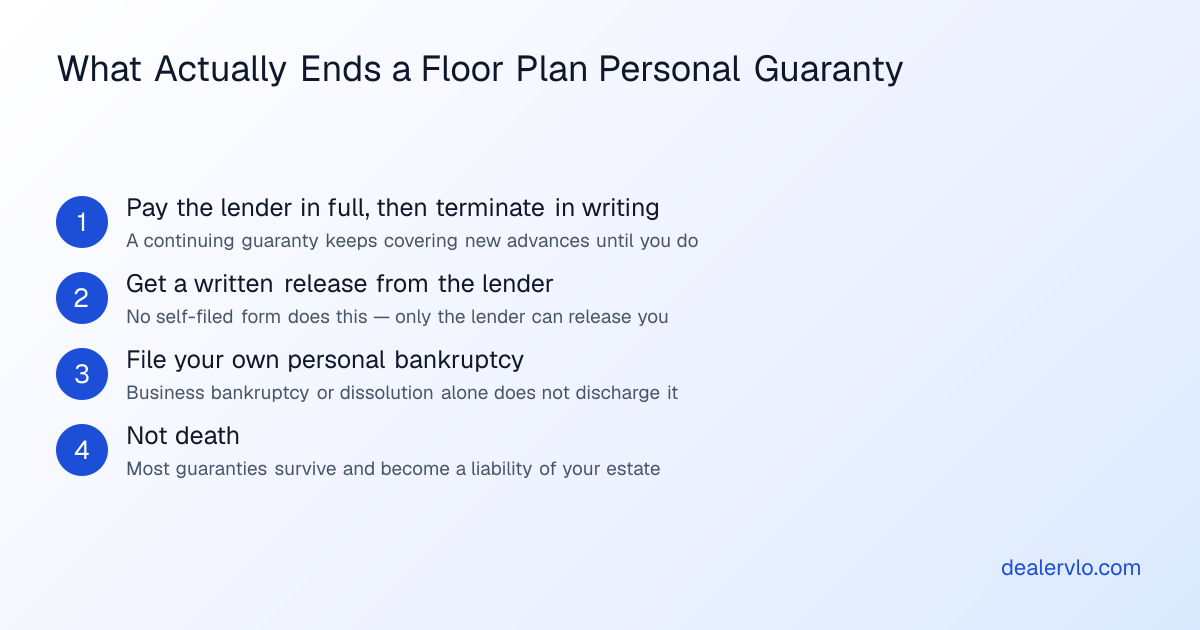
Given all of the above, there are really only a small number of things that end a continuing personal guaranty:
- Paying the lender in full, and terminating the guaranty in writing. The obligation stops when the debt is gone, not when the business is. But a paid-off continuing guaranty still covers any new advances until you send written termination, so do both.
- A written release from the lender. This has to come from the lender itself — there's no form you file unilaterally that discharges it.
- Your own personal bankruptcy, not the business's. An LLC or corporation filing for bankruptcy (or just dissolving) doesn't discharge your personal guaranty — only your own bankruptcy case can do that, and even then it depends on the chapter and the specifics of your case.
Not on the list: your death. Most guaranties survive it and stay a liability of your estate until the debt is paid or the lender releases it (Haywood & York CLE presentation).
On the bankruptcy point specifically: one Florida bankruptcy attorney's commentary states that dealers who have stopped operating can often eliminate guaranteed floor plan debt through Chapter 7 (Florida Tribune / Burgos commentary). That same firm's auto-dealer page says Chapter 7 typically eliminates personally guaranteed floor plan debt within 3-5 months (Juan Burgos Law) — but that figure comes from one attorney's own marketing page, not a fixed rule, and actual timelines vary by case and by bankruptcy court. Treat it as a ballpark, not a promise, and get a specific estimate from a bankruptcy attorney licensed in your state.
One situation lenders treat differently: if a floor-planned unit was sold and the lender wasn't paid off for that specific car — sold "out of trust" — lenders treat that as a serious breach of the floor plan agreement, and it can move quickly toward legal action or a direct demand on the guaranty (Juan Burgos Law FAQ). If you want the mechanics of how audits catch this before it gets to that point, see how to pass a floor plan audit.
What this means for how you run the lot day to day
None of this is a reason to avoid floor plan financing — most independent dealers can't carry enough inventory on cash alone, and our how floor plans actually work piece covers the tradeoff. But it does mean the personal stakes on every floored unit are higher than "the business owes this," and that should change a few habits.
Know exactly what's owed and what's been paid, on every trade you take in. The surest way to end up explaining an "out of trust" sale to your lender — or worse, to a bankruptcy court later — is losing track of a payoff. When a deal has a trade-in, DealerVLO's deal jacket records the trade allowance and the payoff owed, plus the lienholder, the loan account number, and the date the quoted payoff is good through, so the numbers you need to send the payoff check are on the deal. It doesn't send the payoff electronically or remind you when it's due — that confirmation step is still on you, with your own checklist or calendar, before you count a floored unit as settled.
Keep your own financials current enough to see trouble early. A guaranty demand rarely shows up out of nowhere — it tends to follow a stretch of missed curtailment payments, declining sales, or margin erosion the owner didn't catch soon enough.
Don't let aging inventory sit unresolved. Cars that sit too long are often the ones that end up behind on curtailment, and curtailment misses are exactly what triggers the default language in most floor plan agreements (see our curtailment explainer). DealerVLO shows days in inventory on every car, marks anything at 60 days or more "aging, consider repricing," and counts those cars on your dashboard. Which of them are a curtailment risk is your call: check each one against your lender's curtailment schedule.
Estimate your daily floor-plan carrying cost per unit.
Open the Floor Plan Calculator14-day free trial, then $29/mo · Cancel anytime
If you're already facing a guaranty demand
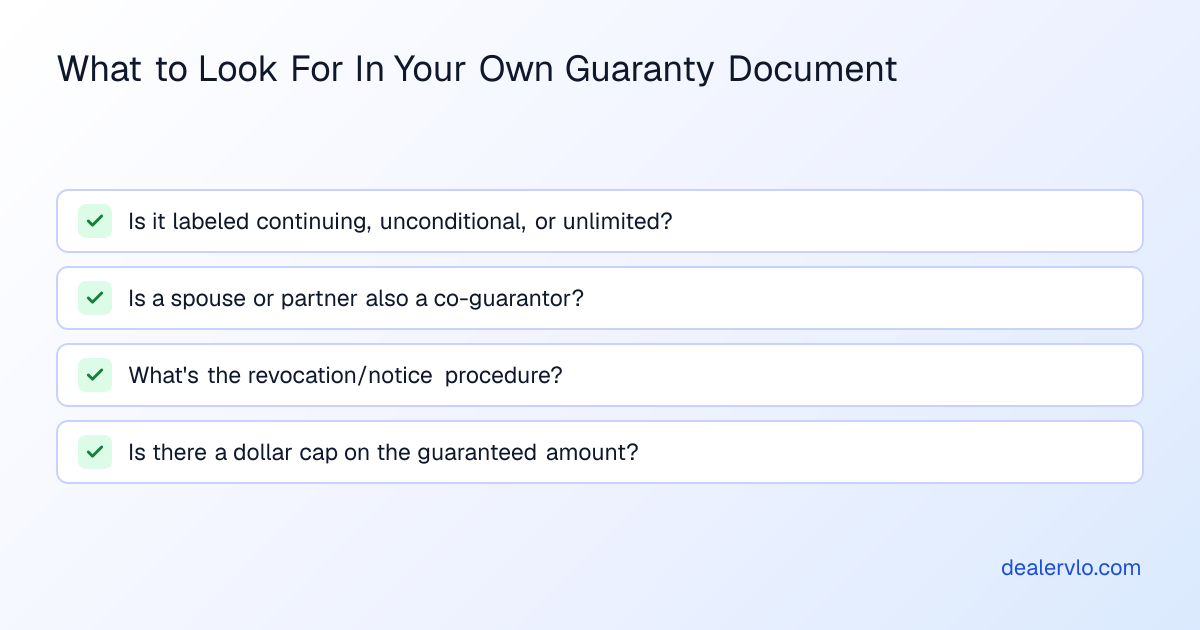
If a lender has already sent a demand letter — whether the business is still open or you've already closed it — a few things are worth knowing before you call them back:
| Situation | What generally happens | Who to involve |
|---|---|---|
| Business still operating, line current | Guaranty sits dormant, no action needed | No one yet — keep paying curtailment on time |
| Business closing, debt paid off first | Nothing left to collect, but a continuing guaranty still covers new advances until terminated | Lender (get written confirmation, a release, or send termination) |
| Business closing, debt still owed | Guaranty survives closure — lender can pursue you personally | Attorney, before you close anything |
| Guarantor wants out of future advances only | Written revocation notice stops new debt, not existing debt | Attorney to draft the notice correctly |
| Guarantor considering bankruptcy | Entity bankruptcy alone won't discharge a personal guaranty — only the guarantor's own filing can | Bankruptcy attorney licensed in your state |
Two mistakes to avoid: assuming that closing the LLC handles it (the one the attorney above says surprises people every time), and waiting too long to get a lawyer involved in the hope the lender "forgets." Neither holds up, and acting earlier generally gives you more options — whether that's negotiating a payment plan, a release, or structuring a personal bankruptcy filing — than waiting for a collections lawsuit to land first.
Reading your own guaranty before you're in trouble
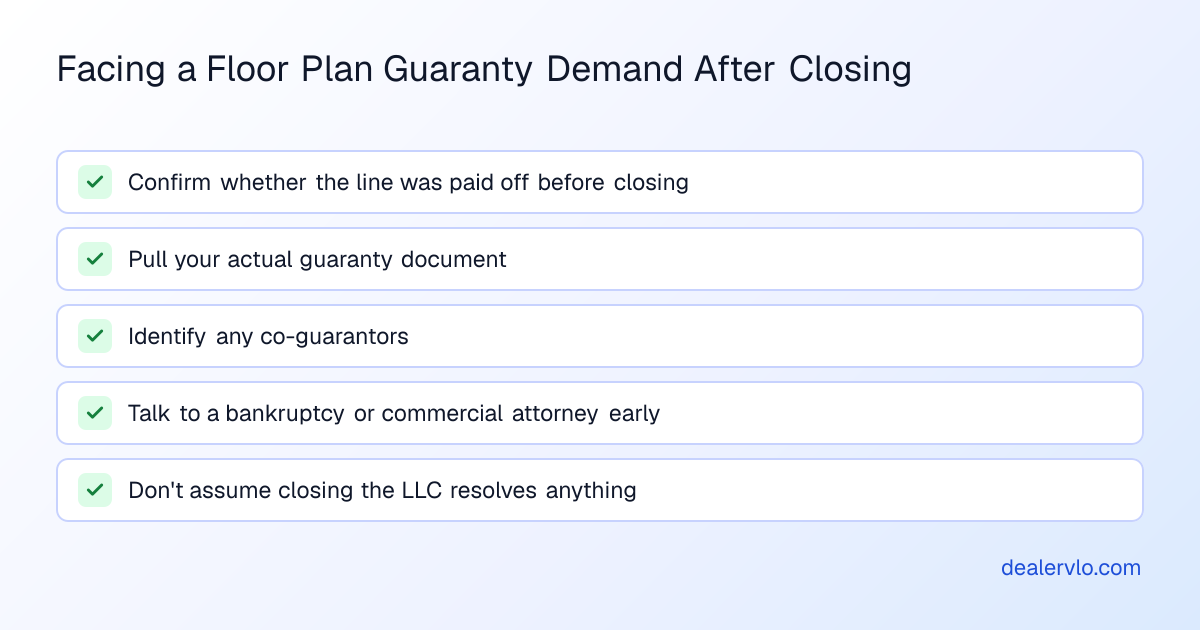
The best time to understand your exposure is before you sign, or — if you already have a line — this afternoon, by pulling the actual document out of your file. Look specifically for:
- Whether it's labeled "continuing," "unconditional," or "unlimited" — that tells you it covers future debt, not just the current balance.
- Whether a spouse or partner is a co-guarantor, and whether the joint-and-several language is there.
- The notice procedure for revoking future coverage — who you'd have to notify, and how, if you ever want to close out the relationship.
- Any cap on the guaranteed amount — some guaranties are capped at a dollar figure or percentage of the line, though many aren't.
If any of that is unclear from the document itself, that's a question for a commercial attorney, not a forum post or a lender's own sales rep. Lenders aren't obligated to explain the downside of their own paperwork to you. Keep the signed guaranty with your lender file, and give your attorney a copy before you need one.
Frequently asked questions
Does every floor plan lender require a personal guaranty?
Close to it. One law firm that works on floor plan deals says virtually every floor plan lender requires the owner to sign personally, and a 2025 industry piece says smaller and independent dealers are now expected to give one on nearly all new facilities, whatever the entity structure (Lefkoff Law; Harney Partners). If a lender tells you otherwise, get it in writing before you count on it.
Does closing my dealership end the personal guaranty on my floor plan line?
No. Closing or dissolving the business ends the business, but the guaranty is a separate obligation you signed as an individual, and the lender can still pursue you personally for the remaining balance unless you pay it off, get a written release, or discharge it through your own bankruptcy (Juan Burgos Law; EIN Presswire / Burgos).
If I send the lender notice that I'm revoking my guaranty, am I off the hook for everything?
Not for debt that already exists. Revocation is generally prospective only — it can stop you from being liable for new advances made after the lender receives your written notice, but you remain fully liable for whatever balance already existed at that point (Ward and Smith, P.A.).
Can bankruptcy get rid of a personal guaranty on a floor plan line?
Your own personal bankruptcy filing can discharge a guaranteed floor plan debt in some cases, but your business's bankruptcy or dissolution does not — the guaranty is your personal obligation, separate from the entity's. One bankruptcy attorney's commentary notes dealers who've stopped operating can often eliminate this debt through Chapter 7, though case timelines and outcomes vary and depend on your specific situation and jurisdiction (Florida Tribune / Burgos).
What happens if my spouse also signed the guaranty and we separate or one of us files for bankruptcy?
Co-guarantors are typically liable jointly and severally, meaning the lender can pursue either guarantor for the full amount owed if the other is released, bankrupt, or unavailable — not just a split share (Ward and Smith, P.A.). This is a question for your attorney specifically, since it interacts with both guaranty law and your state's marital property rules.
Does selling a car without paying off its floor plan advance ("out of trust") affect my personal guaranty?
Yes — lenders treat it as a serious breach of the floor plan agreement, separate from an ordinary balance issue, and it can move quickly toward legal action or a direct demand on the personal guaranty (Juan Burgos Law). Staying current on curtailment and passing your audits cleanly (see our audit guide) is the best way to avoid ever testing this.
Bottom line
The personal guaranty on your floor plan line is close to unavoidable, it's almost certainly written to cover more than the loan you think you're getting, and closing the business does not make it disappear — only paying it off and terminating it in writing, getting a release, or your own bankruptcy discharge does any of that. None of this means avoid floor plan financing; it means read what you signed, keep your payoffs and margins tight enough that you never need to find out how it's enforced, and talk to a commercial or bankruptcy attorney in your state the moment a lender raises the subject, not after a lawsuit lands. Keeping your deal records, trade payoffs, and margins straight day to day in DealerVLO won't erase a guaranty, but it makes you a lot less likely to ever need to find out what yours says.
14-day free trial, then $29/mo · Cancel anytime