Buying a Trade-In or Private-Party Car With a Lien Still On It: The Payoff Process
How to get a payoff letter, verify the per-diem, pay the lienholder directly, and time title release when you buy a car that still has a loan on it.
Part of the BHPH, financing & F&I guide: How to Run a Buy Here Pay Here Dealership: The Whole Loop, From Approval to Payoff
Switching from another DMS? Compare DealerVLO to DealerCenter, Frazer, or Lot Wizard, or see what DealerVLO's car dealer management software includes.
Every lot that takes trade-ins runs into this sooner or later: the car you want has a loan on it, and the loan has to go away before you can put a clean title in your name. The payoff letter is the document that makes that happen — it's the lender's written statement of exactly what it takes to kill the loan and release the lien, as of a specific date. Get the mechanics of that letter wrong — chase a verbal quote, let it go stale, send the check to the wrong party — and you can end up floored on a car you can't yet title, sometimes for weeks.
This isn't legal advice, and the deadlines below vary a lot by state. Confirm your own state's trade-in payoff and lien-release timelines with your state's DMV or motor vehicle agency before you build them into your process.
14-day free trial, then $29/mo · Cancel anytime
What a payoff letter actually promises — and what it doesn't
A payoff letter is the lienholder's own statement of what it will take, as of a stated date, to pay the loan off completely and release the car as collateral. It's not a universal form — every lender writes its own, so don't assume one payoff letter looks or reads like the last one you got (bostonbusinesslaw.com). What they all share is a dollar figure, a "good-through" date, and (ideally) a per-diem number for every day past that date.
That good-through date is the whole game. A payoff letter is a snapshot, not a standing offer. Lenders generally expect to receive full payment by the date on the letter, and most state that if payment lands later, the amount goes up by the per-diem rate for each extra day (bloomberglaw.com). If you've ever had a payoff come back short because you funded three days after the letter's date, that's why.
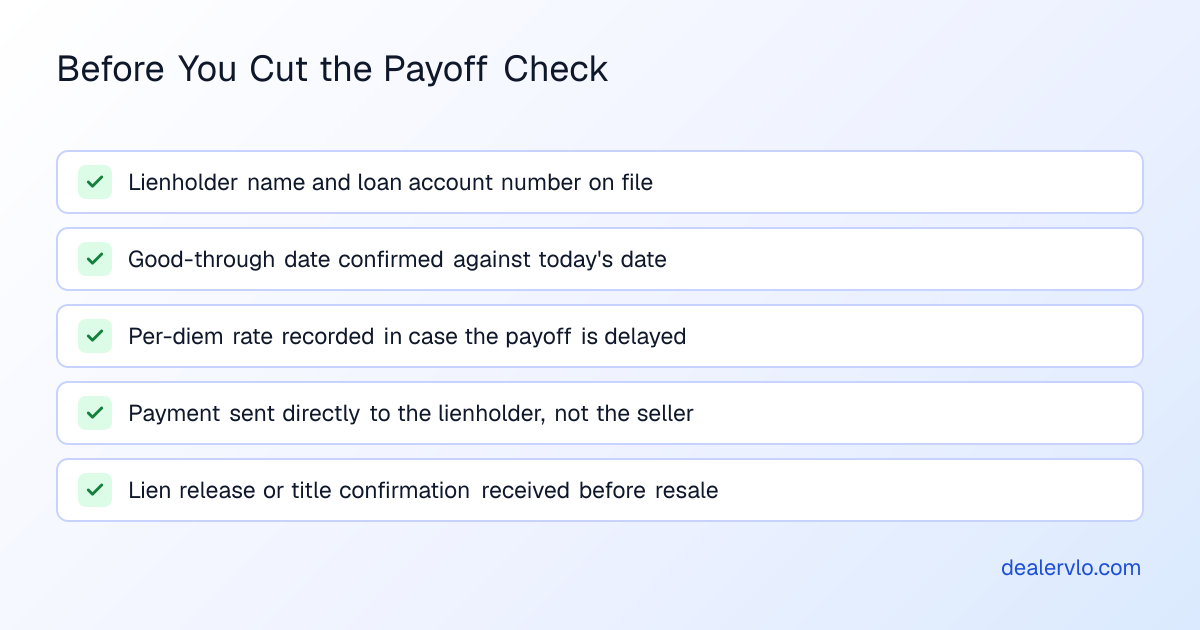
On your lot, this is exactly what the trade-in section of a deal in DealerVLO is built to hold onto: the lienholder name, the loan account number, the date the quoted payoff is good through, and the per-diem rate for reference. It won't recalculate an updated payoff for you — no system should guess at a number only the lender can confirm — but it keeps those four pieces attached to the deal instead of scattered across a sticky note and a text thread, so whoever cuts the check knows exactly what date they're working against.
14-day free trial, then $29/mo · Cancel anytime
Requesting the payoff quote and reading the per diem
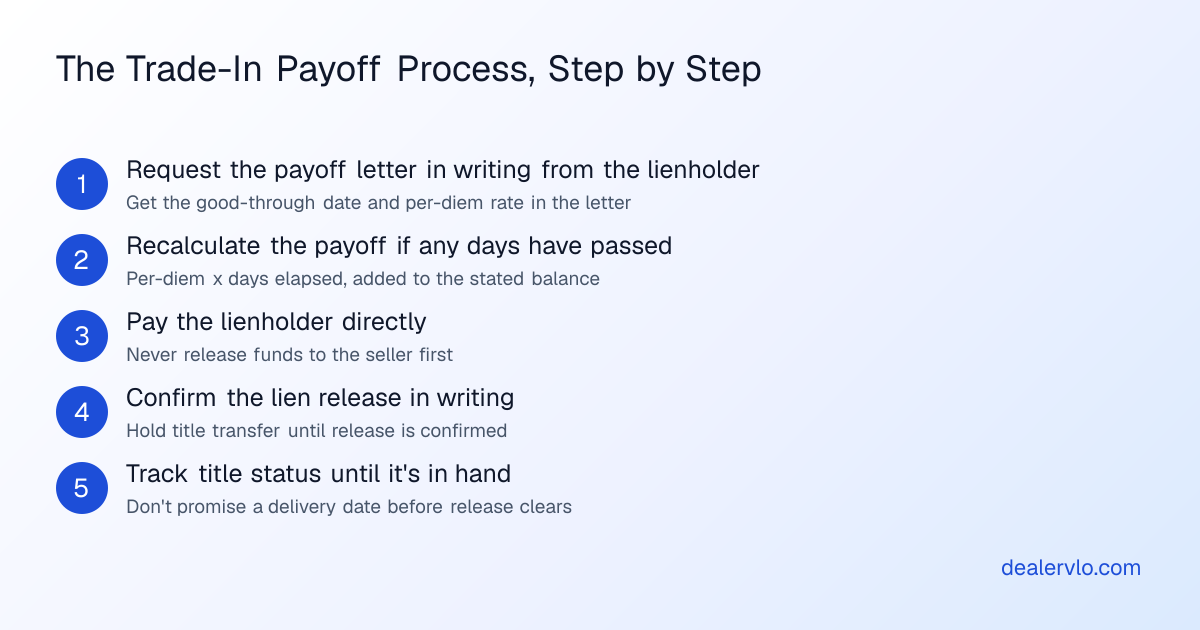
Request the payoff letter from the lienholder as early in the deal as you reasonably can — by phone, email, or through the lender's online portal, depending on what they support (pnc.com). Ask for it in writing even if someone on the phone gives you a number; a verbal quote isn't something you can hold anyone to if it turns out wrong.
Per diem is simply the daily interest the loan is still generating. Because most auto loans are simple-interest, the borrower (or whoever's paying it off) only owes interest for the days the balance was actually outstanding (finzbyte.com) — which is exactly why the number on the letter creeps up the longer you sit on it. Read the letter for two things before you move forward:
- The exact good-through date
- The daily per-diem amount, so you (or your bookkeeper) can hand-recalculate the true payoff if you're funding even a day or two later than the letter's date (pnc.com)
Don't eyeball this. If the letter is five days old when you're ready to cut the check, multiply the per diem by the days elapsed and add it to the stated payoff before you send money. Lenders write that padding into the letter precisely so there's a way to true it up (bostonbusinesslaw.com).
If you're appraising a trade and the payoff is close to (or higher than) what the car's worth, that's a negative-equity conversation before it's a payoff-timing conversation — worth working through with a trade-in appraisal process and, if the numbers come back upside down, a deliberate plan for structuring negative equity into the deal rather than just rolling it in and hoping.
Paying the lienholder directly, not the seller
This is the one rule every source on this topic agrees on without exception: the payoff money goes to the lender, not into the seller's hand, and the seller (or your trade-in customer) only sees whatever's left over. If the loan is bigger than what the car is worth, the seller still owes the lender the full balance — the math doesn't change just because the sale price came in lower (bankrate.com).
The safe sequence looks the same whether you're buying off a private seller or taking a trade-in:
- Confirm directly with the lienholder what they need to release the lien — not secondhand from the seller (gobankingrates.com).
- Pay the lienholder directly, by whatever method they specify in the letter — most include their own payment instructions, account details and all (bloomberglaw.com).
- Get the lien release in writing once it clears. For a private-party deal specifically, don't release funds to the seller until the lender confirms the lien is satisfied and a release document is coming (gobankingrates.com).
- If the full balance can't be paid before you take the car, some lienholders will still hand over the title against a check for the payoff amount — but that's lienholder-by-lienholder policy, not a given, so ask before you assume it (creditkarma.com).
On a deal in DealerVLO, when the trade payoff is more than the allowance, that negative equity shows up on the deal and gets added to the amount due, and it prints as its own line on the bill of sale and the retail installment contract — so it's never a number you're tracking separately from the rest of the deal math. DealerVLO doesn't send the payoff to the lender for you or track whether the lien release actually came back; that part is still a phone call, a check, and a follow-up on your end.
A straightforward private-party buy has its own front-end checklist before you even get to the payoff letter — worth running alongside a full private-party acquisition walkthrough so you're not improvising the paperwork on top of chasing a lender.
State payoff deadlines: know your own, don't assume a national number
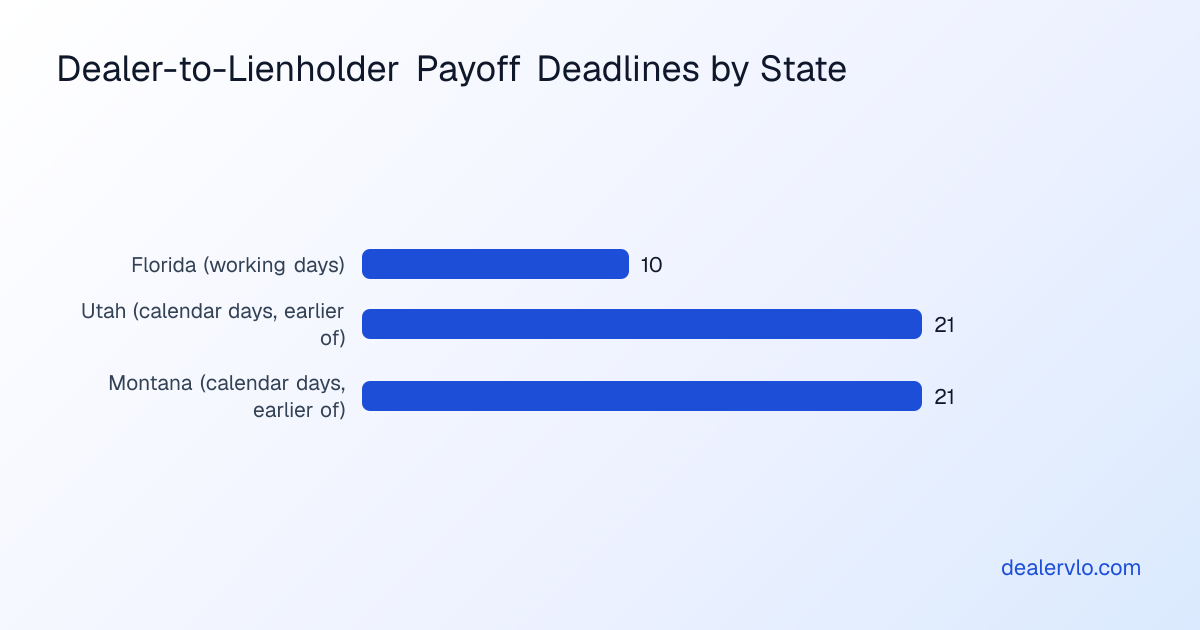
A handful of states put an actual clock on how fast a dealer has to pay off a trade-in's lien once the deal closes. The ones with confirmed, specific numbers:
| State | Dealer's payoff deadline | Enforced by |
|---|---|---|
| Utah | Earlier of 21 calendar days from trade-in, or 15 days after the dealer is paid in full for the car it resold | Utah DMV |
| Montana | Earlier of 21 days from accepting the trade, or 15 days after the dealer receives payment in full | Montana state code |
| Florida | 10 working days from acquiring the trade | Florida Department of Highway Safety and Motor Vehicles (FLHSMV) |
(dmv.utah.gov; mca.legmt.gov; dmvdealerschool.com)
Those three are the only states where this research turned up a specific, sourceable day count — don't assume your state matches any of them, and don't repeat a "21-day rule" you've seen on a blog unless your own state's DMV page says it. Rules like this are exactly the kind of thing that changes by state and gets enforced by whichever agency issues your titles, so check directly with yours before you build a deadline into your process.
What's consistent everywhere is the shape of the obligation, even where the exact day count isn't public in plain language: the clock the dealer is on (pay the lienholder) runs separately from the clock the lienholder is on (release the lien back to you or the DMV). Utah, for example, also requires the lienholder to deliver a released title back within a matter of days of being paid (le.utah.gov) — a second deadline that's out of your hands once you've sent the check.
The "floored on a car you can't title" problem
Here's the part that actually costs a small lot money: paying off the lien promptly doesn't mean the title shows up the next day. There are two separate clocks running — your deadline to pay the lienholder, and the lienholder's own deadline to release the lien and send the title back once paid (dmv.utah.gov; le.utah.gov). Even a state with a fast payoff deadline for dealers can still leave you waiting on the lienholder's side of that exchange.
California illustrates how seriously some states take the lienholder's half of this: a legal owner that doesn't release its security interest and get the title moving within the required window after being paid in full can owe the former borrower a per-day penalty — up to a capped dollar amount, and the penalty can increase further if the lienholder still hasn't paid after a formal written demand (findlaw.com; a government consumer handout on title transfer corroborates the same figures). That penalty exists precisely because lienholders dragging their feet on release is a known, real problem — not a hypothetical.
In states that have moved to electronic lien and title (ELT) systems, the lien itself can be released electronically, and AAMVA — the association that built the ELT standard most states use — tracks which states run it (aamva.org). That's generally faster than paper, but a holder can't always convert an electronic release into a printable paper title the same day in every ELT state (per general background on ELT), so "electronic" doesn't automatically mean "instant" for your purposes. Michigan is a good example of a state that leaned hard into ELT: after launching its system and later making lienholder participation mandatory, the volume of electronic titles there grew enormously (movemag.org) — which is the direction most states are heading, even if the timeline to get there varies.
Practically, this two-clock structure is why you shouldn't treat "I mailed the payoff check" as the end of the job. Follow up with the lienholder, confirm the release is in motion, and don't quote a delivery date to your buyer until you've actually got the title (or a confirmed release) in hand.
Quote a payoff on an in-house note — current balance plus per-diem interest, good through a date.
Open the BHPH Payoff CalculatorWhere this fits with floor plan, BHPH, and your own paperwork
If you're planning to floor-plan a trade-in or private-party unit while the old lien is still being cleared, that's worth reading up on separately — not every curtailment line will take a car that isn't free and clear yet, and the mechanics differ from flooring an auction buy. See flooring a trade-in or private-party purchase before you assume your floor plan provider will touch it.
If the car you're buying is going to end up as one of your own buy-here-pay-here notes down the line — say you take it in on trade, clear the old lien, then sell it again in-house — it helps to already have a handle on running BHPH from approval to payoff and calculating your own BHPH payoffs, since you'll be the lienholder issuing the next payoff letter.
14-day free trial, then $29/mo · Cancel anytime
On the inventory side: a trade-in with a full 17-character VIN gets added to your inventory automatically when the deal is completed in DealerVLO, with the trade allowance set as its acquisition cost and the sale date as its acquired date, under a stock number starting with "T-". A trade without a full VIN — which happens more often than you'd think when a customer's old registration or the car's VIN plate is hard to read — has to be added from the Inventory page by hand. Either way, the car's "Title status" field (In hand, Pending, or Lienholder) is something you set yourself as the payoff moves along, and it prints on the bill of sale so there's no ambiguity about where the paperwork stands.
A private-party payoff with the buyer's own financing
If you're buying a lien-carrying unit from a private party and financing part of the acquisition yourself, there's a variant worth knowing: your own lender can pay the seller's lienholder directly as part of funding your purchase, becoming the new lienholder on the car until your loan is paid (bankrate.com). That's a cleaner path than you handling two separate wires, but it depends entirely on your lender's willingness to coordinate directly with the seller's lienholder — ask before you assume it's available.
And in at least one state, Florida, a private sale with an open lien reportedly can't close at all until the lien is satisfied and the lienholder reports that to the state — treat that as a direction to check with Florida's own agency rather than a number to rely on, since the sourcing behind it wasn't strong enough to state as settled fact here. The broader point holds everywhere: never let a private seller hand you a car and pocket your money while a lien is still open. Confirm the release first.
Once the lien's cleared and you've got a released title or a confirmed electronic release in hand, the rest of the paperwork follows the normal path — DealerVLO fills your state's title and registration form (the official state PDF in most states, a print-ready worksheet of the deal's numbers in the handful of states that only issue title through a portal or controlled paper), pulling from the same deal record that already has the buyer, the vehicle, and the trade. If you ever need to hand a customer or a lender a standalone release document, the vehicle lien release form guide walks through what that paperwork actually needs to say.
Frequently asked questions
What is a payoff letter and why does it have an expiration date?
A payoff letter is the lienholder's written statement of exactly what it takes to pay off a loan and release the car as collateral, as of a specific date. It has an expiration — usually called a "good-through" date — because interest keeps accruing daily on the loan, so the number is only accurate through that date; after it, most lenders add a per-diem charge for each extra day until you pay.
How do I verify a lien payoff amount is still accurate before I send the check?
Check the good-through date on the payoff letter against today's date. If any days have passed, multiply the per-diem interest amount (also listed on the letter) by the number of days elapsed and add that to the stated payoff before funding — lenders expect you to true the number up this way rather than assume the original figure still holds.
Who do I actually pay when buying a car with a lien — the seller or the lender?
The lender, always — never the seller or trade-in customer directly. The payoff goes to the lienholder to release the lien, and the seller only receives whatever's left over after that payoff is satisfied; this holds whether you're taking a trade-in or buying private-party.
How long does a dealer have to pay off a trade-in's lien?
It varies by state and is enforced by that state's motor vehicle agency, so check your own state's current rule rather than assume a number. A few states have confirmed, specific windows — for example, Utah and Montana both tie it to the earlier of 21 days from the trade or 15 days after the dealer's resold the car, and Florida requires payoff within 10 working days of acquiring the trade — but these numbers don't carry over to other states.
Why would I pay off a lien promptly and still not have a title to sell the car?
Because there are two separate clocks: your deadline to pay the lienholder, and the lienholder's separate deadline to release the lien and send the title back once it's paid. Some states put a real penalty on lienholders that drag their feet on the second clock, but even then, electronic lien systems don't always convert to a printable paper title the same day, so plan for a gap between payoff and title-in-hand.
Can my own lender pay off a private seller's lien directly if I'm financing the purchase?
In some cases, yes — if you're financing part of the purchase, your lender can coordinate directly with the seller's lienholder to pay off the old loan and become the new lienholder on the car. This isn't automatic everywhere, so confirm with your own lender whether they'll handle it that way before you count on it.
Bottom line
A payoff letter is only as good as the date on it and the per-diem math behind it — request it early, read the good-through date and per-diem before you fund, pay the lienholder directly, and don't quote your buyer a delivery date on the new title until the lien release has actually come back. Know your own state's dealer payoff deadline (don't borrow another state's number), and remember that paying the lender fast doesn't guarantee a fast title — that's a second, separate clock you don't control. Keep every lienholder detail, payoff date, and per-diem attached to the deal itself, and run your next lien-encumbered trade through DealerVLO.
14-day free trial, then $29/mo · Cancel anytime