ACV Capital and Title-Hold Financing: Paying for a Car Before the Title Arrives
How ACV Capital's title-hold auction financing works, what its terms say today, and how it differs from a traditional third-party floor plan.
Part of the Floor plan financing guide: How dealer floor plans actually work — and where they quietly eat your gross
Switching from another DMS? Compare DealerVLO to DealerCenter, Frazer, or Lot Wizard, or see what DealerVLO's car dealer management software includes.
Every small lot that buys at auction hits the same wall sooner or later: you win a car, the auction wants its money, and the title is nowhere near ready to travel with it. ACV Capital is ACV Auctions' answer to that problem. It's financing built into the auction, including an option that moves your payment due date to when the title actually shows up. Before you sign anything, it's worth knowing whether that differs from a regular floor plan line or is just a new name for the same thing.
This isn't legal or lending advice. Loan terms, fees, and day-counts change, so confirm the current numbers directly with ACV Capital (or whichever lender you use). For any title-delivery rule that applies to your own resales, check with your state's motor vehicle agency.
14-day free trial, then $29/mo · Cancel anytime
What ACV Capital actually is
ACV Capital is the financing arm of ACV Auctions, the same company that runs the online auction platform. It isn't a bank partner bolted on afterward. ACV's annual reports list short-term inventory financing through ACV Capital alongside its auctions, inspections, and transportation (ACV 10-K, fiscal 2023). On its own locations page, ACV calls ACV Capital the preferred lending partner for many leading auction houses nationwide (ACV Capital locations page). That page doesn't list every participating auction, so check before you bid on a car you plan to floor somewhere other than ACV's own platform.
If you've never floored a car before, start one step back with how dealer floor plans actually work. It covers advance rates, interest, and what a lender holds against your line. Then come back for ACV's version.
The headline terms on ACV's own pages
ACV's Capital pages make a few specific promises:
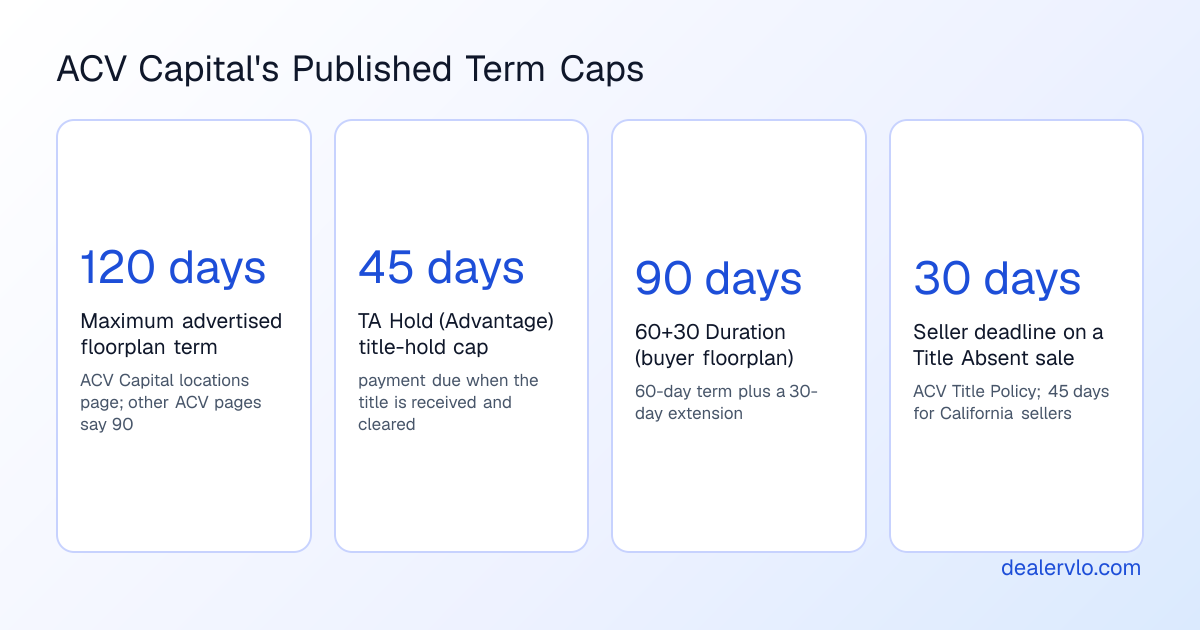
- Floorplan terms of up to 120 days, with the fee set by the amount financed and the term you choose (ACV Capital locations page). Some other ACV materials still describe floorplans of up to 90 days, so the cap you'll be offered is a question for your rep.
- No hidden title, audit, curtailment, or FedEx fees, and no third-party flooring fees, because the financing is part of the auction (ACV Capital).
- No payment due on a vehicle until the title has been sent (same page).
- On cars bought through ACV Auctions, you can floor the cost of ACV Transportation, buy fees, and buyer assurance plans instead of paying them at purchase (same page).
That last point is the real difference. A traditional floor-plan line usually finances the price of the car. ACV Capital sits inside the same transaction, so it can also finance the costs that come with the purchase: transport, the buy fee, and the assurance plan. That shrinks the cash you put down at the auction. It matters most for a dealer who buys several cars a week and watches cash flow closely.
Flooring the fees doesn't make them free, though. Carrying a bigger balance for more days still costs money; you just pay it later. Run the numbers through a floor plan calculator before you assume a longer term is cheaper. When you add the car to your own inventory, decide once whether a floored buy fee and transport count as part of the car's cost, then apply that to every unit so your gross means the same thing on every car.
| Feature | ACV Capital | Traditional third-party floor plan |
|---|---|---|
| Where it sits | Built into the auction transaction | Separate lender you use across auctions |
| What it can finance | Price of the car, plus transport, buy fee, and assurance plan on ACV Auctions buys | Mainly the price of the car |
| Title-hold option | Payment can wait until the title is received (TA Hold) | Lender usually holds the title from the day it funds |
| Published terms | Term caps and fee promises posted on ACV's own pages | Usually quoted per dealer after underwriting |
The title-hold mechanic: how the payment due date moves
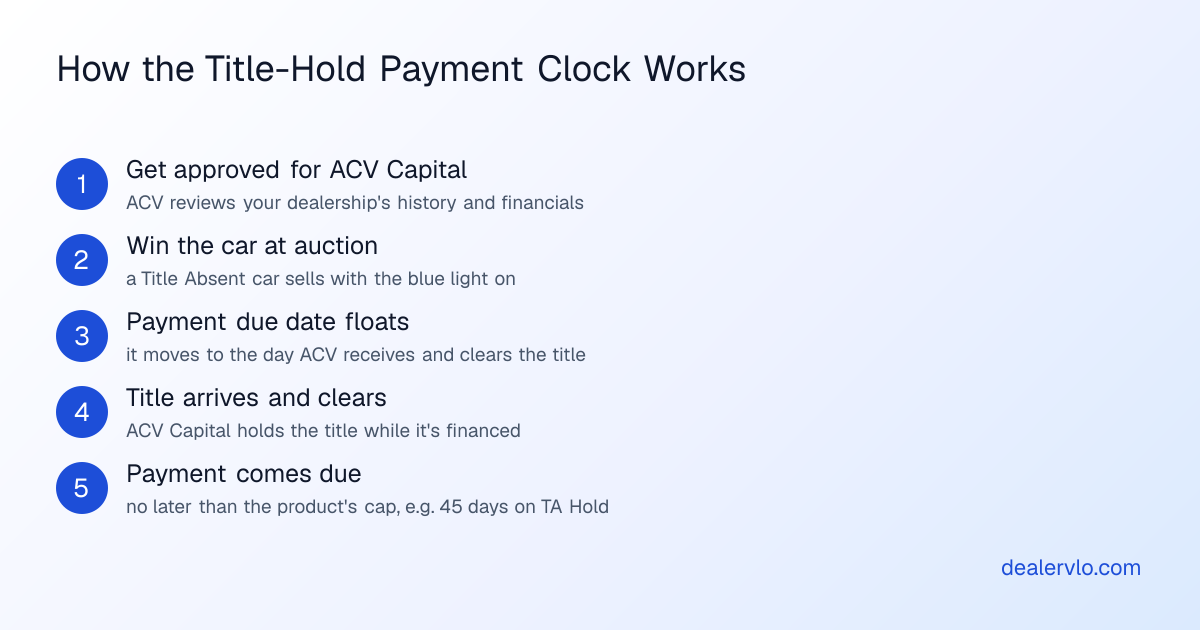
ACV launched its title-hold product in 2021 as ACV Advantage: Buyer TA Hold ("TA" stands for title absent). Normally the buyer pays at the close of the auction. With TA Hold, the payment comes due on the day ACV receives and clears the title from the seller, up to a maximum of 45 days (ACV press release, 2021). ACV's Capital pages still describe Advantage as its TA Hold program, with plans of up to 45 days for a one-time fee (ACV Capital).
The same 2021 launch also introduced a 60+30 Duration option for buyer floorplan customers: a 60-day term plus a 30-day extension, for a 90-day floating period. A May 2022 update added a "60+Daily Fee" choice that charges for each day past 60 instead of the full extra 30 days, and kept the maximum term at 90 days (ACV Capital updates, May 2022). Since then, the locations page has started advertising terms of up to 120 days. These are separate products with separate caps, so get the number for the product you're actually using in writing.
The cash-flow case is simple, and it showed up in ACV's launch coverage. A dealer quoted there said the Advantage product "frees up operating cash on vehicles that we cannot sell or floor due to lack of title" (Auto Remarketing). Without it, the car ties up your cash while you wait on paperwork. With it, you get time without spending money you'd rather use elsewhere.
Estimate your daily floor-plan carrying cost per unit.
Open the Floor Plan CalculatorWhere the title sits while you wait
This explains why the due date can float at all. Once a title arrives, ACV Capital holds it. In ACV Capital's 2024 servicing agreement for its securitization, filed with the SEC, ACV agrees to physically hold the titles for financed vehicles in a secure location at its Buffalo, New York headquarters.
Lenders holding the title is standard across floor-plan lending; ACV didn't invent it. The difference is what starts the payment clock. A traditional lender holds the title from the day it funds the loan and usually runs a curtailment schedule: required paydowns at set checkpoints, wherever the car is. ACV's title-hold product ties the payment due date to when the title arrives, so you're watching a different clock. For how curtailment works on a standard line, see floor plan curtailment, explained.
If you have cars waiting on paperwork right now, what a dealer can do about title-absent cars covers the practical steps. It helps to see each car's title status in one place. In DealerVLO, every car's record has a title status of In hand, Pending, or Lienholder, plus a title number and title state, and the title status prints on the bill of sale. You set and update that field yourself. It doesn't watch an auction's deadline or warn you when a title is late, but it saves you digging through files when someone asks whether a car is ready to retail.
"Title Absent" sales and how long a seller has
The title-hold clock depends on how ACV handles cars sold without a title. On ACV, a blue light means the title isn't present at the time of sale (ACV Buyer's Guide). Under ACV's Title Policy, effective June 18, 2025, a seller who lists a car as Title Absent must deliver the title to ACV within 30 calendar days unless a different period applies. The policy also says that federal, state, and local law overrides it where they conflict (ACV Title Policy). ACV's Buyer's Guide gives California sellers 45 days. If a title runs late, ACV has a process for buyers to cancel a deal over a late title.
ACV has rewritten this policy before, so check the current version before you bid on a car without its title. Note that the 30-day seller deadline and the 45-day TA Hold cap are two different clocks. One governs the seller, the other governs when you pay.
That decision point, before you bid, is also when to check the VIN. Verifying a VIN before you bid covers what to look at in the minutes before a sale.
14-day free trial, then $29/mo · Cancel anytime
How this compares to a third-party floor plan
For a small lot, the main difference isn't the day-count. It's where the financing sits. A lender like AFC or NextGear Capital is a separate company, and you use its line across whichever auctions it works with. These lenders usually quote rates, fees, and curtailment terms per dealer after underwriting, and most of that isn't posted publicly, so get it in writing.
ACV Capital's title-hold product ties the clock to when the title arrives, not to a fixed calendar. Because it's the auction's own financing arm, it can also roll the transport and buy fees from an ACV purchase into the balance. ACV posts its term caps and fee promises on its own pages. Even so, read the loan agreement, because a marketing page isn't a contract.
If you're thinking about switching lenders or adding a second line to get a feature like title-hold, how to switch floor plan lenders covers the process and the cash-flow risk of switching mid-stream. If you haven't decided whether to floor at all, the cash-vs-floor-plan framework covers when each makes sense.
What this means for your own paperwork once the car is yours
Floor plan and title-hold financing pay for the car. They don't solve what happens after you retail it. A car that came in on a late title is exactly the kind that gets lost when you run deals off folders and a spreadsheet. Every floored car needs its own running total: what you paid, what recon cost, and whether it made money when it sold.
DealerVLO records each car's acquisition cost when you add it, and you log recon costs line by line (vendor, description, cost) on the same car. A floored car's buy fee or transport can go on that list too. The car's all-in cost and the gross on the sales report then reflect what you actually spent, not a guess pieced together from receipts when the deal closes.
Chasing the paperwork is still your job, not the software's. DealerVLO doesn't watch an auction's title-hold deadline, remind you when a floor plan payment comes due, or warn you when a title from ACV or anyone else is late. It doesn't calculate floor-plan carrying cost per car either; floor plan goes on the P&L as overhead. You still need your own reminder system, whether that's a calendar note or a spreadsheet column, so a floored car doesn't quietly sit past its due date.
14-day free trial, then $29/mo · Cancel anytime
Questions to ask before you rely on title-hold financing
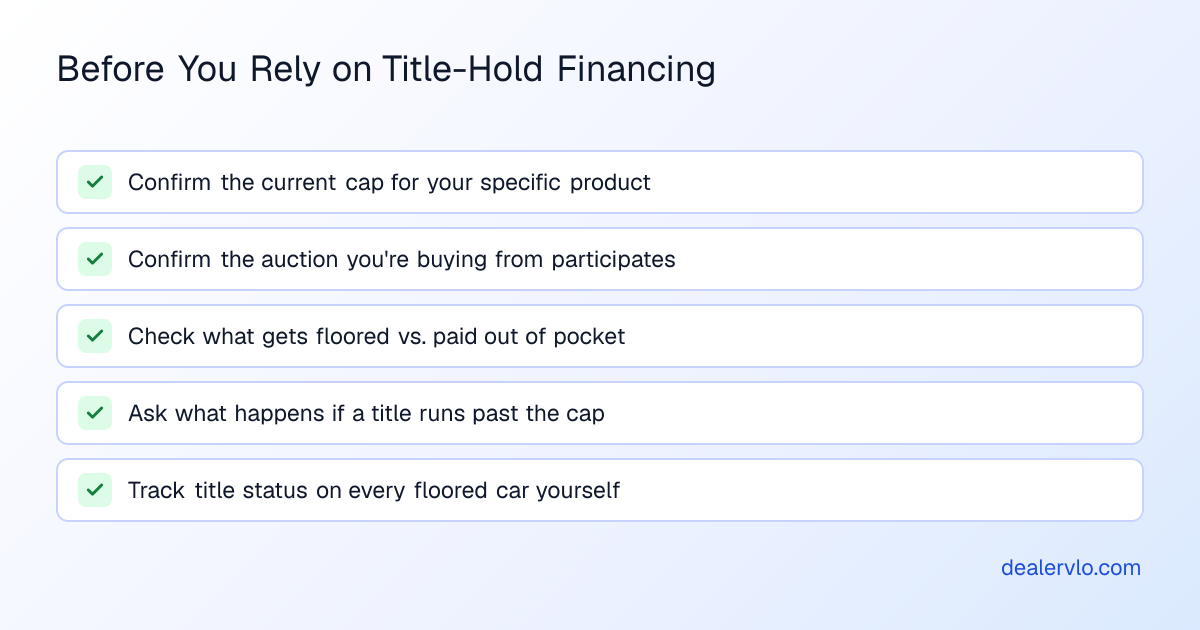
Before you build title-hold financing into your cash-flow plans, confirm these directly with ACV Capital (or your lender):
- What's the current cap for your product? 45 days (TA Hold), 90 days (60+30), and 120 days (advertised floorplan terms) all appear in ACV's materials, and they apply to different things.
- Does the auction you're buying from participate? ACV says ACV Capital works with many auction houses, but confirm your specific auction before you bid.
- What gets floored, and what do you pay out of pocket? ACV says transport, buy fees, and buyer assurance plans can be floored on ACV Auctions purchases. Ask what applies elsewhere.
- What happens if a title runs past the cap? Find out when payment comes due, what fees apply, and what it does to your credit line.
Every floor plan line has its own approval requirements and paperwork. Floor plan financing requirements for a small used car lot covers them if you're still setting one up. If you're about to sign a personal guaranty, the personal guaranty explainer covers what you'd be on the hook for.
Frequently asked questions
What is ACV Capital?
ACV Capital is the financing arm of ACV Auctions. It offers short-term inventory (floorplan) financing for cars dealers buy, and ACV describes it as the preferred lending partner for many auction houses nationwide. Because it belongs to the auction company, it can be built into the purchase itself rather than being a separate lender layered on top.
What is ACV Advantage Buyer TA Hold?
It's ACV's named title-hold product. Instead of paying for a car at the close of the auction, your payment due date moves to the day ACV receives and clears the title from the seller, up to a maximum of 45 days. ACV announced it in 2021, and its Capital pages still describe Advantage plans of up to 45 days for a one-time fee. Confirm the current terms with ACV Capital before you rely on them.
How long can ACV Capital extend my payment due date?
It depends on the product. The TA Hold (Advantage) title-hold option tops out at 45 days. ACV's regular floorplan has had a 60+30 Duration option, a 60-day term plus a 30-day extension, for a 90-day floating period for buyer floorplan customers. ACV's locations page now advertises floorplan terms of up to 120 days, while some other ACV pages still say 90. Ask your rep which cap applies to your account.
How is ACV Capital different from a third-party floor plan lender like AFC or NextGear?
ACV Capital belongs to the auction company, so on cars bought through ACV Auctions it can also floor ACV Transportation costs, buy fees, and buyer assurance plans, not just the price of the car. A third-party lender runs a separate line you use across auctions and usually quotes its rates and curtailment terms per dealer after underwriting. Compare written terms from each before you choose.
Who holds the title while a car is financed through ACV Capital?
ACV Capital does, once the title arrives. Its 2024 servicing agreement for its securitization, filed with the SEC, says titles for financed vehicles are physically held in a secure location at ACV's Buffalo, New York headquarters. Lenders holding the title is standard practice across floor-plan lending.
What happens if a car I buy is sold "Title Absent"?
On ACV, a blue light means the title isn't present at the time of sale. Under ACV's Title Policy, effective June 18, 2025, a seller who lists a car Title Absent must deliver the title to ACV within 30 calendar days (ACV's Buyer's Guide says 45 days for sellers in California). ACV also has a process for buyers to cancel a deal over a late title. Check the current policy before you bid, because these deadlines have changed before.
Bottom line
ACV Capital's title-hold financing solves a real problem: paying for a car before its paperwork is ready. It moves your due date to when the title arrives instead of a fixed date, and on ACV's own sales it lets you floor the auction fees along with the car. The caps differ by product (45 days for TA Hold, 90 for the 60+30 option, up to 120 advertised for floorplan terms), so confirm yours before you plan cash flow around it.
Once the car is yours, DealerVLO tracks its acquisition cost and recon spend so you see its real all-in cost, and its title status field shows where the paperwork stands. Chasing the title is still on you, but the math and record-keeping don't have to be.
14-day free trial, then $29/mo · Cancel anytime