Financing an Existing Used-Car Lot Purchase: Floor Plan Approval With Limited Personal Credit
How floor plan lenders evaluate buying an existing used-car lot with weak personal credit, and what to try before you sign.
Part of the Floor plan financing guide: How dealer floor plans actually work — and where they quietly eat your gross
Switching from another DMS? Compare DealerVLO to DealerCenter, Frazer, or Lot Wizard, or see what DealerVLO's car dealer management software includes.

Buying an existing 40-50 car lot sounds like it should be the easy path into this business — there's a building, a customer base, inventory already sitting under lights. But the floor plan lender doesn't see it that way. They see a brand-new legal entity with no track record, applying for a line of credit against a pile of cars someone else bought. Your personal credit score, not the seller's history, is what gets underwritten.
That mismatch — an established business, a first-time borrower — is the whole problem in floor plan approval buying an existing lot. This post walks through how lenders actually split that evaluation, what a weak credit score (say, mid-600s with maxed cards) does to your options, and what a buyer in that spot can realistically do before signing with whichever lender says yes fastest. Note upfront: this isn't legal or lending advice — license, bonding and lender requirements vary by state and by lender, so confirm current terms directly with your state's DMV/dealer licensing authority and with any lender before you commit.
14-day free trial, then $29/mo · Cancel anytime
Why "existing lot" doesn't mean "existing credit"
A forum account from an independent dealer taking over a 40-50 car lot lays out the pattern clearly: the buyer needed floor plan financing to take over roughly $200,000 of the seller's inventory, and assumed the seller's own bank — which already handled that lot's floor plan — would simply extend the line to him. The bank contact initially said he saw no problem issuing a new floor plan and transferring titles. But nothing about that seller's payment history carried over automatically; the buyer still had to apply as a new borrower, and his own file was the one that mattered (DealerRefresh forum).
No source confirms that a buyer can inherit the seller's floor plan relationship, payment history, or credit line as a matter of practice — the forum case shows the opposite happening in real time.
What does help your case: the existing inventory is real, inspectable collateral rather than a car you're promising to buy next month, and a lender's underwriter can informally weigh the fact that the location has a selling history, even under different ownership — though that's a judgment call by the lender, not a published rule.
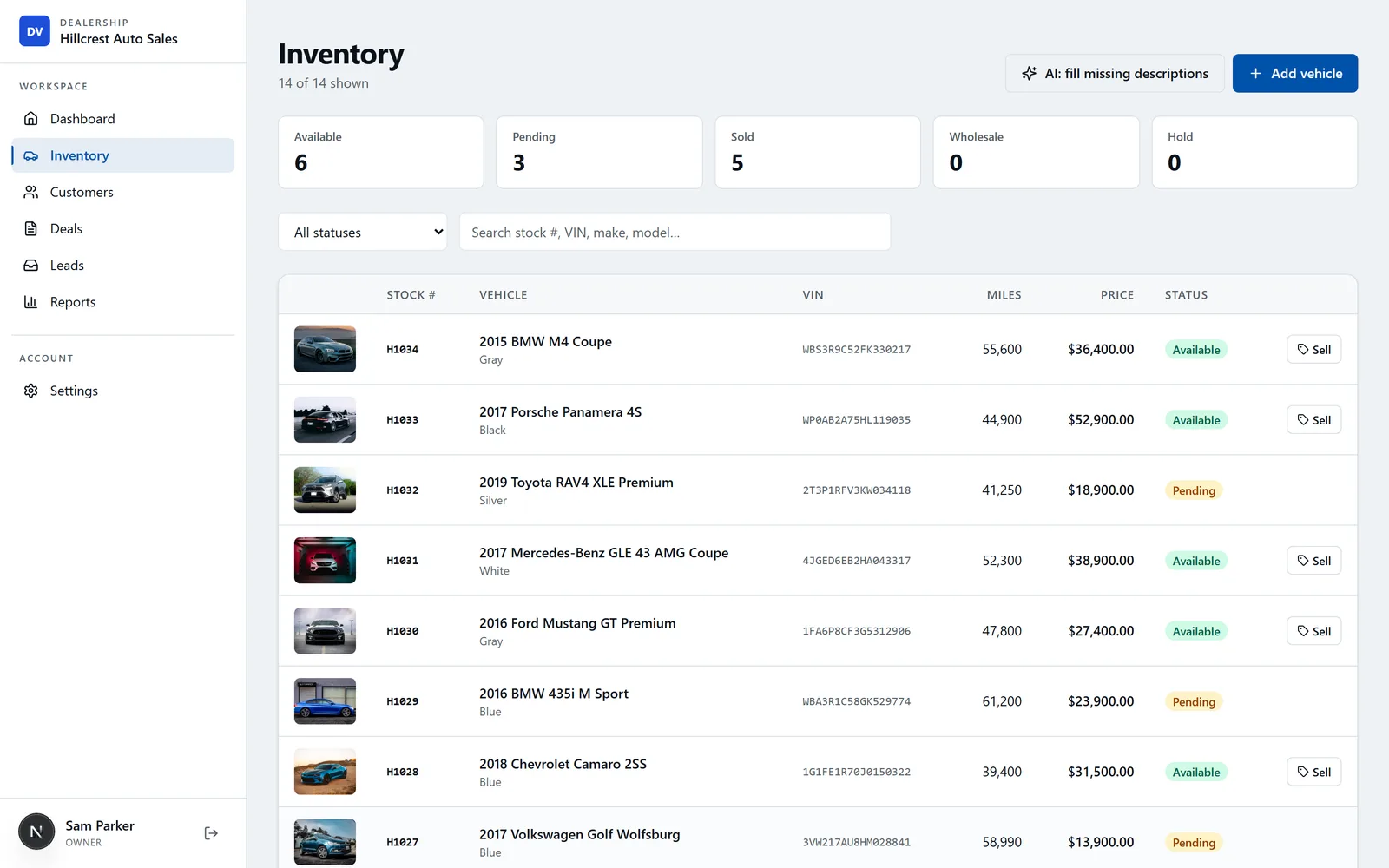
Once you do close, the title status on each car you took over becomes its own small project. Every car's record in DealerVLO has a Title status field — In hand, Pending, or Lienholder — set when you add the vehicle, so instead of relying on memory or a handoff spreadsheet from the seller, you can see at a glance which of the 40-50 units still need a title run down before they're retail-ready.
Bank floor plan vs. specialty lender: the fork in the road
Once you understand that your file gets underwritten fresh, the next decision is which type of lender to apply to, because they evaluate acquisitions very differently.
| Community/small bank | Specialty floor plan company (NextGear, similar) | |
|---|---|---|
| Typical credit expectation | Often cited around 650-680+ owner credit | More flexible; some alternative lenders work with scores as low as 550 |
| Operating history required | Often wants ~6 months of bookkeeping/bank statements before extending a line to a new operator | New-dealer programs exist specifically for entities with no track record |
| Speed | Slower — tied to full underwriting and statement review | Can be much faster when a program fits |
| Line size for a new entity | Varies, often larger once approved | Entry lines for brand-new dealers are intentionally capped lower at first |
A local bank line of credit is generally the cheapest fallback for an independent dealer, but the buyer in that same forum thread reported that local banks wanted a minimum of six months of bookkeeping and bank statements before they'll work with a new operator on a floor plan (DealerRefresh forum) — which is exactly the problem when you're trying to close on day one of owning the lot. You don't have six months of statements for an entity that doesn't exist yet.
On the credit-score question specifically, there's no single industry number. One alternative commercial lender states on its own site that bank floor plans generally want owner credit of 680 or higher with clean licensing history, while a separate page from that same company states most traditional floor plan lenders prefer a personal FICO of 650 or higher (Crestmont Capital; Crestmont Capital) — treat 650-680 as the ballpark banks tend to cite, not a hard cutoff. Specialty lenders can go lower: Crestmont also states that alternative lenders can often work with scores as low as 550, leaning more on the dealership's revenue and cash flow history than the score alone (Crestmont Capital).
If you want the fuller mechanics of how a floor plan line actually works day to day — draws, curtailment, going out of trust — our pillar guide on how dealer floor plans work covers that from the ground up, and it's worth reading before you sign anything.
What a weak score actually does to your application
A mid-600s score with no collections isn't a dead file, but it's a flagged one. NextGear Capital's own materials state plainly that bad credit and hiccups on credit history aren't always deal-breakers, but they will likely reduce the amount you qualify for and will likely have a negative impact on pricing (NextGear Capital). That's the realistic expectation to carry into any application with limited personal credit: a smaller line, priced worse, not an automatic no.
NextGear also calls out a situation in that forum case: the buyer's partner had cards all close to their limits, and NextGear lists credit cards that are all maxed out as a potential red flag even without a single late payment, because handling available credit responsibly is part of what they're assessing (NextGear Capital). If that's your situation, paying down revolving balances before you apply — even by a modest amount — is worth more to your approval odds than almost anything else you can do in the short window before closing.
On rates: no major floor plan lender publishes a public rate card, and different vendor blogs quote conflicting margins over an index rate, so get the actual number from the lender's term sheet, not from a blog post, including ours. Our dedicated post on floor plan financing requirements goes deeper on what a small lot should expect to show a lender and how big a starting line typically runs.
Estimate your daily floor-plan carrying cost per unit.
Open the Floor Plan CalculatorNew-dealer programs: a real path for a brand-new entity
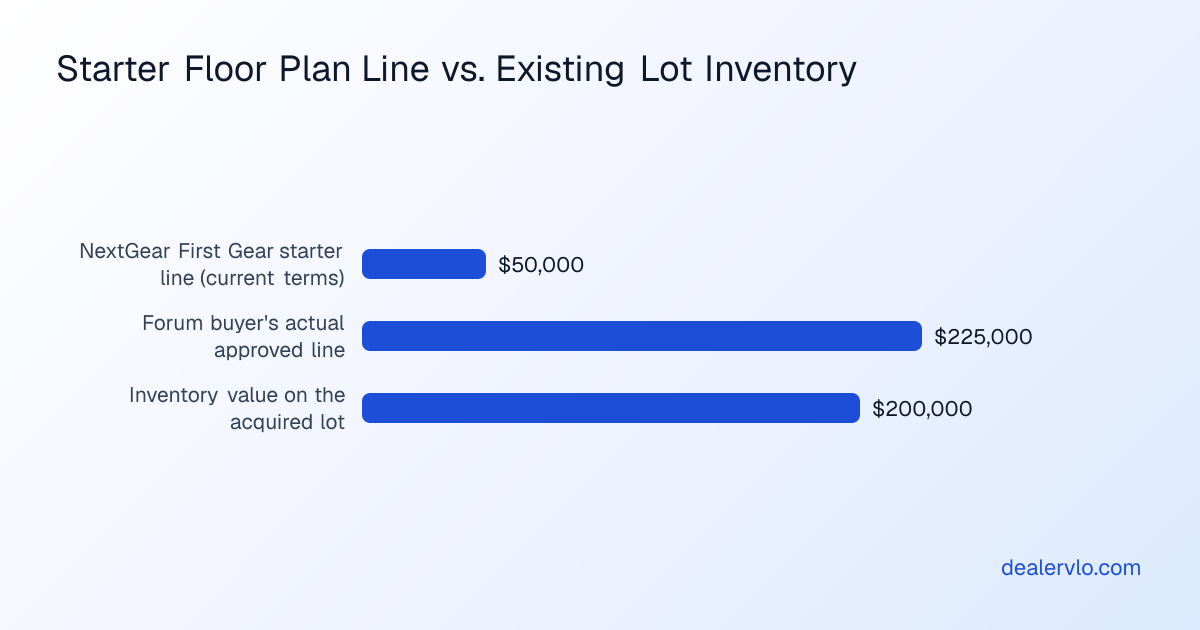
Because a buyer acquiring an existing lot is, on paper, a brand-new dealer entity, it's worth knowing that at least one major specialty lender builds a product specifically for that situation. NextGear Capital's First Gear program is described on the company's own site as built for independent dealers who've been in business for 12 months or less, giving access to a floor plan line without submitting the standard underwriting paperwork at application (NextGear Capital).
The current terms on NextGear's own program page describe an initial, introductory line of credit equal to the greater of $50,000 or the minimum allowed by law in the dealer's state, without submitting bank statements or records up front — and the company is explicit that eligibility is entirely at its own discretion (NextGear Capital). An older archived NextGear announcement cited a higher $100,000 ceiling for dealers in business six months or less, but that appears to predate the current product terms, so don't plan around that figure — use the current $50,000-floor language instead (NextGear Capital archive). First Gear also isn't available everywhere — NextGear states it's not offered to dealers in New York, North Dakota, South Dakota or Rhode Island (NextGear Capital).
A $50,000 starter line obviously doesn't cover $200,000 of existing inventory on its own. For what it's worth, the forum buyer later reported NextGear approved him for $225,000, so a starter line isn't the only outcome. That's the real math a buyer in this position has to do: either negotiate the seller down to floor only part of the inventory at close, bring in cash or a working-capital loan to cover the gap, or phase the purchase. Our guide on floor plan vs. cash walks through that tradeoff in more detail, and if you're also sizing up what the whole acquisition will cost beyond the floor line, the dealership startup cost calculator is a useful gut-check even though it's built for ground-up starts.
Whatever size line you land on, how you track what you actually paid for each floored car matters just as much as the line itself. Each car added to DealerVLO carries its own acquisition cost field, and that figure — not a guess, not the seller's old asking price — is what rolls into the car's all-in cost and what your sales report uses to compute gross once it sells.
14-day free trial, then $29/mo · Cancel anytime
Don't expect SBA money to cover the inventory
A lot of first-time buyers assume an SBA loan solves the whole acquisition, including the cars. It doesn't. Lending resources say an SBA 7(a) loan generally isn't used for floor plan financing (confirm with your SBA lender) — it's built for working capital, the acquisition itself, real estate, or equipment, not for carrying retail inventory (SBA 7(a) Loans resource). A separate lending resource echoes the same split: SBA 7(a) can fund dealership acquisition, facility improvements and equipment, but floor plan inventory financing sits explicitly outside SBA program scope (ClearValue Lending).
Practically, that means a buyer financing an existing lot purchase is almost always running two separate tracks at once: one loan (possibly SBA-backed) to actually buy the business and/or real estate, and a completely separate floor plan line — bank or specialty — to carry the cars. Budget the time and paperwork for both, because they close on different timelines with different underwriters.
Insurance and licensing: the preconditions that stall closings
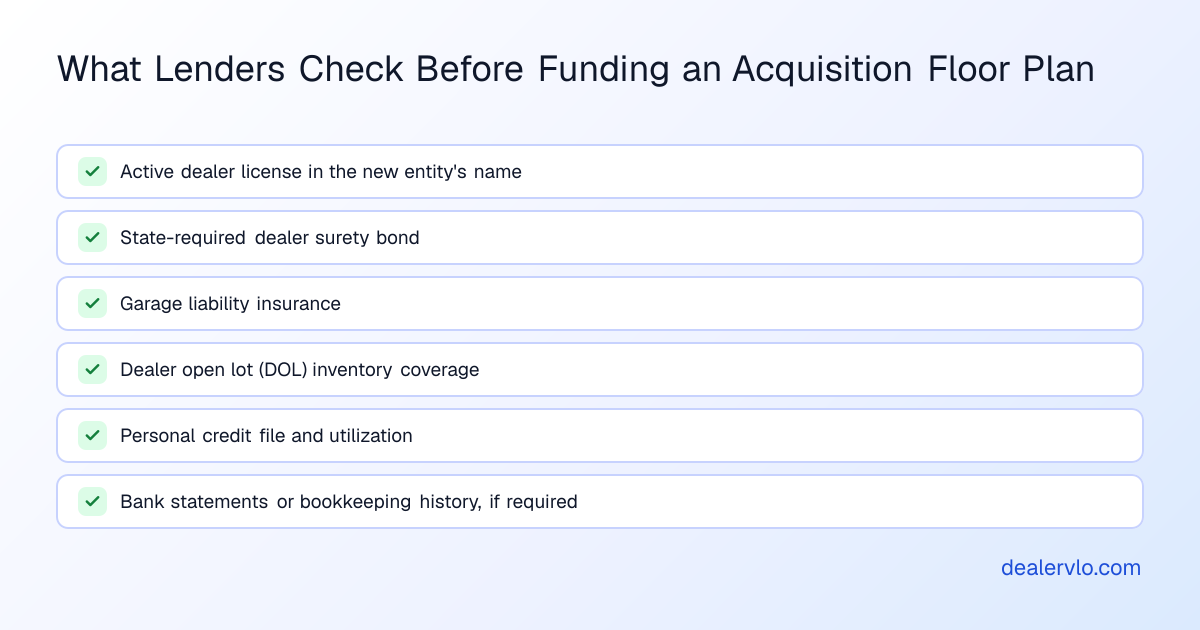
Even a lender ready to approve your credit won't fund a floor plan line without the right insurance in place first. Garage liability (written for dealers specifically, not general repair shops), dealer open lot coverage for the inventory itself, and your state-required dealer bond are standard preconditions, and most floor plan lenders want to be listed on the policy as loss payee (Catanzaro Insurance). If you're assuming you can use the seller's existing coverage, you can't — a new entity needs its own policy, and that paperwork alone can add days to a closing if you start it late.
The license is the other piece that trips up acquisitions specifically, because in many states a dealer license isn't something you can simply take over. If you're buying through a new company, expect to apply for that entity's own license and bond. Bond amounts vary meaningfully by state and license type, so confirm your own state's figure directly with your DMV or dealer licensing board rather than going by a number you saw on a surety-bond vendor's site — don't assume the location's existing license, bond, or insurance transfers with the keys.
If you're starting that licensing process from scratch as part of this acquisition, our dealer license cost guide and calculator is a reasonable place to total up what the first year actually runs before you apply.
What to actually do if your credit is the weak point
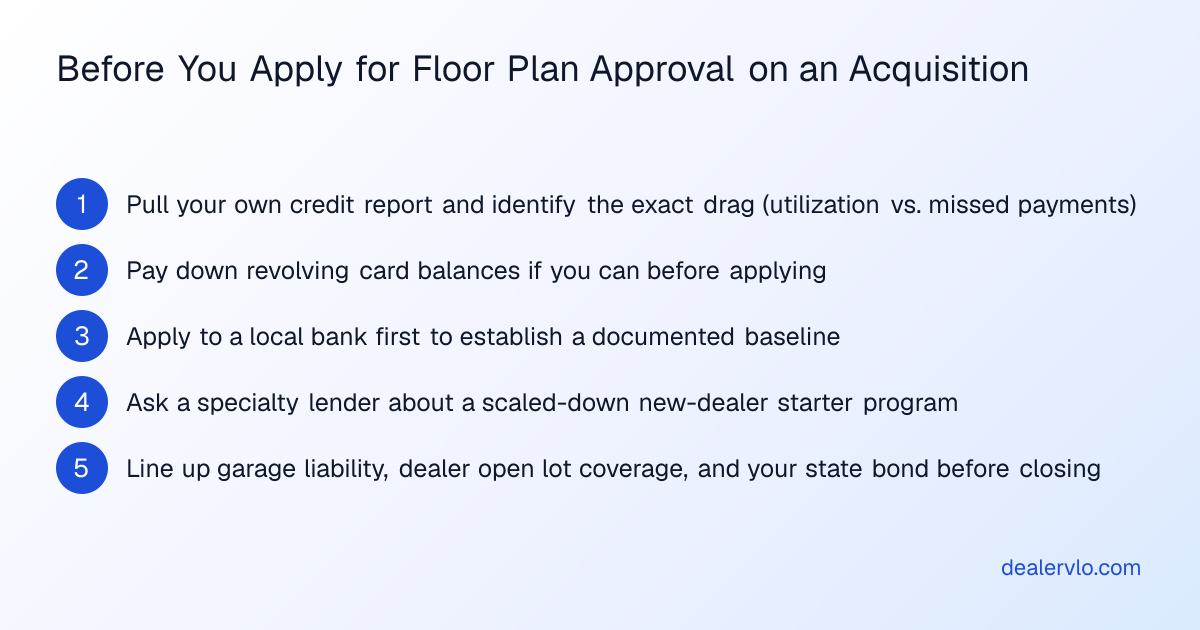
If your file looks like the one in that forum thread — no collections, but high card balances dragging the score down — there are a few concrete moves worth making before you shop lenders:
- Pull your own report first. Know the exact number and the exact reason it's down before a lender tells you. If it's utilization, not missed payments, that's a fixable story to tell an underwriter.
- Pay down revolving balances if you can, even partially. NextGear specifically flags maxed-out cards as a red flag independent of late payments, so this is the single highest-leverage fix available in a short window.
- Apply to a bank first, even if you expect a no. A documented decline, or a clear "come back in six months with statements," gives you a baseline and sometimes a path to revisit once the lot has a quarter or two of sales under the new entity.
- Ask any specialty lender about a scaled-down starter program rather than the full line you think you need — a smaller approved line now beats a declined large one, and most lenders will revisit the limit once you've shown a few clean cycles.
- Separate the acquisition loan from the floor plan conversation entirely in your own planning, so a slow SBA or bank process on the purchase doesn't block you from locking in inventory financing on its own timeline.
14-day free trial, then $29/mo · Cancel anytime
Running the lot once you're financed
None of this changes once you're approved and the cars are legally yours — you still need a system that tracks what you actually paid for each unit and what title paperwork is outstanding from the transition. A messy handoff from the seller's old system is a common way acquisitions lose money in the first ninety days: a car with nobody tracking which title documents are still outstanding, or a cost basis nobody wrote down correctly.
If you're bringing inventory over from the seller's spreadsheet or old system rather than retyping 40-50 cars by hand, the "Add many cars at once" CSV import on DealerVLO's Inventory page reads stock number, cost, mileage, year, make, model and the rest straight from your export's columns — it just needs a valid VIN on every row and skips anything already on file. That's usually the fastest way to get an acquired lot's inventory loaded and under control in the first week.
Frequently asked questions
Can I take over the seller's existing floor plan when I buy their lot?
No — floor plan lenders underwrite the buyer, not the location, so a new owner is treated as a brand-new borrower even if the same bank handled the seller's line. You'll need to apply fresh, and your own credit and finances are what get evaluated, not the prior owner's payment history.
What credit score do I need to get a floor plan for an existing lot?
There's no single industry-standard minimum. Banks tend to cite scores somewhere around the mid-600s to high-600s, while some alternative lenders say they can work with scores as low as 550 by weighing cash flow more heavily — confirm current minimums directly with any lender you're considering rather than relying on a published number.
Can an SBA loan cover the inventory when I buy a used-car dealership?
No. SBA 7(a) loans explicitly cannot be used for floor plan inventory financing — they're meant for the business acquisition itself, working capital, real estate, or equipment. You'll need a separate floor plan line, from a bank or a specialty lender, to actually carry the cars.
Why would a bank turn down a new dealer buying an established lot?
Many community banks want to see several months of bookkeeping and bank statements from the new entity before extending a floor plan line, because the lending decision is based on the dealer's own operating and credit history, not the lot's prior sales record. That's a real obstacle when you need financing on day one of ownership.
Are there floor plan programs built for brand-new dealer entities?
Yes — at least one major specialty lender, NextGear Capital, offers a program for dealers in business 12 months or less that extends an introductory line without upfront bank statements, though the amount and approval are at the lender's discretion and the program isn't offered in every state. It's typically a smaller starter line, not enough on its own to floor a full existing inventory.
What should I do before applying if my personal credit is weak?
Pull your own credit report first so you know exactly what's dragging the score down, and if it's high credit-card utilization rather than missed payments, pay balances down as much as you can before applying — lenders specifically flag maxed-out cards as a red flag even with a clean payment history. Apply to a local bank first to get a documented baseline, then look at a specialty lender's new-dealer program for a smaller starter line if the bank wants more operating history than you have.
Bottom line
Buying an existing lot doesn't buy you the seller's credit file — your own score, your own utilization, and your own entity's paperwork are what the floor plan lender underwrites, no matter how established the location is. A weak score narrows your options rather than closing them: expect a smaller line and worse pricing from a specialty lender if a bank wants operating history you don't have yet, and don't count on an SBA loan to cover the cars on the lot. Get your insurance, bond, and license lined up early, and once the deal closes, get the inventory you took over into a system that tracks title status and real cost from day one. Run the acquisition and every deal after it through DealerVLO: start your free 14-day trial.
14-day free trial, then $29/mo · Cancel anytime